By eleven, I have already decided the grown-ups picked the wrong serious questions.
Some man in a book says the only real question is whether to kill yourself. Another says it’s whether time has a beginning and an end. I read those lines on the bathroom floor with my knees pulled up, toothbrush foam going lukewarm in my mouth, and all I can think is: you’re both cowards.
Time will do what it wants. Death will do what it wants. The question that gnaws at my ribs is simpler and meaner:
How do you make love stay?
If someone could answer that, I’d know whether or not it’s worth sticking around for the ending. I’d know whether the moon is just a rock or an accomplice. I’d know if all the clocks in the world are counting down to anything at all.
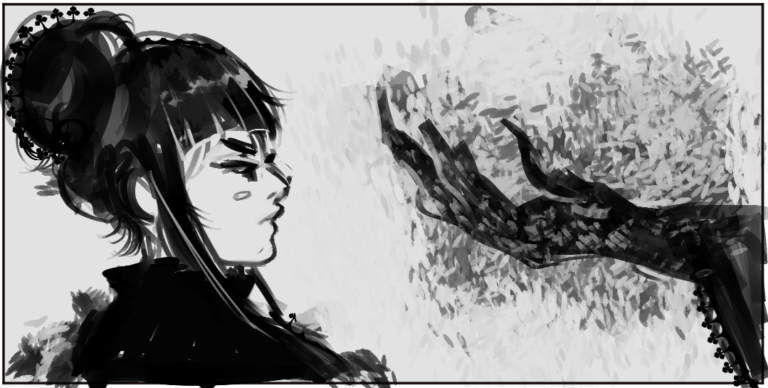
I don’t know anything about love. Only this: there is a kind of loneliness so big you can see it in the second hand of a clock, dragging itself around, and around, and around. People mutilated by too much affection or not enough. People on their knees in the dark, reaching out for a hand they can’t see, praying it’s there.
Love doesn’t excuse itself when it leaves. It doesn’t pack a bag. It vanishes. One day there is warmth and then there is not. You can’t argue with it, you can’t bribe it, you can’t make it breathe the way it used to.
Death feels cleaner by comparison. Death is at least a promise.
I sit with that thought until the garden goes very still. Crickets hold their breath. The birdbath water smooths itself into glass. Somewhere beyond the fence a car passes, a distant sigh of tires on wet road, and then even that sound is gone.
“Kohana.”
My name arrives first, low and amused, threading through the roses.
“Moon-girl. You’re really out here.”
Juniper’s voice finds me before she does. My bones ring with it. My lungs forget how to work. For a second it feels like most of my insides crawl out through my mouth and hurry toward her ahead of me.
She smells like rain after a long drought and cheap drugstore perfume and something of her own—warm, unembarrassed affection. Every time I breathe her in, my head goes light.
“You came,” I say, turning, and the whole world tilts sideways. “You kept your promise.”
She steps out from between two rosebushes, brushing petals off her hoodie. It hangs open over a ridiculous glittery dress that looks stolen from a school play; her socks don’t match and her sneakers are scuffed to hell. Her hair is scraped back in a ponytail that has given up on discipline. My heart beats so hard it feels like it’s trying to get to her first.
“Of course I came.” Her grin shows the tiny chip in her front tooth, familiar as a constellation. “Sneaking out’s easy when your mom’s on night shift at the hospital and your dad thinks I’m at a sleepover two blocks over.”
Juniper is tiny, stubborn green—like the one fern that manages to grow between concrete slabs and refuses to be stepped on. Loving her turns my whole life sideways. It smashes routine, slaps boredom in the face. Nothing is ordinary when she’s in it.
We fall into step along the herringbone brick path. Our hands dangle between us, close enough that the backs of our fingers brush every few steps. Each touch is a small, stupid lightning bolt.
Pastel flowers spill over the borders: peonies bowing under their own weight, old roses exhaling fragrance like secrets. Sweet alyssum dissolves the edge of the path into soft white clouds that smell faintly of honey. The bird feeder to my left is full of water rather than seed—my doing. It holds pieces of moonlight and upside-down flowers, a small, stolen sky.
“Your mom’s in love with that job,” Juniper says. “She talks about her high school music kids like they’re miracles. I bet she can play anything.” She bumps my shoulder, eyes bright. “What about you? You play?”
I snort. “If you sat me at a piano, I’d probably try to bite it. So no.”
She laughs, delighted, the sound fizzing in my chest. I pretend I’m not proud of my own incompetence. My mother wanted a daughter who could sit primly on a bench and make Chopin sound like prayer. I am not that girl. I refuse to be that girl.
Twilight settles in stages. The sky goes lavender first, then bruised at the edges, the first few stars blinking themselves awake like they’re checking if it’s safe. The garden is ours at this hour—no parents, no neighbours, just the soft drip from the rain barrels and the hush of leaves. Pillowy shrubs lean over moss-slick wood. Love-in-a-mist frays around the stone benches in blue haze and ferny lace.
Juniper nudges me with her elbow. “So you dodged the family curse,” she says. “One virtuoso in the house is probably enough.”
“Maybe.” I toe a fallen poppy petal off the path, watching it skid over the bricks. “My mom’s… good. Too good, sometimes. She loves me hard enough for two people, like she’s trying to plug up the hole my dad left with packed lunches and bedtime checks and a thousand ‘text me when you get there’s.’”
Juniper goes quiet, listening.
“He’s never home,” I say. “When he is, it’s like living in a restaurant review. Everything I do is either ‘disappointing’ or ‘barely acceptable.’ He yells about stupid things—how I walk, how I talk, how I look at him. So mostly he’s gone, and when he isn’t, I wish he was.” I shrug, jaw tight. “She keeps over-worrying so he doesn’t have room to call me ungrateful for needing anything.”
What I don’t say: she wants me safe, and somewhere in her head safe means small. Quiet, neat, unthreatening. A well-mannered, well-bred girl who walks in flocks, laughs softly, and folds herself up like a napkin at the edge of the table.
I run through the streets like the boys and get told I’m asking for trouble. I answer back and get told no one will marry me if I keep this up. I think too loudly and everyone reminds me men don’t like girls who think at all.
My mother wanted to raise a daughter. Somehow she raised a fist.
Juniper and I reach our tree.
It’s older than the street, older than the city, maybe older than the country. Its trunk is massive and twisted, bark furrowed in deep ridges, branches spreading out like a thousand arms mid-gesture. The roots hump up through the soil like sleeping animals.
We sit with our backs against it, shoulders almost touching. I can feel the warmth of her through the few centimeters of air between us, like sitting next to a space heater made of teenage longing.
She has brought a book, big and black and battered, leather strap buckled around it. It looks like it should be chained to an altar, not shoved in a backpack with math homework.
“Tonight’s topic,” she announces, patting the cover, “women and myth.”
I’m ready before she even finishes. “Men get to pretend they’re the default version of ‘human,’” I blurt. “They write themselves as sky and sun and heroes, and we get stuck as afterthoughts and consequences.”
Her eyebrows fly up. She isn’t used to people interrupting her, but she doesn’t look annoyed—she looks delighted.
“Go on,” she says, and roses bloom hot under my skin.
“In all the old pairings—Sun and Moon, Day and Night, Heaven and Hell—it’s always male first, female second, if she shows up at all.” I pick at the moss between bricks for something to do with my hands. “Good and Evil? God and the Devil? No woman in the equation. Just two guys playing tug-of-war with the world.”
“And Eve?” Juniper prompts.
“They needed someone to blame.” I roll my eyes. “They make her from Adam’s spare part so she belongs to him, then turn around and call her defective for not obeying all the way. Pandora’s the same story in a different outfit. Men screw up; women get written as the mistake.”
Juniper taps the book, impressed.
“No man would trade places with a woman,” I mutter, more to myself than to her. “But they all want women around. We’re the audience and the prize and the excuse, but never the author.”
I want teeth. I want to be the praying mantis chewing through her mate, the spider fat on what loved her last, the lioness with blood on her muzzle and no apology in her eyes. I want to be the thing men warn each other about in locker rooms.
Juniper’s fingers find mine, lacing slow and sure.
“Being born at all is an insult to them,” she says, voice gone low and thoughtful. “They want to spring into the world fully armored, like Athena. Head to toe, no mother involved. But they always start with blood and screaming and a woman’s body doing all the work, and they hate that. They spend the rest of their lives trying to climb back out of that fact.”
Her thumb strokes along the side of my hand as she talks. Each word is a matchhead. I am a box of them. I burn and burn and burn.
“Death is a woman, too,” she muses. “The Fates, the Parcae, all cutting threads. Earth swallowing bones. Wailing women at every funeral. Men make wars, but women clean them up. It’s on our faces that the loss shows.”
I want to give her everything I have and everything I will ever have. Every heartbeat. Every drop. Every latest possible first of anything. It overwhelms me; the wanting is bigger than my body.
“You have the face of darkness, Kohana,” she says suddenly.
I laugh, startled. “That’s rude.”
“No.” She turns toward me, tucking a stray curl behind my ear. Her fingertips are soft, warm, the barest pressure on my skin. My entire nervous system spikes. “Not bad darkness. Deep darkness. Where everything started and where everything ends. Bottom of the sea stuff. Cave under the world. You’re scary to sailors and saints.”
Her fingers trail down my jaw, to my throat, to the place my pulse hammers. I am sure she can feel it.
“At the bottom of everything,” she whispers, leaning closer, breath warm against my cheek, “it’s dark. Men look up and pretend heaven is theirs. They look down and pretend we aren’t waiting.”
I close my eyes. My mouth trembles. I am a door that wants to open and has no idea what room lies beyond.
She doesn’t kiss me.
When I open my eyes again, the garden is gone.
I stand alone in a forest.
Or—I am the forest, and the forest is me. It feels like both. My body feels too large and too small at once. My skin is bark and bone and soft animal; my breath is fog snagged in branches.
Above me, a grey sky sags, heavy with old rain. Mist crawls around the trunks, thick and low, curling around my ankles like tentative hands. The trees loom taller, closer, their branches twisted into shapes that look suspiciously like faces caught mid-grimace.
The path under my feet is made of bones. Small ones, mold-slick and stacked in careful rows, like someone very patient has tried to pave the way with other people’s endings. With every step I take, leaves blacken. Thornbushes fatten on poison berries.
“But she was just—”
My voice dissolves.
Juniper hangs from a nearby tree.
Her neck and wrists are bound in rough rope, arms spread slightly, legs slack. She sways gently, as if a wind only she feels nudges her back and forth. Her skin is already taking on the wrong colors. Blue. Bruise-purple. The eyes are bulged, the tongue bitten.
My hand clamps over my mouth as if to hold my own heart in. The air smells like rotten meat and spoiled milk and something chemical underneath it all, sharp enough to sting my eyes.
“No,” I try to say, but everything comes out as a choke. “No, no, no—Juniper—”
I force myself closer and find no knife wound, no bullet hole. No visible reason. Just the brutal fact of rope, gravity, and whatever brought her hands to tie the knot.
There are others. As my eyes adjust, I see more bodies hanging in the dim: some fresh, some long stripped to bone, clothes hanging off them like forgotten prayers. The trees groan softly. Somewhere, someone sobs, thin and high.
“Is she yours?” a voice croaks.
I spin around.
The woman who hobbles into view looks like a tree that decided to try being human as a joke. Her coat is black and heavy, fur lining the collar like a ring of trapped animals. Her white hair is hauled back into a chignon so tight it must hurt. Her eyebrows have been braided; one long plait curves over each eye like an ornamental caterpillar.
Her teeth are all present, sharp and yellowed. Her smile is carnivorous.
“You’ve been unusually quiet,” she says. “I thought you brats were all noise.”
Her breath hits me like a wall: diapers left for days, curdled milk, meat gone furry. I gag.
“What do you mean, ‘human’?” I manage, trying to stand up straighter. My voice comes out more defiant than I feel. “What else would I be?”
She snorts, delighted. “Human. H-U-M-A-N. You spell it like an apology. You stink of it.”
She slaps her belly and chuckles, the sound scraping along my spine.
“If my mother hears you talking about me—” I start, still clinging to the normal threat, the everyday anger.
“Your mother?” Her grin widens. “If that hag hasn’t managed to tame you yet, someone’s gotta take a turn.”
The grief flares into rage so fast it makes me dizzy. “If you hurt a single hair on Juniper’s head—”
“Me?” She looks genuinely offended. “Hurt her? Child, she did that herself.”
The words land like a blow. For a second the forest tilts.
From all around us, the crying intensifies. The old woman tilts her head, listening like it’s music.
“Mm. That’s good. Trees are in fine voice tonight.”
She plucks a thin branch from the nearest trunk. The tree screams. A high, tearing sound, like metal being bent wrong.
“Once they were human, now they root in my soil,” she explains, using the twig to pick at her teeth. “They only get to talk when you peel them.”
My stomach lurches.
“You don’t seem nearly sad enough,” she adds thoughtfully, eyes glittering. “Not for a lover hanging on a rope.”
Heat crashes over my face. “She’s my friend,” I snap.
She cackles. “You followed her in here for her mind, did you? For her jokes? You little liar. You came for the way she looked at you over the book spines. For those pretty girl-breasts and the way she says your name like she’s tasting it.”
My cheeks burn hotter. I clamp my jaw shut, but the betrayal is already written in my skin.
“Oh, stop,” she says sharply. “Your youth reeks. Baby fat and puppy breath. It makes me want to vomit.”
“Good,” I shoot back before I can stop myself. “Choke.”
She bares her teeth, entertained.
“People will wonder where she went,” I hiss. “They’ll come looking. They’ll find you.”
“So?” she says. “Let them wander my woods, little calf. Wondering is free. Leaving isn’t.”
I hate her. I hate her so much it vibrates in my teeth.
“You still think magic is kisses under streetlights and rainbows after storms,” she goes on. “You think it’s the first time you hold her hand for real. It’s not. Magic is tooth and claw and last breaths. It’s the moment the floor drops out. Juniper was your doom. You know my name.”
I do. Of course I do.
Everyone who knows anything about magic knows.
“Wren,” I whisper. The word tastes like sap and iron. “You’re Wren.”
She preens at the sound of it.
Oldest tree in the oldest story, the witch in the wilds, the thing that eats soldiers and princes alike. My mother read me those tales when I was small, when I still believed all wicked things stayed between covers.
“The Wren who can eat enough for twelve in one sitting,” I recite, because my mouth has decided to keep going. “Who knows all secrets and helps only when it amuses her.”
“Now the gears are finally turning,” she croons.
Behind her, I see the low outline of a hut, its fence made of bones topped with skulls. The eye sockets seem interested.
“You’ve read the stories. You know this part.” Wren’s voice softens a fraction. Her hand, when it comes up to brush my cheek, is rough and strangely gentle. “Every step from here on is a bargain with pain. Everything is a trap. I’m just more honest about it.”
My hands won’t stop shaking. I shove them into my pockets; they tremble harder. Laughter punches out of me, too loud, too sharp. It feels like a saw drawn down my spine.
“I know so much about magic,” I say, voice high and thin. “And I still can’t do any. I’m useless.”
“Those stories you read,” Wren says, ignoring my outburst, “are about girls with neat names and neat arcs. Sylvias. Rheas. Anaises.” She waves a hand, dismissive. “You are not a neat girl.”
“No,” I snap. “I’m not a protagonist in your little fable.”
Her mouth stretches, wider and wider, until it looks like it could split her head in two. All my fingers go numb. My toes might as well belong to someone else.
“The Sylvias and Rheas and Anaises were appetizers,” she says sweetly. “They cushioned the jaws. Whatever lodged the forbidden fruit in your bones? That’s the main course. You wear disobedience like perfume.”
She inhales deeply, flaring her nostrils. “You reek of first sin. Eat or be eaten. That’s Hell’s motto. Heaven prefers: eat and be eaten. You, Kohana Ohuang-Zhùróng, are indecently tempting.”
My name in her mouth is a violation. The syllables coil around my spine.
“How do you know my name?” I demand.
She laughs. “Your name is soft and black. Black as hymnals. Soft like a pillow. It invites you to lay your head down and then snaps shut.”
That, at least, feels right.
“My name,” I say quietly, “is a snake in tall grass. It waits. It strikes. It doesn’t let go.”
“You’ve been careless, little snake,” Wren says. “Trading pinky promises for war banners. Childhood for command. You’ve got two mothers and neither of us could save you from yourself.”
“Shut up!” The words fire out of me, hot and fast. “I’ve been good. I don’t say what I want. I don’t make anyone uncomfortable. I take care of everyone else’s feelings first. I smile when I want to scream. I never say no. I do everything right.”
“Good isn’t right,” she says softly. “Good is just obedient. And you”—she taps my forehead with one yellow nail—“were never built to obey.”
My father’s voice echoes behind hers: housekeeping, cooking, making sure a man’s ego stays inflated. My future shrunk to a kitchen and a crib.
“Even if I get married one day,” I mutter, “it’s not going to be to a man. I’m not going to spend my life as some guy’s unpaid mom. I hate housework. I don’t want kids.”
Wren watches me, head tipped, like a wolf studying a cub that has just shown teeth.
“Men love danger,” I say, more fiercely now. “Let them find it elsewhere. I’m not a prize. I am the dragon.”
“Fair enough,” she purrs.
Her hands come up again, cupping my face, squishing my cheeks. She smells like wet soil and old smoke. Her smile is all canine.
“You want an archrival,” she says.
“An enemy?” I pull back. “Why would I want that?”
“Enemies come and go,” Wren says. “They snarl, then slink off. An archrival?” Her eyes glitter. “An archrival will circle you for the rest of your life. They’ll forget how it started. You’ll forget too. You’ll just know that your story and theirs are tied like veins. They’ll rise against you even when they know they’ll lose. That’s the only kind of opposition worth having.”
I laugh in her face. I can’t help it. It bursts out, wild and hoarse.
“You don’t know anything about me,” I say, planting my feet.
She leans down so close I can see all the lines etched around her eyes. “I see you fine. I see the outline already. Love, betrayal, hatred that can’t exist without the love underneath. A wolf who starts out worshipping you and ends up trying to tear your throat out. You want that as much as you fear it.”
I glare so hard the air around us seems to stiffen. The trees pull back their branches, wary.
“I am the praying mantis,” I say, my voice low. “I am the spider.”
“Exactly.” Wren’s grin splits into something like triumph. “On my wedding day I was all white silk and fluttering lashes. They thought they’d bought a lullaby. Then came the second act. Legs. Fangs. The whole eight-armed truth.”
She laughs, belly-deep, wiping tears from the corners of her eyes.
“You won’t be a honeybee or a mother hen either,” she says when she sobers. “You’re built for a different kind of hive.”
Something in me loosens. Something else hardens.
The forest blinks.
One moment, corpses and bone-paths and Wren’s hut. The next, the world folds like paper and snaps back.
I am sitting under our tree.
The garden is back—roses, rain barrels, the bird-water mirror. The air is soft and damp and smells of earth and soap from someone’s open window. My hands shake in my lap.
In them rests the book Juniper brought.
Only it’s wrong now. Its black leather is colder, older. The strap is buckled with a clasp shaped like an eye that seems almost to twitch when I look at it directly. Something pulses faintly under my palms, not unlike a heartbeat.
The yew at the back of the garden looms a little closer than it used to. Its trunk is split and hollow, but the crown is green and defiant against the dark. It looks, suddenly, exactly like an old woman in a heavy coat.
“I’ll visit,” I whisper, fingers tightening around the grimoire. My voice shakes but holds. “Every night if I have to.”
The tree does not answer. The book does, in its own way: the leather warms under my touch.
Far away, or very close, I think I hear Wren’s laugh—pleased, hungry, fond.
Love doesn’t know how to stay. That much is clear.
So I will learn other things. How to bargain. How to fight. How to devour.
My name curls sharp and black in my mouth, and for the first time, I feel it fit.
· · ─ ·✶· ─ · ·
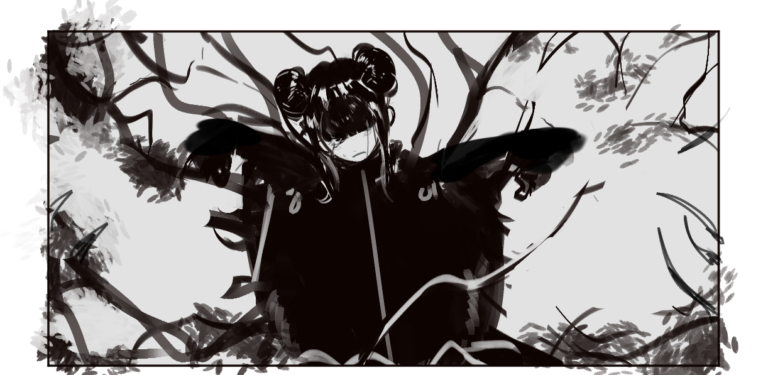
I do homework at the kitchen table because the kitchen is my mother’s kingdom and she says light falls better here.
Math sits open in front of me, but I’m not looking at it. I’ve peeled the workbook away from the table and tucked my real book underneath: a library copy of Introduction to Astrophysics, heavy as a guilt. The pages smell like dust and graphite. Equations climb down the margins like vines.
A daughter, in my father’s head, is a special doll kept behind glass. You take her out when guests arrive, wind the key between her shoulder blades, and she smiles and says charming things about school while the adults drink. Put her back when you’re done. No fingerprints. No dust.
I flip a page. Stars die in neat diagrams. Gravity folds and unfolds. Out there, a universe chews itself apart and no one tells it to sit up straight.
The door clicks.
Keys, lock, the slow drag of a suitcase wheel. My whole body jolts before my brain catches up. Mom’s at her evening rehearsal; she left two hours ago with a stack of sheet music and a tired smile. That means—
“Kaede?” he calls, like the house is a restaurant and he’s already displeased with the service.
“It’s just me,” I say, voice too small, too bright. “Hi, Baba.”
His shoes announce him before anything else: sharp leather on tile, the clipped metronome of someone who times everything. He appears in the doorway still in his chef’s whites, jacket unbuttoned at the throat, apron folded under his arm. The air changes around him—garlic, seared fat, citrus, the metallic ghost of hot pans.
Kai-liang Hsü, five-star Michelin darling of three continents, looks at our kitchen like it’s a bad imitation.
His gaze lands on me. Then on the table. Then on the book.
Not the workbook. The book.
“What is that,” he says, not asking.
The words hit like plates slammed onto a pass.
I try to close the cover casually, as if it’s nothing, just something to lean on. My fingers fumble. The spine thumps against the wood.
“Homework,” I lie.
He steps closer. His hands are what I see first, always: scarred, burn-sheened, beet-stained at the cuticles where he forgot gloves again. They move with practiced economy as he flips the cover up with one knuckle.
Black print. Star charts. No recipes.
His mouth flattens. “Astrophysics.”
I swallow. “It’s… interesting.”
“The only thing interesting about space,” he says, “is that it gives bored people an excuse to pretend their lives matter.”
He drops the book on the table. It lands crooked, half on my workbook, half off, words spilling out like they tried to escape.
I keep my hands in my lap. My hands betray me. They’re too smooth, too clean. Fingers long and quick, good for fine stitches and violin strings, terrible for the kind of work he thinks counts. No callus from a knife handle. No shiny burn patches from grabbing hot steel.
He notices. He always notices.
“You’ve a surgeon’s hands,” he says, like it’s a slur. “Not a chef’s.”
“They’re just hands,” I say. It comes out softer than I intend.
“No.” He takes my wrist before I can pull away and turns my palm upward. His thumb presses along the base of my fingers, testing for something that isn’t there. “A chef’s hands tell a story. This?” He taps the soft skin. “Blank page.”
I want to snatch my arm back. I don’t. I sit very still, like a doll being inspected for flaws.
“My hands remember,” he goes on, almost to himself. “That scar—oysters. Those lines—service for three hundred. That one—stupid mistake with a new oven. You know where yours come from? Pencils and… what is this?” He flicks the corner of my workbook. “Fractions?”
“Algebra,” I say.
“Algebra won’t keep this family alive.” He lets my wrist go as if he’s bored of it. “The restaurant will.”
I look at the sink instead of his face. Our sink is tiny compared to the ones in his kitchen, but the stainless steel still shines because Mom wipes it until her hands ache. She keeps our home perfect, like she’s afraid he’ll fire us from it.
“Mom’s job helps too,” I say carefully. “Her students—”
He snorts. “High school music. Babysitting with sheet music. I built something out of nothing. I bled for it. You think people fly across oceans for a choir teacher?”
My throat tightens. I picture my mother’s hands on the piano keys, the way her shoulders loosen when a chord resolves. The way she tucks me in at night like she’s trying to press safety into my bones.
“She loves what she does,” I say. “She loves me.”
He looks at me then. His eyes are dark and slick with the reflection of the overhead light, as if oil has seeped into them.
“I’m not talking about love,” he says. “I’m talking about legacy.”
The word drops heavy between us. Like a cleaver.
“I don’t want—” I start.
“You don’t know what you want,” he cuts in. “You’re eleven.”
I clench my teeth. I know exactly what I want: a telescope big enough to drink the sky, a brain good enough to understand it, a life where my worth doesn’t come plated with garnish.
In one ear, my mother: Kohana, don’t frown, it ruins your pretty face. Be kind, be polite, don’t say anything that might upset anyone. Please, please, please.
In the other, my father: Learn to take blows. Learn to give them back. Dare. Fight.
Neither voice leaves room for me.
“I saw the photos online,” he says, pacing once around the table like a general inspecting terrain. “Your school project. ‘Careers in Science.’ You talked about going to the stars.” His lip curls. “The gall of it. To throw away my life’s work for a daydream.”
“It isn’t a daydream,” I whisper.
He slams his palm flat on the table. The glasses clink. My book jumps.
“You are my daughter,” he says, low and furious. “You carry my name and my blood. The kitchen is a battlefield where I am king. You think you can refuse the crown for… for numbers about rocks in the dark?”
“They’re not just rocks,” I say before I can stop myself. The words leap out like sparks. “They’re whole worlds. They’re history. We’re made of the same stuff. Doesn’t that matter?”
Silence. I’ve seen him quiet in the middle of service when a plate comes back wrong; this is quieter. Worse.
He leans down until we’re eye to eye.
“When god made the world out of nothing,” he says, “he foresaw that people like you would waste it. Go back to your books about exploration and your moon and stars and your… astrophysics. Push humanity’s end back by a fingernail, if that makes you feel useful. But stay out of my kitchen if you won’t make yourself of use.”
His breath smells like burnt sugar and wine vinegar. My eyes sting.
“I’m doing my homework,” I say. I hate how small it sounds. How obedient.
“You are stalling.” He straightens, wipes his hand on a dish towel that isn’t dirty. “You want a choice. There is no choice. This family has a future because I carved it. You inherit it. That is how it works.”
He turns toward the stove like the conversation is over, opening cupboards, checking our poor, ordinary pots with faint disgust. “Where’s your mother? Why isn’t she here?”
“At rehearsal,” I say. “School concert.”
He grunts. “Of course.”
Cabinet doors open, close, open. He moves through our kitchen like he owns even the air. I watch his hands find knives, a chopping board, an onion from the fruit bowl. The knife in his grip looks right in a way it never does in mine.
“Come here,” he says.
My feet don’t want to move. They do anyway.
He sets the onion down. “Watch.”
The blade flashes. The onion falls apart into perfect, even pieces before I can blink. No wasted motion. No hesitation.
“Your fingers should remember this,” he says. “Not constellations.”
He pushes the knife toward me. The handle nudges my knuckles.
“Grip,” he orders.
I take it. The steel is cold and too heavy. I copy his hold as best I can. Golfers grip, he calls it, but I’ve never played golf. It feels like holding a promise I never made.
“Cut,” he says.
The onion’s skin squeaks under the blade. I press down. The knife bites, slips, nicks my finger.
I hiss.
He catches my wrist again, turns my hand palm-up. A thin bead of red wells at the side of my index finger.
“That,” he says softly, almost satisfied, “is the first true thing your hands have done.”
Tears prick hot at the edges of my eyes and I hate them. He releases me, already moving back to the stove, already done with me.
“Clean it,” he says. “And Kohana?”
“Yes.”
“The next time you stand in my kitchen, it will be because you’re ready to work. Not because you’re hiding.”
He doesn’t look back to see if I nod.
I wash the cut under cold water. It stings. I watch the pink swirl down the drain and imagine it cycling through all the pipes in the city, a small, diluted rebellion.
Above the sink, the clock ticks. For one strange second, the second hand stutters—jerks forward, pauses, slides back a fraction, then jumps ahead as if nothing happened.
I blink. Maybe I imagined it.
My chest feels too small for my heart. Something enormous presses against my ribs, wanting out. Rage, yes, but not only that. A hunger that isn’t about food at all. When I close my eyes, I see the diagrams from my book: expanding space, collapsing stars, mouths of gravity that swallow light.
I picture my father’s restaurant, all spotless chrome and flame, and somewhere far above it the sky opening like a wound. I picture myself stepping through.
My body hums—not quite burning, not yet—but charged, like the air before a storm.
“Dry your hands, Kohana,” my father says without turning around. “Don’t drip on the floor.”
I do as I’m told.
My palm throbs around the small cut. The ache feels bigger than it should. Like the beginning of something that refuses to stay small.
7 responses to “ii.) the devil’s in my head and he won’t let me rest / i should pray a little more, i shouldn’t pray for death.”
The artwork added into this chapter really made it stick out for me tbh!! Wren might be a new fave for me too, plus I love that Kohana didn’t take on Kai-liang’s last name, to me that was a major power move omg.
My goodness, I was eagerly awaiting this chapter and it was so worth the wait. Your wordplay is gorgeous here, especially so, and each sentence just flowed so effortlessly to the next and matched well with the deep conversations Kohana was having here with not only Juniper but also Wren.
I imagine a lot of what is brought up here in these conversations is insight into some of the themes the story will be exploring, as well as the conflicts Kohana has, and what she has to come to terms with — if she ever does or even ‘needs to’.
Wren’s dialogue is probably my favourite in this chapter. She is so terrifically creepy that it’s difficult not to love her.
I look forward to the next instalment!
Working on really honing in and making every line super engaging and just nice and gripping so no part is ever ‘boring,’–really digging my heels in and trying to work my writing style like dough so I’m glad you like the direction I’m taking it in!
I like this re-write because I feel like it really shows what the status quo of a/0 is going to become. I’m especially in love with the line about Achilles and I’m into the devouring imagery that comes with the women.
I remember reading about Juniper and being confused as to why she had no physical description, but I think the reduction of her character to nice breasts and poetry really works to create this dissonance between this supposed love Kohana has for her, the lack of physical description, and then her sudden death. I also think Wren’s talk is good foreshadowing for Kohana’s eventually tumultuous relationship with Isleen and begs the future question of: is this really the kind of love Kohana is best suited for?
I especially loved the description of all the flowers in the beginning and the soft pastels. I think this chapter is strong in how the first half can easily be divided by soft imagery and the other a gritty reality.
One thing I’d love to see in future updates is more physicality. I remember it in Clotho and now in Wren, but I like how you describe movement and how people move whether it be a graceful, teetering weight or an uncertain and confident gait. I think you have a real strength there you should tap into more and try to incorporate more into how you describe the characters in a/0, because every time you do, it really sticks with me.
I also think the choice to have Kohana’s destructive powers shown so early on is an interesting one and I can’t wait to see how it translates to future fights and what it leaves her predisposed for once she actually gets into her role of general. There’s a girlishness to Kohana but also this sense of erosion that makes you wonder how long she can keep up the balancing act between idealism and brutal instinct.
Anyways that’s about it from me for now but I’m really fascinated by this new trajectory for a/0 and can’t wait to see more.
At one point I did stop and think ‘woah I really haven’t physically described Juniper,’ and I actually sat and wondered to what end I would, if I did. I think that’s one of things I’m really trying to focus on as far as improvement with my prose goes, everything having a pointed reason for being there, like the brief mention of Juniper’s book before she dies, and Kohana ending up with it at the end of that scene (which I hope to replace the whole Kyo and Saki thing with later)! My editor had told me one of my biggest weaknesses was foreshadowing, so I put a LOT of foreshadowing in this chapter. Newly edited chapter 1 also has foreshadowing, but I like to think I went balls to the walls here and it paid off! 🙂
I could only justify describing Juniper to be the ideal girl Kohana would fall in love with, but she’d just end up looking like Isleen, and when I get to the rewrite of Isleen’s introduction chapter I have huge plans for that.
As for the character description of their movements and whatnot, I still have to be careful not to segue into unnecessary description because I love description and will go overboard if given the chance so I’ll keep that in mind. I’m really glad you’re enjoying the changes!
this is one of my most favorite chapters! Ive always been a MASSIVE fan of how you use prose, you can feel, smell, taste and hear every line that kohana, juniper and wren spit and its phenomenal?? Im glad to see some insight on kai-liang and how he’s impacted kohana’s life as her father. Very well done!
Thank you as always, King! I had a blast writing this chapter.