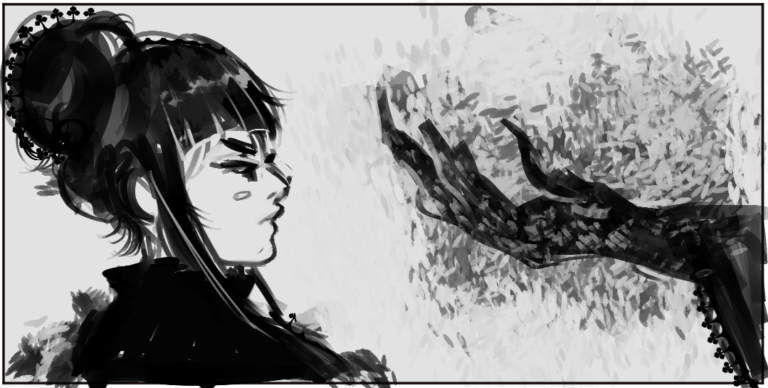
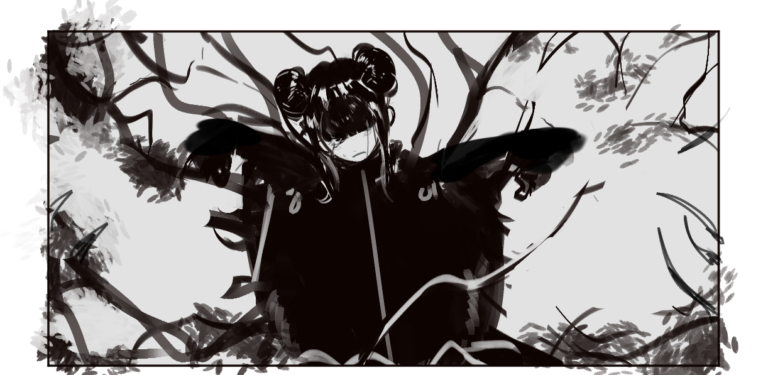
First period is filled with the fresh air of late spring, evoking the excitement of the first trip to the seaside as the weather warms. Its childlike sweetness is reminiscent of juicy apricot pulp. Someone has left a window slightly open, allowing a gentle breeze to tap patiently at the blinds. Outside, the courtyard trees are bursting with new leaves, while inside, the building tries to ignore the heat already seeping in.
I walk in with my shoulders a touch too high, listening for the moment the day stops behaving. Room 2–B passes for ordinary, if you don’t look too closely. Desks in rows that never stay straight. Posters that insist on kindness. A whiteboard with faint tinges of yesterday’s marker. The corners of the windows are fogged by breath and weather, and the season can’t decide whether to be warm or wet. There’s a damp umbrella propped by the radiator, dripping in slow ticks onto a paper towel someone sacrificed to the floor.
Hiroyuki stands at the front with chalk in hand.
He’s been here long enough that no one calls him “the substitute” anymore. The class knows his habits by now. He’s always early, his handouts are lined up with fussy care, and he greets you as if courtesy is non-negotiable. His hair is neatly bound back, gold caught and controlled, a few strands loose at his temples. His cuffs are turned back. When he writes, his hand moves with the calm certainty of someone used to being believed.
On the board:
ON NAMING
Beneath it, three questions:
What do you call a thing you cannot bear to look at?
What do you call a thing you cannot stop carrying?
What do you call a place that insists it is a person?
Kaede is also in the room, standing off to the side near the windows with her attendance clipboard. With the authority of a homeroom teacher and the confident posture of a music instructor, she has the competence to get thirty kids to clap in unison. However, there’s a tension in the way she keeps adjusting the edge of the paper, as if she doesn’t completely trust her own hands to remain steady.
Hiroyuki turns from the board and faces the class, his gaze moving across us with the calm of someone counting living things.
“Good morning,” he says, his voice warm yet soft. “Thank you for arriving.”
A few people laugh, feeling relieved by his politeness. Someone responds, “Good morning, sir,” as if it has become routine, even though a couple of kids still look at him with faint disbelief, like the universe has accidentally hired a model to teach poetry, and no one is brave enough to ask where the real teacher is.
Hiroyuki nods once, an acknowledgement that feels almost ceremonial. “Before we touch the page, I want you conscious of your voice, your habits, your evasions, your honesty.”
He takes attendance without looking down for long. Names move through his mouth with the ease—correct vowels, correct rhythm, even the ones teachers usually flatten to save time. A few students glance up when he says their names properly; a couple straighten as if their spines have been addressed, too. When he reaches mine, his gaze lifts for a brief second.
“Kohana Ohuang-Zhùróng.”
He gives my name the dignity of being said cleanly and continues.
He finishes, closes the folder, and sets it down with care.
“Mrs. Ohuang-Zhùróng is joining us,” he says, turning slightly toward the windows. The courtesy in it is the kind he uses when the room contains more than one kind of authority. “Be kind. Be exact. Those are the same instructions more often than you’d think.”
Kaede lifts her eyes from the clipboard. Her smile appears in the polished shape the school expects, and she offers a small nod back, teacher to teacher. Up close, I can see the extra effort in it: the way her jaw holds itself, the way her fingers keep worrying the corner of the paper as if the rectangle needs supervision.
“Carry on,” she says. Her voice is even, friendly enough for students. “They’ve been unbearable all week.”
A few kids laugh. Someone mutters, “We have not,” and another whispers, “So what if we have?” with the confidence of someone who enjoys being right.
Hiroyuki’s mouth curves, indulgent. “Then we’ll try a different sort of unbearable.”
He reaches for a stack of handouts and slides them into motion down each row. The pages stay aligned in his hands; even the paper looks as though it’s been asked politely to behave. He doesn’t hover over students, doesn’t crowd their desks. He offers the sheet and withdraws, keeping a clean border between bodies.
My copy lands in front of me.
The title sits at the top in plain type:
KILLING SPREE
I hate the tiny, immediate flicker of recognition that moves through me.
Hiroyuki returns to the front and rests one palm on the desk.
“Read the first stanza,” he says. “Silently. Give it your full attention, then we’ll talk about what attention costs.”
Pages shift. Pencil cases close. A few students do the thing where they hold their handouts up like shields; even that looks gentler than usual under his gaze.
My eyes find the first stanza.
Take my name, take my name
I’m borrowing
From future you, for present me.
I move down, letting the words arrive, trying not to react to the places they press. Another stanza catches harder, a hook set under my ribs:
Take my name, take my name
Stay the same
Because of you, in spite of me
Take my name, take my name
Love was made
For future you and future me.
My fingers tighten on the edge of the paper. Habit tries its old move—turn the room into exits and angles, turn feeling into logistics. I read it again, slower this time, and the repetition doesn’t make it safer; it makes it clearer.
Across the room, Kaede shifts her weight near the windows. The blinds tick with the breeze, and her shadow stutters across the floor—an instant where it doesn’t match her movement. Her thumb presses hard into the clipboard until the skin pales. She lifts her mug, takes a sip she doesn’t seem to taste, and sets it down with a careful click.
Hiroyuki remains focused on the class, observing the tilt of heads, the held breaths, and the moments when eyes linger on a particular line without moving on. He never singles anyone out for being affected by the material.
“Excellent,” he says when the pages settle. “Now we read it aloud, together.”
The room exhales and complains in the usual chorus—groans, soft protests, someone drawing out nooo with a grin that’s trying to make anxiety look like a joke. They still fall in line; with him, resistance never lasts long enough to become a habit.
He chooses the first reader near the window, then the second in the front row. He moves through the room, never calling on the student who already looks close to the edge. When someone rushes through a line to get it over with, he asks for it again without shame, patience steadying the whole room.
“Slower,” he says, kind. “Let it carry its weight.”
A student in the back hits From future you, for present me and laughs halfway through it—nervous, quick, the kind of laugh meant to keep the air light.
Hiroyuki doesn’t scold. He tilts his head, listening as though the line has slipped out of tune.
“Try it again,” he says. “Not to be clever. Read it like you mean it.”
The laughter dies. The student swallows and reads it properly. The room feels the change.
Kaede’s gaze lifts from her clipboard and settles on Hiroyuki. Her face stays teacher-neutral. Her eyes don’t.
“Borrowing doesn’t always return clean,” she says, mild enough to pass as a craft note. “Some people take what they need and call it fate.”
A couple of students glance her way, surprised she’s speaking. They don’t catch the undercurrent. They only hear two teachers sharing the same lesson.
Hiroyuki turns toward her, warmth intact, courtesy polished enough to pass for casual.
“True,” he replies. “Which is why we practise consent in language before we ask it of anything else.”
His gaze returns to the class, and he continues selecting readers as if nothing had happened. The room keeps being a classroom. The poem keeps moving mouth to mouth.
Then his attention comes to me.
He doesn’t say my name. He doesn’t point. He gives me that small nod again—permission, not a demand.
I lift the page. My mouth is dry.
I read the stanza in a steady voice because I refuse to let the room take my nerves and turn them into entertainment. When I reach the line, the words scrape on the way out.
Take my name, take my name
It’s prearranged
I’ll ruin you and everything.
Kaede’s pen stops mid-stroke.
Hiroyuki watches my face as though he’s reading my breathing, not the paper.
I finish. I lower the sheet.
He doesn’t praise. He doesn’t soften the moment into comfort. He gives me the one thing that, perversely, feels kinder.
“Thank you,” he says, as if gratitude is a discipline and I’ve done it correctly.
Then he turns back to the board and writes three words beneath ON NAMING:
ERASURE
OMISSION
MERCY
The chalk dust clings to his fingertips. He wipes it away with a clean handkerchief from his pocket—white, folded, absurdly out of place here. He sets it down neatly beside his notes.
“Tell me,” he says to the room, voice gentle, “what changes when a poem refuses to say a thing directly?”
Hands go up. Students offer the safe answers—the ones that sound smart and don’t cost anything. They talk about subtlety and symbolism, about leaving meaning in the gaps instead of stating it outright, about letting an image or an action do the work a blunt sentence would do.
Hiroyuki lets them speak. He listens with patience that makes each answer sound worth considering, even when it isn’t the one he wants.
Kaede’s gaze stays on him.
When she speaks again, it’s aimed at the lesson, but it lands elsewhere. “Refusal can be protection,” she says. “Or it can be control.”
Hiroyuki’s smile holds. His eyes don’t leave the class, but his reply threads the needle with a courtier’s ease.
“Yes,” he says. “And the difference is permission.”
The word drops into the room, changing the temperature of my skin.
Kaede’s mouth tightens a fraction before she smooths it away.
I keep my eyes on my handout. My pencil hovers above the stanza I want to box
Place your head against me now
Your tired lips, your open mouth
Drink my madness if you want to drown
Swallowed by fury and sound.
Outside, the blinds tap again with the spring breeze.
Inside, I can feel the moment tightening between them, polite on the surface, dangerous underneath.
And I’m sitting right in the middle of it.
· · ─ ·✶· ─ · ·
The last bell goes, and the building loosens.
Teenagers leave in layers: a first wave of noise, then a thinner second, then the last few stragglers who always forget one thing and come back for it with a laugh that makes the corridor feel briefly harmless. Late spring light leans through the high windows and turns the dust visible. The air carries cut grass and deodorant and the faint sweetness of someone’s fruit snack that got crushed in a backpack.
My room empties slower than most. Instruments make children linger. They touch what they shouldn’t. They look at themselves in the piano’s black lid and pretend they aren’t.
I let the door close behind the final student. I lock it. The click is small. My shoulders ease by a millimetre.
I move through the end-of-day sequence because the sequence keeps my hands busy and my thoughts in their lane: stands squared, chairs tucked, reeds put away, percussion mallets returned to their tray. The metronome goes into the drawer because I dislike it watching me, even when it’s only plastic and a spring.
The room remains warm from bodies and sunlight, a lingering heat in varnish and brass. My mug has gone cold now. I drink it anyway. Bitter coffee can have its uses.
The knock doesn’t come.
The air at the entrance shifts first.
I don’t turn immediately. I finish aligning the last stack of sheet music with the desk edge. I cap my pen. I place my palms flat on the wood, fingers spread, a habit that reads like teacher composure and functions like a leash.
Then I look.
Hiroyuki D’Accardi stands in my doorway, hair bound back neatly, face arranged into that gentle courtesy he wears the way other people wear a uniform. The fluorescent light is unkind to everyone else in this building. It finds him and behaves. I’ve met his type before—old money manners, pretty restraint, the kind of upbringing that teaches you how to look harmless while you’re deciding what the room is allowed to do.
He doesn’t step over the threshold.
He waits.
“Mrs. Ohuang-Zhùróng,” he says. My name arrives correctly, cleanly, as if it deserves careful handling. “May I come in?”
He has keys. He has been here long enough to stop asking. He asks, nevertheless.
I believe this is part of his job, not an act of kindness, but rather a matter of procedure.
“Yes,” I say, and it costs me nothing to keep my tone mild. I angle my body so he can enter without brushing me. “Close the door.”
He does. The latch settles. The room becomes a sealed box of instruments and varnish and two adults trying very hard not to make this into a scene.
He crosses the floor with unhurried grace, shoes quiet on tile. He keeps a respectful distance from my desk. His hands remain visible. His posture belongs to someone trained in rooms where people read your micro-movements as a license.
“Your lesson,” I say, because teacher sentences are safer than truth. “Naming. Mercy. Consent. You’ve made the class unusually quiet.”
His mouth curves, soft. “They are thoughtful students.”
“They’re fifteen,” I reply. “You domesticated them with a poem.”
A faint warmth touches his eyes at that, as if he’s amused by the word domesticated. As if he’s heard far worse said with far more sincerity.
“I gave them language,” he answers. “They already had the fear.”
I don’t respond to that. Responding would admit he’s right.
Silence expands, filled with tiny sounds: the air conditioning struggling, the distant clatter of a locker in the corridor, the soft tick of a ceiling panel adjusting itself as the building cools. My piano lid reflects us both in dark, distorted lacquer.
I keep my gaze off the reflection.
“You came in after the students left,” I say, and my voice stays even. “So you’re not here to discuss pedagogy.”
“No,” he agrees. Honest, gentle. “I’m here to speak to you directly.”
Directly. The word is a knife disguised as a door handle.
I feel my shadow gather at my feet before I tell it to. It pools in the seam between tile and baseboard, eager and quiet, the way a dog waits when it thinks it’s about to be given a job.
I press my palm harder into the desk. Splinterless varnish. Old gum under the edge. The plain fact of furniture.
“Then speak,” I tell him.
He holds my gaze with that courtly steadiness that makes teenagers behave and makes adults want to argue. His voice stays warm.
“You understand what I am,” he says.
It isn’t a question. It isn’t a boast. It lands as an acknowledgement between professionals.
I don’t give him the satisfaction of flinching.
“An Advisor,” I say, and I keep the word quiet, because saying it too loudly feels like inviting a corridor to turn into a chapel. “Forged where children go in whole and come out as instruments. Trimmed down until the only parts left are useful.”
His expression doesn’t change. It never does when it matters. Only his lashes lower a fraction, as if he’s recognising the accuracy.
“You know more than you should,” he says, mildly.
“I know enough,” I reply. “Spectra doesn’t send you here to help teenagers find metaphors.”
His gaze drifts, briefly, to the cabinet with the good violins—the lock, the glass, the angles around it—taking the room’s measure in a way that could pass for idle attention. Then he returns his eyes to me. “No,” he agrees.
I don’t rush to fill the space after that. I let the quiet sit between us until it becomes his responsibility again.
When he speaks, his voice becomes softer—not kinder, more careful. “Atropa,” he says, and he gives the name its full weight. “The Multiversal Manifestation of Death. You’re having trouble keeping her contained.”
The wrong part of me enjoys that he’s afraid. It lifts its chin against my ribs, pleased to be acknowledged.
I swallow and maintain a neutral expression.
“You didn’t come here to diagnose me,” I say.
“I’m not diagnosing,” he answers. “I’m accounting.”
Of course he is. Accounting is how Spectra makes care respectable.
I keep my hands flat on the desk. My nails press crescents into the skin of my palms.
“What do you want from me?” I ask.
His gaze stays on my hands, not my face. He watches my fingers the way you watch a student’s grip on a bow: for tension, for the moment the string might snap.
“I want you to keep your daughter safe.”
He says it without decoration. The tightness in my throat comes after, sparked by his certainty, by the implication that this should be straightforward.
Kohana has never been simple. Kohana is a weather system with a student ID.
“She is safe,” I say automatically, the same lie I have told myself in a hundred different forms.
His eyes lift to mine. The gentleness stays. The meaning underneath it does not soften.
“She is alive,” he corrects. “Those are not the same condition.”
Anger rises in me because anger is easy to hold. Anger has corners. Anger gives you something to grip.
I breathe in through my nose and taste old coffee. I let it out slowly.
“You came here to tell me what I already know,” I say.
“I came here because you are beginning to lose timing.”
The phrase hits too close to my language. Music teacher. Metronome. Tempo. A private insult delivered with a teacher’s vocabulary.
My fingers twitch.
Shadow slides forward along the desk edge, a thin dark line creeping toward him, curious and hungry and too eager to please. My arm rises a few centimetres before I decide to move it.
It isn’t a big motion. It’s worse than big.
It arrives with confidence.
My stomach flips.
No.
I clamp my hand into a fist and force my arm down. The Shadow snaps back, reluctant, as if recalled mid-lunge. The effort makes my forearm ache.
Hiroyuki doesn’t step away. He doesn’t step closer either. He holds his distance with infuriating calm, like he refuses to reward the wrong part of me with a reaction.
“You felt that,” he says quietly.
He makes it sound like concern.
“Yes,” I answer, and the word tastes like metal.
He watches my mouth for a moment, as if he’s listening for a second voice behind my teeth. Then he says, very softly:
“You’re aware of the risk.”
I am. That’s the curse of awareness. It doesn’t fix anything. It only keeps you from pretending.
I stare at him and keep my voice level. “If you’re here to threaten me, do it properly.”
His brow lifts a fraction. “Threaten?”
“Advisors don’t drift,” I say. “You don’t visit a public school music room after hours for sentiment.”
His smile shows up like manners put on armour—polished, soft-edged, built for rooms with witnesses.
“You’re right,” he says. “Sentiment isn’t why I’m here.”
He lets a beat of silence do the heavy lifting, then continues in the same gentle register. “Your daughter is the Summoner of Time. Spectra doesn’t leave a Summoner unobserved.” His eyes flick once, then return to me. “You know what follows that kind of gravity. You also know what you may be asked to do, and what you may choose to do, before the asking becomes too late.”
My Shadow stirs again, sulking at the restraint I’m forcing on it.
Three taps at the door. My stomach tightens with recognition.
“Kohana,” I call, before she has to wonder whether she’s allowed in.
The door opens. She steps inside with her backpack half off one shoulder, face arranged into that teenage competence she wears when she doesn’t want adults to notice she’s shaking. Her eyes move fast: my hands, Hiroyuki’s posture, the space between us, the air itself.
She can read rooms. Even when she was small, even when she pretended not to be watching.
“Am I interrupting?” she asks, and she aims the question at me, not him.
My chest aches with something maternal and ugly at once: pride, fear, love, the instinct to put myself between her and every sharp thing in the world.
“No,” I say. “You’re on time.”
Her brows knit. “On time for what?”
I keep my hands visible on the desk so she can see them. I keep my voice even, the way I speak when I’m trying not to frighten her.
“You’re sleeping somewhere else tonight,” I tell her.
Kohana’s mouth opens immediately. The protest is already loaded.
“Why,” she demands, and the heat in her tone is teenage, but the intelligence underneath it belongs to my daughter.
“Because I’m asking you to,” I say.
Her eyes narrow. “That’s not an answer.”
“It’s the only answer you get,” I reply, and I let a little more mother into my voice, authority that wants her alive. “Masae’s. Isleen’s. Pick someone you trust. Pack a toothbrush. Go after dinner.”
Kohana’s gaze flicks to Hiroyuki for half a second, then back to me. She’s triangulating. She’s trying to decide whose presence changed the room.
“Did he—” she starts.
“No,” I cut in, firm. “This is me.”
Hiroyuki stays quiet. He lets me own it. Credit where it’s due: he understands when to disappear inside manners.
Kohana’s grip tightens on her bag strap. “What happened?”
I have a hundred answers. None of them are safe. None of them are hers to carry.
My Shadow wants to answer for me. It wants to spill the truth in a voice too clean, too inevitable. It wants to make my fear sound like doctrine.
I swallow hard and force my words into my own cadence.
“I’m having a difficult night,” I say.
Kohana’s expression shifts. The anger doesn’t vanish, but it rearranges around worry.
“You’re a teacher,” she says, like she’s trying to convince herself. “You can handle nights.”
I almost laugh. It would come out wrong.
“I can handle students,” I tell her. “I can handle a room. Tonight, I don’t trust my hands enough.”
Her eyes drop to my hands on the desk. Then back to my face, wide with a kind of alarm she tries to hide.
“Mom—”
“Go,” I say, and my voice tightens. “Go while I can say it calmly.”
Kohana stands very still, weighing her options with that stubborn logic she got from her father and that wild hope she got from me.
“Okay,” she says at last, and it is a promise to return with questions.
She turns to leave, then pauses at the doorway, fingers splayed on the frame as if she needs an anchor.
“Are you okay?” she asks, small now, and she doesn’t look at Hiroyuki when she says it. She keeps it between us.
The wrong part of me wants to lie beautifully. It wants to soothe her. It wants to keep her close.
The mother in me refuses.
“No,” I answer. “That’s why you’re going.”
Kohana nods once and disappears into the corridor. The door clicks shut.
The room feels larger and more dangerous in the space she leaves behind.
Hiroyuki remains where he is, composed as ever, hands still visible, posture arranged into calm.
“You did well,” he says.
I let out a breath and keep my eyes on the desk because looking at him too long makes my Shadow restless.
“Don’t praise me,” I reply. “I’m not your student.”
His smile returns, faint. “No,” he agrees. “You’re an obstacle I’d rather not have to remove.”
The sentence is polite. The meaning beneath it is clear enough.
My Shadow shifts, eager, offended. It wants to turn that line into action.
I press my palm harder into the desk until my skin warms against varnish.
“I’m aware of what you are,” I tell him quietly. “I’m aware of what your Academy makes. If you decide you have to cut through me, you’ll do it with grace and paperwork.”
His eyes soften by a fraction, almost regretful.
“Perhaps,” he says. “But I’d prefer your daughter never sees her mother become an assignment.”
My shadow in the piano lid’s reflection lags again, and I feel the cold satisfaction behind my teeth trying to smile with my mouth closed.
I look away from the reflection.
I keep my voice teacher-even through sheer discipline. “Then leave.”
Hiroyuki inclines his head, courtly as ever.
“As you wish,” he says.
He turns, opens the door, and steps back into the corridor.
The air shifts again when he goes, as if the room is relieved to be allowed to be a music room.
I stand alone with my instruments, my desk, my hands.
And the knowledge that tonight, I did the most maternal thing I know how to do: I sent my daughter away from me.
· · ─ ·✶· ─ · ·
I do not leave immediately.
I stand at the far end of the corridor where the trophy case glass throws back dim reflections and the afternoon light fades into pale rectangles on the floor. From here, I can see the music room door. From here, I can hear what I need to hear without making myself part of the room’s decisions.
Then—faint, through the wall—a single piano note.
It lands dead-centre and holds. The pitch remains in its original position, holding the air around it in place. The plaster takes the sound and gives it back thinner, cleaner, like the corridor has become a throat built for carrying that one syllable. Dust shakes loose from a ceiling tile. The fluorescent light above the noticeboard brightens half a shade and corrects itself.
The instrument behind that wall shouldn’t have the reach for this. Not through old paint, ductwork, or damp seams. The cart’s wheels soften. The building, for a second, seems to listen as if it has been called by name.
My spine remains relaxed. My mouth stays composed. My mind adjusts its list of priorities.
Kaede can do the work. That part remains true. What she can’t keep steady is the interval between one act of restraint and the next. The rhythm slips. The agreements that used to snap into place now hesitate, and the Multiversal Manifestation of Death presses into every hesitation.
I open my notebook and write without flourish, because flourish is a luxury when you are documenting risk.
Kaede: incursion progressing. Shadow latency observed. Instrument response compromised.
Kohana removed from radius for the night. Maintain distance. Prepare containment options.
I tear the page out cleanly. I fold it into a small square that will not catch the eye if someone searches my pockets and expects romance instead of procedure. I slide it into the inner seam of my coat.
· · ─ ·✶· ─ · ·
Masae’s street smells like cut grass and warm pavement that’s been holding sunlight all day. The houses here sit close enough to share fence shadows. Someone’s hydrangeas are already trying to be dramatic, big leaves catching the last light, petals not quite committed yet.
I walk up the path with an overnight bag cutting a straight line into my shoulder.
Kaede’s instruction sits in my head: you’re sleeping somewhere else tonight. No explanation that satisfies. No room for negotiation. The kind of rule you give a child when you’re trying not to show them you’re scared.
My fingers keep wanting to check my pockets for a watch that isn’t there. For metal. For weight. For a chain I can pay with. I catch myself doing it and flatten my palm against my thigh instead, a small, humiliating correction.
The house has a tiny tiled entry and a doorbell that plays a cheerful chime. I stand there for a count that feels longer than it should, then press it.
I heard footsteps inside—quick, light, and familiar.
The door opens, and Masae fills the frame.
Her hair is that impossible spring green even indoors, short and uneven. She’s in socks with little stars and a pink hoodie with a cartoon rabbit in a victory pose. Her eyes go wide the second she sees me, then she does the micro-thing she’s been practising since middle school: smoothing her face into “normal friend greeting” instead of “devotion.”
She gets about halfway there.
“Kohana,” she says, and her voice rings. She clamps it down a fraction, like she remembers there are adults in houses who sleep and don’t want to hear the gospel of friendship at full volume. “You came.”
“I came,” I answer.
She looks at the bag, then back at my face.
“Okay,” she says, too bright. “Okay. Come in. Shoes. I have— I have snacks. I have tea. I have emergency face masks. I have… you know. Things. Normal things.”
I step inside, and the house air wraps around me: clean laundry, rice steam, a faint floral detergent that lives in the hallway. The entry tiles are cool under my socks. A row of slippers waits by the step.
Masae shoves a pair toward me with her foot. Pink. Of course.
I slide into them and follow her down the corridor.
The lights are warmer than school. Everything is smaller here: doorframes, corners, the distance between the living room and the kitchen. A family calendar hangs on the wall, with neat writing and a sticker that reads “GOOD LUCK!” in glitter pen. There’s a framed photo of Masae at some competition, smiling so hard it looks like it hurts.
She glances at it as we pass, like she’s checking whether her past self approves of this moment.
“Kohana,” she says again, quieter this time, and I can tell she’s trying to find the right lane. Friend lane. Mission lane. The lane where she doesn’t make me feel like a shrine.
“Mm.”
“Kaede-sensei told me you were coming,” she says.
My throat tightens. “She did.”
Masae’s hands hover for a second like she wants to touch my arm and thinks better of it. She ends up grabbing the cuff of her own sleeve instead.
“She said,” Masae continues, and her voice drops into something that wants to be serious but doesn’t know how to live there for long, “she said you should sleep somewhere else. Just tonight. And she said… she said to keep you busy. To keep you eating. To keep you from going home even if you decide you want to.”
My fingers flex around the strap of my bag. “Did she say why?”
Masae shakes her head once, quickly. “No. She doesn’t do that when she’s… when she’s trying not to scare people.”
I swallow hard. My mouth tastes like the hallway air at school when the lights buzz too loudly.
Masae leads me into her room like she’s ushering me into a set. The first thing I see is the pink glow of a desk lamp, the kind that turns the corners into a soft haze. The second thing I see is the shrine.
She has a bulletin board covered in photos, stickers, and glitter tape, layered into a collage that looks like a life curated into proof. Medal ribbons hang off one corner. A string of tiny star lights drapes across the top of her window. Plushies sit in a row along the bed, arranged as if they’re waiting for roll call. Her desk is crowded with notebooks and pens and a little jar full of rhinestones.
The room is Masae, condensed.
And on the bed, half-open like it’s been waiting, is the scrapbook.
My stomach dips before my eyes even get close enough to read the title.
Masae sees me looking and her cheeks flush, the colour creeping up under her eyes.
“Okay,” she says fast. “So. Don’t— it’s not— I wasn’t, like, expecting you specifically tonight when I—” She gestures at the bed with a hand that doesn’t know where to land. “I was working on it earlier. It’s— it’s just my thing. It’s not a cult. It’s… it’s a little cult. But, like, a nice cult. A friendship cult.”
The page that’s open has my face on it.
Not the version of me that feels like me. Not the one with a tired eye and a mouth that has learned how to keep secrets. It’s the summer festival photo—petals in my hair, laughing at something I can’t remember laughing at, caught mid-motion. Masae has put stars around it. A tiny crown sticker. Gel pen handwriting looping along the margin.
She edges closer, hovering on the line where her enthusiasm might become too much.
“I realise it’s… a lot,” she says, and there’s a crack of authenticity in her voice. “It’s just. I like remembering the good versions. The ones where you look like you’re here with us.”
I keep my eyes on the page. My fingertips hover above the photo without touching it.
“You have a shrine of my face,” I say.
Masae winces, then makes a face like she’s swallowing her pride. “Yes,” she says. “I do. And I’m not apologising because it’s my coping mechanism and it’s not hurting anyone.”
I finally look at her.
Her chin is up. Her eyes are bright. There’s fear under it, buried deep, dressed up as defiance.
“It’s… weird,” I say, because honesty is the only thing I can afford with her. “But I get it.”
Her shoulders sag with relief so fast it’s almost funny.
“Okay,” Masae says, then points at the floor beside her bed. “Futon goes there. I already told my mom you were coming. She thinks you’re studying. She thinks you’re good for my grades.”
I let out a sound that could be a laugh if my throat wasn’t so tight.
Masae rummages in her closet and drags out a folded futon with the determination of someone hauling a sacred relic. She shakes it out, gets it flat, then tosses a pillow onto it with a flourish.
“Ta-da,” she says. “You get the guest spot. I will not let the floor claim you. Not on my watch.”
Not on my watch.
The phrase hits me in a place behind my ribs and makes my hands twitch again, searching for the shape of metal that isn’t there. I press my palm to my thigh, fingers splayed, and let the impulse pass through without letting it steer.
Masae doesn’t notice. Or she notices and decides not to point at it.
She’s good at that sometimes: pretending not to see the parts of people that would make them feel exposed.
“Tea?” she offers.
“Sure,” I say, because agreeing to small things is how you keep a night from becoming a fight.
Masae disappears down the hallway and comes back with two mugs and a plate of convenience store pastries. One of them is shaped like a star.
She sets everything down on her desk, then turns on her laptop with the ceremonial seriousness of someone starting a ritual.
“I can put on something normal,” she says, finger hovering over the trackpad. “A documentary. A cooking show.”
“No.” The word gets out ahead of me. I draw it back in before it can bruise. “Put on your magical girl show. The one you keep trying to convert me to.”
Masae blinks, and then her entire face lights up. Her eyes widen, and her mouth breaks into a huge grin.
“Wait. You mean Aster Circuit?”
“Yeah,” I say. “Mahō Shōjo Aster Circuit. Put it on.”
She clicks so fast I worry for the little square of plastic under her fingertip.
The opening theme plays—a bright synth accompanied by an uplifting drumline—and Masae laughs as she fumbles to turn down the volume. Despite her efforts, the screen bursts with colour. A girl in a school uniform runs across a painted cityscape and suddenly stops mid-step, drawing the world to a halt. The transformation begins: light bands spiral up her legs, a charm key spins between her fingers, and her hair lifts as if a wind has found a secret path.
Masae settles back on her bed with her mug held in both hands, shoulders hunched in an effort to behave. She lasts for maybe ten seconds.
“Okay, okay—so that one’s Hinata. The protagonist. She’s the Aster Lead.” Masae points with one careful finger, like the screen might be fragile. “Her element is ‘charge’, which is why everybody thinks it’s electricity, but it’s not. It’s commitment. Like—she can store a decision and spend it later. Watch, watch—she’s about to do the key thing.”
On-screen, Hinata presses the charm key at her collarbone. The key flashes, and her uniform transforms into a new shape: sleeved gloves, a short jacket with star-thread seams, and a voluminous skirt.
“The outfit belongs to the first season,” Masae says, with a sense of reverence. “Before the upgrade arc. Later, the jacket gets longer and the stars on the hem change—because she learns she can’t carry everybody by force of will. It’s… It’s actually really good, okay.”
“I believe you,” I say, and mean it.
Masae’s grin turns shy for a moment, then she rallies, eyes tracking the next cut. “And that’s Raika—pink one. She looks sweet, but she’s silly. She fights with a wand that’s basically a taser baton, and she laughs the entire time, which is the best part. Oh, and the blue one, Mizuno, she’s my favourite, but only after episode nine, because before that she’s doing this whole ‘I’m fine, I’m fine’ routine and then—”
She realises she’s accelerating and clamps her lips together, shoulders drawing in.
I lift my tea again. It’s still too hot, and it stings my tongue enough to keep me in my body. “Keep going,” I tell her, quietly. “I’m listening.”
Masae exhales, relief loosening her grip on the mug. “Okay. So. The villains are the Late Court. They steal timing from people. Like… you miss the train by one step, you reach for a doorknob and your hand lands beside it, you say the right thing half a second too late and it doesn’t count anymore.” She glances at me, then back at the screen. “It’s scary, but in a way that makes you feel less alone when you’re scared. They’re not monsters. They’re… mean about the rules.”
On-screen, the girls leap through a city that keeps glitching at the edges: streetlights stutter, a clock face blooms and fractures, a crosswalk ticks too fast.
Masae keeps talking—names, arcs, the episode where Hinata refuses to transform until she apologises to someone she hurt, the mid-season twist where the Late Court’s leader turns out to be a girl who wanted one day to arrive on time and never did. Her voice warms as she goes.
My phone sits in my bag. I pull it out, open my messages, and let my gaze find Kaede’s name.
I type Are you okay.
I delete it.
I type I’m at Masae’s.
I delete that too.
Anything I send feels like pulling on a thread I’m not sure I should pull.
My thumbs hover above the keyboard, then settle on something smaller.
Home safe. I’ll stay.
I hit send before I can overthink it into silence.
The message goes.
I lock the phone and set it face down beside me like it might try to look back.
Masae’s eyes flick toward me, then away, pretending she didn’t see. She reaches for the pastries and nudges the plate closer with her foot.
“Eat,” she says.
I pick up the star pastry and bite into it. Sweet bean paste. Soft bread. Sugar that reminds my body it’s allowed to be a body, not a weapon.
My throat loosens a fraction.
Masae watches me chew with a small, fierce satisfaction, like she’s just won an argument against my worst habits.
On the screen, the magical girl lifts her hand and declares she’ll protect everyone. Masae makes a soft sound of agreement and leans forward, eyes wide.
I let the bright colours wash over me.
My mind keeps trying to write maps in the corners of the room. Door. Window. Hallway. The distance between my futon and Masae’s bed. The distance between this house and mine.
Masae’s room is warm. The fan in the corner turns with a soft mechanical whisper. The star lights by the window blink in slow cycles. A plush rabbit watches me from the pillow with stitched-on courage. No wrongness shows up here. No clocks stutter. No vents cough into a pattern. The ordinary has weight in this house. It holds.
It doesn’t soothe me the way it should.
Because if the night stays normal here, it means Kaede is alone with whatever she’s trying to keep from touching me.
My phone buzzes once.
I flip it over so fast my fingers slip.
Kaede’s reply is only two words.
Stay there.
My lungs catch high, then I force the air down. In through my nose. Out through my mouth. I keep my face neutral because Masae is watching the show like it’s holy, and I refuse to make her carry my fear too.
Masae glances at me anyway. Her eyes track the way my fingers tighten around my mug. The way my shoulders creep up.
“Kohana,” she says quietly.
“I’m fine,” I answer, because my mouth loves that lie.
Masae’s eyebrows lift. She doesn’t smile. “Okay,” she says, and the word is gentle in the way a bandage is gentle. “Then be fine over here. Let her do whatever she’s doing without you trying to run back and bleed for it.”
My jaw aches.
I take another bite of pastry instead of answering.
The episode runs to its end card. Hinata lands the kind of win that barely counts as one—she gets the stolen minutes back into a stranger’s hands, she gets one small “on time” to arrive intact—then the Late Court steps out of the glitching light. The Regent smiles and says something that sits in two places at once: a promise, and the tired truth underneath it. The streetlamps on-screen stutter. A clock face flowers across the sky and fractures, numbers sliding as if they’ve forgotten where they belong.
Masae snorts at a casual remark—Raika, pink and bold, winking directly at the camera—and her laughter is genuine. Relief and ache arrive together, threaded through my ribs.
When the credits finish, Masae shuts the laptop with both hands, careful with it as if it might bruise. She clicks her lamp down until the light turns honeyed and low, and the star string above her headboard starts to matter more than the ceiling does. The little plastic points blink across her posters and the edge of her duvet, throwing constellations onto everything that can hold them.
She brushes her teeth in the attached bathroom and comes back in her pink star pyjamas, hair finally giving up its neatness. Devotion drains out of her shoulders and leaves behind sleep.
She pauses at the edge of her bed.
“You can wake me up,” she says, and her voice wobbles around the seriousness she’s trying to keep steady. “If you… If you need. If you feel weird. Or if you wanna go throw up. Or if you see something. Or if you hear something.”
“I’m not going to throw up,” I tell her.
Masae points at me, dead serious. “Don’t jinx yourself.”
A sound escapes me that tries to be a laugh and comes out softer.
Masae climbs into bed and turns onto her side, facing me. The star lights blink across her cheeks and catch in her lashes. In this lighting, the sharp edges of “heroine” fall away. She looks sixteen again, all bones and brave effort and a heart that keeps showing through.
“Kohana,” she whispers. “She loves you.”
My throat tightens hard enough that swallowing takes thought.
“Yeah,” I manage. “I feel it.”
Masae’s eyes flutter shut with the relief of that answer. “Good,” she murmurs, already drifting. “Then you can rest.”
“I’m not sleeping,” I say on reflex, as if insisting can keep the night in order.
Masae cracks one eye open. “Yes you are. You’re going to do it while pretending you aren’t.”
She closes her eye again.
Her breathing slows. The room keeps blinking. The fan keeps turning.
I stare at the ceiling and count the seconds by the change in light from the star string.
My shadow on the wall moves when I shift.
It matches.
I keep watching anyway, because trust isn’t a switch I can flip. It’s a muscle. It cramps.
Somewhere in the house, a floorboard settles. A pipe ticks once. Ordinary. Settling.
I hold my phone in my palm until it warms against my skin. Kaede’s message sits there: Stay there.
I keep my hand open instead of letting it curl into a fist.
Outside, a car passes, headlights sliding along the curtains for a brief sweep. The light crosses Masae’s wall, glances off a crown sticker on my photo, then moves on.
I let my eye close, not because I’m brave, but because I’m tired of fighting a night I’m not even allowed to be present for.
And in the dark behind my lids, I keep repeating the rule Kaede didn’t have to explain:
Stay there. Stay there. Stay there.
· · ─ ·✶· ─ · ·
I’m not here to be liked. I’m here to get food out and keep idiots from burning it.
The House of Hellfire is built to make a show of the kitchen so customers can watch sweat and pretend it’s entertainment. The hood fans drag air upward in long pulls that leave my skin salted, and the line snaps with work: oil spitting, pans hissing, call-and-response over the pass. The dining room pays for the illusion that nothing ever goes wrong. I make the illusion true.
I stand at the centre of it in a jacket cut to my shoulders. The buttons are plain, the collar lies flat, the cuffs sit where they’re meant to. Over it, a dark apron hangs from leather straps and solid hardware; the moment it catches a smear, it’s off and replaced, no discussion. My hands stay bare. I don’t wear extra fabric when I’m fixing other people’s mistakes.
My hands tell the truth regardless—knuckles glossed from old burns, a thin scar at the base of my thumb from an oyster knife, fingertip pads toughened and scored by years of rushed work. You don’t wash that off. Money can’t undo it; it just lets you wrap it in better fabric.
“Fire table twelve,” I say, and my voice carries to the back without me having to raise it. “Two lamb. One halibut. One vegetarian.”
“Yes, Chef,” comes back in the usual chorus. Everyone remembers the last time someone tried to negotiate.
I watch the plates arrive in the order I expect. I watch a young cook try to outrun his own nerves by moving faster. That strategy annoys me every time.
“Slow down,” I say, without looking up. “You want to be fast, be accurate first.”
A sauce lands unevenly on the rim.
“Again,” I say, and my voice stays level because raising it would be a waste of air. “Start over with a clean plate. If you can’t respect the pass, you don’t touch it.”
He nods once, jaw set, and goes back to the stove like he’s been yanked by a hook.
The printer by the pass coughs out another ticket, and I catch it without looking. My eyes skim for ink and land on clean white. I flip it over, then hold it closer under the harsh light, waiting for a faint trace of text to show through. Nothing surfaces.
“Print’s out,” someone says.
I don’t look at the kid who says it. I keep my gaze on the ticket because if I look at him, I’ll waste time on facial expressions.
Another strip of paper feeds out. Another. Both blank.
“Replace the roll,” I say.
“It’s new,” the kid answers, then realises he’s answered at all.
I look up. “It’s new,” I repeat, calm enough to be dangerous. “So why am I holding a blank ticket?”
He swallows. “Maybe it’s jammed.”
“Maybe,” I echo. “Do I run a maybe kitchen. Open it.”
He fumbles with the latch. The printer keeps chewing paper like it’s proud of itself.
“Show me,” I say.
He cracks it open, hands shaking just enough to annoy me. “See? New roll.”
I lean in, just close enough that he feels me there. “Great. Brand new useless paper. Fix the feed.”
“I— I did—”
“Don’t argue with a machine that’s humiliating you,” I cut in. “Reset it. Reseat it. Make it print. Those are your options.”
He nods fast. “Yes, Chef.”
“And next time,” I add, eyes on his hands, “you answer the instruction, not your feelings about it.”
He bends over the printer again, fussing with the latch and the feed like he can bully it into behaving. It keeps spitting blank paper anyway, smug in its own incompetence.
I tap the casing with two knuckles—light on, motor humming, still chewing through roll after roll.
“Turn it off,” I say.
He reaches for the switch and hits it once. Nothing. He hits it again, harder. The printer keeps running.
I don’t wait for him to make a third attempt. I grab the cord and yank it out of the wall. The machine coughs out one last blank strip as it dies, a final petty insult.
The line pauses. A pan hisses, and in the half-second of quiet everyone remembers exactly who’s standing at the pass.
“Keep moving,” I say. “Call your tickets. Speak.”
They obey. Voices rise. Two lamb walking. Halibut in thirty. Vegetarian plating. The kitchen shoves itself back into rhythm, grateful to have something ordinary to do. I fold the blank tickets into a tight square, drop them into the bin, and then the air changes.
It’s subtle at first—an odd chill along the underside of my forearm when I reach for a plate, cold that has no business existing this close to a salamander. I check the vents. Nothing. I check the back alley door. Closed. I check the floor drain by the dish pit. Dry. The kitchen is behaving.
My body doesn’t buy it.
Behind me, a cook laughs at something I don’t hear, then the laughter stops abruptly, as if cut off.
The pass throws my face back at me in a warped strip of stainless, light dragged thin and ugly across my features. Fluorescents carve the angles sharper than they deserve; they make me look like a harder man than I feel at this exact second. I shift my weight to take pressure off my knee.
In the reflection, my shadow comes after me.
A beat late. Almost nothing. Still enough to turn my stomach.
The reflection shows it clearly: I move, and my shadow answers late. That delay isn’t a lighting trick; it’s behaviour, and my skin goes tight with the simple fact that something in this room is deciding things without me.
I keep my hands where they belong on the pass, and I keep my face neutral. Whatever this is, it doesn’t get the satisfaction of watching me react in front of my staff.
“Chef?” someone asks, carefully.
I lift my eyes. The atmosphere has become tense—bodies still moving, but attention directed toward me. Everyone is bracing for the moment the weather changes. They seek reassurance. They need permission to continue pretending that this is just another service.
“Focus,” I say. “Plates.”
They obey instantly. Fast hands. Quiet voices. Grateful for an order they can follow.
My gaze slips back to the stainless. The reflection has corrected itself.
I try to blame it on glare, on fatigue, on the way heat makes air shimmer—some cheap trick of light. The excuse fits neatly enough to use for half a second.
Then another thought arrives that isn’t mine.
Count.
My stomach tightens because I’ve counted my whole life—orders, covers, seconds, cuts—and nothing about that should feel foreign, yet this does. I clamp my hand around the edge of the pass until the steel bites into my fingertips.
“No,” I mutter, and I don’t even know who I’m addressing until my shadow in the stainless steel tilts its head, slow, as if it heard me.
A plate lands in front of me—lamb resting properly, juices gathered where they should, herbs placed with care—and the normality of it makes my jaw set. I lift my hand to wipe a smear from the rim, then stop with my fingers hovering above the porcelain. For a moment, my awareness snags on my own throat, on the pulse under my jaw, on the stupid fact that I’m still a body even in a jacket that costs more than some people’s rent.
A phrase tries to surface—too polished, too composed to be mine—and I crush it before it becomes sound. My jaw aches with the effort. I wipe the rim anyway, quick and clean, and call “Walking” like nothing in my kitchen has changed.
The runner takes the plate and disappears. I stare at the empty space left on the pass as if it might confess what the room is doing.
In the corner by the prep table, the shadow gathers into something deeper than lighting should allow, a patch of darkness that looks less like absence and more like depth. The overhead light seems to avoid it. A commis drifts too close, heel nearing that edge.
“Back,” I snap, and he jolts away so fast he almost collides with the dish station.
“Sorry, Chef,” he blurts.
I don’t explain; explanations are for people who want a story. I give orders because orders keep hands safe. I point at the sous.
“Cover the pass.”
He blinks once—“Chef?”—and I cut through it.
“Now.”
He steps in, face set, and takes the heat without complaint.
I walk to the office at the same pace I’d use to check inventory or sign invoices. I shut the door and lock it, and only then do I let myself breathe out. I take out my phone.
My contact list is short because I don’t collect people; I collect competence, and even that has a shelf life. My thumb stops on Kaede’s name and hovers there without pressing. Pride is a stupid thing to carry into a burning building.
Another thought slides in with oily confidence—Found—and my skin crawls. I look down at the office floor, at the shadow that should be nothing more than a shape made by light and body.
It isn’t behaving like a shape.
The shadow’s hand is lifted slightly, fingers curved toward my throat as if it’s considering the soft part of me, and my mouth goes dry.
“Put your hand down,” I say, low and controlled, the voice I use when someone is about to ruin an entire service with one stupid choice. The shadow hesitates, then slowly lowers its hand, reluctant, like an employee complying while making it clear they resent the instruction.
I keep my eyes on it until they sting and refuse to blink first. The laminated schedule on my desk is already straight, but I straighten it anyway, aligning it to the grain like I can bully the world back into order with one clean line. My hands remain steady throughout the motion. I take the steadiness and don’t thank anything for it.
When I lift my eyes, my shadow has shifted behind me on the wall, and it still doesn’t move when I move. That mismatch twists my stomach.
I pick up my phone and stop hovering. Calls turn into conversations, and conversations turn into openings. I type instead, blunt enough to be useful.
Where is Kohana tonight.
I don’t add courtesy. I don’t soften it. Anything extra would hand the wrong thing more information than it deserves. I send it, turn the phone face down, and open the bottom drawer in the same breath.
The false base gives with a small, familiar click. The tin inside is plain, unlabelled, and kept where nobody earns the right to look. I lift the lid and take out the Spectra holo band.
It isn’t jewellery. Matte, dark, weighty the moment it touches skin, with a seam that catches light at the wrong angle when you tilt it—Spectrian work always has that quality, expensive and unfriendly. I slide it onto my wrist. Cool contact. A brief pulse across my skin: recognition, nothing else. A thin pane of light blooms above the band, clean and colourless, hovering where my forearm ends and the room begins.
I type with two fingers.
VOROBIEV-MOSKÓVSKIY
The system takes the request on first contact. The band warms a fraction against my wrist and throws up a pane of clean light.
Then it stops being a pane.
The projection pushes forward into volume, building him in stages—outline, colour, texture—until Uodalrich Vorobiev-Moskóvskiy stands before my desk. He’s short. That fact registers and immediately becomes irrelevant, because the room treats him as a larger problem than his height suggests. The corner lines behind his left side skew a degree off true.
His uniform reads like containment dressed up as command: deep carmine underlayer, gold filigree branching heavier across the left where his body refuses to stay obedient. The gold isn’t decorative when you keep looking at it. It’s a set of fastenings. A map of where reality keeps trying to split him open, only to be told no.
His head is bare, polished by time and grief rather than vanity. The eyepatch covers the left eye—filigreed, Spectrian, expensive. Fine chains hang from it and catch the projection light in quick, dry flashes whenever the feed stabilises. His remaining eye fixes on me straight on: deep red, wax-seal red, the colour of decisions.
Skin, too, comes in two halves. One side stays matte and dark, taking the light without giving anything back. The other reflects in gold and amber, shifting under the surface. The left glove hides most of the instability, but the field around him gives it away anyway. My teeth ache faintly. The air near my desk feels colder than it should.
Behind him, a halo resolves—fractured sunburst spires, luminous geometry anchored to the idea of him more than the body. It flickers out of sync for a beat, then locks into place.
His voice arrives through the band’s speaker and the room’s bones at the same time.
“Speak.”
“I’ve got Shadow,” I say.
He doesn’t react in the human way. No widening of the eye, no shift of the mouth. The pause that follows is brief and exact.
“Define.”
“It’s in my building,” I answer. “It’s touching equipment. It’s touching light. It tried to take my throat.”
His gaze captures me like someone examining an inventory list they anticipate will be disappointing. In the silence that follows, I can almost hear him categorising me in ways that are unlikely to be flattering: asset, liability, nuisance. Which label I receive will depend on my next actions.
“Location.”
“House of Hellfire,” I say. “Shinjuku.”
The fluorescent above my desk flickers once—old ballast, old wiring, the cheap fatigue of a building that’s been asked to pretend it’s fine for too long. The holo projection stays perfectly steady, clean as a scalpel line.
“How long?”
“Minutes,” I say. “Enough to know it isn’t an accident.”
“Contain,” he says. One word, and the room seems to accept it as instruction. “Do not engage.”
A small breath leaves my nose. “I’m not an idiot.”
“That remains to be demonstrated,” he replies.
I could take offence. I could waste time on pride.
Instead, a colder sensation settles under my ribs—relief wearing irritation’s face. Someone else is now holding the size of this. Someone who has survived the consequences of holding it.
“My daughter’s with Kaede tonight,” I add, because I’d rather give him the fact than have him pry it out. “I’ve asked where.”
Another pause. His attention narrows, not in intensity but in focus, like a lens tightening.
“Do not draw her back,” he says.
“I’m checking,” I answer. “Not summoning.”
“Continue,” he says, a stamped form slid across a desk: you may remain useful.
I glance at my wrist. The holo pane shows a small symbol I haven’t seen in years: a thin ring with a mark through it—acknowledged. That’s all the comfort I get.
The call ends without ceremony. The light collapses back into the band.
I take it off, wipe it once on my sleeve, and return it to the tin. The false base clicks back into place. The drawer closes. The office goes back to pretending it’s separate from the heat.
I unlock the door and step back into service.
The stainless steel by the pass throws my reflection back at me, and it looks normal, which is the kind of lie I can work with. Behind my shoulder, in that same warped strip, my shadow smiles with my mouth closed.
Fine.
I don’t reward it with panic. I don’t reward it with curiosity. Plates keep coming; I send food out and keep the dining room blissfully unaware that their evening is balanced on a thin line of compliance.
By the time the rush loosens, my shirt is damp under my jacket, and my patience has sharpened into something useful. The staff start breathing as if the worst is over. Someone cracks a joke too early. I don’t laugh. I don’t need them relaxed; I need them accurate.
“Break down,” I tell them. “Clean. Restock. Nobody leaves their station looking like it lost a fight.”
“Yes, Chef,” they answer, and they move with the relief of a command they understand.
And I keep the line tight, because the moment I loosen my grip is when something decides it can take more than paper.