Bad girl. Bad wolf. Bad dog.
That’s what their eyes say when I lean in and breathe them, when I let my nose do what it was made for. Men don’t like being sniffed. They like to believe they are the ones doing the choosing.
They try to pretty me into something harmless. Cherry-cola mouth. Bubblegum voice. Strawberry-lemonade cheeks. Hands they call delicate. Delicate, as if that word could file the teeth down in my skull.
Among animals there is always a conversation before blood. The predator and the prey read one another: a certain tilt of the head, the soft shiver that runs under skin, the way muscles ripple when something decides it will run instead of fight. When the prey lowers its gaze, offers softness, it’s an agreement. I am yours to take.
I look up at them now, lashes lowered, eyes wide and wet as if I’m begging for instructions, not air.
“Ain’t she—” one of them starts, feet sliding a little on the concrete. His speech is frayed, his pupils blown, red veins threaded through the white. “Ain’t she pretty?”
His breath hits me like a gas leak: boiled rotten eggs, burnt matchhead, sewer steam. He belches and the stink rides high across my palate, sulfur and rot. A human throat would lock, gag, claw for clean air. I only taste. Catalog. File away.
He lists toward me, bottle neck sweating in his hand, then wobbles back as if the ground has shifted. “Like one of ’em dolls,” he mutters, squinting, trying to line me up into one neat outline instead of two.
The other one is worse. Hungrier. He watches me the way a starving hunter watches a fawn that’s limping. Feast or famine—wolves understand that look. You survive on whatever falls behind: the very young, the very old, the injured, the thin.
He leers because he thinks I am that deer.
He leers because he is sure he can catch me.
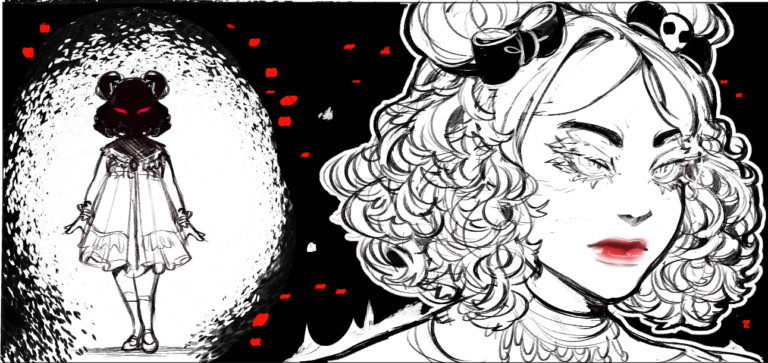
“Can’t be more than fourteen,” the bigger one slurs. His words smear together, thick with alcohol and rot. Up close I see the abscesses on his cheeks—angry, swollen domes of pus ready to split. He’s huge, all bulging muscle and rope-veins. The kind of man who could snap a chain around his chest. The kind who thinks he could snap me.
“Imagine how much money she’ll make us,” he adds, and his gaze turns to inventory.
I was waiting for them. Bone on the road. Bait in a red dress.
I smell like everything they were taught to trust. Coconut lotion, cheap pink rose body spray, vanilla sugar baked into skin. I rolled out of bed and straight into the sort of scent that makes predators smile and convince themselves they’re the ones hunting.
“Whaddaya say you work with us?” the big one says, squaring his shoulders so the alley feels smaller. “Be a good girl and say yes, or things’ll get ugly real fast.”
The world has always insisted girls run, stall, sob, bargain. That sweetness is a shield, that modesty is armor. I tried obeying predators once. It didn’t take.
Now I am not afraid of the darkest dark. I am not afraid of offal, rot, bones, blood, or the men who make girls into meat.
“It’d be a shame if I had to knock out them pearly teeth,” he adds.
If only he knew what they’re for.
My teeth are built for shearing. For cracking. For grinding bone until it remembers powder. Under his noise I can hear the wet thump of two human hearts, the ragged drag of their breath. Fear smells like metal before it ever tastes like it.
He stares, slack-jawed, and reaches out for my face with the kind of confidence only the very stupid or the very cruel can manage.
“Ain’t no girl looks like that and lets herself get cornered in a dead-end alley by two guys three times her size,” the one with the bottle mutters, circling. His legs don’t quite listen to his brain. “This one’s experienced. She ain’t even put up a fight. See? Watch.”
He tips the bottle back, drains the last mouthful, feels the burn sink into his gut like courage he didn’t earn.
Then he hits me.
His fist connects with my cheekbone. The impact barely jostles my head. The sound that follows is not mine—it’s his wrist, bending where no bone should bend, his knuckles folding like wet cardboard. When he drags his hand back, it hangs wrong, arched and shattered, skin already mottling.
The look on his face is delicious. His blood goes cold all at once. His scream comes out raw and animal, the kind of noise prey makes when it realizes it has misread the dance. He gulps air for a second round of panic, but nausea catches him by the throat; his stomach heaves, bile climbing.
I could hit him back. One strike and his atoms would remember how to fall apart. But there is a hierarchy to hunger. I want the big one first.
“You worthless fucking cunt!” he spits, voice cracking on the last word. Rage is easier than fear. “Kill this stupid bitch, Lyam!”
Every hair on Lyam’s arms lifts. His muscles listen faster than his courage; his legs stutter as he steps toward me, shaking, then firming as duty—or terror—does its work.
“Kill her! Kill her!” the broken-handed one howls behind him.
Before either of them learned to stand, I was older than their sky. Before their great-grandparents met, I was carrying solar systems on my back and breaking them open when I sneezed. God worried I might bite through heaven.
Lyam comes close enough.
I move.
Chorded muscle jumps in his neck when my teeth meet. Flesh parts. I feel his skin give, his blood surge hot against my tongue. My hands—paws, claws, any shape I want—tear, rake, open him. The drunkard sees every detail: the flex of my jaw, the gleam of my canines, the shock in Lyam’s eyes as he understands too late what I am.
“What the fuck—she’s not human,” he babbles, voice cracking in half. “There’s no way she’s human, we gotta get out of here, Lyam, forget it, forget this shit—Lyam—Lyam, I don’t want to die—”
Lyam can’t answer him. His ears are ragged strips, his hair slick with his own blood. His chest hauls for air, huge frame shuddering. I look at the other man over Lyam’s shoulder. His gaze locks to my mouth and does not move.
I don’t need human meat. I don’t need protein or iron or vitamins. I eat because I enjoy it. Because when someone decides I am meat, I believe in returning the courtesy.
Does a corpse have rights, once someone has decided to carve it? A dead body is a dead body. But a man who tries to make you into meat while still breathing? He has forfeited something more.
By killing them, I make this alley better than I found it.
I bite down.
My jaw closes with a sound like wet branches snapping. Lyam’s throat opens. Blood hits the air in a high red arc, pumping fast, spraying the concrete and the walls and my hands. The trees beyond the alley—a scraggly line of them—seem to shiver, branches clawing at the sky as if something under the soil has rolled over.
The alley fills with a salt-iron tang. Old blood, fresh blood, memory of blood. It smells like the underside of history.
I dig into the rent in his neck, fingers working until I find what I want. His tongue slides into my hand, heavy and slick, coated in spit and yeast. For a moment I just hold it, let it dangle between my fingers where his friend can see.
Then I raise it to my mouth and pull.
Tongue tears loose with a quiet, obscene sound. Human tongue is a muscle like any other—fattier than most, tender, rich. On the teeth it feels like veal that’s been well-rested. I chew slowly. I want him to see every movement of my jaw.
The drunkard’s breath comes in ragged, knife-short gasps. His fear is so close he can taste it himself; it sits at the back of his tongue like pennies and bile. Lyam’s head lolls, still attached by stubborn strips of flesh and spine. As I drag his body forward, the ruined face swings against the backs of my legs, the weight of him thudding with each step. I’ve eaten half his features away. It doesn’t matter. He doesn’t need them anymore.
Humans like to pretend death is a straight line: one body, one grave, one ending. They forget that death is always a hinge, never a wall. While one side of the heart empties, the other side fills. While one breath leaves, another arrives somewhere else.
There is no light without something to shine out of. No gem without the dark around it. No lesson without the cut.
Death must eat too.
Tonight, she does it with my teeth.
· · ─ ·✶· ─ · ·
Bone knits to bone. Hair remembers where it grew. Piece by piece, I come back.
In dreams, in déjà vu, in headlines no one understands, I reassemble. Sometimes I am a girl with blood under her nails. Sometimes I am a wolf that was never a girl at all. The shape changes; the hunger does not. Wherever a story goes, I find a way in.
All stories are about wolves. They only pretend otherwise. They talk about escaping the wolves, outsmarting the wolves, feeding other people to the wolves so the wolves won’t eat you. They talk about packs and lone beasts, about turning into the creature everyone feared, about taking the alpha’s throat and wearing its shadow.
I do not die. I molt.
My wolf bones outlast every version of myself. I make and unmake myself with my own hands.
I owe nothing. Not to God, not to the Devil, not to whatever narrator thinks they’re in charge. I am the fulcrum, the clause that changes the ending. If you have wandered this far into my story, you have already agreed to be tested. Every line is a barbed wire fence; you climb or you turn back. Pay attention.
The mud remembers my footprints and the world’s first breath lingers on my fur. I am hunting a girl who is a loop instead of a line, a girl without clean beginnings or ends. I could track her even if the universe were silent—by the pattern of her lungs, by the way her heel strikes stone, by the small refusal in her joints when she’s told to kneel.
I am older than tides. Older than the first fish that thought about walking. However cornered, however sick, however furious or tired, I keep going. I would drag myself toward her on snapped legs if I had to.
Tonight, I move downhill through a pedestrian lane in Kyoto where the wires overhead have been hidden like shame. Lanterns glow against old wood. Narrow stone steps tilt between tea houses and cafés and shops selling hand-cut paper and lacquered things humans tell themselves they need. Machiya fronts lean close together, gossiping in cedar and tile.
When I pass, I brush the edge of memory in each person I cross. A shiver. A sense of having almost remembered something important. Eyelids grow heavy. A few sit down on stoops “just to rest” and doze off like they’ve earned a hundred years of sleep. They have walked with Death’s breath at their necks, stumbled through forests that tried to hold their ankles, outlived storms and famines and quiet, private catastrophes. Their medals are on the inside. They are tired down to the marrow.
I am the drought that empties them. I am the river that carries their recollections away like silt. When I leave, they will not be able to explain what they forgot. Only that something slipped out of their hands and did not come back.
“Excuse me.”
The voice cuts cleanly through the silence. This one hangs on to her memories with both fists. She steps into my path and catches my hand like she’s done it a thousand times, small fingers warm, insistent.
“Would you like a bouquet?”
My body answers before my mouth does. Joints ache in recognition. Old scars wake up and hum under my skin. I have been here before. I have been her wolf before.
She is spring in human shape—field and vine and early fruit. I am the opposite season, long night and frostbitten earth, yet her flowers reach for me anyway. In the cart beside her, orange roses flare against blue thistle, golden craspedia pop like little suns. Every petal leans forward, expectant.
She smiles. The hill exhales scented air down into the street, slipping through the branches overhead as if they’ve been waiting for this cue. “What, you don’t like flowers?” she asks. She looks like she has been basted in dawn—round cheeks, warm skin, the soft shine of someone who hasn’t yet learned how to dim herself on command. Biting into her would be like breaking open a piece of candy that runs with juice.
She is everything the world thinks it means by “spring.”
“I should’ve picked something cooler,” she muses, squinting at me with a little wrinkle between her brows. “You’ve got winter bones. These are too warm for you.” She hums as she tucks the bouquet back into its bucket. “You don’t talk much, huh? It’s hard work carrying the conversation all by myself.” She dusts her hands on her skirt, then offers one again. “I’ll make it easy. I’m Juniper. What’s your name?”
This body speaks a dozen languages without words—heat, pallor, prickling skin, the drag in the chest when hope sinks, the sudden lift when it rises again. It shakes. It stills. It flares. My heart drums a rhythm only predators and goddesses understand.
Juniper looks up at me and all at once her eyes smell like fresh-cut grass. Like leaves still wet from rain. Like a tire swing twisting slow over dirt while a beam of light holds it from above. I know those pupils, slit and sharp. I know this feeling of being pulled toward someone like the tide toward the moon.
I have met her before. In another life. In the same one. It doesn’t matter.
Who are you really? How deep do you go?
I catalogue every small detail—the way her smile hooks slightly higher on one side, the way she presses her tongue against her teeth when she’s thinking, the little almost-imperceptible stiffness in her shoulders like she’s used to bracing for impact.
“I’m looking for someone,” I say.
When I blink, the street folds away.
I stand beneath a yew so old its trunk has cracked into several separate columns, a crowd of trees pretending to be one. Like me, it has refused every invitation to die. The tree was male once; stress is teaching it to bear fruit. A few red arils gleam among the needles like drops of blood that decided to become berries instead.
Its canopy blankets broken gravestones, shadows pooling over names worn down to ghosts. Part of the trunk has been torn by storms and rot; that side is cold and damp, flesh-like in the worst way.
Ahead: skulls. Some polished by time, some still glistening faintly in the low light. They’re mounted on stakes, pierced from neck to crown. On the ground, more skulls have been sawn just below the eye sockets, turned into crude cups, leather thongs knotted through bone.
I taste the air, nose full of lime and rust and fat and the faint sweetness of decomposing marrow. My ears swivel for the smallest sound, picking up whispers from dirt and root and stone. I have tracked prey across galaxies; this graveyard is not going to hide them.
“Over here, silly.”
Lavender. Velvet. Her again. Juniper’s voice comes from just beyond the yew, and my body responds in a full-body shiver of recognition and warning. I have crossed the world for her, more than once. I will do it again.
People think it takes strength in the obvious places—biceps, jaw, back—to stay with a creature like me. It doesn’t. It takes a heart that is willing to die and wake up and die again without giving up. A heart that can look at sharp teeth and unlit woods and say: Yes, I will go.
She has that heart. She is not scared of beauty with claws. She is not scared of what other people call ugly. She steps forward anyway, even while she’s crying.
We love each other like that: in loops. We find treasure, lose it, find it again. We strip down to bone and then to nothing and then grow back wrong and right at the same time. Passion burns out and returns as something stranger. Pain leaves, then knocks on the door wearing a new face. To love like this is to live through a thousand endings and a thousand beginnings without leaving the room.
“I’ve waited a long time for you,” she says, eyes shining, voice steady. “Here. Take my heart. Bring yourself to life in my life.”
I follow her home, into rooms and into dreams. Into whatever she calls “mine.” Stop running, Wren told me once. Face the wound. Take the drum. The heart is the drum. Juniper hands me that drum now without flinching, trusting me with rhythms that could crack open stone.
Who knows what we will hunt. Who knows what will hunt us.
She doesn’t get to find out.
Our bodies hit the ground together when I slam into her. Her ribs sing in my ears as they give. My cry rips out of me, raw and animal; hers comes out higher, thinner, threaded with my name and someone else’s.
“Wren?”
My claws open her throat with one clean swipe. Arterial spray paints my face; the heat of it shocks my eyes closed for a heartbeat. My fingers dig into her sternum, pry it apart until bone shrieks and parts. Ribs open like the mouth of a trap.
“Wren!” I snarl, tearing a strip from her arm and stuffing it between my teeth because I don’t know what else to do. Blood strings from my chin. “I did what you asked. I brought her. I brought her here—” My voice breaks on the last word.
“Delicious creature.”
Wren’s laugh creaks from the threshold—a sound halfway between a crow’s call and a rusted hinge. She waddles out from between the trees, wrapped in a black coat heavy with fur, hair scraped into a knot so severe it might be holding her skull together. Her teeth are all present and all wrong: long, yellow, sharp, eager.
She lives in the thickest, darkest part of the woods, in a hut that is less house and more warning. The fence is femurs and ribs, skulls spike the posts, eye sockets staring without blinking. Doorposts are made of human legs. Everything about her home says: if you come in, you do not leave unchanged.
Wren is not the sort of villain you kill once and forget. You push her into the oven, she comes back through the chimney in the next chapter. She is the hinge of the story, not its casualty.
“You feast on thunder and lightning,” she says, delighted, “and still you crawled to my forest on your belly.” Her body is old in the way mountains are old—low to the ground, solid, mottled, stubborn. Her laughter shakes every layer of her, from whisker to cracked heel. “Typical. Pick off the unguarded. Tear more than you need. Kill like eating is a language you can’t stop speaking.”
She stands where maps crease, where myth and logic rub against each other and throw sparks. The ground here never feels entirely solid. I can taste how long she has been at this: witching, watching, writing people down in stories so they can’t lie about what they are.
“This was always yours,” she says. “Coming back through the fog to find the mother of monsters.” Her eyes glitter with a satisfaction that makes my hackles rise. She has been waiting for me.
“Sit down, Isleen Tchaikovsky.” She points to a stump so rotten it writhes with worms. “Let’s be quick. I’m going to tell you everything that will ever happen to you. Best to be comfortable.”
My ears tilt for the girl I am hunting; my eyes sweep for any sign of her. Wren flicks her knife and peels the scalp from a severed head with the detached care of someone shelling a nut. She cracks the skull open on rock, scoops out the brain, chops it into pieces and tosses it into a hot pan with oil, onions, peppers. The smell is rich and fatty and wrong in all the right ways. My stomach answers like a drum.
“The Earth was told,” she mutters, stirring, “you will give birth and you will devour what you birth. That’s the agreement. Don’t act surprised.” She tips the pan so the sizzling fat hisses louder. “You want to know where you’re going, wolf-girl? Start at the beginning. You, my little crumb, are not good.” She says it fondly. “You need no reason at all. Your very existence as the one who stands against Omnipotence makes you either a fool or a legend.”
“If I must fight,” I say, “I prefer the biggest opponent available.”
Her grin breaks her face wide open. “You walk in like ten Furies braided together, and the dirt shakes. What you can’t take by force, you’ll steal by cunning.”
“Wren, you are going to kill her, right?”
Juniper’s voice is small and sweet, and it still slides under my ribs like a blade. She smiles at Wren, all dimples and politeness, and I know she will bare her teeth the moment that back is turned. “You saw what she did. She hurt us both. She deserves it.”
“Of course I saw. You think I’m blind?” Wren snaps, baring teeth at her now. She is annihilation and mercy wrapped in the same sagging skin. Looking at her is like trying to see three things at once: newborn, executioner, angel.
I accept her the way you accept gravity. She can’t be bargained with, only respected.
“Juniper, love,” Wren purrs, “this one lives on the rim of time, on the lip of the world. Some call her She of the Woods. Some call her the Wolverine. Some call her Spider Woman. Some call her the sun, some the storm that eats suns. The names change; the thing does not. In every tongue she is the one who tangles fates and tears them, who burns through worlds and then grows flowers in the ash.”
Wren knows my history better than I do. She has written it down a hundred different ways. She lives under the roots of the world and on its surface and in my own marrow.
“She is like me,” Wren goes on, pleased with herself. “Between life and death, teeth and cradle. Female and male and beast and neither. A door that eats you on your way through.”
She doesn’t offer me comfort. She offers her hand. It is clawed and filthy and honest.
Juniper flinches from all of this, shoulders hiked, eyes shining with the frantic, restless fear of someone who would rather starve than bite back. She swallows every scream. She counts to three and never moves.
“Yes,” I say quietly. “You are Wren. Earth’s old nerve.” I look at Juniper, who trembles like she’s made of static. “You are small.” The statement lands between us with the weight of a diagnosis. She feels its truth and cannot argue.
“I want to leave,” Juniper says, voice breaking. “I did what you asked. Why won’t you let me go?”
Wren laughs until her breasts slap against her knees. It is a vile, glorious sound.
“The smallest fly on a lump of goat shit is more interesting than what you want,” she says at last, wiping tears from her face. “My job is not to indulge you, child. My job is to make sure things happen the way they happen. Your arm knows it will move before you decide to move it. I am that knowing.” She opens her arms in a parody of maternal welcome. “Life is a punishment that keeps pretending to be a gift. You are God, playing make-believe, rerunning the same life until you stop lying.”
Then her gaze snaps back to me.
“And you. Patience, volchitsa.” Wolf-girl. Little wolf. “You’ll meet Kohana soon enough.”
Kohana.
My sun. My white-gold. My small, impossible salvation. It is not really possible for two people to be each other, not without breaking the borders of bone, without tearing flesh, without swallowing each other whole. I have tried anyway. The effort cracked me into this liminal thing.
Every moment between us has become a search. She is in clouds and in puddles and in faces that almost match and never do. Every man’s profile mocks me. Every woman’s walk twists the knife. Everything seems to say: she exists, and you don’t have her.
Kohana is the part of me that lives outside my skin.
“I know,” Wren says softly, seeing the howl in my face before I make it.
“She puts absence into every word,” Wren continues. “Haunts every sentence. You’re chasing a ghost that’s still alive. I see how you’ve torn yourself trying to separate. You never quite manage.”
“She turns everything around her into almost,” she adds. “I’ll say it plain, Isleen: I will take you to her. She-wolf, she-tiger, pitiless girl with a tempered ferocity. You and I and Juniper—we’re three pieces of the same trick. Girl, woman, widow. Maiden, mother, crone. Heart, teeth, hand. We are the pattern of how things end and begin.”
The number hangs in the air: three. Three faces of the same moon. Three ways to break.
Juniper’s skin goes the colour of paper. She breathes too fast. She knows what is coming and cannot slow the tide.
“The one you’re looking for loved Juniper once,” Wren says, like gossip, chewing on a half-done sausage. Fat rolls down her chin, gleaming. “Not long ago. Your trail leads straight into this girl’s chest. She’s killed herself over and over trying to scrub that love out. Never quite finishes the job.”
Juniper sags where she stands. Her hair mats. Dirt climbs her legs like a second skin. Her nails curve dark and sharp. Her eyes are raw around the edges.
“Alive, dead, alive, dead,” Wren sings. “So fast you can’t see the blur. Doesn’t matter which. The stain remains.”
I bare my teeth, and somewhere very far away, the She-Wolf bares hers with me.
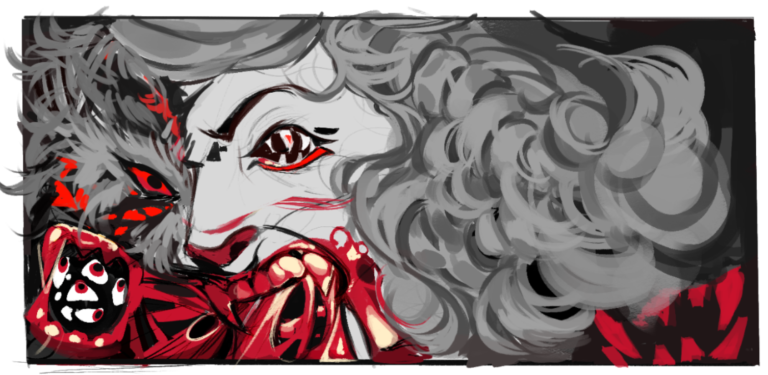
Give me your heart.
I barrel into Juniper, my full weight shoving her to the ground, jaws snapping at her neck, wolf’s teeth digging deep into her throat. When I pull my head back most of her windpipe comes with it, her furiously-pumping blood squirting across the ground. Her free hand grasps at her neck, touching only hot liquid, sticky veins and pulsing meat. I pull out her slippery intestine and feed the long gray tube into my mouth, the dark venous blood of her thighs oozing into a slow-spreading pool.
Give me your heart.
Where does love end and hunger begin? I have never known how to draw that line. I always want more—more closeness, more proof, more of her. I want to take in everything she is, chew through distance and doubt and leave nothing between us but the fact of my teeth.
It is the old greed, the oldest one: a plateful of stars, the urge to swallow what gods do to you before it swallows you first. To devour the very thing that ruins the faithful and the faithless alike and call it communion.
I reach into Juniper’s chest and give her heart a comforting touch, but she doesn’t want comfort. Her heart is still warm, still beating. It looks like a fruit, a wise, ripe cherry, a ruby dripping blood, dripping with kindness. I sever the veins and arteries with a claw and lift the muscle into the moonlight, still-pounding, gleaming as I bite deep into its naked fiber.
Give me your heart.
Not as a surgeon, not as a saint, but as what I am: wolf, end of the story, first question. The rhythm that belonged to her spills into me, a hot, aching echo. I raise what I’ve stolen to the moonlight in my mind’s eye, see it gleam, feel my teeth sink through its brightness.
This is what Death requires of love: that you admit the wanting, that you admit the cost. I have always danced with Death; to love like this is just another step in the same choreography.
My heart is a lonely hunter. When it finds something worth hunting, it never pretends it came only to watch.
4 responses to “iii.) i’m drowning here on solid ground / i’ll step lightly lest I grow tired of the search for the cure for apathy, was it her?”
The ghastly descriptions of Isleen had me hooked ( and feeling somewhat uncomfortable ) oh my goodness! Absolutely loved what she did to the drunken bastards. They have to be some of the best you’ve written! Wren’s fondness of Isleen was a nice stark contrast to her interactions with Kohana in the previous chapter.
My Thots…. i think what I really like about this chapter in terms of improvement is youre using your physicality more. I always thought you had a very good grasp on physical movement and adding weight to gestures but it was sorely underused in the past so im happy to see it happen more with the drunkards and Wren. I think its very difficult to convey weight in writing and how people move so i think thats def a really sharp tool in your arsenal i want to see even more of.
Another improvement is you’re scene setting more which is Great and I Want To See More. A/0 has such rich lore and world building that I like descriptors that sink your teeth more into the world and what’s happening there.
Also your descriptions for Isleen are so good and albeit a little nauseating and gorey which is GOOD because that’s what you’re going for. You’re going for making your readers feel squicked out with Isleen’s brutality and the gore. Your handle on grotesque imagery is Really Good and I was uncomfortable at many parts HDHSJDUD WHICH LIKE I SAID is really good because you want those kinds of reactions for your readers.
An Isleen POV is definitely interesting because with the other draft, I got the impression Isleen didn’t feel the same magnetism towards Kohana that she felt for her so it’s interesting to see that isnt the case, it’s just that Isleen processes it differently.
I’m def curious about your approach for the chapters though like do you intend on having each of Kohanas team have their own pov before coming together with Masae included, or are you more focused on Kohana’s inner inner circle like Hiroyuki and Isleen.
I think I remember commenting on a previous chapter where I spoke about how much I liked Wren’s dialogue; her presence alone something that I enjoy. It’s great to see her interactions with not only Kohana, but with Isleen now — a character that has eluded me for some time so I am thankful this chapter exists.
The horror surrounding Isleen’s being is explained so effortlessly here, and yet the secrets around her remain, as if we’ll never truly know what her form is capable of — as is the nature of eldritch beings in their entirety. I like how her character is the perfect ‘tone-setter’. I enjoy the nightmarish quality of her drive, her thoughts, her subsequent actions and the ones she dreams of making and it does make me fear for Kohana’s safety!
This is probably one of my favourite passages in the chapter:
“I am old beyond time, older than oceans, an inimitable and ineffable force, once dead, revived. No matter how sick, how cornered, how alone, afraid, or weakened, the She-Wolf continues. I would run towards her with a bounding stride even with two broken legs.”
I think this alone tells me what type of being Isleen is. Her drive and conviction something to be feared and remembered.
I really love this chapter, I kept reading it over and over and over again it’s so good???
I think it was satisfying seeing isleen attack those assholes but also I just love how wren is so fond of isleen, sort of like a mother & child or a mentor and student?? Wren is still one of my favorite characters and I’m excited to see more, (I hope she shows up to masae next aaa)