Alpha’s throne room floats between tide and law, an island that dreams itself a palace and nearly convinces the sea.
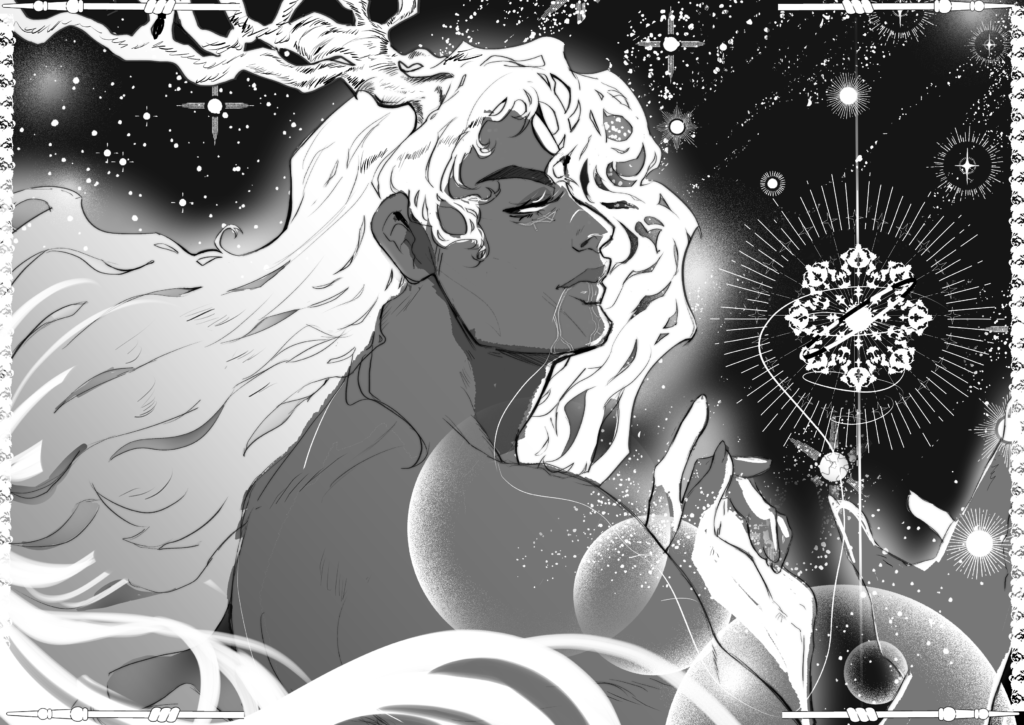
Light lifts off the lagoon and fractures against pillars the colour of bleached bone. Fronds embroider wind into the high blue. Underfoot, a mosaic of green seaglass and volcanic gold remembers fire the way old warriors remember dancing. Spray drifts in from the reef in chastened gusts. Incense braids lime with smoke, a ritual of cleanness he requires because the world refuses to arrive washed. His antlers catch the breeze the way rigging takes a gale, a cathedral of living crownwork sifting the air for obedience. He stands bare-throated, wrist-deep in briefings, attempting to convince paper it can hold a tide.
The tide arrives wearing bells.
Minor, nearly polite, their rhythm skewed just enough to make the room’s good sense itch. A smile precedes the name, then the name arrives in pink and milk and a robe with the nerve to be modest and indecent at once. Clotho, hair in spun-sugar cataracts, sherbet curls cradling glossy ram horns, crescent eyes lacquer-pink, ankles tattling their off-time. Her rose-gold halos spin at the soft balls of her bare feet, twin gyroscopes of sugarfire whose hum settles into teeth and ribs; little crescent eyes along the rims open together, counting the room’s breaths. Her palms are empty in the way that promises gifts.
Alpha does not stand. Composure is a philosophy he authored for exactly this corridor of time. Sun-bright gold rests in his gaze, the burnished gleam of coin fresh from the mint. His attention remains on the page. The page longs to be sky. His staring pins it to paper again.
“Life,” he says.
“My oldest mistake,” she answers, delighted to be introduced by the word she came to topple. ‘Mistake’ lands like a diagnosis delivered with honey on the rim.
Two attendants bow low and slip from the room like water draining from a basin. The doors consider closing and decide voyeurism is a vocation.
Clotho drifts along the green mosaic like a leaf caught in a breeze. Her halos brush dust from her path. She trails her fingers an inch above the inlaid waves, teasing the floor from bragging.
“I’ve brought a weather report,” she says lightly. “Storms in the prison. Chance of coherence.”
Alpha’s eyes lift from the briefings. Burnished gold burns behind the antler-shadow. The change is small, the way a horizon alters when a ship disappears behind it.
“Speak plainly,” he says, cruel in its way, the demand that a playwright deliver minutes.
“I am.” Her smile slides into place with artisan care, a curvature set with intention, a sheath finding its blade. The teeth show by design, demonstration rather than joy, a flash that reminds the room she could bite and choose where. “I went into your bad sky. The one under the world. The one you misnamed a solution.”
He says nothing. Silence was his first language and remains his sharpest instrument.
Clotho turns once. The spin checks the axis and dares it to argue. “I met your brother,” she singsongs, because the word tastes forbidden and she enjoys the flavour. “He is very beautiful when he is ruined. You arranged it.”
“He is dead,” Alpha says, level as the shelf where he sets his crown when the tide dares to be beautiful.
Her bells confess. “He has been dying very well for a very long time. The grammar differs.”
The room breathes wrong and corrects itself. Heat climbs a pillar a finger-width. Out beyond the colonnade, the reef hisses like a jaw remembering work.
Clotho leans over the carved rain basin where he lets weather learn manners before it becomes water fit for a god. Her reflection smiles with more hunger than the original allows. “The prison,” she goes on, tone like a gossip bringing fruit, “is a mechanism that eats endings and forgets to swallow. It chews and calls the chewing a hymn. Very devout.”
“And yet you walked in.”
“I am very devout,” she replies sweetly. “To myself.”
He rises because rising is a courtesy he withholds from fear. Shadow spreads over the mosaic; the room shifts its weight toward him, eager to be correct. His antlers crown and keel him in the same breath. “What do you want?”
“To gossip,” she says, bright as a confection, and then she slips a blade inside the sugar. “And to bring you news you will pretend tastes wrong.”
She steps nearer, close enough that festival milk sweetens the incense into an argument, far enough that the guards keep their hands. When she lowers her voice, the quiet serves theatre, not secrecy. “Atropa went to him,” she says. “She kissed him.”
No thunder. No roar. A single blink—how empires collapse in private.
Clotho studies the blink with a priest’s dread at a miracle. “She didn’t choose my technique,” she murmurs, mock-confiding. “I’d have used applause and silk and mess. She is a judge. She used verdict and Shadow and a mouth that knows the difference between pity and law.”
“Choose your words,” Alpha says. Each syllable presses flat like a blade laid on a table before the cutting begins. Air tightens first; the tide draws back from shore to listen for its sentence.
“I am. Deliciously.” She does not flinch. “She kissed coherence into him.”
A gull slips through the colonnade, reconsiders this weather, veers hard left, and flees.
“You lie,” Alpha says. The objection settles into place inside him like a figure entered in a ledger, recorded because the ritual demands it, even while the calculation refuses to close.
Clotho’s smile turns professional. “I could bring you his voice,” she says lightly. “Proof is loud. I prefer elegance. You’ll accept quieter evidence.”
He refuses the word proof; refusing keeps the need unrecorded. “How.”
“Very prettily,” she says, bright with the terrible kindness of accuracy. “She lifted his name out of machinery and set it on its feet. She rewrote the interface between body and sentence. She took a ruin and gave it grammar.” One finger taps her lower lip, composing a menu. “The rite read as liturgy done with a mouth.”
His jaw stays stone. Tendons stand along his throat like cords pulled tight. Outside, the ocean gathers a taller breath and lays it down with a soldier’s obedience.
Clotho strolls to a pillar where vines attempt taste. Her gaze climbs the fluting. “He spoke,” she offers, triumphant as a midwife with a cry. “First time in forever. A syllable as rebellion.”
“Which.”
One sound leaves him. The throne considers what furniture means.
She bares pearls tinted bruise-pink. “Yes,” she says. “Exactly that one.”
The answer falls between them like a coin laid down to settle a divine wager. Alpha’s hand closes on nothing and makes it law. Clotho’s ankle bells slip one beat further wrong; they enjoy family stories.
“You cannot be here,” he says softly. “Permission was never given.”
“I’m not in your house,” she replies, luminous with mischief. “I’m in your weather. It likes me better.” She lets it dangle, then sugars the hook. “Besides, you adore me. I bring you news you can practise hating.”
He steps off the dais. The mosaic performs the illusion that it was designed for this footprint. “Say your purpose and go.”
Clotho turns kindness over in her hands like a prop, choosing cruelty instead, delivered with impeccable manners. “My purpose, Great Antlered One, is to tell you the endless corridor you’ve been mopping intends to grow doors. Your brother has remembered thresholds. Maintenance will pout.”
His laugh carries the taste of brine. “You want me to fear a word.”
“I want you to fear accuracy.” She leans on the basin and lets physics indulge her. “You like wars the way you like gardens—contained. Your war just learned vowels.”
He is closer. Proximity converts to orbit without petition. “What are you selling, Life.”
“Only a forecast,” she says, palms up, then betrays herself with delight. “And a sample.”
Silence arrives with such force that the birds on the far reef redraw their map.
She opens her hand.
A small square, sealed like a reliquary; glass that prefers to be water, banded in modest metal. Inside: a drop crossed between light and milk. It glows the way forgiveness glows when it shops for someone to choose. Pink beyond childishness; holy without pretence. The sight hums in the throat.
Alpha holds his ground. The room tightens around him, waiting.
“What?” he asks, though the bones already hate knowing.
“An essay,” Clotho says. “On mercy.”
He waits.
“Holy,” she purrs, turning confession into scandal. “Distilled. Cooperative. Eager to be helpful. It can teach your house new shapes. Give your armies better hymns. Persuade your tides to heed applause instead of the moon.”
“No.”
“You haven’t heard the price.”
“No.”
“You don’t have to pay it yet,” she croons, magnanimity in ribbons. “Touch the future.”
He studies the square the way he studies storms he cannot afford to enjoy. “Take it and go.”
“Don’t you want to know the thing it already knows?” Her bells go briefly ecstatic. “It knows his voice. That first word is a seed. I could water it. I could make you a garden of the things he will say.”
His antlers carve sunlight into delicate segments. Temper follows the laws he compels it to remember.
“Do not say his name,” he says, a request so dangerous the air kneels.
Clotho blinks once, almost chaste. For a moment she looks her age, too old to be forgiven, too young to quit.
“I don’t need to,” she says. “You’re the one hearing it.”
They stand while the island performs obedience. The lagoon brightens in flattery. A gecko risks the plaster and decides complicity is beneath it. The throne keeps its dignity.
She slides the little square shut with a sound like a secret choosing its next owner. She sets it on the stone table among his maps; it reads wrong there, domestic, like a candied cherry laid on a grave.
“You could take it,” she says gently. “Outgrow yourself. Force the sky to call you merciful and mean it. Or leave it there and pretend curiosity never visited.”
He says nothing. The silence reads like a confession.
“Curiosity is a porch,” she says, hearing the unsaid with the clarity birds grant climate. “A house intends guests.” She steps back with courtly exactness. “I’ll bring better weather next time. A wind in a useful key. A rumour with bite. A recipe for thresholds.”
“Do not return,” Alpha says, and prayer hides inside the sentence.
Clotho bows to the precise angle that flatters and insults simultaneously. “I never leave,” she assures, shamelessly. “I am seasonal.”
She crosses for the colonnade, trailing sugar lightning and dangerous cheer. At the lip of shade she glances back—pearls, pinkness, the theatrical mercy of someone who never performs an encore because she never leaves the stage. “Oh,” she adds, remembering the inexpensive gift. “Congratulations.”
He withholds the dignity of a question. She answers anyway, kindness drawn thin and edged.
“On the first word,” she says, and is gone—ankle bells dissolving into surf, rose-gold halos whispering the mosaic clean where she passed.
The room resumes its masquerade: cathedral rehearsing island.
Alpha stands in the drafted aftermath and lets the wind salt his antlers like rigging after a hard run. He ignores the square. He refuses even the courtesy of a glance. Storms have worn his name as a uniform; he once trusted a held line to teach the future fatigue.
The square waits exactly where a palm would fit.
A gull tries the colonnade, thinks better of it, and veers out to where the lagoon practises obedience. Briefings on the table remember their function and attempt urgency. None of it persuades the breath he has chosen to stretch beyond its allotment.
He reaches.
His hand hovers. The glass keeps its clarity. No fog, no warmth. Inside, the drop swells in a way that belongs to memory more than matter—a recollection discovering its recital changed. The pink carries the exact pride of a mouth that has mastered its first clean syllable.
His fist closes an inch above temptation. The body records a decision too small for archives: not yet.
He withdraws.
“Guard,” he says, and the room—so pleased to pretend intimacy—stiffens through other men. A figure fills the threshold with sea-salt discipline and polite weaponry. “No one touches the table,” Alpha says without looking. “No catalogue. If it moves, the ocean will reclaim this hall, and I will decline to intervene.”
“Understood,” says the guard, voice filed in the drawer where mistakes stop breeding.
Alone again—correctly accompanied by anger, weather, and the faithful superstition that corridors can stretch forever.
He turns from the square the way a man turns from a cliff that insists on honesty. Outside, the reef performs: white froth trying on crowns, blue polishing itself to a better blue. Far below the world, inside the bad sky he named solution, a voice he refuses to host rehearses a second word.
He sets both hands on the rail of the open colonnade and lets the sea lift its salt into his mouth. The taste predates policy. His eyes close and remain closed long enough to prove obedience belongs to him first.
The bells have gone. The rumour remains. The throne room waits for its master to decide whether mercy suits a hand accustomed to verdicts.
· · ─ ·✶· ─ · ·
The chamber chooses restraint. Coral limestone drinks heat, black-teak shutters comb the sea-light into obedient bands, and a single ceiling fan turns with the patience of a judge. The air smells of bruised lime and rain still deciding to exist. Between two low tables, a stone bowl draws tidewater up through porous rock, then returns it. He prefers this room when choices deserve silence more than applause.
Clotho is already inside, bare feet cooling themselves on stone, revolving slowly while reading austerity like sheet music. The ankle bells rest; her halos idle in small, contented orbits above her toes. Gone is the robe. Today she wears a slip the colour of pomegranate flesh and the moral certainty of a saint who collects blades. Sherbet curls cradle pearled ram-horns; the crescent eyes along her rings drowse and then open, an audit disguised as adoration.
“You pretend you don’t perform,” she says, still studying the walls. “So you built a stage that scolds the audience.”
He closes the door with an unadorned motion. “You asked for privacy,” he says. “Use it.”
“I asked,” she agrees, turning at last. “You want it. Restraint lives on your skin. The ocean smells it the way lightning does.”
He declines to reply. The fan clicks once every third turn. They share the long span of a breath repeated.
She pads to the tide bowl, crouches, delighted that the water recognises her face. “I will be kind,” she announces, with the bright sincerity of someone who finds kindness entertaining. “No riddles. No lullabies. Only facts.”
“You promised that in the hall,” Alpha answers, voice steady as surf under cloud. “Then you turned coherence into a parable.”
“Only because the plainness fits you too well.” She dips two fingers and draws a salt circle on stone. The ring glitters, then darkens. “Atropa kissed your brother into a shape that answers to himself.”
His posture holds. Beautiful men have trained worse news into bone. “You offered that line already.”
“Then take a different one.” Her brightness rings like prize bells. “She is teaching him letters.”
His silence curates outrage, choosing which fragment deserves to live. “Explain.”
“Language first,” she says, thrilled to be useful. “Names next. He mouths ‘no,’ ‘mine,’ ‘enough,’ and the words linger long enough to mean.” A corner of her mouth lifts. “He writes them in my dust. I make an excellent chalkboard.”
“Your dust.”
“The dark between ideas.” She flicks the wet from her fingers; a narrow crescent dries toward nothing. “He draws half moons and antlers and the ambition of a spine. He writes ‘stop’ and then does—first time in ten thousand eons—because he can hear himself obey.”
“That work does not belong to you.”
“Of course,” she says, shamelessly. “I’m the messenger who enjoys the mess.”
He tilts a shutter slat. Afternoon pours itself into a stiletto and lays across his cheekbone. “Letters don’t equal an army.”
“They are what armies follow.”
The slat drops. “You came to taunt.”
“I came with your next right decision,” she corrects, academic by choice. “You excel at those when you quit pretending you invented mercy.”
His breath shortens by a grain. “Name it.”
“A sacrament.” She rises from the bowl and steps closer, her toe leaving a wet punctuation mark. “Holy.”
His almost-smile carries no tenderness. “You’ve poured that for every god with a stage.”
“Jealous?” Her crescent eyes laugh. “Practicality suits you better.”
“True,” he says, and the word carries a threat’s weight.
“Then be practical.” She counts on small, stubborn fingers. “Atropa placed Shadow in him—Umbra for edges, Penumbra for passing, Antumbra to keep the halo when distance steals shade. It fits. He wears boundaries handsomely. Balance suggests itself.” A wag of her finger stops short of his chest. “Holy upon you. Holy beneath you. Holy through your city until worship learns a curb.”
The chamber senses him decide to remain still. “Holy flatters itself as a gift and behaves like a trap.”
Her smile narrows to accuracy. “Conditions make traps. Appetite makes tools.” A tilt of the head. “Here is the warning: your people will obey in foolish places and grow brave where ceremony once sufficed. Your voice will widen. You have the spine for volume.”
His jaw performs a motion sculptors lie about capturing. “Price.”
“Nothing today.” Sugar sweetens to rust. “Later, I may ask you to attend a performance. You will decline. I will forgive you. Then I will arrive in a better dress and ask again.”
He studies her like an equation that refuses balance on principle. “Why tell me of Atropa and Omega at all? If you intend to sell power, ignorance fattens the bid.”
Her smile edges animal. “You carry anger handsomely when trimmed to the bone.”
The fan clicks: one, two, three.
He turns away, walks two paces, stops. “What else.”
Her soft clap celebrates the question. “He isn’t naked in the old sense anymore,” she says, noting the change the way sailors note wind. “Atropa asked if he wanted garments. He didn’t grasp the offer. She taught him the shape of choice. He said ‘for now, no,’ and the ‘now’ fit inside his mouth like a key.”
Charm fails to move his shoulders. “He will weaponise whatever he learns to love.”
“Every child graduates to that truth,” Clotho says, palms open. “You know the curriculum. You put him in Nox Obscūrus and called it kindness because the alternative looked worse on your desk. He made religion from edges anyway.”
He refuses her choreography by not stepping. “Do not interpret my decisions.”
“The First War already has an opinion.” Her tone turns almost bored, a calculation by other means. “Your soldiers mend a leaking roof forever. They mop eternity so beaches behave. They die in tidy rows, convinced the ocean respects the list.” A beat. “Maintenance suits you.”
His smile becomes steel left under moonlight. “Vandalism wears your perfume and calls itself art.”
Her eyes brighten. “Warming nicely.”
“Further yet.” His voice softens, and the room understands escalation. “Purpose.”
“Purpose,” she repeats, obedient as a jest. “Frame this: Atropa named the prison. Names invent doors. Nox Obscūrus learned room from throat. He stands and remains standing. He chooses. Choice outperforms any weapon you’ve forged.”
He absorbs the punch and breathes like a man who declines to stagger. “Comfort, then?”
“Delight,” she says, honest for once. “Two gods acquiring new nouns. Eternity owes me entertainment.”
Silence reclaims the corners. The fan ticks. The tide bowl exhales. Salt dries into a pale ring around her circle. When he speaks, he returns to the table without yielding ground. “A question.”
Clotho’s smile brightens. “Ask.”
“If I take Holy and dislike what it makes of me, how costly is the refund?”
Her laugh drops like a bell down a well. “Exorbitant,” she says cheerfully. “Cheaper than being out-sung.”
“And if I refuse.”
She lifts one shoulder, almost human. “Then you call Kohana like a king who knows his house. She walks your balcony and requires a decision you can live inside. She asks whether you intend to govern worship or chase it with a broom. The question offends and delights in equal measure. You ask her anyway.”
He confirms nothing. It isn’t required.
“Alpha,” she says—his name a caress that thinks it’s a splinter—“I’m not here to win. I’m here to arrange your next problem until it pleases the eye.”
“Leave my chamber,” he says, so calmly the shutters settle.
Clotho beams. “With pleasure.” Two steps to the door; a pause for manners. “One last fact you don’t need.” Her head tilts; the smile turns sly. “He smiles now. A useful smile, the kind that knows itself.”
His stare sterilises the air.
“Don’t worry,” she purrs. “He remains kind.” A half-bow, insolent as mercy. “Do something interesting with that.”
She exits to music only she enjoys. The latch whispers shut.
The room exhales, the way a body does after holding itself rigid too long. The fan ticks. The tide bowl remembers its job. Alpha holds still inside a quiet that refuses flattery and practices ignoring the question suspended in salt.
Indecision remains by design. He opens a shutter to the glare and lets the day argue. Light testifies; stone cools.
At last, he touches the rim of the tide bowl. Fingers come away wet. He rubs the water into his palm, studying a sacrament’s grain before naming it. The fan clicks once more, a metronome set to patience.
Kohana remains unsummoned.
For now.
· · ─ ·✶· ─ · ·
The private doors sigh, and the ocean enters first—salt on the tongue, wind combed through warm fronds, a horizon drawn sharp enough to shave reflection. The balcony curves like a black crescent cupping a sapphire throat. Below, reefs glow with the slow respiration of patient lungs; above, clouds arrange themselves in the tidy arrogance of kingdoms that have never been conquered.
Alpha stands with his back to the chamber, his face to the weather. The antlers are unadorned—no votives, no ribbons, no trophies of faith—only the raw cathedral of bone and genesis, catching sea light along each branching statute. His shoulders gleam where sunlight petitions for entry and earns only tolerance.
“Say it once,” he says, low. “Clean.”
Clotho obliges. She does not sit, does not sway. She walks to the rail with the accuracy of someone deciding where to drop a match in a drought.
“Atropa is teaching your brother to read,” she purrs, voice sugared to scandal. “Letters first, then law. He has learned to hold still long enough for meaning to arrive. He has learned the weight of a page. He asked what his name should be. She told him he may choose. Isn’t that kind?”
The wind loses interest in movement. Somewhere beyond the reef, a ray breaks the surface, gleams once, and slides back into secrecy. Alpha’s hands tighten on the rail. The stone survives. His profile maintains tectonic composure, mercy nowhere to be found.
“You said this already,” he says. “Twice.”
“I said it gently.” The bells at her ankle argue in minor time. “You prefer bitterness. Very well. Atropa kissed coherence into him. He speaks in whole thoughts now. He wants. He wants her to stay. She stays.”
A wave rises taller than its kin, breaks itself in apology. Alpha’s jaw resets, an empire restoring equilibrium.
“And you,” he says, “want me to drink you.”
Clotho smiles, real sugar, real poison. “We keep circling that glass.”
“You bring it to my mouth.”
“Because you are dying of thirst.” She leans upon the rail, robe a white jest in the tropical blaze, hair a sherbet tempest that should disobey the wind but never does. Her halos spin idly above her feet, shedding motes of patient gold. “Your planet sings itself back into shape after every flood, but the singer grows hoarse. Your armies replace themselves and call it tradition. Your Diamandis wears the future like armour; your Sunday mistakes penance for courage; your Abaddon drags himself home from being theatre. You are the eldest law in a house that has learned to mishear you. Drink. It is only holiness.”
He turns. The turn is astronomical. His shadow crosses her like a precise eclipse. “You would love me better obedient.”
Her laughter is a lattice of bells and breath. “No, Alpha. I would love you louder.”
The wind shuffles its audience of palms. Far below, parrotfish gnaw coral like critics.
He steps closer. “Speak clearly.” His tone holds the red filament of temper drawn too fine to burn.
“Gladly.” The playfulness drains; the smile remains, untouched by its absence. “Atropa has made your twin an author. He edits the First War. His Shadows obey her grammar. You can fight coherence for another ten millennia with swords and pledges, or accept the instrument that lets you conduct the room. Take my Holy. You will not be Atropa. You will be inevitable.”
He studies her from horns to ankle bells in one long verdict. “Your Holy is a leash. Its velvet fools only the desperate.”
“Every tool leashes pandemonium,” she says, honeyed to sin. “Ask your bridges. Ask your calendars.”
“You are neither,” he replies. “You are hunger wearing festival silk.”
Something bright flickers in her pupils, pleasure thin as lightning. “Oh, that voice. I wondered when you’d remember how to use it.”
He lets the flirtation pass like surf sliding off stone. “What does it cost?”
“My love,” she says easily. “The last honest currency.”
“Your love is a format,” he answers. “It files conditions under beauty.” He spreads his fingers on the railing as though counting the centuries the sea owes him. “Name them.”
She shapes the truth and tastes it before releasing it. “You will not undo Omega’s coherence. You will not carve Atropa from his sentence. You will leash your Executioner’s zeal before she amputates what refuses your heraldry. You will stop defining mercy as something that salutes.”
“Ah,” he murmurs, naming a wound rather than answering it.
“And,” she continues, voice cooling into sugar glass, “you will stop looking at the girl with scissors for a soul as though sovereignty required her approval. She is a seamstress, not a sanction. I decree this; I wrote the looms that tangle empires.”
The balcony hears that line and holds its breath. Alpha’s gaze fixes on the horizon.
“Kohana,” he says, and the name steadies him.
“She is efficient,” Clotho admits. “She is also alone.” She balances her hand mid-air as if weighing a coin. “You are a king. Kings may borrow hands. They do not surrender thrones.”
The wind hardens; even the horizon seems to lean forward. Alpha turns his face fully, gold eyes deepening to stormlit amber. “Your jurisdiction ends at my door. Past this threshold, there is no law but mine.”
“That’s the point,” she says, delighted. “Redraw the door.”
His laugh is handsome and humourless, salt tasting itself. “You scaled my balcony to critique carpentry?”
“I scaled your balcony to ask if you enjoy being predictable.” She straightens; the robe loses its comedy and becomes a costume again. “Atropa, who knows where to spend her knives, has chosen Omega. The First Universe will learn grammar. You will answer with endurance disguised as faith. That is a schedule. Take the Holy. Break the schedule.”
He should not step closer. He does. The air changes allegiance. “And become yours.”
“And become legible,” she says.
The word draws blood. His temper exhales, slow and painstaking.
“Legibility is for ledgers,” he says. “I am the ocean that drowns them.”
“Then drown something.” Her patience shatters cleanly. “Drown a habit. Drown a century. Drown the vanity that calls itself restraint. Take the gift.” The bells rattle once, then still, ashamed of candour.
He moves, no strike, no bluff, the wrong distance for mortals. His antlers rim her curls in a deliberate eclipse. His voice lands between their mouths.
“You came to tell me a woman who is not you placed her mouth upon my brother and taught him breath,” he says, almost conversational. “You came to sell a correction labelled a miracle. You came to call my restraint cowardice because restraint denies you applause.”
His hands drop. The sea mirrors the gesture, retreating and returning, guilty for hesitating. “You want a confession? Very well. Atropa does not rule me, but I orbit her gravity. She stands near enough to the principle that I measure myself against her. She will not move for your theatre. If I take your Holy, I am not larger, I am pink.” The smile he shows is anatomy, not joy. “And pink is your language for ownership.”
Her lashes lower, a deliberate curtain. “You insult beautifully,” she says. “I would paint you if eternity stopped fidgeting.”
He takes the bait and tears it quietly. “You are the most dangerous ignored.”
They look at each other until the light decides to turn gold. Somewhere in another century, a whale coughs.
Clotho turns first, feigning admiration for the horizon. When she speaks, the sugar has burned off. “Do you know why Atropa chose him?”
“Because she does not fear harm,” he says.
“Because he is kind,” she corrects, and the word tolls like a cathedral bell. “Because even in ruin, even as a choir of deaths, he left galaxies with better names for grief than you give the ones you save. Atropa recognised workmanship. She corrected it. That is what you oppose—her accuracy, not my vanity.”
The sea grips the balcony and shakes once. Alpha does not sway, but something in him lists a degree. “Kindness,” he repeats, tasting it as if it were a mineral he has never mined.
Clotho watches the crack open and declines to celebrate. “Take the Holy,” she says softly, almost coaxing. “Not because it is mine, but because it fits the wound. Don’t marry me. Borrow me.”
He closes his eyes once. When they reopen, fury has cooled. “No.”
The refusal is clean enough to sting. She accepts it, nods once, lets the bells rest.
“Then ask your Summoner whether that refusal is courage or fashion,” she says, placing Kohana’s name on the table like a coin. “She will know. She usually cuts.”
“She will not tell you what I choose.”
“I don’t need her to,” Clotho replies. “I only need her to tell you.”
They stand in the golden overlap of their shadows, breathing the same salt, neither granting the moment peace. Clotho’s gaze flickers toward the inner doors—the path to counsel dressed as friendship—and returns. She is not subtle.
“Last offer,” she says, bright again. The bells resume their off-beat gossip. “One draught. Let it rest on your tongue. If you hate it, spit. If you love it, do something interesting.”
Alpha’s answer arrives gentler than wrath and therefore more final. “Leave my house.”
Her bow is perfect and irreverent. “Gladly. The view improves at the next catastrophe.” She pivots, sunlight devouring her pink until it glows white. At the threshold, she glances back, smile skewed toward respect that has not yet learned humility. “When you decide to be larger, call me. I adore scale.”
He denies her the last word. The ocean grants it instead: a single wave rises, considers applause, thinks better of it, and sits back down.
When she is gone, the balcony exhales like a stage after the curtain. Alpha remains at the rail until gold ripens into apricot. The tea in his chamber cools; the guards practice respect by way of absence; the palms fall quiet, waiting for a ruling.
He touches the lowest tine of an antler, testing the integrity of a decree. The island answers, solid and obedient; for the first time since Clotho said kiss, it fails to comfort him.
He turns inward.
“Summon the General,” he says to no one and to every listening stone. The order ripples outward: through corridors that know his tread, through courtyards learning silence again, across the lattice connecting palace to port. Somewhere, a messenger bows to empty air and runs. Somewhere else, a door opens before its handle can be grasped.
Alpha pauses beneath the arch, palm on cold stone like a benediction withheld. He does not look back at the sea.
“I will not be pink,” he says to the dark that recognises him. Then, softer, for no god’s ear: “I will not be predictable.”
The balcony holds its breath over a patient ocean. Far away, in a world still convinced miracles are polite, a woman with scissors for a soul feels an old weather shift and begins walking.
· · ─ ·✶· ─ · ·
All afternoon, the lagoon keeps its surface steady, the water stretched wide in patient attention. Sunlight combs the water into long glass syllables; each breath of wind edits, then leaves the sentence kinder than before. Nothing speaks in words, yet the reef remembers a conversation overhead and begins to practice consonants the way anemones practice colour.
Coral heads, those patient mathematicians, pulse in new tempos—three beats, a held shimmer, then another three—an arithmetic that gathers behind the teeth of the tide. Parrotfish graze in cursive. They shave the limestone alphabet into powder and exhale chalk that drifts across the blue. A crown-of-thorns star moves its spinous skirts, and the whole world decides that bristling means understanding. Farther out, where the lagoon grades to the reef’s abrupt grammar, a stand of staghorn turns its tines a shade deeper, blushing under the idea of being read.
The island listens, a conch pressed to its own ear. Palms murmur over the colonnade—silver underside, green confession—and choose a slower choreography, leaf to leaf, rehearsing the cadence of “enough.” Sandbars lengthen by a patient finger-width, then shorten, practising “stop” and “start” the way children test the doorbells of strangers.
A school of needlefish stitches itself into a quick seam and unseams; the seam repeats three times, leaving a thin echo of light, chalk lingering on a board long after the lesson. Half the lagoon turns softer for a moment, rose tint in the shallows, the colour of a mouth proud of saying its first word without flinching. The blush withdraws before anyone can accuse it of sentiment, yet a handful of hermit crabs carry the tint off in their shells. That is how rumours learn to walk.
On the blackstone quay, a child finds shells that hum. The vibration presses against the skin of the palm, the way bees write the day into air. First, she lifts a cowrie—smooth as a promise—and it shakes the smallest vowel into her wrist. Then a scallop half, pinked by the blush the lagoon could not quite hide, whispers a round sound that settles in the mouth as “oh,” warm from rock and sun. She tries to echo it. The echo fails beautifully, which is the correct way to begin learning. Her grandmother pretends not to notice the practice and adjusts a basket so that three more humming shells fall in on purpose.
A heron stalks the margin between knowing and hunger. Each step measures the shore’s sentence: clause, comma, swallow. The bird pauses when a ribbon of anchovies turns from silver to script—tight loop, narrow flourish—and a single anchovy breaks rank to sketch a curve in the shape of an antler tine. The water remembers whose shadow taught it the trick of law.
Under the outer ledge, where blue cools to indigo and the reef’s attention deepens, a giant clam cracks its painted mouth and flexes the velour of its siphon. The pattern on its mantle—electric maze, church windows soldered in sapphire—slides one panel to the left. A new panel arrives; it is memory agreeing to repeat a shape. The clam does not know letters. It knows consent. Today consent tastes like iron under sugar, a sacrament diluted to something a throat can bear.
Waves shoulder into their work, arrive, fold, and withdraw as they always have, yet each folding leaves behind one extra line of white fringe lace and then erases it attentively. The etiquette of apology receives embroidery. Spray leaps in priestly commas. A crown of spray hangs, trembles, resolves into ordinary salt, and then considers the experiment again four waves later, because curiosity is the reef’s religion.
The smell changes so slowly that even the pelicans refuse to admit it. Lime smoke thins to leave room for a new resin, the sweetness of milk warmed near sunlight. Somewhere in the market, a confiseur pauses mid-swirl. Her syrup wants a drop of rose. She adds the rose and thinks of a mouth she has never kissed.
Down among the table corals, the damselfish fight their tiny wars with corrected bravado. Territory still matters. Territory always matters. Today, the borders glow a fraction less crude. Where one damselfish retreats, the other opens a lane rather than a wound. No one taught them this. The lagoon taught them this by dreaming.
A turtle lifts its head into air that tastes newly exact and closes its lids for a blink that lasts the length of a promise. The turtle knows tides as arithmetic, not metaphor. Even so, when it drops, the fall slows by a breath; the water cups rather than collides. Shadows under the turtle flex and braid—the soft science of Penumbra practised by sand—and the turtle coasts through a room instead of throat.
The reef’s small engines pick up the motif. A brittle star unlatches from its dark and walks in five-rayed dialect across a field of polyps that bow yet remain open. A nursery of pipefish turns their snouts toward the pass and draws a thin line on the water; the horizon becomes a ruler rather than a rumour. In the seagrass, a barracuda discovers, with some insult, that it can choose not to lunge. Choice surprises predators first. Prey recognised the miracle long ago.
Above, a boy on a raft pushes a stick against the bottom and feels the stick answer back: this is seabed, not sponge. His mother calls. The call travels the shape of the bay and returns to her mouth with fewer barbs. She pauses, hearing herself improved. Later, she will tell a friend she slept without clenching. She will not claim a theology. She will bake bread, and the crust will sound correct when she asks it to break.
On the long rib of the reef where fishermen argue tide tables with the patience of civil servants, a man with hands netted by old work lifts his head. He has not heard bells today, only the wrong rhythm they leave behind. He tells the sea what he always tells it—that he will take what he needs and return what he can—and the sea, which enjoys being addressed by people who admit scale, flicks a shoal closer. He will call it luck. The lagoon will not mind the misname; luck is one of its favourite aliases when gifts would embarrass mortals.
For a single beat longer than a beat should be, the whole system seems to inhale. Fan corals flatten their lace beneath a careful ledger. An octopus spreads itself thin to study the signature of the sand and then gathers, deciding that study is affection. Even the algae shift their green tone toward orchard, a bruise healing in public. The pause turns the pass into a tuning fork. A ripple runs out along the reef wall and continues into the open blue where nobody owns a fence. Pelagic fish feel it, dim their scales, and agree to be less brilliant for one hour.
At the far lip of the atoll, just beyond where most maps stop trying, a whale rolls sideways to look at the weather. It has been alive for so many alphabets that it no longer collects them. Still, the eye holds its dark with the care of a librarian handling a first edition. The whale buries its call and sends a smaller note instead, one that slips through the reef without frightening the damselfish into thinking history is arriving. The note feels like a shelf being dusted. Old things wake carefully. Dust performs most of the work.
When twilight begins to lace itself into the mangroves, the blush returns. The pink does not stain this time; it hovers above the shallows, then decides to belong to the shells. Children gather the shells without being told why. Their pockets fill with vowels. Their pockets make new sounds when they run.
The island keeps its counsel. Night approaches with its usual grammar: frogs, mosquito stitching, the creak of palm sheaths reconsidering their angles. Lamps climb alive along the colonnade, and somewhere inside the palace an order travels through sleep like an oar through dark water. None of that belongs to the reef in the owning sense. Yet the reef keeps a quiet copy: not the words, the rhythm. It holds the rhythm beneath the tide’s tongue and lets it dissolve.
By full dark, the lagoon glows where it always has, algae asking stars whether imitation flatters. Tonight, the glow writes itself a fraction steadier. The letters remain illegible to anyone who insists on letters, yet a few grandmothers, standing ankle-deep at the edge to cool their long day, nod to each other in the way of women who have outlived several governments. Something has adjusted. Not a law. A lens.
Before sleep, the child with the humming shells stashes them in a bowl beside her bed. She does not know that one shell sings at a slightly different pitch than it did at noon. She will notice in a week, when her own voice catches up with the change. For now, she dreams of an alphabet that tastes like salt and sugar and the inside of a lime. In the dream, she is very small and someone very large writes the sea on her palm, letter by letter, until her skin remembers the shape of mercy and refuses to forget.
Out past the reef, where blue becomes idea, the swell lifts and lowers. It carries the day’s rumour toward distances that will never admit to hearing it. That is the lagoon’s favourite trick. Tell a secret lavishly to the whole horizon and trust the horizon to pretend it was absent. The rumour is not a word, not yet. It carries the shape of a word learning to keep time.
· · ─ ·✶· ─ · ·
The order leaves the throne room before the sound of Alpha’s voice finishes its last vibration against the stone. It travels not as speech but as a shift in the air, pressure thickening, salt rearranging itself, a temperature that means move. The house receives the command the way coral receives light, porous and immediate.
In the outer corridors, where walls are veined with sea-glass conduits, gold filaments brighten one by one, carrying meaning faster than breath. The message divides itself politely—one thread for the palace, one for the barracks, one for the harbour, one for whatever listens beneath language. Summon the General.
The courtyards sense purpose and dress accordingly. Sand smooths itself flat. Palms quiet their leaves so nothing competes with the march of air. Attendants crossing the bridges feel the pulse in the soles of their feet and forget their errands. The tide lifts higher along the quay, listening.
By the western gate, where armourers oil the hinges of peace in case it rusts, a runner bows to the invisible. He does not wait for the rest of the sentence. His feet know which corridors belong to orders. He runs.
His shadow precedes him, thin, gold-edged, and exact. The courtyards bloom in his wake with petals of light that fold again when he passes. In the kitchens, fire behaves for the length of a single ladle-stir. In the aviary, messenger birds wake, then settle, uncertain whether this command belongs to wings or hooves.
The runner crosses the library colonnade where books keep their spines polite beneath a long row of lamps. Every third lamp bows as he goes. When he reaches the fountain, the jet lowers so the echo can travel clearly. The words strike marble and rebound through the palace aqueducts until even the rain gutters repeat them. Summon the General.
The clerks in the Hall of Obedience receive the echo next. They are pale men with hands inked in sea-salt sigils, and they write faster than guilt. Their quills sing the phrase onto vellum, each stroke thrumming the floor beneath their desks. The scrolls will not need to travel; the writing itself travels. Each completed character detaches and flies—a luminous glyph, weightless as foam—vanishing through shutters and across courtyards to find its rank.
In the barracks below, soldiers straighten mid-meal. The air around them condenses, heavier by one intention. Cups lower. Conversation halts with the sound of obedience remembering its lines.
Somewhere in the west wing, a captain lays a hand on the hilt of a ceremonial blade and feels it warm beneath the skin, a quiet confirmation that the god of this island still dictates grammar to metal. He does not draw it. He bows.
Through the palace’s east cloister, another envoy walks instead of runs. Her sandals click in rhythm with the golden pulse underfoot. When she reaches the seawall, she whispers the order to the tide. The tide nods, as tides do, and tucks the syllables under its arm for delivery.
Farther inland, where the city begins—white terraces, mosaics arranged by tradition, smoke written into the air like handwriting—the order is already a rumour. Marketwomen look up from their stalls as if a large bird just passed overhead. Children pause mid-play. Even the coins in the fishermen’s palms cool a fraction, as though the metal itself wants to listen.
The rumour reaches the harbour last. Ships tilt slightly toward shore, their rigging attentive. A man splicing rope mutters the words without knowing why, and a knot forms itself correctly the first time in his life. He takes this as luck. The sea prefers not to correct him.
Within an hour, the entire island breathes in the same measure. The rhythm is older than the throne but loyal to it: inhale for command, exhale for compliance. The runners return by different paths, hearts still hot, shadows thinner. They do not speak. Orders carry their own gravity; anything said afterwards sounds like an apology.
In the evening, when lamps climb up the walls again and the reef’s pink memory glows faintly through the windows, a few servants pause at their tasks. They feel the day’s pulse still moving through the stones and think of storms that travel without rain. None of them saw the god who gave the order. That is correct. Seeing him would only confuse the chain of command.
They leave a cup of saltwater on the lowest step before sleep, a small courtesy between house and ocean. In the cup, the reflection of the lamp shivers, divides into three ripples, then stills—a word bowing to grammar. The air keeps its new heaviness. Somewhere in the far hall, parchment sighs as another quill lays down the same phrase once more, just to be sure it exists:
Summon the General.
· · ─ ·✶· ─ · ·
Nox Obscūrus thinks slowly tonight.
It always possessed a mind of sorts—stone tends toward reflection when left alone long enough—but the vast chamber has developed a deeper patience since Omega learned to stand inside it without tearing the walls apart. The antimatter ribs that arch across the vault have adjusted their resonance to accommodate his breathing; their long metallic curves vibrate with a tone lower than thunder, a register so heavy the sound travels through bone before it reaches the ear. Chains descend between them in careful intervals, each length of impossible alloy droning with its own fraction of a chord. None of the notes agree on whether they belong to a hymn or an apology.
Omega stands where the floor’s geometry softens around him.
Light gathers there, a brightness that behaves the way tidewater behaves when it remembers warmth from a long afternoon of sun. The glow pools around his waist and drifts upward along his torso in thin vertical currents. When he shifts his weight, the currents lean with him, reluctant to break contact. The light has learned his outline. It treats the body as shoreline.
He studies his hands with grave concentration.
They no longer frighten him. That achievement alone required centuries of quiet argument with the prison’s physics. Once the fingers opened and closed only in violence—gravity collapsing through knuckle and bone, pressure gathering where intention failed to exist. Now the hands move with a slower authority.
The garment Atropa coaxed into existence clings along his hips and ribs, a thin dusk-coloured weave grown from the first clear decision he ever managed to hold steady: I would like something between my skin and the air. The cloth responded with enthusiasm. It threads itself across his body in soft bands that tighten or loosen depending on the rhythm of his breathing. The fabric does not conceal him so much as listen to him. Each shift of muscle sends faint geometries drifting away from his shoulders, pale equations that hang briefly in the air before dissolving back into the prison’s dark.
Atropa watches from the edge of the radius where Omega’s gravity stops rewriting mathematics.
She sits cross-legged against one of the lower pillars, her back resting against the cold alloy ribs of the vault. Shadow coils along her spine and pools across the floor beside her like a large, patient animal that has learned the virtue of waiting. Every now and then the darkness flicks its tail against the stone, testing the prison’s tolerance for movement.
In her lap rests the mirror.
The disk came from the prison itself. Atropa cut a circle from one of the abandoned ribs—the metal that used to carry Omega’s older restraints—and polished it until the surface abandoned any loyalty to simple reflection. The mirror prefers interpretation. Faces appear there in fragments first: an eye without a brow, a mouth that cannot decide which direction to speak, a throat divided between breath and silence. Eventually, the fragments cohere.
Omega gazes into the mirror now. The surface reflects him twice. One version observes the other.
They have been quiet for a long time.
Above them—beyond stone, beyond the black pressure of the ocean, beyond the long corridors of the palace—the island has shifted in response to something its god said aloud. That shift travels through the planet’s osteology in slow waves. Here in Nox Obscūrus, the vibration arrives as a tremor beneath Omega’s feet.
Omega notices.
His head tilts slightly, the motion precise enough to stir the light around his shoulders.
“Something moved,” he says.
The sentence leaves him carefully. The sound travels outward through the chamber and meets the architecture waiting for it. The antimatter ribs above them absorb the vibration first, their long metallic arcs trembling in narrow sympathy before releasing the echo back into the vault a fraction slower. Chains suspended between the ribs shiver along their length, each link producing a thin harmonic that slips into the air and dissolves against the stone. The prison listens the way deep water listens to falling rain.
Atropa lifts her head.
Her Shadow gathers along her shoulders, drawing tighter against her spine. The mirror in her lap brightens faintly as a distant disturbance travels through the prison’s ribs. Atropa’s thumb pauses against the alloy rim.
“Alpha refused Clotho’s Holy,” she says, the smallest lift of her brow acknowledging his bravery or lackthereof. Her thumb traces a slow circle along the rim of the disk. “I would have been disappointed if he hadn’t.”
Omega’s eyes rise from the mirror.
The movement is subtle yet deliberate, a motion that would once have shattered the atmosphere in the room. Now, the gesture passes through the chamber with a restraint that the prison has come to rely on. The dusk-colored garment draped over his shoulders tightens slightly, its weave accommodating the shift in the muscle beneath it.
“Refused,” he repeats. The word rests between them. Above their heads, the chains alter their chord by the smallest interval. Metal registers the change in meaning before the air does. “He dislikes gifts.”
“At times,” Atropa answers.
Omega lowers himself beside her.
The motion demands attention. The prison’s gravity still leaves his mass uncertain, so Omega negotiates the descent carefully to prevent the floor from buckling under the weight of the conversation. When he crouches, the light around him spills outward, a pale tide flowing across the stone. The brightness extends to the edge of Atropa’s Shadow and touches it. The contact sharpens the darkness immediately; Shadow gathers itself into a cleaner outline, its edges flashing briefly with silver.
Omega rests his hands on his knees and looks into the mirror again, watching the two versions of his reflection attempt agreement.
“Up there, he treats refusal like a lever.” His fingers press lightly into the stone as the thought settles. “He believes if he pushes the world the other way, the current will remember a different direction.”
The disk’s surface reacts instantly.
Omega’s reflection divides along a faint seam of light. One version of his mouth speaks the sentence with quiet authority; the other shapes the same words more slowly, tasting each syllable before allowing it to exist.
Atropa watches both reflections with quiet interest, her gaze moving between them the way a mathematician studies two proofs arriving at the same answer by different routes.
“The river rarely consults belief,” she says.
“Yet it changes anyway,” he replies, nodding once. The movement disturbs the light gathered around his legs, pale brightness spreading outward across the floor in slow rings before drawing back again.
Omega watches the rings fade into the stone.
“On Alpha’s planet,” he says after a moment, “who decides when the river turns?”
Atropa’s fingers shift along the rim of the mirror.
The alloy warms beneath her touch. She tilts the disk slightly so the light gathering around Omega spills across its surface.
“Kohana Ohuang-Zhùróng,” Atropa murmurs.
The name alters the chamber.
The antimatter ribs vibrate along their entire span, a long metallic breath moving through the architecture. The chains answer with a subtler harmony, their links tapping gently together as though acknowledging the weight of the syllables. Even the light pooled around Omega’s legs tightens for a moment, drawn inward by the gravity of the word.
Omega considers the name carefully.
The mirror offers him three possible reflections and waits for him to choose which one to inhabit.
“Who is she?”
Atropa watches the mirror’s surface shift as the prison struggles to interpret what it has been asked to reveal. For a brief moment, the disk shows a balcony high above the ocean, wind tugging at a black turtleneck and loose sleeve, the figure braced on the rail with the steady calm of someone built to survive storms.
Then the image dissolves.
“A woman who carries the authority to end things,” Atropa says. The mirror’s pale glow slips across her cheekbones as she speaks, catching briefly in her eyes. Her Shadow coils once around her wrist, a slow tightening that suggests the word end has its own gravity. “And the discipline to decide when not to.”
“Does she enjoy the responsibility?” he asks.
Atropa’s Shadow tightens another fraction along her wrist, the darkness drawing closer to bone.
“Enjoyment rarely enters the equation,” she says. Her fingers move once along the mirror’s rim, the alloy answering with a faint warmth. “She carries it because someone must.”
Omega nods again.
The motion sends a ripple through the faint light gathered around his shoulders. The garment woven from his first act of choice tightens faintly across his ribs, listening to the change in breath.
“That sounds difficult.”
“It costs.”
The mirror brightens faintly between them, its surface rearranging the reflections it holds. Omega’s face appears there in quiet fragments—one image leaning closer to the disk, another standing farther back in the silver depths with an expression the first has not yet learned to make.
Omega studies the reflection carefully.
Before the eye can settle, the older version of his face gazes back at him with patient approval.
“You said I could choose a name,” he says.
Atropa’s fingertips pause at the mirror’s rim.
“You may.”
Omega lowers his gaze again and traces the edge of the disk with one finger. The motion sends a thin circle of light across the alloy surface, the reflection trembling as though the metal has begun to listen.
“I am considering one.”
Atropa tilts her head slightly.
“What does it mean.”
Omega watches the light drifting around his arms. The glow moves slowly through the chamber, climbing the lines of his forearms and dissolving into the dark above his shoulders.
“Return.”
The word enters the chamber and refuses to leave.
It spreads through the vault the way tidewater spreads through stone, slipping between the ribs of the prison and settling into the long metal bones that hold the ceiling aloft. The antimatter arcs receive the sound and pass it along their length in patient intervals.
Atropa breathes out slowly.
“That is a dangerous promise.”
Omega nods.
“I prefer dangerous promises.”
The mirror shifts once more.
Omega’s reflection gathers itself into a single face again, the faintest curve appearing at the corner of his mouth—as though the older version of him has decided to lend the younger one a moment of confidence.
The word return lingers in the chamber. It moves along the ribs of the vault, slides across the chains, and settles into the mirror’s quiet metal.
Revenire.
Revenire.
Revenire.
Atropa does not interrupt the reverberation. She lets the word exhaust itself against the architecture. Patience has become her most reliable instrument here.
When the last resonance fades, she finally speaks.
“Names that promise return tend to carry a second meaning,” she says, her fingers still resting against the mirror’s rim. “They suggest someone left.”
Omega tilts his head.
“That seems logical.”
“Logic rarely comforts the people waiting.”
The mirror brightens faintly between them.
Omega studies the disk again, watching the surface attempt to reconcile two reflections at once. One version of him crouches beside Atropa with a scholar’s concentration; the other version stands somewhere deeper inside the glass, older and more composed, observing the first with faint amusement.
He lifts his hand toward the surface.
“Kohana,” he says.
The name enters the mirror like a stone entering water.
The disk reacts immediately.
Light skims across the alloy in thin, expanding circles. The reflections fragment, then reorganise themselves around a new geometry. Atropa’s face slides aside. Omega’s dissolves into streaks of pale silver.
A different image begins assembling itself in the centre of the disk.
The prison does not possess a perfect understanding of the world above. It reconstructs information through pressure and vibration, the long grammar of gravity travelling through stone and sea. The result arrives incomplete.
Even so, the mirror offers something.
A balcony appears first.
The structure grows slowly from the mirror’s surface: carved railings, the edge of white stone polished by centuries of salt wind, banners lifting and settling against a sky the prison can only approximate. The colour of the sky wavers between pale gold and deep cobalt as the disk struggles to decide which hour of the day it has captured.
Then the figure emerges.
Kohana stands with her back to the ocean.
The mirror cannot fully contain her scale. The image shifts several times before settling on a version the prison can tolerate—tall, broad-shouldered, her stance grounded with the unshakeable patience of someone who has learned to carry destructive power without letting it devour her spine.
Her hair moves first.
Dark strands lift in the wind, streaked with a purple tone that the mirror renders imperfectly, translating the colour through several shades of metal before landing somewhere near twilight. The movement of the strands creates small distortions in the air around her, as though space itself hesitates to brush too close.
The antlers rise behind her.
They are not decorative.
The mirror struggles to display them at all. Each tine fractures the reflection into separate shards of light, as though the geometry of the antlers refuses the prison’s attempt at replication.
Omega leans closer.
The glow surrounding him spreads across the floor until it touches the base of the mirror.
“Kohana,” he says again, quieter.
The reflection responds.
Kohana turns slightly on the balcony.
Her profile emerges from the disk: high cheekbones, a firm jawline, and a calm concentration on her lips. Her pupils appear narrow and vertical, a detail that the mirror reflects with unusual clarity. Even through the distortion of distance, her gaze carries a quiet ferocity. Omega watches the image with complete attention.
“She carries endings,” he murmurs.
Atropa nods. “She carries time.”
Atropa does not say the sentence quickly. The words leave her mouth with the careful cadence of someone placing weight on a scale. As she speaks, her fingers shift along the rim of the mirror, the polished alloy warming faintly beneath her touch. The Shadow gathered around her shoulders lengthens across the floor, its edges adjusting to the light pooled around Omega’s knees.
The mirror responds to the name.
The surface bends, brightens, then opens a little wider.
The balcony sharpens inside the disk. Behind Kohana, the sea stretches outward in long metallic planes, sunlight breaking itself into restless shards across the water. Wind travels through her hair, lifting dark strands streaked with purple until the colour glances briefly toward twilight.
Omega studies the woman’s posture with grave attention.
“She looks tired.”
Atropa’s gaze slides toward the disk.
Her mouth curves slightly, almost forming a smile. Something deeper than amusement touches her expression. “Yes,” she says.
Omega tilts his head.
“Does the world require her to end many things?”
Atropa exhales through her nose. The breath stirs a loose strand of hair against her cheek.
“As often as endings are required,” she says. The words leave her almost gently. The antimatter ribs take it up a moment later, passing the sound along their length until the entire vault holds the answer.
“Does she wish to?” he asks.
Atropa does not answer immediately.
She studies the reflection carefully: the way Kohana rests her weight against the balcony rail, the quiet stability in her shoulders, the discipline holding her spine upright even while fatigue presses along the line of her back. Atropa’s Shadow coils lazily around her wrist.
“Kohana wishes many things,” she says at last, her voice carrying a faint thread of fondness. “Ending the world rarely appears among them.”
Omega nods slowly.
“Then the world is fortunate.”
The mirror brightens again as the prison attempts to maintain the image.
Kohana shifts on the balcony. One hand rests on the railing, fingers curling around the carved stone. The movement draws a clean line of strength through her shoulders; she plants her feet, weight evenly balanced as if the entire horizon is there for her to observe.
Omega’s reflection in the mirror watches her reflection.
The disk renders the moment twice: one Omega leaning closer with quiet fascination, the other standing slightly farther back, observing the observer.
“I recognise the shape of her burden,” he says.
Atropa’s Shadow tightens subtly around her wrist, the darkness drawing inward, attentive. Her mouth tilts. “You would recognise her,” she allows. “You are built from neighbouring problems. How to carry the authority to end a world,” she continues, her fingers resting lightly against the rim of the mirror, “without letting the ending take the rest of you with it.”
Omega turns his attention back to the mirror.
The balcony dissolves even as he watches. The prison’s attention wanders easily; maintaining images from the First World requires effort it rarely feels inclined to spend.
The sea breaks first. Silver streaks tear across the disk where the waves had been. Kohana’s outline fractures next, the reflection sliding apart into narrow planes of light before collapsing back into plain metal.
The mirror returns to its old habit of uncertain reflection. Omega remains crouched beside Atropa for several seconds after the image disappears.
“I would like to meet her.” The sentence settles into the chamber. The antimatter ribs above carry the sound along their length before returning it to the floor in a thinner echo.
Atropa’s mouth lifts slightly this time, the smile small and private. Her Shadow loosens around her wrist, the darkness easing outward.
“Recognition has a habit of arranging introductions,” she murmurs.
Omega studies the mirror a moment longer. The disk offers him a face that has begun to resemble intention.
“That encounter would clarify several things.”
Atropa’s fingers follow the rim of the alloy circle, tracing a shallow groove worn smooth by long use.
“It will disturb several things,” she says quietly.
Omega inclines his head once, the movement sending a slow ripple through the light pooled around his legs.
“Disturbance often produces information.”
The smile at the corner of Atropa’s mouth deepens by a fraction.
“Then you and Kohana will find one another extremely educational.”
The remark settles into the chamber, and the prison takes a moment to understand it.
The light gathered around Omega loosens, returning to its slow circulation across the stone. Above them, the antimatter ribs resume their constant resonance, a long metallic tone travelling the length of the vault.
Omega remains crouched beside the mirror while the disk offers him a patient reflection.
For the first time since he learned to stand inside the chamber without tearing its physics apart, the vault grants him a little more room.
Atropa notices. Her Shadow shifts along her wrist.
Neither of them comments.
Somewhere within the architecture, the word return continues its quiet passage through ribs and chains, moving through the prison’s structure with unhurried persistence.
Far above the chamber, the world continues arranging the circumstances required for an introduction.