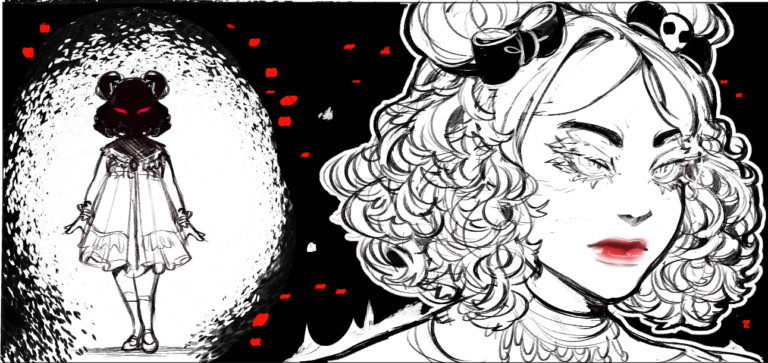
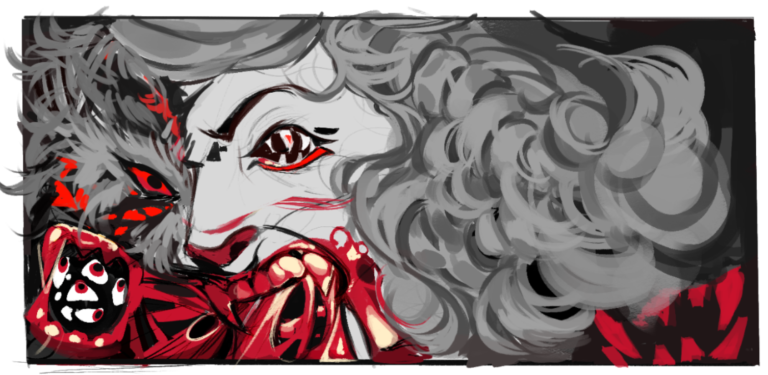
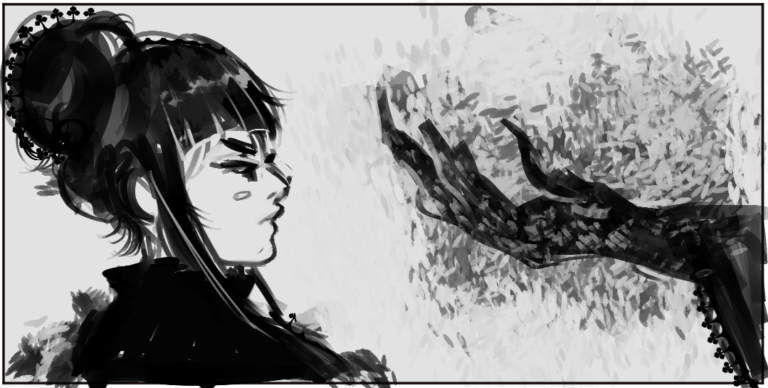
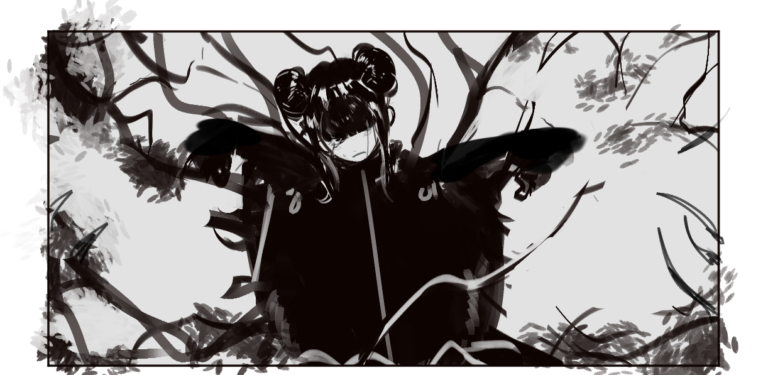
By mid-morning, the banners have gone back to being scenery. WELCOME still yells in bold capitals from the far wall, but now it’s just the backdrop for a folding table that’s been dragged out of storage and bribed into acting official. Somebody has thrown a blue plastic cloth over it, creases still sharp from the packet, and the cartoon otters printed along the hem keep offering their paws to no one.
Juice cartons crowd the near edge in lopsided phalanxes: apple, orange, grape, truce-sweet and sweating. A sign-in sheet lies on a clipboard, corners already softening. Permission slips sag in a plastic tray. Pens huddle in a Styrofoam cup, tips stained from sitting in the same sticky ring of leaked juice. The air has picked up a new note under the usual school smell, faint and metallic.
I’m halfway through counting exits again when I see what the PTA has built their little customs desk under.
Not the WELCOME sign. The thing above it.
Stapled dead centre to the cinderblock, edges too crisp for anything that’s lived in this hallway, hangs a poster I watched Wren rip down two weeks ago.
FIELD TRIP—FERRY CROSSING.
New staples bite clean into the wall, four neat mouths and no scar tissue. The edges of the paper are crisp, no thumb-creases, no sun-fade. The ink looks as fresh as the day some office desktop spat it out, except the office printer died before I ever transferred here, and the font in the date stamp has never lived in this building.
The date reads TODAY.
The minute stays sheathed. My hand remembers the weight of it automatically, thumb wanting the familiar orbit over the tiny engraved numbers on the pocket watch under my blazer, but I keep it away. I let my fingers worry the slick edge of a permission slip instead, feel the drag of ballpoint grooves, the press of someone else’s signature.
Parents shuffle forward in little waves: sweater vests, winter coats, perfume that means office jobs and late-night emails. Kids orbit them, miraculously horizontal for once, backpacks slung, sneakers squeaking on waxed floor. A juice cart rattles past, plastic wheels complaining. Someone farther down the hall laughs at something that probably isn’t funny.
It looks like a weekday morning.
It feels like the hallway is holding its breath.
I scan exits the way Hiroyuki taught me: mark the main doors, the side doors, the stupid little custodial closet that keeps wanting to turn itself into an oubliette. Two double doors to the breezeway, one at each end of the hall. Fire doors halfway down, chained open with a rubber stop. Windows out to the parking lot, glass reinforced with that wire grid I hate because it always looks like the school expects impact.
Drains: one in each bathroom, one in the custodial closet, two in the multipurpose room, none visible out here. Railings: low and sensible along the ramp to the breezeway; they used to hum wrong until Isleen had a conversation with them. Today they seem quiet. I make myself catalogue the ordinary, even as my eye keeps sliding back to the poster.
Same cartoon ferry as before. Same row of kids in matching life vests, same teacher waving from the dock with a clipboard. The water underneath has that generic blue that never met an actual body of anything. Only the date is different.
And the font.
The office owns fonts that sigh. Garamond, Times, Arial, the tired cousins of bureaucracy. This date is printed in a crisp little sans that belongs on airport gates and departure boards, not attendance slips. Letters are all straight-backed and sure of themselves: T O D A Y.
The paper behind them feels thicker than it should. My teeth itch.
“Summoner.”
Isleen’s voice lands next to my shoulder like a folded note. I turn. She stands half a step behind me, as always, as if any room might decide it needs an axis and she is on call to supply one. Beige cardigan, sensible flats, her hair up in a bun that looks like the world’s tidiest storm front. Clipboard to her chest, pen already squared along its top edge.
She follows my gaze to the poster, tilting her head the smallest degree. The overhead lights catch on her glasses, admin light—the colour of forms stamped APPROVED.
“We’re early enough,” she says. “Let’s remind things.”
She steps past me toward the breezeway doors. On anyone else it would be nothing, just a guidance counsellor doing a room check. On her, the air pays attention.
She lays her hand flat against one metal bar.
“Hold,” she murmurs.
The door shivers once, like a horse feeling the halter, then settles in its frame. The slight give I have learned to hate disappears. Hinges square themselves. Rubber kickguard presses fully to the tile. The gap at the bottom takes a breath and closes.
She walks to the opposite door, fingers trailing along the railing as if she is checking for dust.
“Behave.”
The main hinge at the top of that door gives a little squeak, then quiets. The door swings once, forward and back, finding a middle, then rests exactly on the centre stop. The glass in the upper window stops wanting to rattle.
Isleen looks up, tracking the duct that runs the length of the hall. The good bell’s note lives in there now, the single rung from assembly that Hiroyuki coaxed into place to keep geometry from improvising its own exit strategies.
She touches the wall under the vent with her knuckles.
“Admit.”
The vent louvres ease a fraction wider. Somewhere in the metal, a small, kind note wakes up and sits down, like someone taking their assigned seat at a table that otherwise might have overturned. I can feel it in my jaw more than hear it, a tiny hum in the bones.
“Should stay a school,” she says, mostly to herself.
“We can only hope,” I answer.
Behind us, the PTA table woman laughs too loudly at some dad’s joke. Paper cups clack together. Someone opens a juice carton, and there’s a little rip of cardboard, the soft suck as the foil seal gives.
I check the sink in the staff bathroom off the main hall almost on autopilot, crooking my head in as we pass. Faucet: still metal, still a faucet, not a mouth. Mirror: reflects me, Isleen, the fluorescent lights, the crooked motivational poster about teamwork, nothing else. Drain: just a circle, no teeth, no desire.
The poster in the hallway watches my reflection go by in its glass.
Hiroyuki appears at the far end of the corridor. His coat is dark, his knee-length gold hair pulled back in a low tail that still swings almost to his knees, his expression calm in the particular way that means he has completely lost patience with something but will only admit it under oath. A stack of pamphlets sits under his arm, each one perfectly squared. Behind him, the main office door stands open to the sound of phones ringing, printers grinding, and a secretary trying to help three parents at once.
He sees the crowd bottleneck forming in front of the PTA table in a single glance.
“Good morning,” he says to the parents, already stepping into the flow. The tone is soft, the kind people obey without thinking. “If you are here for ferry slips, form a line along the lockers. If you are here for anything else, this way.”
He reaches without looking and nudges one trash bin two inches left, another three inches right, narrowing the central aisle just enough that the bodies have to stream where he needs them. Parents in office-visit clothes drift obediently into the space he roughs in. A dad in a reflective work jacket finds himself angled naturally toward the attendance window instead of the ferry forms. A mom with three kids and a bakery box ends up with that box resting safely on a flat portion of the counter instead of the edge.
Hiroyuki shifts one PTA chair a fraction backwards so the line curves instead of blocking the exit. It looks like nothing. It turns the hall from a cluster into a channel.
“Stand here, please,” he tells a tall mom in a camel coat, touching the floor tile with a fingertip. “Thank you. And here.” He places another parent opposite, a human pylon. “Perfect. You’re banks now.”
She laughs, thinking it’s a joke. Her teenager rolls his eyes. They stay exactly where he’s put them.
I breathe a little easier. Corridors hate blanks. Give them a path, and they might accept it instead of making their own.
Wren is already at the bulletin board.
They stand on the low wooden bench someone dragged in for decoration at the start of the year, camera in one hand, a palmful of thumbtacks in the other. Their hair is in its usual mess, a streak of pink catching the overhead light, ID badge tucked into their shirt pocket instead of dangling—a quiet refusal to give lanyards any extra swing to play with.
“What did we say about antiques?” I call.
“You said sentimental, I said haunted, we both compromised,” Wren answers without turning. Their voice has that medium register they use when they’re pretending they slept. “Look.”
They lift the camera, squint through the viewfinder, and snap a picture of the blank space above the ferry poster. The device whirs, little gears chattering, and spits out a white-framed rectangle. Wren shakes it once, only because the kids watching from below expect that motion, then pins it above FIELD TRIP—FERRY CROSSING.
The photo hasn’t developed yet. It hangs up there blank, an empty room hovering over fake water.
Wren takes a pencil from behind their ear and, with neat block letters, writes along the white border:
THIS STAYS A HOUSE.
The graphite looks almost too dark, like it borrowed heft from ink.
“Receipt,” they say.
“Might be premature,” I respond.
“Receipts are supposed to be early.” They finally glance over at me, mouth twitching. “We can always write a refund.”
Kids have started to cluster near the table, dragging their parents in their wake.
“Are we going to the harbour now?” a little girl asks her mother, barely above knee height, hair in two different braids that argue with each other.
“Field trip’s not until Friday, sweetheart,” the mom says, distracted, already reaching for a pen. “And it’s a ferry, not a harbour.”
“The harbour’s where the boat lives,” the girl insists. “We’re going to the boat’s house.”
Another kid down the line tugs their dad’s sleeve. “Do we get to see the harbour too, or just the water?” he asks. “I want to see where the ships sleep.”
The dad blinks. “Who told you that word, captain?”
“It feels right,” the kid answers, shrugging.
Behind the table, the guidance counsellor in charge of logistics—Mr. Ortiz, kind eyes, terrible ties—has his hand on the sign-in sheet. He writes BUS LISTS at the top, pauses, frowns, and looks closer.
The S’s both try to turn into H’s.
He scratches out BUS and writes it again. The U fattens, wants to open at the bottom, wants to become ER. His pen keeps catching halfway through each letter, as though the ink cartridge thinks it has moved to a new word without informing the rest of the device. B–U–S limps into existence, wrong joints in the strokes.
He stares at it like the paper personally offended him.
“Long morning already?” I ask, stepping close enough to see.
“The pen’s being cute,” he says, forcing a laugh. “I keep wanting to write bird lists. Brain’s on spring migration,” he jokes, because the alternative is stranger.
I look down. The B is fine. The U and S carry the faint ghost of an E and R under them, thin graphite-colored afterimages. BERTH LISTS, almost.
I press my thumb over the word once, like smoothing a wrinkle from a shirt. The wrong letters fade, but slowly, as if dragged.
“My tongue tastes rope,” Juniper says quietly, the voice sliding up from the part of my memory where the catechisms live. If a door is going to pretend to be a river, we will name children like buoys.
I swallow. The taste lingers; fibres, salt, the faint bitterness of preserved hemp.
Juniper herself stands halfway down the hallway, near the trophy case, sorting a stack of emergency contact forms into three piles. She’s mortal now, cheeks a little pink from the walk over, hair pulled back with an elastic that has seen better days. She looks up as if she heard herself speak, even though those words stayed behind my teeth.
“You’re chewing the past again,” she says, arching an eyebrow.
“Better than it chewing back,” I answer.
She smiles, small and real, then jerks her chin toward the ferry poster. “I thought we agreed that thing retired.”
“We did,” Wren says from the bench, not looking away from their work.
Juniper makes a noncommittal noise that says she’ll schedule feelings about it later. For now, she tucks a stray form back into the middle stack with brisk fingers. Her hands have always been good at carrying last words; paper must feel light in them.
Behind me, the ferry poster rustles.
Just once. A small, papery shift.
I turn. For a second, I think the fluorescent hum has changed, but no. The image itself has been edited.
The cartoon ferry now has two little rectangles on either side of its printed hull, pale grey ovals that weren’t there before. Handles. Like the cut-outs on a library book cart or a moving box. The kind of handles a human hand could slot into and lift.
The ink has the same flat quality as the rest of the art, but the paper bulges microscopically under each oval, as if someone reinforced those places from behind.
“You’re seeing that, right?” I ask.
Wren hops down, crosses to stand beside me, and squints. “Handles,” they confirm. “Because why shouldn’t a poster be a prop?”
Their hand goes automatically to their pocket where the sticker sheets live, fingers counting the edges, ensuring inventory. Later, they will start affixing PRESENT dots. For now, they just stand there, eyes bright and sharp.
The floor directly under the poster shows a faint line of darker wax, running perpendicular across the tiles. It catches the light whenever anyone moves. Same beige as always, just a shade glossier, as if someone dragged a wet brush along the seam and the school hasn’t dried yet.
I shift my weight. My shoe sole skims over that stripe. For an instant, there is a give where there shouldn’t be any, a soft discrepancy, like stepping on the lid of a closed box left in the middle of the hall.
It passes. Tile again.
“Don’t like that,” I mutter.
“Add it to the list,” Hiroyuki says from behind my shoulder. I hadn’t heard him approach. Of course. The building probably did and came to meet him halfway. “Summoner, stand here, please.”
He taps the floor just off the darker stripe, positioning me between the poster and the PTA table, a human breakwater. When I obey, the crowd flow settles further. Parents edge past on the sides. Children funnel through the middle lane, jolted gently around my presence like water around a rock.
He places one more trash bin with its opening facing away from the darker line. An ordinary bin, full of stacked paper cups and an empty juice carton with a straw crumpled inside. Still, I feel tension ease in the floor, as if the building appreciates the ballast.
“See?” he says under his breath. “Harbour, not carnival.”
I look at the dark stripe again.
It gleams. Just a little. As if something under the wax is remembering how to be wet.
· · ─ ·✶· ─ · ·
The stripe keeps pretending to be nothing.
Kids scuff across it on the way to homeroom, sneakers squeaking, backpack straps slapping, parents bending to kiss foreheads and issue last-minute instructions about lunch money. Every time a sole passes over that darker seam in the wax, the floor winces.
By the time the first bell rings, the stripe has made up its mind.
The colour shifts while I watch, slow enough that no one screaming into their coffee would notice. Beige deepens to a more deliberate tan. The gloss lifts. It looks like someone came through with fresh paint at four in the morning, taped off a neat rectangle from the PTA table to the breezeway doors, and rolled a single even coat of “municipal dock” across the tiles.
There is no smell of paint. There is the smell of river again, stronger now—coins that have been rinsed and stacked in damp hands.
“Is that new?” a dad asks, frowning down at the stripe like it might stain his shoes.
“It’s just wax,” the PTA mom says, the way people talk when they are being paid in volunteer hours and resentment. “The custodians have… a system.”
The stripe runs exactly along the place Hiroyuki has been soft-placing bodies, parent-banks and kid-stream. It is not centred to the hall; it is centred to his idea of a path. That should make me feel better. It doesn’t.
A minute later, the paper arrives.
It comes from the main office as butcher paper usually does: someone feeds a roll through the guillotine-cutter on top of the filing cabinet, drags a long, white tongue of it into the hall, and starts taping it down. The secretary is muttering about “keeping scuffs off the floor” and “PTA will have my head if we scratch their decorations,” more to her own nerves than anyone in particular.
The paper unspools obediently along the stripe.
She tapes the end near the PTA table, then crouches every few tiles to slap more tape down. The sound is familiar: rip, press, palm smoothing. The paper ripples once, twice, then lies flat, a makeshift runner over the freshened paint.
“Gangway,” one of the kids says, delighted.
The secretary laughs, then stops halfway through the sound as if she heard herself and does not remember why it was funny. “It’s just so we don’t ruin the wax, sweetheart,” she says.
The word hangs: wax. The stripe underneath glistens faintly, as though enjoying its new costume.
At the far end of the hall, the small plastic label outside the multipurpose room clicks in its frame.
For weeks, it has said MULTIPURPOSE ROOM in the school’s old, tired font, the one that lives on door placards and standard forms. Even the backing tape had started to curl at the corners.
Now, letter by letter, the word vanishes. Not like someone wiped it; like the plastic decided to forget.
MUL…TI…PURPOSE…ROOM ghosts to blank.
New letters grow in, small and crisp, bright black against white.
EMBARKATION.
Same airport font as the date on the poster. Same sure little strokes, as though built to be read over a crackly intercom.
A teacher walking past pauses, frowns at the sign, then gives her head a little shake and keeps going.
“You saw that,” I say under my breath.
“I’ve been seeing everything all morning,” Wren answers. They have migrated down the wall, laying out more Polaroids—blank for now—in a loose row under their caption. “The corridor’s just being honest about it.”
The air changes before the sound does.
The AC hum has always been a thin, steady thread up near the ceiling, metallic and impersonal. Now there is a second note beneath it, lower, slower, the way the world feels on a ferry docked but idling: an engine’s patience, waiting for a signal.
At first I think it is my own heart, out of step. Then a kid’s juice box straw rattles on the table in a rhythm that isn’t the hall’s. The metal legs of chairs vibrate a hair off-beat from the shiver of the vent. The hum is not quite electricity. It has weight.
Somewhere beyond the walls, gulls call.
Not the city birds that scream over the grocery store parking lot, harsh and opportunistic. These voices are farther out and higher up, that thin, laughing sound that lives over bigger water. The nearest actual harbour is an hour away by car.
The good bell note in the duct keeps its seat, polite and steady. I feel it choose not to interfere. This, it seems to decide, is someone else’s jurisdiction.
The watch behind my blazer burns a slow circle into my sternum. My fingers twitch toward it, then curl into my palm. I’ve been so good all morning. No placements. No pads. No cheating. But the line at the PTA table is growing again, parents two-deep in front of the WELCOME sign, kids weaving under arms and around knees, papers fluttering in the air full of river and diesel and early history lessons.
The hour will bottleneck if I let it.
A soft pad is nothing. Barely even magic. Just a little fold in the minute, like pinning back bangs to keep them out of your eyes.
When the secretary drops her pen for the third time and almost steps sideways off the paper runner, I cave.
I step back, shoulder to cinderblock, as if I need the wall to hold me while I check my pockets. My thumb finds the minute by muscle memory. Cool metal. Familiar etching. I flip it open against the knit of my uniform in a single, tucked motion; anyone watching sees a kid fidgeting with jewellery.
The second hand on the watch sweeps its usual calm orbit. The minute hand points just past the twelve. :24 is a safe hold. A breath and a half. Enough to let people catch up without attracting notice.
“Okay,” I murmur, voiceless. “Just a little.”
I put my thumb on the crystal and press.
Normally, the world responds along the lines you ask: surface tension, a gentler slope to the second. It’s like convincing a room to exhale more slowly. Lights don’t flicker. People don’t freeze. Things simply take their time finding the end of their motion.
This corridor does not exhale.
The watch glass chills under my thumb, then heats up, the way metal does when it has been under friction too long. The second hand jumps once, stutters, and keeps going. Not slower. Sharper. Each tick strikes the back of my teeth like a tap on glass.
My jaw clenches. The diesel hum under the AC hitches, doubles down. For half a breath, the hallway feels shallower, like someone drained an inch of depth from it. The paper runner under the parents’ shoes rustles as if catching a wind that didn’t pass through the air.
My stomach drops. The taste of rope spikes so hard in my mouth that I almost gag.
I yank my hand off the minute. The watch snaps itself shut as if offended. The skin of my thumb bears a faint, reddened circle, an echo of the crystal’s rim.
No one around me freezes. No one moves in dreamy slow motion. Time rejects the tender like a vending machine spitting a wrong coin.
The corridor keeps its own rhythm. The engine hum steadies again. The handles on the ferry poster look, for a heartbeat, more solid.
“Do not do that,” Hiroyuki says.
His voice is low enough that only I and the wall hear it. He is at my other shoulder now, close enough that I can smell coffee and whatever he used to put his hair back this morning. Not cologne. Something clean and simple. It makes my throat hurt.
“I was just—” I start.
“You were just attempting to bribe a mechanism that does not take your currency.” He doesn’t look at me; he’s watching the line, counting heads, mapping flow. “This one is not interested in minutes.”
“What is it interested in?”
He lifts his hand, makes a tiny, almost absent gesture with two fingers. The parents at the front of the line shift half a step; the crowd untangles itself a fraction. “We are going to find out,” he says. Then, a little louder: “Everyone listen, please.”
His tone changes. Not louder. More structural. He steps forward until he stands on the edge of the paper runner, between the PTA table and the beginning of the painted stripe.
“We are going to treat this as a drill,” he announces. “Nothing more, nothing less. Drills keep us practised. Practised people go home on time.”
That gets a few small laughs from parents, the brittle kind people give when they don’t want to admit they’re scared. Kids turn, drawn by the shape of an adult standing like that, hands visible, shoulders relaxed.
Hiroyuki crouches so his eye level is somewhere between the tallest fifth grader and the shortest kindergartener.
“Here is how we will board,” he says. “Name. Hand. Square. Breath.”
He holds up one finger.
“Name. A grown-up says your name. You say your name. We match the sounds. No nicknames unless you tell us them on purpose.” His eyes flick briefly to me, to the sign-in sheet, to the ghost of BERTH under BUS. “Names belong to you here. You will not be given one by accident.”
Second finger.
“Hand. Your grown-up’s hand, or your teacher’s hand, or if you are in the upper grades and too cool to hold hands, you will at least let us tap your shoulder. Skin to skin, or skin to sticker. No one walks the paper alone.”
Third finger.
“Square.” He gestures with his other hand and, without my seeing where it came from, there is a roll of blue painter’s tape in his palm. He tears off a strip, then another, laying them on the runner in a tidy cross, making a small box big enough for two sneakers. “We will mark squares along this path. Your square is where your shoes go when it is your turn. You do not step off until you are asked.”
Fourth finger.
“Breath. We breathe once together in each square before we move the next group. In through the nose, out through the mouth. If you get silly with the breathing, you will still breathe, so I am not concerned, but the point is: we move at the speed of lungs, not panic.”
He stands up, looks at the parents, the teachers, the cluster of PTA volunteers. “Outcomes over spectacle,” he adds, quieter, but it threads through the hall anyway. “Everyone who goes out comes back in. That is the only acceptable story.”
Isleen, who has been half-listening while reviewing the emergency cards with Juniper, closes her eyes for a moment. When she opens them, I feel the hallway accept a new layer of instruction.
Arrows appear.
Not on the floor. Not on the walls. In the mind’s eye: subtle, light as chalk lines on the inside of my skull. Every person in the corridor gains a faint arrow above their head, pointing toward the breezeway doors at the far end. The main double doors glow a fraction clearer in my awareness; the alternate exits blur, the custodial closet door feels heavy and uninterested, the far fire doors taste of stale air and “not now.”
A teacher in a hurry veers instinctively toward the side door to the parking lot, hand going to the bar. She stops a centimetre before touching it, frowns, thinks better of it for reasons she could not articulate, and turns back toward the main flow.
All other doors decide to be staff-only without needing signs. The building withdraws hospitality from those hinges. Handles sit like folded arms.
“Single entrance, single exit,” Isleen says under her breath, a note to herself. “Let it pretend to be a dock. It is still a hallway.”
Wren, bless them, hears “skin to sticker” and is already moving.
They hop off the bench, fish a fat stack of sticker sheets from their pocket, and start peeling. Matte circles, pale yellow, no reflective foil—some instinct in them knows better than to give light more toys. Each circle carries one word in the same blocky handwriting as the Polaroid caption.
PRESENT.
They move down the line, affixing one dot per kid, right where the shoulder seam meets the collar. They don’t ask permission. They tell small jokes: “New fashion line, very exclusive, only for people who exist,” and “Sticker checks the ‘here’ box so you can think about snacks instead.”
Every time the paper presses to cloth, something unsettled tightens, then smooths.
A boy near the middle of the line has that fizz around him, the slight, double blur when he shifts weight, the way his shadow doesn’t quite keep up. Habit of almost-splitting, a corridor’s favourite game: one body where two could be. His hands worry the hem of his hoodie, fingers trying to count themselves.
When Wren steps in front of him, there is a flicker, a half-second in which two mouths are breathing, two sets of eyes blinking, and an almost-twin sliding a half step to the right.
“Hey,” Wren says softly. “You only need to stand here once. Lucky you.”
They press the sticker gently to his hoodie. The glue bites. The second outline loses confidence, folding back into the singular body like a card shuffled firmly into a deck.
The boy’s shoulders drop. His hands find his pockets instead of the hem.
Each dot Wren places dims a little itch I didn’t know I was carrying. The corridor relaxes about numbers as stickers proliferate.
Behind my breastbone, the minute sulks, but the tightness in the air eases.
I am mortal now, Juniper’s thought-scent brushes the back of my neck, as if she has leaned in without moving. A corridor learns manners faster when it hears a yes it can cash.
I look toward her.
She is watching Hiroyuki lay out the next square of tape, lips pressed thin, eyes doing the math the hallway is refusing to show us: number of kids, number of adults, number of seats on the ferry in the poster, number of dots Wren has left on each sheet.
The diesel hum under the AC takes on a new contour. The notional boat settles more fully into the walls.
It isn’t language, exactly. More like the imprint of language, the way a pre-recorded announcement feels right before it plays.
Until arrival, the passengers must remain on board.
Not words. Not sound. Just the weight of that instruction, the expectation of it, lying across the paper runner from the PTA table to the EMBARKATION door. A policy that the corridor has adopted without asking us if we agree.
The gangplank-under-paper flexes under the next pair of sneakers that cross it, not with the give of tile but with the very faint, slow bounce of a wooden plank with water moving underneath. The handles on the ferry poster seem deeper, shadows darker in the cut-outs.
Somewhere under all of this, under the names, under the stickers, under the tape, the corridor holds its hand out.
Attendance, it says, without saying. Names matched to hands. Bodies counted. And one keeper who rides the line all the way across.
The watch under my palm has quieted, but I can feel it listening, the minute hand poised, useless for once.
The aisle is a dock now. It has rules.
We have not yet decided who pays them.
· · ─ ·✶· ─ · ·
The first name is easy.
“Rowan Lee,” a mom at the front of the line says, her touch light between her son’s shoulder blades.
“Rowan Lee,” the boy echoes, voice somewhere between proud and embarrassed.
“Rowan Lee,” Wren repeats, not for the corridor’s benefit but for their own fingers. The silver clicker in their hand—one of those little metal counters you can spin with your thumb—ticks once.
“Square one,” I call.
The bell in the duct gives a small approving hum, a bright overtone through the diesel under-note. The strip of blue tape Hiroyuki laid down waits, two sneaker-sized boxes wide. Rowan steps onto the first square, toes exactly inside the cross. His mom squeezes his shoulder, then lets go.
“Breath,” Hiroyuki says, steady, and four of us inhale on reflex—Rowan, his mom, me, and him. The exhale threads through the duct, weaving around the bell’s note. The corridor listens.
“Next name,” he nods to the PTA volunteer.
“Jasmine Ortiz,” Mr. Ortiz reads from the clipboard, relieved to have something familiar to do. “Jasmine?”
“Jasmine,” a girl in fuzzy unicorn earmuffs pipes up, raising her hand.
“Hand,” Hiroyuki prompts.
Her father—work shirt, oil stains, eyes too tired for this hour—reaches down. She wraps her fingers around two of his and tugs him forward until their shoes touch the edge of the paper.
“Say it together,” I remind them. “So it knows who you are.”
“Jasmine Ortiz,” they say in unison.
Click.
“Square two,” I call.
Jasmine steps into the tape box beside Rowan. Their shoulders almost touch.
“Breath.”
Rowan’s inhale is shaky, Jasmine’s is loud enough to make the parents behind them chuckle. Air goes in. Air goes out. The paper under their shoes dips once, the soft give of a gangplank meeting water, then steadies.
The drains stay asleep.
I can feel them in the bones of the building: little circles of potential in the bathrooms, in the custodial closet, under the kitchen sinks. Sometimes, when geometry goes hungry, they wake and start eyeing feet. Today they snore, soothed by the bell’s good note and whatever quiet thing Isleen told the pipes at dawn.
Name. Hand. Square. Breath.
We settle into cadence.
Parents lean in, say the names they chose in hospital rooms and family kitchens and court offices. Kids echo, some with confidence, some with the small, bewildered awe of hearing themselves treated as cargo worth manifesting correctly. Wren stands by my left shoulder, thumb finding the clicker’s button on each matched pair of syllables.
“Marcus Castillo.”
Click.
“Dani Kim.”
Click.
“Rena Patel.”
Click.
The numbers climb, each tick a tiny anchor thrown into the corridor’s current. Wren’s face has gone still in that way it does when they’re counting for real, the silliness shutting off like a tap. The clicker’s window shows 017, 018, 019, the digits clean and uncompromising.
Once, when a dad stumbles and says his son’s nickname first—“Buddy—uh, Evan Torres”—Wren’s thumb twitches twice too fast. The clicker refuses to accept the extra. The button jams solid under their skin, stuck between positions, until they exhale, whisper “Evan Torres” neatly once, and press again.
“Fine,” Wren mutters at it.
The corridor will not tolerate miscounts. At least we agree on one thing.
I move down the runner in little half-steps, calling out squares as Hiroyuki lays tape.
“Square three. Square four. Square five.” Each cross of blue becomes a temporary station on an invisible route: dock, gangway, deck. Kids ripple forward in four-person clumps, a series of miniature tides.
“Breath,” I say, over and over. “Again. Lungs, not feet. Good.”
The bell harmonises, a faint second above my own voice, smoothing frayed nerves. A few younger kids start matching their inhales to its tone as if this is a game. That’s fine. Games get remembered.
Every so often, a body tries to split.
You can feel it before you see it. A little fuzz around someone’s outline, like heat over asphalt. Their sticker tugs toward the possibility of a second chest. Shadow double-checks the math of one person versus two. The corridor is greedy; it likes contingencies.
A girl in a glitter hoodie—Alana, sticker says PRESENT at her collar—steps into square seven with her mother’s hand in hers. For a blink, there is an echo of another Alana half a step behind, phase-shifted just enough that if I don’t look straight at her, I might swear there were two matching pink shoes and two matching braid-ends.
“Hey,” I say gently. “You’ve got enough of you for one.”
Wren is already there. They press two fingers over the sticker, deliberately, as if stamping a seal. The matte circle warms under their touch. The corridor probes, looking for a foothold, then retreats. The extra braid-ends blur, then vanish.
Alana sticks out her tongue at the empty air, then giggles when she realises she just insulted an invisible hallway. Her mom squeezes her hand.
“Square seven, breathe,” I tell them. They do.
Group after group, the blooming stops when the dots get attention. Each time a bud tries to open, a PRESENT sticker is there: thumbed, patted, reminded. Here-ness over multiplication.
The number on Wren’s clicker climbs past fifty. Parents peel away once their kids have moved through the first squares, hovering at the edge of the crowd instead of hovering on the paper. They watch with the brittle focus of people studying a procedure they will replay in their heads at two in the morning, looking for a step they missed.
“Hey, Kohana!” a too-bright voice calls from near the middle of the line.
Masae waves, her other hand already busy coaching three third graders through a four-count. She stands just off the runner, parallel to the tape boxes, never closer to the gangway than the lockers.
“One, two, three, four,” she chants, a little train of kids picking up the rhythm. “One, two, three, four. Feet together on four, then we scoot.”
“Near, not instead,” I say to her, because that’s the important part.
“I remember,” she says, rolling her eyes in the exact way that means she’s taking it seriously enough to be annoyed. “I’m not touching your corridor. I’m just touching the kids.”
“Thanks,” I say, and mean it.
Her count weaves in and out of Hiroyuki’s cadence, threading through “Name. Hand. Square. Breath.” like percussion. The hall starts to feel less like a potential incident.
“Okay, locomotives, ready?” she tells a cluster of fourth graders. “On my count, you’re going to walk to Kohana one square at a time so she can make sure the hallway doesn’t eat you. One—two—three—four—stop. Now you, your turn.”
They obey, laughing, part of them thinking this is all an elaborate safety theatre for liability’s sake. The corridor hums under the paper, listening to their numbers like offerings.
We hit our first snag on a name.
“Claire Nguyen,” Mr. Ortiz reads, scanning his BUS/BERTH list. “Claire?”
“Clare,” corrects a man farther back, frowning. “C-L-A-R-E. No i.”
Next to him, a woman with the same tired eyes and a different wedding ring tightens her grip on the handle of her tote bag. “The form I turned in says Claire,” she says. “We agreed.”
“I agreed to nothing,” the man shoots back. “I signed what your lawyer sent. Her name is Clare. Family name.”
“Excuse me,” Claire/Clare says, because she has heard this argument enough times to know exactly how much space it takes up.
The corridor perks up.
The letters on Wren’s clipboard shimmer, briefly showing two spellings at once. The sticker sheet at my hip rustles with a static that has nothing to do with plastic. Names are doors. Doors are delicious. Given half a chance, the hallway will write one for itself and see who walks through.
Hiroyuki steps in before the air can thicken.
“We honour both,” he says, voice pitched so only the three of them and the corridor hear. “The body answers one.”
He kneels so he is at eye level with the girl.
“What do you want your name to be here,” he asks, “when the doors count you?”
She looks between her parents. Her expression is tired in a way that has nothing to do with mornings.
“My name is Clare,” she says. The barest hint of defiance under the vowels. “No i.”
“Very good,” Hiroyuki says, accepting this as if she just recited a safety rule. He glances at the clipboard. The i in CLAIRE fades, leaving CLARE in neat block letters. Both forms in Mr. Ortiz’s folder twitch, paper fibres re-weaving.
He doesn’t apologise to the mother. He doesn’t side with either. He simply adjusts reality to the child’s choice.
“The corridor accepts that,” I tell her quietly, because it’s true. The tug around her sticker eases. The letters stop trying to change under my gaze. “Square… fourteen. Clare Nguyen.”
She steps into the tape box when I call it, shoulders a fraction looser.
Click.
The number on Wren’s counter flips to 68.
The hour streams. Groups move, breathe, step through the EMBARKATION door and vanish into the multipurpose room’s interior, which is still fluorescent and carpeted and anchored by the same ugly banner as last week, but carries a second scent now: deck wash, old diesel, the faint ghost of damp rope in the corners.
Teachers on the far side—briefed, bribed with extra duty pay and coffee—receive each cluster, check stickers, check faces. The count holds: 68, 72, 79. Every child who leaves my squares arrives in theirs.
Halfway through, someone at the back of the line panics.
We feel it roll forward as a ripple of motion before we see where it started. A younger sibling bolts, weaving between knees, tiny shoes skidding toward the runner with that wide, wild toddler gait. He darts under the taped-off path, aiming for the EMBARKATION door as if he knows that is where the world bends.
“Hey, hey,” I call, hand flying to the minute on reflex. “Hold—”
I don’t finish the word.
The second my thumb lands on the watch, the hall hardens.
The air goes from breathable to glassy. The diesel hum flattens into a straight line. The minute under my skin feels like a coin pressed to dry ice, burning without warmth.
Every hair on my arms lifts.
The corridor does not tolerate even a single-second pad here. No elongation. No slack.
It flinches from what I am and raises every hackle it has—in the floor, in the ducts, in the doorframes. The EMBARKATION sign over the multipurpose room darkens along its edges, ink gaining a shadow like a closed throat.
No, the space says, clearly, silently. We will not be paid in time. Not during embarkation.
My thumb spasms away. I let the minute go, breathing through my teeth.
The toddler stumbles on the boundary where paper meets bare tile. His shoe catches on nothing. He falls—not forward, thank god, but down, hitting the floor with a startled oof that knocks the wind out of his panic.
Masae is there before his cries fully start. She scoops him up, checks his elbows, his knees, and runs a quick four-count over his ribs that doubles as an assessment of bones.
“One, two, three, four. All here,” she declares. “Locomotive okay.”
She looks at me over his hair, eyes wide, cheeks pale. She felt it too, the brief glass wall.
“Tools, not miracles,” Juniper’s voice cuts across from the side, firmer than it was earlier. “You promised me.”
“I know,” I say, throat tight. “I know.”
I step back fully from the runner and force my palms open so that everyone can see I am not touching the watch. “No placements during boarding,” I say aloud, so the corridor hears it as a rule, not an apology. “We do this on foot.”
The diesel hum eases back into its earlier sway. The EMBARKATION sign’s edges normalise. The minute settles against my ribs like something sulking but resigned.
We keep going.
By the time the clicker reads 112, voices have gone hoarse. Parents are thinner on the ground, most having peeled away to return to work or coffee or the fiction that this morning will file itself under “normal.” Teachers now shepherd the line’s tail, coaxing stragglers forward.
The corridor has learned the shape of our pattern: name, hand, square, breath, door. It accepts the sequence each time, no complaints, no special effects. Out in the parking lot, late arrivals sprint, backpacks bouncing. When they burst into the building, panting, the arrows in their minds turn them automatically toward our river instead of homerooms.
I can feel the strain in the duct bell, though. The good note has held itself kind for over an hour. It sits like a candle flame in a drafty room: steady, but every new gust takes a toll.
We are close to done.
“Last ten,” Wren calls, showing me the clicker. 140. “Then we hit all souls accounted and I might actually throw up.”
“Please wait until after the children have snacks,” Hiroyuki says dryly. “Cleaning this floor twice would be an unnecessary complication.”
The last cluster forms: eight kids, two teachers. Fourth- and fifth-graders mostly, with that exaggerated slouch that tries to pretend they are above being nervous. One of the teachers is Mr. Ortiz, who refused to leave his clipboard even when his official task ended. The other is a young woman with a whistle on a lanyard and the expression of someone who has already taught three gym classes and would happily wrestle a god if it meant five minutes of silence.
We run the pattern anyway.
Names. Hands. Stickers checked for NEW PRESENT versus duplicates. Squares called. Breaths drawn.
By now, the paper runner has taken on a life of its own. Each time a shoe crosses a tape cross, the fibre shows a faint, darker print, as if it loves the weight. The gangway feeds on repetition. The ferry’s ghost thickens in the doorway; you can smell lakewater over the cafeteria bleach.
“Okay,” I say, rubbing my aching throat. “This is the last group. After them, we shut it down. We retire the corridor. We finish the story once.”
I say it louder than I intend, voice carrying all the way to the office door, catching on metal and glass. The words echo back, not like sound, exactly. More like policy.
We finish the story once.
The bell in the duct settles on that sentence like a bird on a branch. The corridor accepts it. The diesel hum dips in acknowledgement.
The last group steps onto the squares. Eight stickers gleam. Eight small faces look at me with the distracted impatience of kids who have been very good for very long and now expect a reward.
“Name,” Hiroyuki prompts.
They answer. Click, click, click, click. 148. The number looks right. No extra ghosts hiding in the margins. No almost-twins shimmering at the edges.
“Hand,” he says.
Teacher to student, student to student. Fingers lock. Shoulders brush.
“Square,” I say, pointing them along the tape. They march, a tiny procession, toward the EMBARKATION door.
“Breath,” I remind them at the last cross.
We inhale together, the ten of us plus the rest of the hallway listening. The exhale pours down the runner in a warm rush, pushing against whatever not-water waits.
“Go on,” I say, softer. “They’re ready for you in there.”
The first four step through the doorway.
For everyone watching from this side, the multipurpose room looks the same: grey carpet, folding chairs, the WELCOME banner from last assembly. For them, there is also a brief sensation of boards underfoot, railings to either side, water moving under metal. The ferry inhales them, counts their heads, and cross-checks their weight against the clicker.
The skin of the door frame shivers.
The last four line up on the final square. Mr. Ortiz takes one step onto the threshold, clipboard hugged to his chest. The gym teacher stays on my side, hand still on the shoulder of the smallest kid.
The gangway, which until now has behaved like a roll of paper over waxed tile, refuses to lift.
Not physically—it has no ropes, no hinges—but the sensation of “ready to cast off” does not arrive. The diesel hum stays in idle. The invisible line tying the dock to the hull holds taut, uncut.
The corridor has spent an hour learning our rules.
Now it shows us its own.
Under the AC’s breath, under the bell’s kindness, under the smell of river and coin, something wordless presses against my ribcage.
Until arrival, a keeper aboard.
The thought is not mine. It has the weight of an instruction printed in some staff manual I have never seen. The ferry will not depart with only children in its cabin and numbers in a clicker. It wants a body committed to the crossing. An adult who will ride the length of the story and lock the door from the far side.
The paper under our feet waits. The handles on the poster gleam, edges sharper than ink should allow.
The last group stands on the square where the dock becomes not-quite-boat. Eight small faces. Two teachers. Ten warm shoulders under matte PRESENT dots.
No one has moved to stand in the place the corridor is holding out.
Yet.
· · ─ ·✶· ─ · ·
The dock waits like a held question.
The last four kids stand on the final tape cross, shoes neatly inside the blue. Mr. Ortiz hovers with his clipboard just over the threshold, weight half on paper, half on tile. The gym teacher keeps her hand on the smallest boy’s shoulder, jaw set, whistle rising and falling with her breath.
The not-boat beneath the paper refuses to leave.
I feel the refusal the way I feel my own pulse, low, insistent, not interested in negotiation. The diesel hum keeps its patient rhythm. The bell in the duct holds its note. The gap between dock and not-quite-ferry stays closed and uncut.
Until arrival, a keeper aboard.
The thought presses against my ribs again, as if the corridor has written it on the inside of my chest.
I reach for the only thing I know how to spend.
The minute jumps into my hand like a guilty habit. I flip the watch open, shielding the gleam with my palm. The second hand walks its circle; the minute hand waits just short of the tick that would turn the hour.
“How much do you want?” I murmur toward the floor, keeping my voice out of human ears. “I can give you ten minutes of my day. Ten years. A century. Take interest. Take whatever you like. Just accept it and let them dock without—”
The glass under my thumb fogs.
Not the condensation of breath. The frost of refusal. The second hand freezes for half a beat, then resumes with brisk, unimpressed ticks. The numbers around the dial grain over, as if the corridor is scraping them out of its teeth.
The stripe of paint under the paper runner darkens. Something in it curls away from me.
The corridor will not be bought with time.
Behind me, Hiroyuki says, “Summoner.”
His tone is all the warning I need. I snap the watch shut, throat tight. “I was offering—”
“Exactly. And it is declining.” He steps up beside me, gaze on the kids, not on my hand. “This mechanism is not designed to run on your currency. You already tried to pad, remember?”
The reminder sits like a stone in my stomach. The earlier attempted :01 pad. The air turning to glass. The EMBARKATION sign going dark at the edges.
“Then what does it want?” I ask, keeping my voice low.
He looks at the paper, the tape squares, the handles on the ferry poster.
“Attendance,” he says. “Names matched to bodies. A keeper aboard. It wants someone in the cabin who is not cargo.”
He straightens, shoulders slipping into formal lines, and steps forward until he stands where the paper runner meets the tile.
“This is Hiroyuki D’Accardi,” he tells the corridor, as if addressing a very stubborn clerk. “Advisor, Spectra. Witness of this process. I will stand as countersignature.”
He lifts his right hand, palm outward, so the hallway can see the rings, the veins, the calluses from writing and war.
“I affirm that every child who has crossed this threshold is accounted for. I accept responsibility for the manifest. I will sign whatever line you require.”
The air around his hand brightens in that quiet admin light. For a moment, the gangway responds. The paper under our feet firms, the diesel hum leans forward.
Then everything settles back exactly where it was.
The corridor takes the signature. Files it. Does not move.
“You are a seal,” Juniper says, from somewhere behind my shoulder. “Not a ballast.”
Hiroyuki’s fingers curl slowly back in. He lowers his hand.
“Insufficient,” he says, with the bitter grace of someone used to being obeyed by things with far more teeth than this hallway. “Very well.”
Isleen, who has been listening with the kind of silence that makes pipes behave, steps to the edge of the runner. Her shoes stop shy of the first square. She puts two fingers against the paper, as if testing grain.
“It wants a keeper,” she says. “We can give it one without sending a person.”
She closes her eyes, takes a slow breath, and reaches for the shape of verbs.
We all feel it when she names things; the air alters, hinges square themselves, doors remember old promises. This time, the word she chooses carries weight.
“Proxy,” she says, quiet but clear.
The sound slides under the paper, into the wax, into the bones of the building. It should latch to some compromise—let the idea of a teacher stand in for the teacher, let a signature carry weight across the water. Doors love proxies. Institutions are built on them.
For a heartbeat, the gangway considers it. The diesel hum flickers, listening. The EMTBARKATION sign above the door pulses once, as if checking definitions.
Then every letter on the placard sharpens in unison. The air around the paper runner stiffens.
No.
The refusal is wordless and absolute. The corridor rejects the verb the way it rejected my minutes. Whatever rulebook this ferry is running on, it has a line carved deep: representation does not satisfy the requirement for presence.
“No proxy,” Isleen says, opening her eyes again. The corners are damp; her verbs take more from her than she admits. “It wants a person. Physically aboard. Until arrival.”
The gym teacher squeezes the shoulder under her hand. Mr. Ortiz looks at his clipboard as if it might volunteer.
The kids’ eyes flick between us, not quite understanding but sensing the weight.
“We could send—” I start, and stop, because every option that springs to mind is set on fire halfway through. A teacher with no clearance. A parent who came late. Wren. Me.
The minute in my pocket thrums its disapproval. Time cannot stand in for mortality. I could ride that gangway for ten thousand years, and the corridor would still be waiting for someone who bleeds on schedule.
Juniper moves before the silence has time to sour.
She walks down the line along the lockers with the unhurried gait of someone carrying coffee, or bad news, or both. The PRESENT sticker on her own chest looks almost comically small against her sweater, a pale coin over the heart.
She steps onto the first tape square.
The paper accepts her weight without protest. The plank under it does the same.
“I am not immortal,” she says, voice level. “I am available.”
Everyone hears the words differently.
The kids hear I am a grown-up and I am not going to bolt. The teachers hear I understand the risk and am agreeing anyway. The corridor hears here is a unit of mortality that matches the tender you requested.
The diesel hum shifts, interested.
Juniper looks at me, then at Hiroyuki, then at the EMBARKATION sign.
“Hallway catechism,” she reminds us, almost gently. “Tools, not symbols.”
My mouth is already moving before I know what I plan to say.
“You do not spend on my field,” I tell her.
My voice comes out rough and smaller than I want it. The words still hit the duct and ride the good bell’s note back down.
Juniper’s face does something complicated. The smile that isn’t a smile, the tired fondness she reserves for kids who try to carry their own stretchers.
“This is not your field,” she says quietly. “You’re the one who keeps insisting it’s only a school.”
She steps closer to the edge where paper meets EMBARKATION. I follow without meaning to; the tape under my soles remembers every step I’ve taken today and makes room.
We stand near what passes for a rail—just the imaginary line where the hallway stops pretending to be a corridor and leans fully into acting like a dock.
From here, the multipurpose room’s interior smells more strongly of water. The voices inside—teachers calling “Find a seat,” chairs scraping—come filtered through a sense of cabin, as if walls have ribbed themselves into hull planks.
Juniper looks at the last four kids, the two teachers, and the tape square that holds them.
“You escort,” I tell her, words coming out harsher. “Not embark. You stay on the land side. You stand with me when doors get uppity. That’s your job.”
“And right now the land side is asking for someone to ride the middle.” Her eyes flick up to the duct, to the bell that has stayed faithful all morning. “You keep the structure. I ride the exception.”
I shake my head. “If someone needs to stay on until arrival, there are other adult bodies. We can—”
“Volunteer them?” she asks, one eyebrow arching. “You of all people?”
Her tone isn’t cruel. That almost makes it worse.
Behind us, Wren’s pen scratches on cardstock. They have found a free bit of bulletin board to lean against and are already halfway through a receipt in their tight, neat hand. The card trembles just enough that the ink marks it in a slight wobble.
“This is not a permission form,” Wren says, voice low, mostly for the card’s benefit. “This is a log. Participation does not alter whether the event occurred.”
They do not plead. They document. That is what they were trained for. Their jaw is clenched so hard a muscle ticks in their cheek.
“Juniper,” I say, softer. “Please. I can bargain. I can—”
She cuts me off with a small wave of her hand, the same motion she used yesterday to shoo away a kid’s apology for spilling juice.
“You already tried to pay,” she reminds me. “It told you no. Let it keep its rules. That’s the only way these things ever retire.”
Her eyes soften.
“I escort. You keep,” she repeats, turning my job description into a division of labour. “You said it yourself.”
Memories crowd up my throat: her handwriting on cards, her voice in my ear during drills—Name, hand, square, breath—long before Hiroyuki turned it into a public doctrine. She has carried people to thresholds all her life. This is what she does.
It still feels like I am participating in the murder of someone whose job is to prevent worse deaths.
“I don’t want your last word to be in a hallway,” I manage.
Her mouth moves around the idea of last and rejects it.
“I don’t want a last word.” Her gaze goes to the EMBARKATION sign. “I want a correct door.”
The corridor listens. The diesel hum approves. A rule obeyed in spirit, not just letter, satisfies it.
Hiroyuki steps back in, expression carefully stripped down to function. He pulls a strip of pale paper from his stack of pamphlets and folds it into a loop. The movement is precise, almost meditative: flatten, crease, overlap, tuck.
He takes a pen from his breast pocket—the good pen, the one that writes treaties and remands and mitigation orders—and prints two words on the paper band in block capitals.
BORROWED AUTHORITY.
The ink soaks in deeper than it should. The paper thickens under his fingers.
“Hold out your hand,” he says.
Juniper does. Her wrist looks small in his grip, delicate bones under worn skin. He knots the band there with a tug that makes the paper sigh. For a second, the strip glows with admin light, the warm colour of stamped forms and filed affidavits.
“Staff doors will obey you once,” he tells her. “Emergency clauses. You have the right to open, close, and lock anything along this corridor for the duration of this… passage.”
She flexes her hand. The wristband snugly follows.
“Feels like a hospital bracelet,” she says, wryly.
Isleen steps to the edge of the paper runner again. She looks down at the gangway, then up at the EMBARKATION sign, then at Juniper’s new band.
“All right,” she says quietly, as if she and the hallway are about to shake on something.
She touches the tape where the dock meets gangplank, two fingers, light as a supervisor’s approval.
“Hold until counted.”
The word goes down like a nail. The paper accepts it, the paint under it accepts it, the ferry hum accepts it. From now on, the gangway will not retract, dissolve, or otherwise misbehave until the manifest has landed on the far side. It will not snatch children mid-step. It will not split the last four from the main group. It will wait.
My turn.
I crouch at the edge of the runner, palm flat on the tile just before the paint starts. This close, the smell of river is almost overwhelming. The tile is cool, then strangely neutral.
“KEEP,” I tell the planks.
The word is different from any I put in the watch. It belongs to the category of things I am allowed to tell architecture without breaking realities. An administrative instruction, not a miracle. The bell in the duct shifts its tone, acknowledging a sibling.
“No grief in this wood,” I add under my breath. “No echo. No appetite. You are a dock, not an altar. You hold feet and let them go. That’s all.”
The stripe under the paper warms. The idea of splinters filled with mourning loosens its grip. This corridor will not turn into a pilgrimage site of its own accord. Whatever we plant here, we plant on purpose later.
Juniper watches me do it, then nods once, satisfied. “Thank you,” she says.
“You can still say no,” I answer, because I have to say it.
“I could,” she says. “I am not going to.”
I chose this, long before your watch ever ticked in my direction, her thoughts whisper against my teeth, old catechisms surfacing. Somebody has to stand where the rule meets the door. Today, it is me.
She turns toward the last four kids and the two teachers.
“Okay, sailors,” she says, tone lightening by a fraction. “Looks like I’m riding with you. Does anyone get seasick in buses?”
Two hands shoot up, delighted at the opportunity to overshare. She grins. The corridor loves that. Jokes are offerings, too.
“We will all suffer together,” she says. “Square stays square, remember? Name, hand, square, breath.”
They nod, fervent. They’ve watched the pattern enough times to own it now.
Wren, at the board, finishes their card with a final stroke.
PAID: ONE KEEPER. NO PARADE, they write in the corner, smaller than the rest. Then they tuck the card half under the existing Polaroid caption as if saving a place.
“Juniper,” I say, last try.
She looks back at me just once, over her shoulder.
“You keep,” she repeats. “Make sure when we retire this corridor, it stays retired.”
Her eyes are steady. There is fear in them—it would be insulting to pretend otherwise—but it sits alongside something older and quieter. Acceptance. Annoyance. Relief, even, at having the decision made.
She steps fully onto the final square.
Paper adjusts under her weight, happy to have an adult finally committing to the role it has been rehearsing all morning. The PRESENT sticker at her collar seems to sink roots into the fabric of her sweater.
The smallest boy reaches for her hand without being asked. She takes it. Mr. Ortiz moves without hesitation to her other side, clipboard now tucked under his arm instead of held like a shield. The gym teacher falls in behind, one hand ready to keep any kid from trying to bolt backwards.
“One more time,” Hiroyuki says, as much to the corridor as to them. “Name.”
They go down the line.
Each child says their name. Juniper repeats them under her breath, as if recording them on the inner surface of her ribs. The corridor listens. The clicker ticks. 152.
“Hand,” I prompt, even though their fingers are already linked.
“Square,” I say, pointing, though there is only one left.
“Breath,” I whisper, and we all inhale together.
On the exhale, Juniper lifts her foot.
She steps across the threshold.
The others follow, a small procession of warm bodies and matte stickers and borrowed authority. For them, the instant they pass under the EMBARKATION sign, the floorboards underfoot become wood, the air becomes river-cool, the fluorescent hum becomes an engine’s patience.
Juniper does not look back.
For a moment, nothing happens.
Juniper and the last cluster disappear under EMBARKATION the way everyone else has: one blink, and they are on the other side of the door, in the multipurpose room that currently thinks it is a deck. I can see them through the frame—same fluorescent lights, same cheap banner, same stack of folding chairs—but layered over everything is that sense of hull: ribs instead of beams, water instead of the parking lot beyond the cinderblock.
The kids shuffle into a loose clump out there. Mr. Ortiz counts them under his breath. The gym teacher plants herself by what would be the rail, if the room had one.
Juniper stands a little apart, wristband stark on her skin.
The gangway waits.
Here, at the dock edge, it is all paper and tape and wax. There, where Juniper stands, it is boards and bolts and scuffed paint that remembers sand. Somewhere between my side and hers, the corridor has built an inside it trusts.
A lever appears in that space.
I don’t see it so much as feel the geometry of it, a length of rusted metal bolted to a plate, half-hidden behind a folding chair that hasn’t decided if it’s furnishing or ballast. The knowledge drops into my head whole, like locating an emergency exit on a plane after the safety demo. It exists only from that angle. From mine, the wall is uninterrupted.
Juniper looks toward it.
Her hand goes out. Of course she finds it on the first try. Her fingers curl around a handle that no one else in that room will ever touch in quite that way.
“Finish the story,” she says, not loud, not for us.
Finish the story once, her thought echoes, clean and sure, threading through my teeth.
She pulls.
The lever moves with the thick reluctance of metal that has spent decades in damp air. There is a low, private groan, a clunk somewhere under the floor that sounds like satisfaction, not alarm. On my side, the paper runner quivers as if a knot has been untied.
The gangway retracts with the shy sound of success.
Not a dramatic crash, not a cinematic thunk. Just a soft slide—paper skimming over wax, a quiet unlatching. The sensation of “there is a bridge here” eases out of the hallway. The line between dock and deck becomes a line between here and there.
The diesel hum deepens, then steadies. The ferry has, in whatever metaphor this corridor runs on, pushed off.
I step right up to the threshold.
“Okay,” I tell the space, the kids, and myself. “We’re going to land this.”
I plant my hand on the doorframe, feel its dual nature under my palm: school paint over driftwood that agreed to be drywall for a while.
“Everyone listen up,” I call, voice carrying into the multipurpose room / cabin. “We’re going to finish our attendance on the deck. Same rule as before. Name, hand, square, breath.”
The last four kids look back at me, wide-eyed.
Behind them, the rest of the groups are already scattered on chairs, on the low risers, near the cheap sound system. Their stickers form a little constellation of PRESENTs across the room.
The ferry listens.
I can feel it, the way I feel the watch under my ribs. It wants every name confirmed on this side of the water. It wants me to say them.
So I do.
“Hao Martinez,” I call.
From the deck, a boy in a soccer jersey shoots his hand up. “Here!” His voice echoes oddly, as if the room has grown more ceiling than it can reasonably support. Somewhere under that echo rides another—thinner, metallic, the way announcements sound over a ship’s PA.
“Hao Martinez,” the ferry repeats, dispassionate and correct.
One.
“Hannah Jeong.”
“Present!” she yells, because that’s how she has been taught to answer roll. Her sticker catches the fluorescent light, a matte halo over her collarbone.
“Hannah Jeong,” the room answers. The invisible hull writes her down.
Two.
I keep going.
Name after name, kid after kid. Each call gets two replies: the warm, wobbly here of a child and the cool, exact echo of the corridor recording its manifest. Wren’s thumb clicks in time with my voice, even though the ferry seems to have its own counter now. The bell in the duct hums along, weaving my cadence into something the building will remember as protocol, not an omen.
“Ryo Nakamura.”
“Here.”
“Ryo Nakamura.”
“Ananya Singh.”
“Here.”
“Ananya Singh.”
Drains somewhere in the depths of the school sigh in their sleep and roll over. Whatever appetite might have woken if we’d messed this up is content to stay unconscious.
As I talk, the world narrows.
The diesel thrum under the AC smooths out, then thins. With each confirmed name, it loses a little texture, like a recording fading at the end of a tape. The gulls that have been circling our attention all morning quiet, their distant cries trickling away into ordinary roof creaks and parking lot car doors.
The corridor is retracting its theatre as carefully as it laid it out.
“Jasmine Ortiz,” I say, even though she answered that once already in the squares.
“Here!” The echo carries less of a wobble now. She knows how this works.
“Jasmine Ortiz,” the ferry affirms.
The sheen along the painted stripe dulls, dew drying to matte. The line of “dock” on the waxed floor starts to look more like an overambitious janitor job and less like a harbour hard-coded into tile. My shoes feel less like they’re on some imagined planking and more like they’re on school.
I keep naming.
Each child catches my eye, raises a hand, and says their name. The room repeats. The bell sings along. The watch stays put and blessedly irrelevant.
When I get to the last four, something in my chest tightens.
“Luca Rivera,” I call.
The smallest boy—the one who tried to bolt earlier—straightens. Juniper has one of his hands. Mr. Ortiz has the other. He takes a breath that seems twice his size.
“Here,” he manages. It comes out more like a question.
“Luca Rivera,” the ferry says back, clean and final.
“Two more,” I tell him. “You’re doing great.”
We finish the kids.
The gym teacher. Mr. Ortiz.
Every name on our manifest crosses my tongue and crosses the deck. Every answer returns.
When the last echoed syllable—“Mr. Ortiz”—dies away against the ceiling, the diesel hum drops out entirely.
In its place, I hear a softer sound: pencil on card.
At my periphery, Wren writes the final stroke on their log. Somewhere in the office, someone notes attendance and doesn’t know their pen just partnered with a ferry.
The air in the duct lets go of the good bell note. It doesn’t fall or snap; it eases, like a throat finishing a song.
Gulls, distant, concede the morning back to traffic and HVAC.
The corridor has landed.
On the deck, the kids start to murmur. Their teachers clap once, sharp, breaking the spell.
“All right,” someone says, “everyone find a seat. We have rules to go over before we go outside.”
Outside. To the buses. To the actual, physical, not-magical ferry that’s waiting an hour away. The field trip we almost lost gets to be boring.
I scan faces through the doorframe, matching stickers, shoulders, and hair elastics. Every child I counted in the hall stands somewhere in that room.
For a second, in the ordinary chaos of chair-scraping and snack-rustling, I can almost pretend that is the whole story.
I shift my hand on the doorframe.
Skin catches on adhesive.
I look down.
A PRESENT sticker clings to my palm, a pale yellow circle stuck just below the base of my thumb. The ink is freshly dark, as though it were written seconds ago.
I did not peel this one from Wren’s sheet. No one pressed it to my skin. I have never worn one. They belong to the kids.
I peel it up, slowly.
The glue resists, then comes away all at once, leaving the faint sensation of a kiss that missed its target.
It is blank.
No name. No initial. Just the single printed word, in Wren’s neat block letters—
PRESENT—
and nowhere to spend it.
Across the room, the chair where Juniper stood is empty.
She is not at the rail. She is not in the corner by the banner, not folded into shadow near the sound system, not leaning against the wall with her clipboard. Mr. Ortiz fusses with his papers alone. The gym teacher counts heads.
There is no splash. No scream. No dramatic slow-motion fall. The floor did not open. The walls did not bleed.
Juniper is simply no longer among the counted.
The ferry, having accepted her tender, has already routed her to wherever it sends keepers who finish their ride.
Finish the story once, her thought lingers, as faint as chalk dust. Then close the book.
The multipurpose room looks like a multipurpose room again. The EMBARKATION sign over the door wavers, then returns to whatever bureaucratic label it wore yesterday. The stripe on the floor keeps its new shade but no longer glistens. The gangway is only butcher paper.
Behind me, the hall sounds like school: lockers opening, distant laughing, an intercom hiccup.
I close my fingers around the orphaned sticker.
It sticks to my palm like an answer I am not ready to read.
Wren moves first.
They back away from the doorframe like someone leaving a hot stove: measured, careful not to bump anyone. The card they finished during the boarding rides between two fingers. Their other hand pats for the camera at their hip.
“Stay there,” they tell me quietly, as if I had any intention of moving. “Keep counting.”
“I already did,” I say.
“Then keep… keeping,” they reply, too tired to find a better verb.
They duck into the multipurpose room.
From my angle, I see flashes only—Wren weaving between folding chairs, stickers, elbows, the sagging WELCOME banner. They pause twice to shift kids a foot left or right, nudging a chair, guiding someone’s backpack strap off the floor.
Arranging a picture.
The kids tolerate it the way kids tolerate all adult rituals they don’t understand: with a mixture of boredom and curiosity. Someone asks if they can make a funny face.
“No,” Wren says, which means one or two do anyway.
Wren steps back until they stand in the doorway, halfway between hull and hallway. They lift the camera, squint through the viewfinder, and click.
The flash is small, just a puff of chemical light against fluorescent. The camera whirs, spits out a Polaroid, its blank square slowly dreaming itself into an image.
They don’t shake this one. They hold it by the edges as they walk back to the bulletin board.
The hall has started breathing like a building again. Teachers lead their classes away in twos and threes. Someone rolls the juice cart toward the staff lounge. The PTA mom takes down the handwritten WELCOME sign and folds it along old creases.
Hiroyuki stands for a moment, watching the room behind the EMBARKATION sign as if it might do one more trick. It doesn’t. Kids take their seats. A teacher taps a whiteboard with a dry-erase marker and starts outlining ferry rules—life jackets, no standing at the rail, stay with your buddy. The real field trip is still ahead of them: buses, chaperones, a boat that runs on diesel and scheduling, not corridors.
He exhales once, then turns to the poster.
FIELD TRIP—FERRY CROSSING hangs exactly where it has all morning: four neat staple bites, date still fixed at TODAY in that wrong font. Its cartoon boat looks almost embarrassed now, outgunned.
“Can I?” he asks Wren.
“Give me ten seconds,” they say.
The Polaroid has finished developing.
It shows the multipurpose room as it is and as it briefly thought itself to be: rows of chairs, kids on them, teachers standing along the walls. PRESENT dots form a constellation across small shoulders. Light from the high windows falls in ordinary rectangles.
In the middle of the frame, one empty seat.
Not glowing. Not spotlighted. A chair with no occupant, bisected by a stripe of daylight.
Wren studies it, jaw set, then climbs onto the bench again. Thumbtack between their teeth, they pin the photo beside the earlier blank one over the poster. Same spot on the board, different truth.
With their pencil, in the same neat, uncompromising hand, they write along the white border:
PAID IN FULL — NO PARADE.
The words darken as if the board absorbs them.
“Now you can,” they tell Hiroyuki, dropping back down.
He nods.
From his pocket, he draws a thin black pen. Not the treaty pen this time. The ordinary one. He steps up to the poster, braces his free hand lightly against the board to steady the paper, and draws a single horizontal line through FIELD TRIP—FERRY CROSSING.
Not an X. Not scribbles. A librarian’s line: straight, clean, sparing the letters enough dignity that they can still be read under the strike. A record retired, not defaced.
Then he reaches up, tugs each staple loose in turn. They come out too easily for how deep they looked. The paper sighs as it releases from the cinderblock.
He already has an envelope ready, of course.
Manila, thick, the kind used for files that will live in a cabinet for as long as the cabinet keeps existing. On the tab, in his careful block letters, he has written:
RETIRED CORRIDOR — FERRY.
He slides the poster in face-down, so the cartoon cannot look at anything else, and seals the flap.
“This does not go in the War Archive,” he says quietly, mostly to me and the wall. “This is a building matter.”
I nod. War gets monuments. Schools get procedures.
He carries the envelope toward the office, where a drawer is already waiting.
Isleen kneels by the stripe.
Most of the dock has already faded with the retreat of the ferry, paint dulled, wax dried. The darker seam still holds the memory of weight, though, the faint impression of tape crosses and paper between feet.
She rests her fingertips against the tile at the centre of that line, just where my KEEP sank in earlier.
“You have done your job,” she tells the floor. “Thank you. Forget.”
The word lands like a soft stamp.
The tile warms, then settles. The darker tone evens out with its neighbours, not perfectly—it will always look slightly over-waxed to the eye that knows where to look—but enough that a new custodian will mop over it without noticing. The sense of “edge” dissolves. Feet can cross here without the tiny internal stutter that comes when ankles expect water.
In the pipes, a few old echoes unhook themselves and drift away.
No future corridor will find a ready-made harbour waiting. If someone wants to build a dock again, they will have to lay it from scratch.
Isleen straightens slowly. She dusts her hands on her skirt, as if she has just finished planting something.
“Might leave a smudge,” she says.
“Smudges are fine,” I answer. “We just don’t want a shrine.”
She smiles at that. It’s small, tired, and approving.
The hall has thinned to familiar shapes. A few parents who couldn’t bring themselves to leave earlier now hover by the office door, counting out loud as their kids flood back from the multipurpose room. “One, two, three, four,” a mother whispers, fingers tapping each head. She repeats it twice, just to hear the numbers land. A dad lifts his daughter into his arms despite her protest that she’s too old for that now, holds her a second longer than strictly necessary.
A teacher produces a Tupperware of cut fruit. Someone else starts pouring out the PTA juice boxes. Children who almost became cargo argue over cookie flavours instead.
The drains stay asleep.
I check them anyway, on my loop back from the doorway. Bathrooms: ordinary echoes, tiles and graffiti. Custodial closet: mop bucket, chemical smell, nothing with teeth. The little floor grate near the kitchen sink: gurgles that mean plumbing, not hunger.
The bell that lives in the duct tests its voice once toward the end of the day. When dismissal comes, it rings the clean note, brighter than before, as if relieved to be allowed back to a single job.
No corridor tries to steal it for a siren.
By the time the last bus sighs out of the parking lot, the hall looks like it always does: tired walls, scuffed lockers, a bulletin board with flyers for book fair and choir practice and flu shots. The only new items are Wren’s Polaroid and a small, blank space where the poster used to hang.
And one more card.
I write it in the little gap of quiet after lunch and before dismissal, sitting on the bench under the board. Same stock as Masae’s cards, same size, same off-white that looks normal in every lighting. My handwriting is worse than Wren’s, but I keep the letters steady.
KEEP.
That’s all. No explanation.
I tape the card at the door hinge where the dock had been—right at eye level for staff, just high enough that kids will ignore it unless someone tells them otherwise. A reminder to the building, to us, to whatever walks through here next year or ten years from now: hold your own, no more corridors pressed into pretending they are rivers.
Wren watches me do it, arms folded.
“Brand consistency,” they say. “Masae will be thrilled.”
“It’s for her file,” I answer. “And mine.”
“Juniper’s, too,” they add, so softly I almost miss it.
We don’t say anything after that.
Dismissal bell, buses, the usual chaos of coats and forgotten lunch boxes. The air smells like crayons and cold gear and the faint chemical sugar of hand sanitiser. Parents collect their kids on the front steps, counting again, recounting, joking now that they have the proof in their arms.
Hiroyuki stands by the main doors, nodding to each group as they leave, eyes doing silent tally against Wren’s card, my internal manifest, his own mental grid. When the last child steps off school property, he lets his shoulders drop by a centimetre.
“Outcome,” he says to me without preamble.
“Outcome,” I echo.
No parade. No speech. No announcement over the intercom about “a tragedy averted” or “a hero remembered.” Juniper does not get a moment of silence in the gym. She gets, instead, the absence of sirens and the presence of children on a field trip that will, for them, be about gulls and wind and the taste of fries at the harbour snack bar.
After the buses, after the parents, after the PTA has stacked its table and rolled its juice cart away, we circle back to the bulletin board one more time.
The Polaroid Wren pinned there has dried into its final colours. Kids in chairs. Teachers leaning. One empty seat framed by ordinary light. Caption: PAID IN FULL — NO PARADE.
“Make me a copy,” I say.
They look at me, then at the picture, then at their camera.
“Of course,” they answer.
They take the board photo down, leave the thumbtack in place, and slip it carefully into a small plastic sleeve. From the pocket of their vest, they produce the duplicate—the one they printed from the same shot as insurance, tucked away the moment they saw where this day was going.
“Official,” they say, holding up the sleeved one.
“Unofficial,” they add, handing me the spare.
The duplicate is slightly off-centre. The empty seat leans a little more to the right. The light catches the edge of a chair leg differently. Nothing a casual eye would notice.
I fold my fingers around it and the sticker still stuck to my palm.
The PRESENT circle has lost some tack, but it adheres to the back of the Polaroid when I press them together. One side of the sandwich shows kids and an absence. The other shows the word PRESENT with no name.
“I won’t cry in here,” I tell Wren, the board, and myself. “No grief learned in girders.”
“That’s for the best, koshka,” Wren says. “They’d only try to echo it, and we’ve trained them better than that.”
Her voice holds, but the rest of her doesn’t. The hand braced on the edge of the desk goes white at the knuckles; the other comes up like she’s going to adjust her glasses and never makes it that far. A tear hits the laminate between us with a small, obscene sound, darkening the flecked surface. Another follows.
I don’t look.
I give myself a task instead. I peel the combined circle-and-photo carefully off my fingers and cross to the board, like that was always the next step and not a rescue mission.
“Here?” I ask, even though I already know where it should go. My voice comes out neutral, for once. Not sharp. Not soft. Just school.
“Higher,” Wren says behind me. Her throat clicks around the word. “Let it anchor the row.”
I lift my arm. The cork gives under my thumb as I press the pin through paper, then card, then into the board. PRESENT slots into place among all the other names and faces, pretending it belongs there.
I feel more than hear Wren move. A sleeve brushes fabric. A breath comes out slowly, like she is exhaling a whole different sentence. By the time I turn back, her hand is flat on the desk again, fingers exactly spaced, eyes a little brighter than the overhead lights have any right to cause.
“Better,” she says, looking at the board, not at me. “Thank you.”
I nod, as if we have just completed a normal piece of classroom administration and not committed a small betrayal of her own rule on the desk between us.
“Do you want me to update the roster too?” I ask. My pen is already in my hand. It gives me something to stare at that isn’t the drying crescent mark by her wrist.
“If you would,” Wren says. The teacher-voice is back in full, only the slightest roughness on the edges, like chalk worn down to a nub. “Just strike through for now. Doctrine hasn’t decided how they want us to annotate…this yet.”
This.
Not her name.
My fingers tighten around the pen. I lower my head over the clipboard so my hair hides my face and start drawing a line that could be neat if my hand would stop shaking.
Across from me, Wren picks up a tissue from the box on the corner of the desk. She doesn’t dab; she adjusts her glasses. The tissue happens to pass near the corner of her eye on the way.
I don’t notice.
She doesn’t cry.
The board doesn’t learn it.
We work in silence for a while, the tick of the clock and the scratch of my pen doing their best impression of a world where that empty desk is just a temporary absence and not a story that has already reached its last line.