Morning comes late to Kyoto; the flood channel has been up all night.
It keeps the evening in its ribs, scorched plating, star-char glitter, glass pebbled into black sugar by heat. The river-smell of iron and algae threads through the metal. In the distance, a train clears its throat and decides not to come.
“You could have chosen an emptier river,” I murmur to the air, to the memory of a hull that once knew every orbit I approved. “But I suppose you trusted me to be discreet.”
Isleen stands where the culvert yawns. She is small enough to be mistaken for a child and immune to the mistake. The dark at her feet tests its shapes, considers rebellion, and chooses manners. She says a single verb: “Open.” It does. There is no slap of wind, no torn veil. The shadow simply corrects itself and offers a passage sized for honesty. Red eyes in her hair blink once, a ripple from temple to nape, and then the silver falls still along her back. She does not enter. She lets me pass, and the culvert, relieved to have a task, learns to be a corridor.
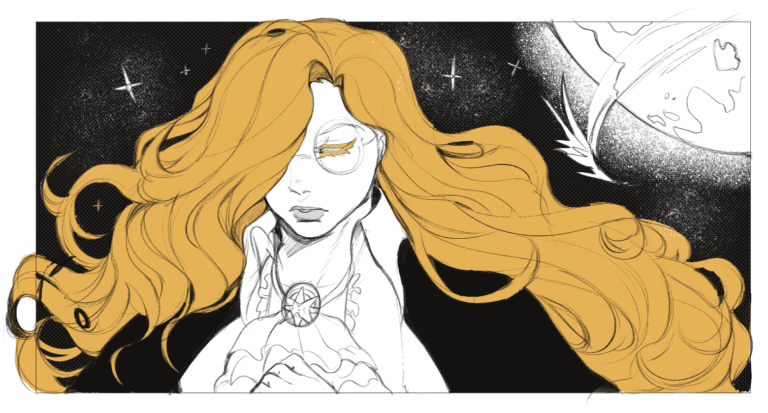
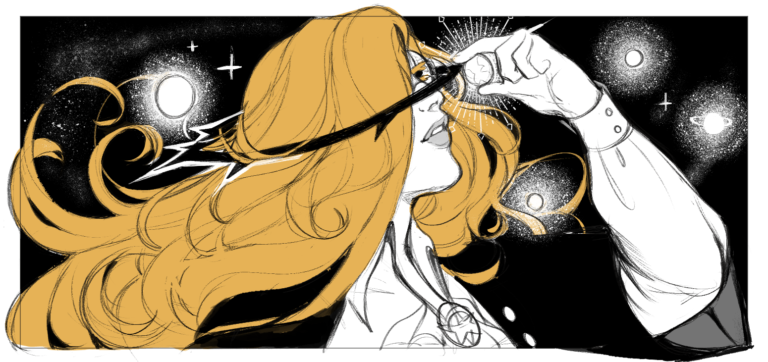
My left glove slips into my pocket. I prefer etiquette, but ruin responds to candour. Bare skin is a promise: I will handle this myself. The constellations wake along my wrist not with flourish but with duty; small dark stars surface, take their places with the confidence of clerks who know their stacks. The air around us prickles as if a thousand hair-thin strings had been plucked in a room next door. Phone compasses die without complaint. Digital watch faces bloom a quiet frost and forget which hour they meant.
“I am here,” I tell her as I walk, voice low enough that only wreckage and gods could be expected to overhear. “You held together under a god’s gun; I am in no position to reproach you for falling.”
I follow what is left of the Aphelion by the habits that survive it. Capacitors split into wire-bloom, blue and green and copper like seaweed after a storm, guide my steps better than signs. A rib of hull lists against rebar. Under a buckled girder, a panel still hums—power trapped like a heartbeat under ice. I touch the steel with the back of my fingers. The hum stutters, then steadies, then shifts into a pattern I could pick out of a galaxy’s worth of noise.
“You flew as I asked,” I say. My voice sounds wrong in this place, too intact. “You broke where you had to. You kept breathing until I arrived. That is more than I had the right to demand.”
A single status light, stubbornly positioned in one corner of the casing, flickers once, twice, then remains steady. The circuit is barely alive, but it arranges itself around my touch as if standing at attention.
“I have read the telemetry,” I murmur. “Atmospheric detonation. Shields to slag, wings to confession, core to cinders. You did not fail. You followed doctrine.” My thumb rests along the seam of the casing, as if I could smooth the ruin back into hull. “My heart rate is elevated, in case you are still monitoring. You may log that as a success. You made me run.”
Behind the panel, cooling fans rouse themselves. Somewhere deeper, a relay clicks over; locks decide they have been loyal long enough. One by one, emergency strips gutter to life in the floor, marking a dim, unwavering line forward.
“Good girl,” I tell her. “One last corridor.”
The current under the plating shifts. Bolts think better of holding. The corridor ahead of us straightens in quiet apology. The ship hears me—and, loyal even in ruin, concedes a path.
On the far side of the collapsed bulkhead, something that was once a corridor has been folded into itself like paper. The folds creak with their own memory. I half-close my eyes so the room will stop performing for me and tell the truth. A line of my stars unspools ahead, not bright—brightness would be vanity—but exact enough to make a country out of debris: here a step, there an arm’s-length to spare. I move through, careful not to make the offerings ashamed of their poses.
“You did what you could,” I say quietly to the bent beams and scorched insulation. “I will handle the rest. Stand down.”
“Advisor,” Wren’s voice calls from the culvert mouth, sly as steam. “If you cut your hand, do it beautifully.”
“I intend to keep all my blood,” I answer without turning. “Beauty is wasteful here.”
She laughs like someone putting coins on a tavern table, silver for the sound rather than the drink. Her flashlight clicks on. It does not require batteries and, of course, cannot mind its own brightness.
The case is farther in than I want it to be and exactly where it would be if I had been wise enough to foresee catastrophe. Doctrine taught me where to bury what we cannot afford to lose; my temper taught me to bury it deeper. When I see the lacquer under the tilt of deformed plating, my body remembers the room where I set the seals—cedar and ink, the soft chime of chain links cooling in a forge, a silence that had already decided whose hands it was waiting for.
“You kept her for me,” I tell the wreck, and by extension the ship that once wore this corridor as vertebrae. “You broke around the case instead of through it. Well done.”
I shift the bent plate carefully. The metal complains and then apologises in one long sigh. The case reveals itself a centimetre at a time, red-black lacquer with a finish you see as depth rather than gloss; everything near it insists on looking like reflection and fails. Doctrine seals—my handwriting flattened into formal sigils—lace the lid. They are unshowy. They do their work.
“When you were new,” I say, more to myself than to the others, “you asked me why we had to carry a weapon made for another hand. You resented the extra mass.” The memory is not literal; ships do not pout. But she threw small tantrums in her turbulence, and I chose to read them as a disagreement. “This is why. You have been vindicated.”
When I slide my fingers under the handle and lift, the hinge accepts the idea of movement. Light in the air thins around the seam, like a pond remembering the shape of the stone that used to lie at the bottom. Heat ghosts my palm. The weight is accurate.
Behind me, Isleen says nothing. Wren says everything without language: the little pleased breath she keeps for found things, the way she leans on one hip so her skirt makes a landscape, the plastic crackle of a fresh Polaroid she produces from nowhere and then feeds into the hungry mouth of a square camera that hasn’t been manufactured in two decades. The flash is a polite sin. She shakes the white frame as if that helps. The image comes up fast: a blur where the case should be, a smear where my hand insists on remembering lines. Wren tucks the picture into her coat with a grin. “For accounting,” she sings.
“This is not your ledger,” I say.
“My dear, ledgers are communal. We’re all keeping the same book. We’re just arguing margins.” She tips the flashlight against her shoulder and, with the other hand, makes a small, obscene trumpet of satisfaction. “Proceed,” she hums. “The day is short and the children in it are shorter.”
Isleen’s head inclines a millimetre.
Past the culvert, the city is pretending to be fine. Salarymen bow over briefcases that have learned to be obedient weight. A bicycle’s bell tries out a new timbre and keeps it. A drain mouth lifts its eyelids and looks away. Kyoto does this well, denial dressed in impeccable light. The flood channel’s concrete shines like a chalkboard just cleaned. We are three figures on the wrong side of the morning, and still no one looks twice. My cuffs remain immaculate. That is a choice.
“Do not worry,” I tell the absent hull as we emerge into the ordinary morning. “I will not let them know what you did for them. They would only build statues, and you never cared for ornament.”
I do not open the case in the street. A blade at this pitch insists on a room that can receive it without faltering. We take the long way along the back of a fish market where tubs of ice sit like altars, past a shuttered shop whose welcome mat means it, and across a side-bridge where the river shows its throat. I carry the case like I would carry a child who is asleep and must not be woken until the bed is ready.
We pass two schoolgirls practising a cheer under their breath, a custodian unhooking a chain from a gate with the delicacy of someone taking off a necklace after church, and an old man smoking without inhaling. The city moves. It does not progress. The difference is civic and theological.
“Once, you rode above cities like this,” I say inwardly to Aphelion, my hand steady on the handle. “You will not envy this walk. It is beneath your dignity.”
At the sentō, the CLOSED sign is a simple lie that harms no one. Doors here mind their manners with minimal coaching; they like being doors. Inside: a steam clock that ticks only on the minute, an enamel basin that remembers eucalyptus, Fuji painted in colours that continue to believe in water. The bathhouse accepts us the way a well-swept temple accepts three travellers who know how to be quiet.
I set the case on cedar. I wash my hands in the basin and dry them with a towel that does not lint. Ritual is the only language I trust when I am about to break it. The water runs clear over my fingers, and for a moment I imagine coolant flushing through scorched conduits, heat bleeding harmlessly into vacuum.
“Rest now,” I think at her, habit too old to kill in a single crash. “Your part is concluded. I will steward the cargo.”
“Advisor,” Wren says, softly now. She has put away her trumpet. The Polaroid camera hangs like a ridiculous sacrament from her wrist.
“Do not document the first breath,” I tell her. “If it chooses to show itself, it is not for your records.”
She pouts in good humour and looks at the ceiling mural instead. Fuji, indulgent, allows her gaze to skate off.
Isleen stands by the latch. The door considers excuses and decides it has none. Her red eyes shutter once in a tide that feels, if not kind, then at least like permission to live.
My glove goes to my pocket again. I touch the seals with my naked hand and speak the old line that is neither spell nor rank but something closer to familial obligation: “Tell me where to stand.”
The seals let go.
When the lid rises, the air rearranges. No gasp, no golden rain—just an adjustment. White-silver waits within, seven feet of mandate, the odachi’s edge quenching light into pallor and then, mercifully, letting it go. The hilt-wrapping shows no weave I can name. It shifts in very small ways, accommodating the memory of a hand that has not yet touched it this morning. It remembers futures as easily as it remembers weight.
“I know,” I say, though no one has spoken. “You want the one who matches you.”
I do not lift the blade. It is not mine. I do what I was made to do: I make a space where the correct gesture can occur without harm. The steam clock ticks. The minute acknowledges itself. The city does not. I bow my head, because reverence is not weakness when the object has earned it, and because my voice, when I offer what must be offered next, must be tempered by that posture.
“Kohana,” I will say when she crosses the threshold, “tell me where to stand. I will not turn away.”
For now, there is only me, the case, the weapon, and the quiet of water in pipes choosing good behaviour. I close the lid a fraction so the room can breathe around the fact of it. The lacquer shows me nothing back. Good. Weapons that mirror are vain; this one obliges the world to find itself and make adjustments.
On our way out, I bow to the memory of the Aphelion in my mind rather than to its bones. She was a ship and then a shield and then a grave. I do not thank her. Thanks would be a request for absolution, and hulls have no business granting it. I keep my palms at my sides, warmed by the handle of the case. Old gratitude suffices.
Outside, Kyoto continues the labour of seeming ordinary. A woman locks her bike with the absent-minded care of someone who has never seen a lock fail. A child trots to keep pace with his father, steps inside the shadow of a traffic light, and leaves it without remembering he ever changed colour. The morning and I share a secret we both intend to keep.
I walk the odachi home through a city that refuses to remember the sky it split. I do not correct it. That is later’s duty.
Now: the rite.
· · ─ ·✶· ─ · ·
Steam combs the air into neat ribs. Towels, warm from the coil, sit stacked like offerings—white, then cream, then the one with a faint blue stripe that insists on being topmost. Fuji breathes in the mural—blue layered upon blue—clouds held polite and still as if they’ve been told they are guests.
I set the case on cedar. The wood recognises the weight made for it and keeps its composure. My throat recognises the sentence it was built to carry and does not falter.
“Tell me where to stand; I will not turn away.”
It is a Doctrine line, yes, but Doctrine only bothered to write down what love had already decided. The steam clock ticks on the minute. Doors behave. The room listens.
Kohana steps in. There is fatigue around her eye that she will not let become posture.
Before I open the lid, I owe her the name of what waits inside.
“In Spectra,” I say, “we call this a Celestial Weapon. It is not a tool. It is the part of you the Multiverse could no longer bear to keep abstract.”
Her brow tightens a fraction. “A weapon that is… me?”
“An instrument built around your wound,” I answer. “Around your vow. Most of them arrive on their own—tear out of the air, out of a heartbeat, out of a moment so honest the world has to make room. A blade, a key, a lantern, a voice. Yours is more complicated.”
I touch the seals. They shiver under my fingers like something relieved.
“Summoners are too much for ordinary miracles,” I continue. “Your tether had to be anchored through the Codex, built rather than merely born. Sophia designed the protocols. I followed them. What you are about to hold is your Celestial Weapon, Codex-born and soul-bound. Its formal name is the Star Stealer.”
Her mouth moves around the syllables once, silently. The air leans closer.
I open the lid.
The sound thins one fraction. White-silver declares. The blade gleams with that particular pallor that persuades light to become discipline. Along the hilt, the black wrap shifts—no trick of breath, an actual minute correction—as if it recognises the pulse at the threshold and would prefer to meet it halfway.
“Come,” I say, and my voice is a bridge.
She closes her hand.
The odachi answers at the speed of bone. Not audible, not exactly—more like a resonance strung through teeth, sinus, spine, the whole orchestra of a human frame agreeing to tune. The edge pulls the room’s attention without greed: shadows lean, colours pale by a shade as if they have remembered a dress code. Kohana’s jaw tips a fraction, as if listening to a language she did not know she spoke and now cannot stop hearing.
“Your Magic Affinity,” I say, “is Elementalist. There are only two in the Multiverse that we know of. You and a god-king who refuses to retire. You do not cast elements; you rearrange matter itself. Solid, liquid, gas, plasma—between your hands, they are a single sentence you can rewrite.”
Her fingers tighten almost imperceptibly around the hilt.
“This weapon does not grant that,” I add. “It survives it. It gives your power somewhere to go other than through your bones. If you are an impossible storm, this is the lightning rod that insists you live long enough to see the weather change.”
Isleen is in the doorway. She does not need to announce herself; the latch has already changed its mind and elected to be exemplary. A ripple passes through the red eyes braided into her hair—closing in a wave, opening again in even measure. “Behave,” she says, as if to the air, as if to the steel, as if to the hour.
Kohana breathes. The odachi reads her breath as an invitation and paces it. I have seen a thousand first touches between Summoners and their tethers—trembling bravado, theatrical awe, sometimes relief sharp enough to bleed—but nothing ever feels rehearsed. Each weapon is a grammar, each child is a voice; their first sentence together is always new.
“It will feel lighter than it should,” I tell her, because honesty is a courtesy long before it is a rule. “You will still fatigue.”
Her gaze stays on the blade. “Understood.”
“Technique arrives,” I continue. “Endurance does not. The knowledge that fills your hands is mine to give you. The stamina you must bargain for with your body.”
She makes the smallest sound, agreement salted with irritation at the truth. The weapon hums, as if pleased she did not pretend to be made of anything other than muscle and will.
“It amplifies your choosing,” I say, and I keep my tone as even as the steam clock, “not your mercy. If you swing carelessly, it will make carelessness sovereign.”
The line lands. She nods. The Star Stealer is not charitable. Forgiveness is not a weapon’s business.
“Never pass it to another.” I let the sentence breathe a full second. “It will refuse them—perhaps politely, perhaps not. The politeness will not matter.”
Isleen’s eyes do not flicker. She knew that rule before I spoke it. Doors know to whom they answer. So do blades.
Kohana’s fingers relax, and the wrap answers her in kind—minute yielding, like a glove learning a scar. She draws halfway, very slow, the way a calligrapher might bring the brush down to test paper and ink. White-silver exposes itself line by line. The sentō makes room for the length as if it had been designed around this dimension and had been patiently waiting for the proof.
“Breathe with it,” I say, and she already is. The faint resonance slides through her ribs and decides on a rhythm; the hum eases when the inhale meets it without rush.
She turns her wrist a degree and completes the draw. The edge travels an inch of air and then a towel’s fringe. No thread severs; they slip aside along geometry they’ve been politely shown. Each fibre chooses the correct side of the line. When the length is complete, the fringe remains a fringe—perfect, disciplined—no loose lint, no brutalised hem. The demonstration is not for spectacle; it is for trust. This is not a club. It is mathematics that fell in love with violence and learned manners.
Kohana’s mouth opens with a breath she did not intend to say aloud. “It knows the shape of my hands.”
“I built it to,” I say. “Because I learned the shape of your hours.”
Her gaze lifts from the blade to me, not grateful, not angry—something steadier, a recognition that is not relief. She understands the cost in that sentence, and I do not require her to pay it back.
“And you?” she asks after a heartbeat, voice low. “Do you have one?”
In the corner of my sight, Wren brightens like a match about to be struck. Isleen’s eyes shutter once. The latch tightens, suddenly very interested in being a latch and nothing more.
“Yes,” I say. “Every Celestial Being bears a Celestial Weapon. Mine is… elsewhere.”
“What kind?” Wren starts, hunger already in the question.
“Classified,” I reply, without heat. “My Affinity as well.”
Wren’s mouth twists into a wounded smile. “Isleen and I know,” she singsongs. “You’re not as opaque as you think, golden boy.”
“And you are very fond of having tongues,” I say mildly. “Let us keep both arrangements intact.”
Isleen’s hair settles by a fraction. Wren lifts her hands in theatrical surrender, a little delighted trumpet dying on her lips.
“Again,” I say to Kohana, and the word is not impatience. It is an invitation.
She tilts the odachi, lets its impossible length find balance with no clatter, no show of force. The tip behaves—no hunting for floor, wall, or mural. It obeys her breath. She advances one step—left foot soft, right foot placed as if she has always stepped this way—and lowers the blade to horizontal. A mouth of steam makes a small O and then learns, wisely, to close.
I move where she is not looking and never will need me to be looking: to the place where the sheath will be when her hand reaches back without checking. “Here.” The lacquered scabbard tilts itself into the angle her shoulder will find. The city calls this luck when it happens with umbrellas and revolving doors. Doctrine calls it duty.
“Draw and sheathe,” I say. “Two halves of the same answer.”
She repeats the motion, slower than pride would prefer and quicker than fear would allow. The blade returns home without nick or apology. The faint vibration subsides to something like a cat’s approval in another room.
The towel’s fringe lies perfectly. She touches it as if to check whether the proof will change under scrutiny. It does not.
Rules must be finished, or they will return to collect themselves at the worst time.
“If it sings too loudly,” I add, “step back and eat. I will stand there.” I indicate the stretch of floor that wants to be door and is not. “If your hands shake, sit. I will stand there.” The threshold—good—lies quiet. “If you are angry enough to think you are harmless, stop. I will stand very close and disabuse you.”
That makes her almost smile. It takes someone young to be amused by a leash described honestly. I do not mind youth. It is why the weapon exists.
Isleen’s hair lifts one ripple’s worth, red eyes closing in a tide as if a blessing were something as simple as synchrony. The latch glows with satisfaction no one but doors can feel. The room accepts the blade; the word is acceptance, not surrender. Fuji in the mural keeps breathing, blue laid on blue until it is almost black, one vapoured cloud exactly where it wishes to be.
Kohana’s knuckles ease. She breathes with the Star Stealer once more, as if agreeing on a secret no one else has to like. “May I—?”
“Yes.” It is not ownership. It is a refusal to be the kind of man who needs to be asked twice.
She draws a final time—no flourish, only exactness, the long arc that looks too big for a human and yet suits her as if she were made to carry a horizon with one arm. The edge passes a hair above the cedar; the air thickens politely and then returns to correct density. When she re-sheathes, the small click sounds content.
Silence returns, not empty—kept. The sentō holds it like a secret placed in its care and promised back on demand. The steam clock ticks once. The towels hold their line. The door keeps its manners, having been asked to and having enjoyed success.
“Rite completed,” I say, but only to myself. Ceremony would have asked for witnesses and applause. Ritual asks only that we do not betray it later.
I close the case enough that the blade is neither flaunted nor hidden, and I let my hand rest on the lacquer a single heartbeat longer than necessary.
She looks at me, then at Isleen, then at the door as if measuring the day’s appetite. When she speaks, it is to the room as much as to me. “We’re done.”
“For this hour,” I agree. “The next hour has not been briefed.”
She nods. The odachi hums once through the scabbard, the faintest thread of sound across her bones, and stills. Fuji keeps breathing. Outside, I can hear the city telling itself stories about ordinary errands and finding comfort in its lies. I take up the case to carry nothing, because the blade is exactly where it belongs.
The sentō keeps the silence like a secret. The door approves. And the hour we have made together stands upright inside the day, ready to be asked for its work.
· · ─ ·✶· ─ · ·
The bell changes its mind about being metal and decides to be a blade. The tone slices the hall in clean sections: lockers, faces, the smear of a sky that pretends to be noon. Fluorescents sharpen from a drone into a whine that settles behind my teeth. Roll sheets breathe out TRANSFERRED in tidy columns; no one winces. Paper accepts absence faster than bodies do.
I move through the doorway as though the lintel is counting me, and maybe it is. Chalk dust floats like pale pollen above the whiteboard. Desks scrape. The room rehearses its own ordinary.
She is there. Pale as milk glass, hair a bright green bob that could cut light to ribbons if it felt like it, eyes huge and green enough to be their own exit signs. Athletic jacket with the zipper bitten by nervous teeth at some point; medals clink softly in a pocket like small coins settling after a train stops. She watches me with a steadiness that is not staring. It’s orientation, as if I am a lighthouse and she got seasick last year and wants a new outcome.
“Morning,” she says, no tremor, no brag, just an offering she can afford.
I nod because my mouth is busy remembering how to be a mouth and not a gate. The minute hand in my belt knot ticks soft and private at :56. I pat it once like a dog that cannot be seen here.
Mr. D’Accardi—Mr., today; never Hiroyuki where walls can learn a name—writes the day’s poem on the board in a hand that refuses to rush. Sleeves immaculate. The cuff meets the wrist at the exact angle that tells the world not to ask what it costs to be that steady. He has traced the exits already. The exits have traced him back. I feel the map simmering under his shoulder blades, the way heat lives under lacquer before it shows itself as steam. He smiles at the class like a bench in shade smiles at feet.
Isleen stands inside a uniform that does not convince anyone who knows how uniforms behave. Her hair is gathered and quiet—quiet for her—and yet the little red eyes stitched into the black veil at the back blink in an obedient ripple when the AV cart trundles in. On the monitor, the feed fuzzes around her. Pixels think better of crispness and choose reverence instead. Students laugh at the stutter and blame the school’s budget. I glance toward the green-haired girl to see whether the static persuades her.
In her peripheral, the monitor stays crisp.
She blinks, long and deliberate, and the image runs a quick diagnostic across the glass and decides to remain true. A refusal so small it could be a sneeze held in. My skin prickles the way it does when doors behave too well.
Kaede—my mother—leans in through the open door to pass along a stack of slips for the field trip. She is all plain kindness and chalk, the careful hair tucked back to outlive the day. She meets Mr. D’Accardi’s gaze with a teacher’s cool courtesy. There is a tremble under the fluorescent that doesn’t belong to the light; I file it under petty things the city is doing. I put the slips on the front desk. A corner of the stack lifts and tries to flip itself; it relents when I rest a fingertip on it.
“Today—” Mr. D’Accardi begins, the chalk making a small thankful noise when he picks it up, “—we’ll try a poem about noon. Not time in general. Noon in particular. Hours have personalities.” His eyes slide, just once, to the minute hand tied at my belt. The class reads it as a teacher’s glance toward a fidget. I read it as a question asked and answered by our morning in the sentō.
Chairs creak into attention. Someone in the back yawns too wide and apologises with laughter. The bright-green girl sits straight. She takes her pen out of her pocket, the medals clinking again, softer. I drop mine. It skitters toward her and stops precisely at the toe of her shoe.
She picks it up and offers it back. “You saved me,” she whispers, as ordinary as please.
A bell goes off in my bones, full church bronze. I haven’t saved anyone in this room ever, not in a way anyone got to keep. I open my mouth and close it again because none of the correct sentences can be spoken here.
“What’s your name?” I manage, keeping my voice to homeroom scale.
“Masae,” she says. “Baishō.” The syllables are bright and clean, no static. She says my name without saying it. I feel it pass from her throat to mine without sound.
Near the door, Isleen watches the hallway. She doesn’t lean. The hallway leans for her. The exit sign above the frame pumps once in quiet, as if it had a heart. Kids who pass lower their volume without knowing they’ve done it and immediately turn the noise back up ten steps away. The AV monitor tries again to blur her outline and fails—no, not fails. It decides it’s more interesting to be faithful while Masae is looking.
We take roll. Kaede reads TRANSFERRED like a word that never knew the shape of an apology. She does not hurry. She does not linger. Chalk lifts and lowers. A boy two rows over says, “Here,” in a voice that belongs to someone who forgot he had one. Masae listens to each name the way some people listen for their number to be called in line for safety. She nods when she hears a name she will never have to use.
Between ka and sa on the board, a hairline crack runs through white paint to brown plaster. I remember the sugar that sealed faces at the gymnasium and look away. The minute hand in my belt flutters at :59 and then calms. Outside, a siren trails off in mid-wail and finds another street to finish its thought.
Mr. D’Accardi writes a line across the top of the board that isn’t in the handout: The hour insists. He puts down the chalk and turns to us, sleeves clean, throat clear. He teaches leaning on nothing. A poem about noon that pretends to be about a bench on a hot day becomes a confession about where you sit when you cannot afford to pretend you know which direction shade will arrive from. Students hum their approval. He smiles as if their listening is a thing he wants to keep alive, and it is.
Masae’s attention never wavers. It tracks. She writes only three words in her notebook: light, lie, lunch. Her pen taps the margin once, twice. The third tap goes where a name should go.
When the bell rings again, chairs scrape into hallways, and the hallway swallows them. Masae does not move. She folds her notebook shut like someone closing a shrine door. She also pockets a candy wrapper left on the floor by the boy who forgot he had a voice. It is a tiny act of housekeeping that chooses a team without being asked.
“Lunch,” she says to me, standing but not stepping away. “Can I—” She stops, and the brightness is gone from her voice for a blink. She recalibrates. “Can I sit near you? My friends… switched schools.”
“Sure,” I say, and the word feels like a receipt I have to give for a service I can’t prove was rendered. “It’s noisy. The courtyard is better.”
Her smile glints like the medals in her pocket. “Noisy is okay.”
We file into the hall. The AV cart stutters as we pass—blue rolls into green and back again—and the monitor’s image flickers around Isleen for every eye except Masae’s. In the glass reflection of a trophy case, we all see something slender and short with hair like mercury and eyes like poppies; in Masae’s peripheral, that reflection is a girl in a uniform who is not taller than my shoulder and is, apparently, allowed in the hall. She blinks. The world chooses not to correct her.
I catch Mr. D’Accardi’s profile as he erases the board. His sleeve rides back a fraction; ink-dark stars fidget under skin and settle like well-behaved fish returning to shadow. He glances to the doorframe, measuring its mood. It agrees to be a door for the next hour. He nods to it. The nod is courtly enough to be almost a joke.
“Poetry temp,” a kid says behind me, full of the cheerful cruelty of someone who thinks adults appear by request and not because the world ran out of better options. “He’s too put together. Bet he has a lint roller in his pocket.”
“Better than cigarette packs,” someone else says.
“Better than knives,” someone says who has no idea what knives are for.
Masae’s gaze stays on me. It’s the weather of attention—steady, temperate, the kind that keeps boats from drifting. I don’t know if I deserve to be a boat. I don’t know if boats deserve to be saved.
The hall smells like disinfectant and cheap curry. The vending machine near the stairwell makes its little compressor sigh, the one that always sounds like compromise.
On the AV cart, the screen catches a flash of the courtyard. For everyone else, it ghosts; for Masae, it remains a rectangle of true. Isleen passes it; the image remains whole. I watch Masae not be persuaded. The refusal lands in my chest like a small, warm weight. Dangerous. Useful. Both.
“Do you run?” she asks, and the word drops out of nowhere, but it doesn’t feel random.
“I hunt,” I say, then force a smile so it can be mistaken for a joke. “Sometimes that looks like running.”
“Me too,” she says. The medals in her pocket answer her with an approving clink. “Track. Relays. I like being part of the thing that gets handed off.”
The minute hand at my belt hums once, soft warning: :12. The day is practising noon in little rehearsals. I look at the clock and then don’t, because looking gives minutes ideas. “Eat with me,” I say. “Courtyard. Stay in the light that belongs to us.”
“I can do that,” she says. It’s a promise, not an oath.
We step into the flood of the hallway. The glare from the windows arrives one stop too bright. Cross-hatched shadows from the blinds lay bars across the floor, and then decide not to imprison anyone today. I feel an under-thrum, the seam yawning somewhere under the tiles, learning the bell schedule. I check the straps on the case slung along my back—too long to be anything the hall monitor can name without summoning a rule. Mr. D’Accardi taught me how to carry a horizon like luggage. I carry it.
At the far end of the corridor, the camera above the stairwell blinks in a small constellation—one, two, five—and then returns to stupidity. Hiroyuki’s routes flash and dim behind his eyes; I can see it in the angle of his head as he pauses outside the teacher’s lounge and lets a second pass so the door will open when it should.
Isleen lingers where the stairwell shadow goes a notch too long. She doesn’t look at me. “Soon,” she says, and I pretend she is talking about lunch.
Masae falls into step on my left, matching stride in that easy teammate way. She keeps her voice low enough to stay ours. “You looked tired this morning,” she says, like concern is a language she’s fluent in and uses sparingly. “Do you want half my bread? Grandma uses too much butter.”
“I want all of it,” I say, because honesty is easier around people who refuse to forget you’re a person.
“Deal.” She grins. A green strand of hair catches the sun and flares like a leaf on fire.
The bell considers ringing again and thinks better of it. The hallway breathes. On the notice board, a sticker peels up a millimetre at one corner, showing the suggestion of something pressed and green beneath. I don’t look a second time.
Normal holds. Normal tightens. I walk it like a wire, minute hand humming against my hip, lighthouse to a girl who shouldn’t be able to see through the fog and does anyway. The school behaves, for now. The hour takes attendance. The exits memorise us back.
· · ─ ·✶· ─ · ·
The gym smells like varnish and oranges, and then wrong.
Polish crawls over the floorboards in a wet shine that isn’t wet; sugar skins the maple until it gleams like a glazed bun the size of a court. The bleachers exhale a sweetness that curdles on the tongue. Lines meant for games ripple—the white of half-court tries to become crosswalk stripes, the free-throw arc twitches toward a lane that goes nowhere. Noon laughs without sound, a bright pressure that pushes on eardrums.
A class crowds midcourt in a clench of bodies. A whistle hangs dead around Coach’s neck; she’s shouting syllables that want to be drills and come out like prayers, breath fogging in a room that should not fog. Phone cameras lift and immediately lose ambition—focus finds softness and stays there.
There—at the margin of the herd where the banner rack fell—green hair like a leaf on fire. A strip of nylon has ribboned itself around her ankle, tightening when she tries to move as if it knows where tendons live. Masae’s eyes are huge and clear. She doesn’t scream. She braces.
The case on my back has been heavy all day. I slide it to the floor. The latches recognise my hands and give way.
The Star Stealer breathes.
Not a sound, a change in the room. Light leans toward the odachi’s length as if the edge were gravity. The blade is white-silver that isn’t a mirror; it returns the world corrected. The black wrap greets my palm with warmth like a name spoken correctly after a week of misuse. Vibration runs up my teeth into my sinuses; my tongue tastes like a spoon against a battery and then like the first clean swallow of cold water after running.
Scoreboard numbers smear into comet tails. The shot clock hiccups, tries to count, forgets. I draw.
The first arc is horizontal and slow enough to watch. Seven feet of geometry moves like one thought. Lacquered Shadows—paper-thin bodies in school sizes wearing sugar like armour—step into the plane of it and fall apart along their own wrong seams. There’s no splatter. They delaminate. Sheets unglue. Sugar hisses down in flurries and laces my hair with winter.
Reach. Bleachers gape. Two buds slide along the bench backs toward the children, slick as icing. I take one more step than I have legs for, and the length answers. The edge writes a white line through the air; the world obliges by splitting on that line. Both buds come apart into polite halves that decide to be ash.
A third lunges—a glossy thing with a desk’s shadow for a spine—and I bring the odachi in close, laying the long spine along my forearm. The weight is leverage. The Shadow drives itself onto the back of the blade and stops existing. Not a kill. A correction. Like crossing out the wrong word and watching the sentence right itself.
Hips carry the length; wrists stay soft. The blade is a hinge with my breath for a pin. Stance widens—left foot chalk, right foot maple, toes finding the little indentations where floor gives from a thousand suicides run by teams who never prayed to be spared this. Every pivot lands as if I practised for centuries. I didn’t. The bond did. My lungs remember a rhythm I’ve never trained and match it; the hum in the steel eases when I align.
Centre court grins.
Where the circle should be squats a kernel the colour of old buzzers—rust-red, nicotine-gold, a clock’s mouth with teeth. It opens, and a noon-bell comes out bent, detuned by laughter. The lines blur; my next step wants to turn into an errand, and my hand reaches my pocket for change I don’t have. I bite my tongue until iron floods my mouth. Anchor. The odachi answers with a cold flare along the fuller. Cadence returns.
Up in the bleachers, constellations flicker at the corners of the room—Hiroyuki lifting a net only he can hold. LEDs on phones blink in a small pattern and then go stupid; camera lenses forget the focus they just had. Sound folds around the children the way blankets behave when someone who knows blankets is nearby. He never touches the blade. He makes the room agree to the grammar required to use it.
At the double doors, Isleen’s voice is a verb that learns manners into wood. “Recount.” The painted lines on the court remember being lines, not mouths. The doors decide they are doors. It’s enough to stop the far bleacher from trying to become a throat.
“Left!” Masae—because of course she notices the only opening that matters—throws me the quick warning a relay runner throws a hand with the baton already on its way.
Banner-tight sugar around her ankle cinches as if hearing her. I cut once, low. Cloth gives; skin survives. Odachi is exact because my intent is exact. The loop falls in two slick ribbons; Masae staggers free and plants, breath sharp but steady. Her medals click in restraint with approval. She doesn’t try to be brave; she is busy being.
A wave of buds drops from the ceiling rafters—the gym’s dust bunnies wearing mirror glaze. I step into them on the exhale. The blade skims high, then low, then high again, and each pass leaves a clean negative. The air looks like paper whose wrong lines have been erased perfectly. Sugar snow thickens. It squeals faintly between my teeth when I breathe. A child coughs. Coach gathers three into an arm and backs toward the double doors that are currently doors.
The kernel belches another broken noon. My next thought wants to be check the time. I refuse it. My next impulse wants to pick up a whistle. I deny that, too. Errand gravity tugs at my knees; the odachi insists on footwork. Ten beats carry me across the court in a progression that feels like remembering a dance I mocked earlier. The long blade never drags. It never fights me. It’s a script and I’m reading, breath to breath.
Three steps from Masae, a lacquered thing in the shape of a girl with no face closes fast with a banner-pole spine. I raise the odachi into a guard that would have shattered my wrists yesterday and flows today like water over stone. The faceless meets the flat. The blade sings. The girl folds on that note and comes apart into powder that tastes like dates.
My forearms begin to tremble. Not the good tremor of adrenaline. The honest one that says: your body is still a body. The sword doesn’t weigh me; consequence does. Sweat runs along my ribs and cools. I move anyway because movement is language and I am fluent today.
A boy goes down—shoelace, sugar, panic—mouth opening to admit a scream that loses its verb. I cut a line between him and what’s falling. The cut is thin as a hair. The space behaves differently after. The bud that would have worn him like a coat crumbles on the edge of that boundary and oils the floor with nothing. I pull the boy up by his elbow and push him toward Coach without taking my eyes off the kernel. He runs. He never looks back. Good.
Hiroyuki’s net tightens a fraction. The overhead clock grinds toward 12:00 and can’t find zero; it sticks at 00 and pouts. A ring of little stars—only I can see them because I know where to look—marks a circle the children can’t step out of unless invited. Wren leans in a doorway opposite and tucks a Polaroid into her coat like she’s just collected a receipt for breath. I’ll deal with her later or never.
“Now,” Isleen says. Not to me. To the court. The paint settles. The free-throw dot stops pulsing like a pupil. The kernel shivers with the effort of its own insistence and shows me the angle.
I take it.
Rising diagonal. Knee to shoulder. If it had a shoulder. If it had knees. The odachi doesn’t care about the names of parts; it cares about lines. The first half of the cut lifts sugar with it into a small storm; the second half finishes behind my left ear in a hiss that snaps hair against neck. The kernel’s grin opens wider to disagree—and then understands it has been addressed in its native language.
It loses composition. The grin sheds its outline; what stays behind collapses in a heap that is half powdered dates, half chalk, all absence. The sound is the end of a buzzer with no game to end. Scoreboard lights clatter and reset to 00:00. They stay there like they’re proud of knowing nothing.
Silence collects. It’s aftermath putting its hands in its pockets and whistling.
I breathe. The odachi hums down with me, the resonance smoothing as my pulse smooths. Sugar sticks cold along my forearms where sweat caught it; a film of sweetness burns my eyes. My arms shake one heartbeat longer than my pride can hide. I let them. I’m not here to be impressive. I’m here to make lines behave.
Coach is already counting heads. The class whimpers and gathers. Phones come back wrong and pretend they never tried. Hiroyuki lowers the scrim a degree at a time so the room doesn’t argue with itself. Isleen watches the double doors remember hinges.
Masae stands in front of me with the cut banner still knotted around her calf. Her eyes are wet at the edges, not with fear. With witnessing. Her smile is quick and private and then gone. “You run,” she says, as if we’re back in a hallway where things have less appetite.
“I run,” I answer, and sheath the Star Stealer. The blade’s song fades into the hilt’s black wrap, into my palm, into the breath I owe the next hour. The room keeps the silence like a secret.
00:00 hangs where a clock should be useful and isn’t. I taste iron and sugar. My shoulders remember weight they did not carry and ache like I asked them to bear a sky. The odachi, light as honesty, rests against my back as if it belongs there.
I look once at the powdered dates and chalk where the kernel was and make myself not call it victory. It’s a receipt with the numbers blurred. It will have to do.
· · ─ ·✶· ─ · ·
The room exhales like a sprinter after the line.
Kids wobble on new legs, finding their voices in hiccups and half-laughs. A PE teacher claps too loudly and calls it a drill that went “a bit enthusiastic.” Another invents an electrical surge with hand motions no surge has ever made. The scoreboard, stuck at 00:00, pretends it is broken on purpose. Sugar grit squeaks under shoes. The gym decides to be a gym again the way a liar decides to be honest in front of a camera: awkwardly, with tells.
Wren is already working the edges. She magics a wad of triplicate forms from her coat—the kind with checkboxes for “faulty wiring” and a stamp that smells like somebody else’s office—and hustles a janitor with the brisk mercy of a hurricane offering you a ride.
“Electrical fire,” she chirps. “Very boring. Very plausible. Sign here, here, and—oh, you blink like a saint.” She steals a rumour off his sleeve as payment and tucks it behind her ear. The rumour rustles like a receipt that has decided to be true.
Masae comes to me through the melt of teachers and explanations with the clean line of a runner cutting a curve. She is smaller up close and brighter at the edges—pale skin flushed hard at the cheeks, bright-green hair damp where the sugar dust clung, big green eyes the exact colour of a stoplight that refuses to obey. She stops one arm’s length away, as if respecting a rule she can’t name, and does not glance at the blade. She looks only at me.
“You saved me,” she says. Not grateful—certain. A statement in the tense of church bells. It lands in my chest like the first word of a vow.
I don’t know how to receive praise without flinching, so I give her what she can use. “Stay in crowds,” I tell her, voice low, throat sanded with sugar and iron. “If it blinks, don’t look twice.”
Her chin dips once, sharp as a salute. It reads like a knight receiving a charge. “Yes,” she says, a promise sewn to a single syllable. A medal in her pocket taps the plastic edge of another: proof of a thousand drills that did not include this one.
Behind her, a teacher starts an anecdote about a fuse box. The class tries to nod along. The gym lights hum as if remembering a song they nearly forgot.
Hiroyuki moves without looking like motion. He passes at an angle that makes the space relax, a clean vector along the benches; cuffs immaculate, eyes quiet as ledger water. He does not touch the odachi. He stands where the blade’s shadow won’t tangle with his constellations and lets his voice be a private corridor between us.
“It fits your hand,” he says the way one might say a date out loud to see if the numbers balance.
“It does,” I answer, throat raw. The odachi’s hum has settled into my bones like a vow under the skin. It isn’t noise anymore. It’s pulse adjacent.
“It will ask for more,” he adds, soft enough that a whistle can’t hear it. Double-edged counsel, offered without plea. Technique arrives; endurance will not. Do not let the room bait you into spectacle.
“I know,” I say. I don’t, not completely. My forearms know. They tremble under their best behaviour.
Isleen at the doors is weather deciding whether to rain. Her hair’s red eyes have gone half-lidded. She doesn’t come close. “Place later,” she says, even. “Cut now.” Permission and limit in two words. The gym hears her and forgets to misbehave.
Wren slides between us like gossip in a kind family. “Hold out your hand, koshka,” she purrs, delighted. I do, reflex quicker than suspicion, and she slaps a Polaroid into my palm. The photo is still warm: the odachi caught as a silver syllable mid-air, a white curve written across the sugar flurry. On the border, in her sharp marker, she’s written: THIS WAS A SWORD. She taps the ink as if sealing lacquer. “Receipts,” she says, pleased. “You’ll want the story that goes with the ache.”
I curl my fingers around the picture. It smells like old cameras and a bakery. In the angle where the blur becomes edge, I can see what the room did not: the way the blade corrected the line it cut, the way reality agreed to be different. I do not show it to anyone. I don’t know why. It feels like letting someone read my pulse.
Wren has already palmed a second photo—Masae half-turned, ribbons at her ankle like a snake—and pockets it with a fox’s private glee. “For accounting,” she trills, seeing my look and giving me no quarter. “After likes to be admired.”
“You will bring those back,” Hiroyuki observes, mild as tea steam.
“I will bring back what the story owes,” she singsongs. Which is not the same thing.
“Stay in crowds,” I say again to Masae, because the first time was instruction and the second time has to be an anchor. “If anything asks you for a name, do not give it yours.”
She blinks once, slowly. “I like yours,” she says, quiet lightning. It’s not a challenge. It’s a belief.
“Don’t,” I tell her, and it’s the kindest I can manage. “Not yet.”
Her mouth makes the shape of a promise and then closes around it. “Okay.”
The coach—heroic in her confusion—herds kids toward the doors that now remember hinges. Teachers compare lies until their narratives agree. A siren somewhere outside decides to be late. The sugar on the floor is already deciding to be dust.
I slide the Star Stealer home.
The sheath takes the blade in with a soft, precise sigh. The hum in my bones does not stop; it relocates, nestling in the cords of my forearms, the notches of my wrists, the small of my back where the wrap warms the spine. The odachi is not quiet. It is contained. The room shivers once, then pretends it didn’t.
Hiroyuki’s gaze touches my hands and leaves them alone. “Where do you want me to stand tomorrow?” he asks, as if we were discussing a seating chart, as if the answer were a matter of taste and not survival.
“Where I can find you,” I say, which is not a place but a promise. He accepts it like a map anyway.
Isleen’s hair blinks in a wave—red eyes closing and opening like a benediction that refuses to be named. “Doors will test themselves,” she notes to the wall. The wall chooses not to answer.
Wren, satisfied with the paperwork of a lie, claps her hands once and produces a piece of nothing from her pocket. She folds it, tucks it into the janitor’s chest pocket, and leaves a sugar fingerprint where a badge should be. “You saved a lot of children today,” she tells him, benevolent deceit. He looks down at the nothing like it’s the best commendation he’ll never frame.
Masae steps backwards without turning. Her eyes keep me in them like a held breath. At the threshold, she touches the cut ribbon at her ankle, then lets it drop. “I’ll stay in crowds,” she says, like a runner repeating the coach’s plan at the line. Then softer, just for me: “Thank you.”
I do not say you’re welcome. That would make it small. I nod, and it is not small.
The gym performs normalcy as a final trick: whistle, clipboard, attendance check. But 00:00 hangs above us like a secret the day can’t metabolise. Sugar prints our shoes; kids track it into hallways that refuse to remember why they’re sticky.
In my palm, the Polaroid cools. THIS WAS A SWORD. The ink will dry; the receipt will keep. The odachi’s vow under my skin does not fade. It settles its teeth into the hour, and the hour, for once, bites back with me.