The doors of Alpha’s palace open slowly enough to turn every arrival into a ceremony.
They were cut from stone taken deep below the oldest foundations, where the planet’s mantle cooled around seams of ur-metal, leaving gold branching through black mineral in veins as thick as roots. When the mechanisms hidden inside the walls begin to bear their weight, the sound travels as a long subterranean complaint through the throne hall, followed by a faint trembling through the marble underfoot. Water shivers in the narrow channels cut beside the central aisle. Orchids arranged in silver basins stir on stems too thin for the movement reaching them from beneath the floor.
Abaddon enters while the doors are still travelling.
Rhavessan has survived the journey home on him. Salt has dried pale around the seams of his boots and into the lower hem of his campaign cloak; one shoulder plate carries three parallel gouges from an Eschatid that reached him before Eidolon Breaker removed the command driving its second strike. His hair remains divided into the heavy campaign braids he wore across the flats, but they hang differently now. Somewhere between Clotho’s theatre and the palace doors, they have gained several inches, the thick violet lengths brushing the backs of his calves where they had not reached before. A few have loosened enough to spill strands across his armour, making the change harder to dismiss as a braid settling.
The geosmin beneath the skin of his throat and hands has not yet returned to its ordinary banked glow. It burns visibly along his wrists, the expense of two days spent making Obliviscence distinguish command from tissue, occupation from architecture, enemy from whatever happened to be standing too close when the world opened under its edge.
Monday follows with a leather case tucked under one arm and three lengths of cleaned Rhavessani bone strapped inexplicably across her back. Nobody asked her to bring them. The question had been raised at the departure gate and died there.
Her spectacles have survived Rhavessan by accumulating repairs rather than retaining anything resembling their original construction. One lens remains crossed by a pale fracture, wire replaces the hinge on the left arm, and something that may once have belonged to an instrument case has been tied around the bridge. Her hair has been washed, at least, though it dried in uneven waves around her jaw where the campaign cut has already begun to grow out.
The throne hall receives them in cool water-light after weeks of salt glare, forge heat and the greasy animal musk of Eschatids. Abaddon keeps walking. Monday manages six steps before curiosity defeats whatever ceremonial restraint she had intended to maintain.
Her gaze finds Alpha first.
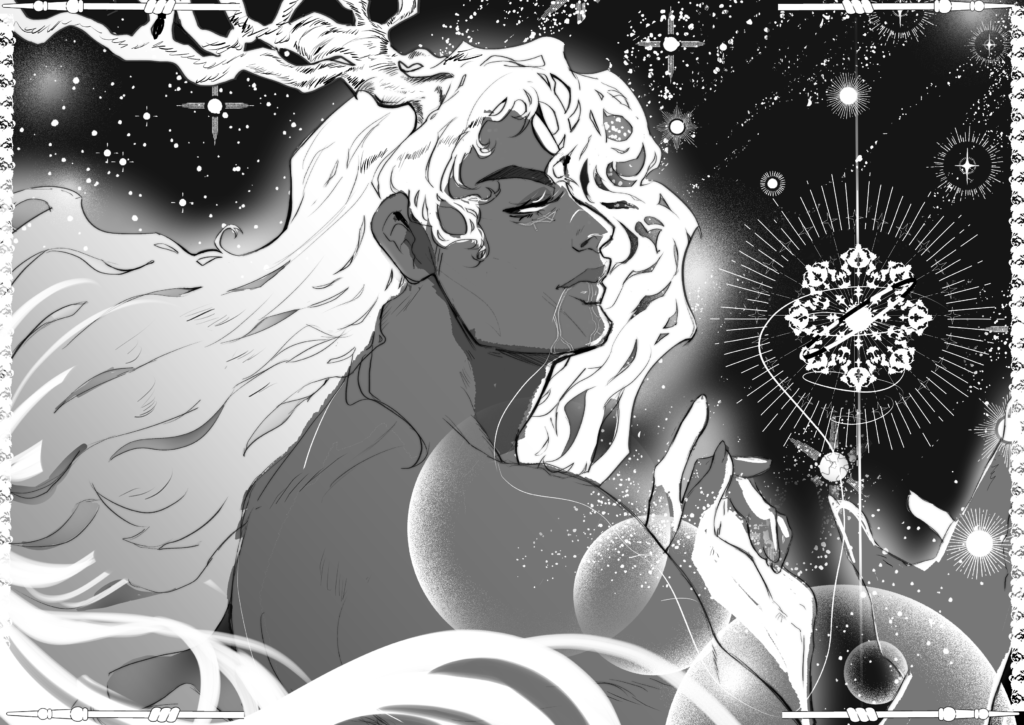
He sits on the low steps of the dais, one hand resting beside a stack of unopened correspondence, silver hair flowing around the throne and nearly reaching the floor. The colours carried beneath it—sea-green, ultramarine, the deep blue of water beyond sunlight—surface wherever reeflight passes through the outer silver. Green geosmin traces his hands and throat. His gold eyes settle on Abaddon immediately and remain there.
Monday looks beyond the dais.
The woman standing beside one of the long marble tables near the dais is difficult to mistake for anyone Sunday might have described badly.
Kohana Ohuang-Zhùróng has a glass of iced guava-lime sweating in one hand and has forgotten entirely to drink from it. Her floor-length purple hair falls loose behind her, flecked with points of cold stellar light that brighten where it crosses the deeper shadow beside the column. Black clothes follow the full, heavy curves of her body before disappearing into heels high enough to vindicate at least one part of Sunday’s report. Her acid-green eyes find Monday at the same moment Monday finds her. The pause becomes mutual.
Kohana’s mouth moves first. “Sunday told you about me.”
Monday shifts the report case higher under her arm, the leather edge briefly catching on her sleeve. “At length. I could have identified you from the shoes.”
Kohana glances down at her heels, then tips her head back toward the ceiling. “God. How bad?”
“Four paragraphs.”
A laugh escapes her through her nose. “Only four? He’s getting disciplined.”
“He is not,” Alpha says from the throne.
Kohana turns toward him, one brow lifting. “You read it?”
Alpha rests an elbow against the carved arm of the throne, expression composed enough to make the answer worse. “He addressed several remarks to me directly.”
“Ah.” Kohana’s brows lift. “So he insulted you.”
Alpha’s mouth shifts by barely a degree. “With persistence.”
Monday lowers her eyes to the report case for a moment, though the corner of her mouth has already betrayed her.
Kohana catches it and looks back at her. “Mm. That’s Sunday.”
Monday studies them both, and Abaddon knows the exact instant she remembers the rib shelter on Rhavessan and the question neither of them managed to resolve there. He passes her without comment and stops at the foot of the dais.
Alpha looks over the condition of his armour before speaking.
“Report.”
Abaddon unfastens the packet beneath his arm. An attendant starts down the side aisle to receive it, but Alpha raises two fingers and the attendant stops. Abaddon climbs the first step himself, sets the sealed report into his father’s hand and returns to the floor while Alpha breaks the seal.
Monday is capable of remaining still when lives depend upon it. The ability does not extend comfortably into throne rooms. By the second page she has inspected the nearest orchid, adjusted the wire at her spectacles, followed the branching gold inside one wall with her eyes and shifted the bone strapped across her back because one length has begun digging into her.
Alpha turns another page. “Southern-ridge command degraded across three tiers.”
“It did.”
Alpha’s eyes remain on the report. “Duration.”
“Nineteen minutes at maximum disruption. Intermittent failure continued after Clotho withdrew.”
Alpha’s thumb moves along the margin where Abaddon has marked the times. “Your subordinate officers reorganised without central signalling.”
“They had to.”
Alpha looks up. “That describes circumstance.”
Abaddon meets his gaze. “I did not countermand it.”
Monday stops shifting her weight. Across the hall, Kohana looks up.
Alpha returns to the report and reads another line. “Several units ceased recognising your authority.”
“For a time.”
“You retained them.”
“They retained themselves.”
Abaddon hears the answer only after he gives it, but he doesn’t replace it with something more obedient.
“The runners remembered the campaign objective after they lost the meaning of their command cords. One standard-bearer could identify his unit, the civilians in the street and the route that would take them out of the line of fire, but could no longer explain why I had the right to order him. I told him to use what remained. He gathered his people by name and took them through.”
Alpha lifts his eyes from the report and holds Abaddon’s gaze.
“And Obliviscence?”
“Clotho loosened the same structures it relies upon. Command became vulnerable to removal, including mine.”
“You could have taken it. Why didn’t you?”
The answer comes with the memory of the ridge: a runner holding loose colours in his hands; soldiers stripped of hierarchy who still turned toward wounded people; Monday cursing while her own bone refused a barricade and became a bridge instead.
“Because losing their obedience did not end my responsibility for them.”
The answer settles into the hall. Monday’s gaze drops toward the marble beneath her boots, while Kohana continues looking directly at him. Alpha studies his son for several seconds before returning to the report. No praise crosses his face, and Abaddon is grateful for it. Praise would make what happened on Rhavessan smaller, reduce it to something correctly performed and properly rewarded.
Alpha reads farther. “Civilian preservation.”
“Viable through withdrawal.”
Monday clears her throat. Alpha looks to her.
“Diligence.”
Monday shifts the bone strapped across her back before answering. “My structures changed function under Clotho’s influence. Palisades opened evacuation routes, defensive supports redirected themselves toward occupied buildings, and one bridge built itself where I had intended a wedge.”
“Did you regain control?”
Monday rubs her thumb along the broken edge of the case. “Eventually I stopped trying to restore the original function. I gave the bone the nearest living load and let it solve from there.”
Alpha waits, the report open in one hand. Monday knows which part he expects her to say aloud.
“Some of the solutions were structurally superior.”
Across the hall, Kohana lifts her guava-lime until the pink drink hides most of her smile. Her shoulders have already begun to betray the effort of keeping quiet.
Monday catches her. “You may laugh.”
“I’m trying not to.”
Monday expects that to end it, but Kohana keeps looking at her. She had chosen structurally superior with care, trying to make the admission sound like engineering rather than grievance.
“What gave me away?”
Kohana lowers the glass. “Because you look personally betrayed that your own bones learned something without asking you first.”
Monday’s grip closes hard enough around the case to flatten its softened corner. “I don’t appreciate being that easy to read.”
Kohana finally takes a drink, one corner of her mouth lifting. “Sunday gave you four paragraphs on me. I was owed at least one good read.”
Monday’s brows pull inward. She appears to consider the arithmetic and reject it. Whatever exchange rate Kohana has invented between four paragraphs of advance warning and one accurate observation, Monday does not approve of it.
Alpha turns another page before either of them can continue. “How many Crown dead?”
Abaddon has repeated the count often enough that the figures arrive before the page can offer them. Two hundred and twelve belong to certainty. Thirty-nine remain unresolved. Eleven resist even that distinction, stranded behind memories Clotho disturbed badly enough that witness and record no longer agree. He keeps them separate. They deserve at least that much.
“Two hundred and twelve confirmed during the ridge action. Thirty-nine unaccounted for when we left. Eleven remain uncertain because of memory interference.”
“Rhavassani?”
Abaddon already knows which figures come next. These are slower to give. Crown losses arrive with unit designations, command chains, bodies recovered beneath familiar insignia. Rhavassani dead had to be gathered from municipal ledgers, surviving relatives, damaged clinic rolls and whatever testimony Clotho had left intact.
“Sixty-eight civilian dead confirmed across the occupied sector. Military count incomplete. Graft casualties remain under review; several deaths initially recorded as Eschatid removals were later found to include host loss.”
Alpha’s eyes remain on the page. “Names.”
His father has asked for casualty totals across more campaigns than Abaddon can number. Names are different. Names consume time that summaries preserve. They force the report to admit that sixty-eight is made of mouths, houses, professions, people who had been alive long enough to become inconveniently specific.
Abaddon begins with Vanuhi Demirakian. Then Garabed Kalian. Ishkhan Esayan. Masoumeh Davoudi. Ra’na Babaei. Nousha Farhangi.
The first names come easily because he read them before leaving Rhavessan. Others make him search through the pages he carried home in his head: a clinic stairwell, a woman beneath a collapsed awning, a ledger with water dried through the ink. He refuses to hurry simply because Alpha could find the rest himself.
He reaches twenty before Alpha raises one hand.
Abaddon stops on the next name.
“The rest are recorded?”
“In the appendix.”
Alpha’s thumb settles against the edge of the page. The paper bows slightly beneath it. For several seconds he remains there, holding his place between the names already spoken and the tables waiting beyond them.
“I’ll read them.”
Abaddon watches him closely enough to catch the small change in his grip before the page moves. His father has never needed ritual around the dead. No bowed head, no spoken blessing, no performance of grief for the benefit of witnesses. When Alpha decides something deserves his attention, he gives it the rarer thing: time.
He will reach every one of them. Whether Vanuhi Demirakian will remain in his memory a year from now, Abaddon cannot know. Tonight, at least, she will exist there long enough to be read. Garabed Kalian after her. Ishkhan Esayan. Masoumeh Davoudi. Every name the appendix has managed to recover, followed by whatever names emerge once the uncertain count stops changing.
His father’s thumb lifts from the paper. The page turns beneath it with a dry whisper, carrying them from the dead into what remained standing.
Alpha reads several lines, then stops at the occupation figures. “The western settlement remains occupied.”
Abaddon knows the passage he has found. The evacuation estimates. The terraces beneath the old Crown line. The civilian foundations that would once have appeared in one of Abaddon’s reports only as an acceptable complication attached to a necessary objective.
“We withdrew the Crown line and left the civilian sector intact.”
Alpha’s eyes travel farther down the page. “The priest-engine?”
“Its command architecture is gone. The primary support system remains in place.”
A pause. Alpha looks back over the figures, then toward the diagrams appended beside them.
“Monday’s work?”
Abaddon thinks of ivory driven through Rhavassani stone, of bone learning to carry whatever living weight happened to fall beneath it, of his own Obliviscence stopping at boundaries he would once have considered unnecessary.
“Hers and mine.”
Alpha studies the accompanying schematic, where Monday’s ivory reinforcement crosses the portions Abaddon left intact beneath the settlement. His finger follows one marked load path through the lower terraces, pauses where the support divides around an older foundation, then moves farther down the page.
“The school remained inside your withdrawal line.”
For an instant Abaddon sees the yellow X again: paint weathered into the wall beside the entrance, bright enough to survive dust, occupation and everything Clotho made uncertain. He had looked for Nilo when the column withdrew and found only the mark.
“It stands.”
Monday turns her head. Abaddon belatedly hears what she has heard in him. The answer came too quickly and carried more than structural confirmation deserved. Across the hall, Kohana looks from Monday to Abaddon.
Alpha does not look up. He reads the notation beside the school, follows the reinforcement figures into the margin, and turns the page.
His eyes stop moving. The pressure of his thumb leaves a shallow bend along the paper before he notices and eases his hand.
“Clotho found you on Rhavessan.”
Monday’s grip shifts on the report case. Kohana’s amusement disappears.
Abaddon brings his hands behind his back. “She identified herself.”
Alpha looks up. The gold of his eyes has sharpened considerably. “Voluntarily?”
“She made no attempt to conceal what she was.” Abaddon lets the sequence of events arrange itself before he continues. “She interfered with memory and sequence, altered material function, degraded military signalling and directly affected the conceptual structures available to Obliviscence. She also knew events beneath the western settlement that occurred before she entered our position.”
Alpha’s forefinger rests beside the final line. The rest of his hand loosens from the page, leaving the report open beneath it. When he raises his eyes, whatever warmth the room had managed to draw from him is gone. “What did she want?”
Abaddon would prefer an answer with edges. An incursion can be mapped, damage can be counted, an objective can be anticipated and obstructed. Clotho had given him none of those mercies. She had watched him smile, asked what would remain if nobody needed him useful, stripped command and obedience away simply to see what he would do without them. Curiosity had been the word she chose, and Abaddon finds it no more useful here than he did on Rhavessan. “She said she was curious.”
Alpha’s upper lids lower slightly, cutting the gold of his eyes into thinner, brighter crescents. “About Rhavessan?”
“No.”
The answer settles heavily enough that Monday’s thumb stops against the damaged edge of her case. Kohana lowers her glass completely. Abaddon could leave it there; for half a second, the possibility presents itself, clean and available. Alpha waits him out without moving.
“About me.”
Alpha’s mouth closes into a flat line. His eyes stay on Abaddon instead of returning to the report, unblinking now. Abaddon has spent too much of his life studying that face to misunderstand the change. Clotho’s curiosity has already cost Alpha enough that he knows better than to mistake it for passing interest.
He is angry.
Alpha takes his hand from the report entirely. Monday lowers her gaze and begins studying the gold seam beneath her boot with implausible interest. Kohana makes no such attempt at discretion. She watches Abaddon openly.
“What did she ask?”
Abaddon had expected this question since leaving Rhavessan. During the return journey, he had separated the encounter into what belonged in the report and what would remain his. Clotho’s interference, capabilities and effect on the campaign were Alpha’s to know. What she had asked Abaddon, what she had seen in him, and what she had managed to draw from him were not.
“That portion had no tactical relevance.”
Monday closes her eyes. Abaddon keeps his gaze on Alpha. He knows the possible corrections: relevance is mine to determine; this report is not yours to curate; answer the question asked. His body has already prepared for them—spine straight, chin level, hands fixed behind his back, every line arranged for an order he has already decided he does not want to obey.
Alpha says nothing. The silence stretches past the point where the correction should have come. Then he closes two fingers over the edge of the report. “Very well.”
Abaddon does not answer immediately. One by one, his fingers loosen behind his back. He had expected to spend the rest of the audience defending the limit he had set; Alpha has accepted it in two words and returned to the report. Pressure he understands. Resistance gives him something to meet. Being granted privacy without having to fight for it leaves him considerably less certain what to do with himself.
Alpha closes the packet and sets it beside the throne. “Medical clears both of you before another Rhavessan deployment. Command will review the interference pattern before I approve a return date. Send the revised missing list when the western occupation reports.”
Monday exhales through her nose and accepts the defeat with far less grace than she did when she survived Clotho.
Only then does Kohana set her guava-lime on the marble table. By the time she leaves it behind and steps closer, condensation has gathered beneath the glass in a small, bright ring. Her eyes go straight to the closed packet beside Alpha’s hand.
“Can I read it?”
Alpha does not glance at the packet. “You may not.”
Kohana looks at him, acid-green eyes narrowing with more amusement than offence. “I’ve sat through your war councils.”
“Your presence at council does not grant you unrestricted access to Crown reports.”
“You say that like I’ve ever needed much encouragement.”
Alpha’s fingers remain beside the packet. Nothing in his posture changes, but Abaddon recognises the patience in it: the patience of someone who has had this argument with Kohana in several forms and expects to have it again.
“Your history of acting without encouragement is among the reasons you will not be reading it.”
Kohana’s mouth curves. “So this is about me stealing it.”
Alpha finally looks at her. “You have moved closer to it with every sentence.”
She considers that for barely a second. “Fair.”
Then she reaches for it anyway.
Alpha moves no faster than necessary. His palm settles over the packet before Kohana can take it, leaving one corner exposed beneath the heel of his hand. She catches it between two fingers and gives it an experimental tug.
Nothing happens.
Abaddon watches from the foot of the dais. Alpha’s refusal offers no offence, and Kohana’s persistence poses no genuine challenge. Beside Abaddon, Monday has gone suspiciously attentive. Reeflight flashes across the fracture in her lens as she turns toward him, and he immediately knows she is saving the entire exchange for later misuse.
Kohana gives the packet one final testing pull; Alpha’s hand remains exactly where it is. She could keep making a game of it—her fingers are already curled beneath the edge, and the challenge in her face has hardly faded—but her eyes pass over Alpha and settle on Abaddon instead.
“Do you want me to leave it alone?”
“Leave it.”
The answer has barely left him before the tension leaves her fingers. She releases the packet without another tug, smooths the corner she had bent beneath her thumb, then draws her hand back to her side. Whatever mischief had sharpened her grin eases from her face as she meets Abaddon’s eyes.
“Okay.”
Alpha’s hand remains over the report for another moment. Kohana does not reach for it again. She simply turns away, returns to the marble table and retrieves her guava-lime.
Abaddon follows her with his eyes. Alpha’s hand had stopped her from taking the report; Abaddon’s answer had made her let go. On Rhavessan, he had tried to imagine what his father wanting someone could become when that person retained the ability to refuse him. Monday had answered in the language she trusted: load, fracture, structures tested by what they were made to carry. Here is something closer to evidence. Alpha has neither punished nor corrected Kohana, and Kohana shows no gratitude for having escaped either. She behaves like punishment was never among the possible outcomes.
Her glass pauses halfway to her mouth. “Why are you looking at me like that?”
The question catches against an unpleasantly familiar place in him. Abaddon had spent enough of Rhavessan discovering what it felt like to have observation turned back upon him.
“I was considering what just happened.”
Kohana glances toward the report, then back at him. “You needed my face for that?”
“You were involved.”
Her mouth twitches around the beginning of another smile. “That is an incredibly long way to say yes.”
Abaddon considers correcting her and decides, with some irritation, that he cannot. Kohana draws breath to pursue his silence anyway, but Monday, incapable of letting conversational space remain unused, gets there first.
Monday gestures back toward the report. “The school stayed because of him.”
Abaddon turns to her. “You had already designated it for preservation.”
“And you marked it after I said it stayed,” Monday says.
“Then the decision was yours.”
Monday remains dissatisfied with that answer. “You also gave Nilo the pin.”
Kohana glances over. “Who’s Nilo?”
Abaddon looks at Monday. Monday realises a fraction too late what she has just volunteered.
“Oh, no,” Kohana says, looking between them. “You started it. Finish.”
Monday adjusts the case again, buying herself time that accomplishes nothing. “A boy from the eastern school. We found him hiding beneath a desk. Abaddon had an old service pin with the Crown crest removed, and he gave it to him.”
“It belonged to no one,” Abaddon says.
Monday glances at him. “Which was part of the appeal.”
His gaze shifts to her, faintly displeased by the interpretation. “The child was frightened. The object had no claimant and served no military purpose. Giving it to him required no further consideration.”
Kohana’s brows lift once, then settle. Abaddon prepares himself for whatever sentimental conclusion Monday has just handed her.
It never arrives.
“Did you put the school in your report?”
“It was operationally relevant.”
“And the pin?”
Abaddon’s mouth flattens slightly. “There was nothing to report.”
She considers that, then gives one small nod. “Then you left it where it belonged.”
His brows draw together. “What makes that where it belonged?”
She looks faintly puzzled by the question. “Because once you gave it to him, it was Nilo’s.”
That leaves Abaddon with no useful objection. Kohana doesn’t linger on the point or try to make the gesture mean more than he’s allowed it to. She glances briefly at the report beneath Alpha’s hand, then back at him.
“You describe everything you did there like an absence,” she says.
Abaddon’s brow lowers.
Kohana counts them off on the fingers of her free hand. “Command structures removed. Eschatid nodes removed. Reinforcement routes removed. Priesthood orders removed.” Her eyes move over the campaign armour, the Rhavessan salt still caught at its seams, the violet light lingering beneath his wrists. “But every time Monday talks about the same battlefield, half the story is about something you chose to leave.”
“You have read neither the report nor the battlefield.”
Kohana tips her head. “I’ve been listening to you. I’m a general too, Abaddon. I know what commanders sound like when they think they’re only describing the field.”
Violet warmth thickens beneath the skin of his wrists. Abaddon draws his hands behind his back before it can travel farther. “You are inferring motive from an incomplete account.”
“I’m noticing repetition.”
“Which you have mistaken for an invitation to continue.”
Her mouth pulls briefly to one side. “Was I supposed to wait for one?”
“I was hoping you might develop restraint independently.”
“Repetition generally does warrant investigation,” Monday says.
Abaddon turns his head toward her. “Diligence.”
“I am discussing methodology.”
“You are assisting her.”
“Those are not mutually exclusive.”
Alpha rests two fingers against the closed packet. “Monday.”
She looks toward the throne. “Creator.”
“Do not encourage her.”
“Bit late.”
Alpha does not look at Kohana. “I was speaking to Monday.”
“Still late.”
Monday clears her throat and adjusts the report case beneath her arm. “For the record, I have withdrawn from the investigation.”
Abaddon decides he has exhausted everything useful the conversation is likely to produce and turns toward the palace doors. “Are we dismissed?”
“After Medical,” Alpha says.
Abaddon looks back at him. “I meant from this conversation.”
Kohana laughs softly. Abaddon looks over, and the sound fades when she meets his eyes. Whatever answer she had been preparing disappears before she gives it.
“You want me to stop picking you apart.”
“I would like you to.”
She gives him a brief, searching look, then nods. “Okay. I’ll leave it alone.”
She takes one last drink, returns the glass to the marble table and walks past him toward the open stretch of floor below the dais. Abaddon watches her cross the hall and, for several seconds, believes she has done exactly what she promised.
Halfway across, Kohana turns. She plants her feet, folds her arms and grins. Monday straightens beside him.
“Fight me instead.”
Abaddon stares at her. Monday’s exhaustion disappears beneath sudden, ravenous interest. On the throne, Alpha closes his eyes for one long second, suggesting that this development is either entirely predictable or has happened often enough in other forms to require no surprise.
Kohana waits.
“Explain,” Abaddon says at last, “how that is an improvement.”
Kohana uncrosses her arms. “I’ve been listening to people describe Obliviscence for months, and most of them are too frightened of it to tell me anything useful. Monday says you spent the last operation cutting around things you could have taken whole. I want to know what that difference feels like from the other side.”
“You could read the weapons analysis.”
“I could also eat it. I’d learn about the same amount.”
From the dais, Monday murmurs, “Potentially more. Depends on the binding.”
Abaddon does not reward her with a response.
Kohana has already begun loosening her shoulders, rolling one arm back until the joint settles comfortably. “You’re tired. So am I. Alpha will stop us before we destroy anything expensive.”
“You have described precautions, not a reason.”
Alpha’s voice reaches them from the dais. “If you choose to test one another, the limits of that exchange will be mine to set. You will stop when I decide you are finished.”
They both look toward the throne. Alpha studies Kohana first, then Abaddon, his expression carrying the weary familiarity of someone who has recognised where this conversation was headed several minutes before either participant admitted it.
“No erasure beyond the central floor. No temporal displacement outside the hall. If either of you reaches the western columns, the exercise ends.”
Abaddon’s mouth tightens. “You are permitting this.”
“I am defining the limits of a decision you have already made.”
Beside the dais, Monday immediately begins unfastening the Rhavassani bone strapped across her back.
Alpha does not turn toward her. “Diligence. The bone remains where it is.”
Monday pauses with one length already loose beneath her hand. “I had no intention of entering the exchange.”
“You were preparing to alter its conditions.”
“For observation.”
Alpha turns his eyes to her at last. “Then observe. You will do so without contributing to the outcome.”
Monday looks down at the length she has already half-freed, then threads it back beneath the retaining strap with considerably more force than the fastening requires.
She finishes securing the bone across her back and retreats to the edge of the dais. Within seconds, whatever offence remains has been overtaken by professional interest. Her gaze travels across the central floor, up the nearest columns and back through the distances between them, already measuring the room with the absorbed concentration of an engineer who has just been given excellent seats to a structural failure.
Abaddon looks back at Kohana. No hand beckons, no teasing invitation crosses the floor. She simply waits, weight settled evenly beneath her, acid-green eyes on him, leaving the decision where it belongs.
Refusal begins to feel more conspicuous than acceptance.
Abaddon calls Eidolon Breaker into his hand. Black metal resolves in a sweeping length beneath his grip, its edge swallowing the reeflight rather than returning it. Purple geosmin threads the haft in narrow veins and answers the fissures burning beneath Abaddon’s hands.
Kohana lets out a small, delighted breath.
“He’s beautiful.”
Abaddon’s grip shifts by a fraction.
Kohana studies the weapon openly, from the long dark blade to the geosmin worked through the haft. “Eidolon Breaker, right? That’s a beautiful Celestial Weapon.”
The compliment catches him with nowhere obvious to put it. Kohana smiles at whatever she sees in his face, but leaves it alone. Instead, she opens one hand at her side. Light answers. White-silver radiance spills along her palm and stretches downward in one clean line before widening into steel. The shape resolves from hilt to point until the Star Stealer settles into her hand, the odachi immense beside her, its long blade carrying its own cold stellar sheen.
The instant the Star Stealer settles into Kohana’s hand, a low growl rolls through the throne hall.
Kohana looks down at the odachi in her hand. “Yeah, I see him.”
The growl deepens.
Monday leans forward at the edge of the dais, elbows settling onto her knees. “Does he always do that?”
“When he doesn’t like somebody.”
Abaddon looks from the Star Stealer to Kohana. “I have given him no cause.”
“Doesn’t matter.”
“Then what exactly is his objection?”
Kohana’s mouth twitches. “You’re standing near me.”
Abaddon regards the odachi again. “That is sufficient?”
“For him? Usually.”
Kohana smiles, small and fond. “He’s protective.”
“Possessive.”
Kohana looks at the Star Stealer for a moment. “Also that.”
The Star Stealer gives another irritated rumble, and the tassel at his hilt snaps once against the fittings. Kohana’s thumb passes once along the grip in absent reassurance.
The gesture tells him more than her explanation did. She handles the Star Stealer with the ease of an old companionship: annoyance understood without translation, comfort offered without thought, affection returned through touch. Whatever passes between them has been repeated often enough that neither requires many words from the other.
Abaddon lowers Eidolon Breaker into guard. The smile leaves Kohana’s mouth. Her feet settle beneath her, weight balanced cleanly over her heels, and the Star Stealer angles across her body until its edge lies between them.
He moves first.
Eidolon Breaker sweeps low through the space between them, its arc crossing Kohana’s path rather than threatening her body. Obliviscence travels ahead of the black edge and enters the route she would ordinarily use to close the distance. The marble remains whole beneath their feet. What disappears is the spatial continuity joining one tile to the next. The floor still exists; stepping across it no longer guarantees arrival at the adjoining point.
Kohana sees the alteration and steps into it anyway.
Her first stride divides.
For less than a second, Abaddon sees two completed possibilities occupying the same movement: one Kohana committing her weight into the altered route, the other finishing the trajectory that existed before Obliviscence severed it. The Star Stealer reaches across the discrepancy. His blade arrives from the second path and strikes Eidolon Breaker near the midpoint.
The impact travels through the throne hall hard enough to shiver the water channels and send a tremor beneath the marble. Monday immediately puts one palm against the lowest step of the dais.
“Load shifted east,” she murmurs.
Alpha’s eyes remain on the fighters. “The hall has not exceeded tolerance.”
Abaddon bears down before Kohana can recover the angle.
She meets him with considerably more force than his first assessment of her had accounted for. The Star Stealer barely gives beneath Eidolon Breaker. Strength runs through her shoulders, back, and hips in one connected line, enough to hold him without sacrificing her stance. When her feet finally slide half a span across the marble, it is because she chooses to surrender the ground rather than waste strength defending it. She lets his pressure carry her, rolls the Star Stealer along the haft of his glaive and redirects the entire exchange toward the opening beneath his right shoulder.
Abaddon removes the opening.
Her blade continues toward him, but the final relationship between attack and target is simply gone. The Star Stealer reaches the place from which the strike should connect and finds no usable continuation beyond it.
Kohana’s pupils narrow. She abandons the attack before Obliviscence can take anything more consequential than its arrival, catches the lost fraction of time behind her and folds herself back through it. Abaddon has barely finished closing one avenue when she appears at his left instead.
Eidolon Breaker meets the Star Stealer with another violent report of metal. Kohana’s mouth curves.
“You really do pull it in.”
Abaddon drives against her blade. “Fight.”
Her grin disappears. Conversation becomes impractical after that.
Abaddon understands within three exchanges that speed is only the most visible part of her advantage. Kohana commits early because commitment costs her less than it does another fighter. A shoulder can turn toward one strike, her hips can follow, her weight can begin transferring—and none of those choices fully binds her while the next moment remains available for revision. She fights inside consequence with the confidence of someone accustomed to changing her mind after the world has already begun obeying the first decision.
Eidolon Breaker makes that increasingly expensive.
Abaddon stops trying to catch her and begins reducing what the room permits.
A retreat behind her left heel loses its continuity. The useful space beside a marble table contracts until the Star Stealer can no longer complete an odachi’s full arc there. He removes the connection between one promising angle toward his ribs and the arrival that would make it dangerous. Each absence is narrow, chosen around bodies, furnishings and the servants watching from beyond Alpha’s boundary. Nothing unnecessary disappears.
Kohana catches the pattern. She traces the routes he has removed and finds the single lane still open.
The odachi contracts between motions, white-silver length drawing inward until a spear occupies her hands.
She attacks through exactly that space.
Abaddon catches the spearshaft against Eidolon Breaker and turns hard, intending to carry the point aside, but Kohana releases one hand before he can complete the motion. Time compresses beneath her foot as she drives upward into his guard and plants one heel directly on the flat of the glaive.
Abaddon’s gaze drops to the impossible footing just as she uses Eidolon Breaker itself as a step. Purple hair pours upward behind her while she turns over his shoulder, stellar points streaking through the reeflight. He twists the haft beneath her with enough force to tear the balance from almost any other fighter, but Kohana simply abandons that version of the movement before its consequence can catch her. The footing remains behind in the second where she still possessed it; by the time Abaddon’s counter reaches the moment meant to unseat her, she has already chosen another.
She lands behind him in the same motion and turns with the impact. The Star Stealer lengthens back into its odachi form while Abaddon pivots to meet her, and their weapons collide hard enough to send a fracture racing through the repaired marble beneath his rear foot.
Monday winces and leans forward. “That’s a repair seam.”
Alpha does not spare the fracture a glance. “It was rebuilt to withstand considerably greater force than this.”
Monday studies the join again, following it beyond the point of impact. “That reinforcement isn’t original to the hall.”
“Very little of what you are examining is.”
She traces the seam outward through the marble, then up the nearest column. What had passed for natural veining begins resolving into filled fractures, replacement stone and sections matched carefully enough to disappear unless someone knew how structures failed.
Monday straightens slightly. “This was recent.”
“Recent enough that you can still distinguish the restoration.”
She follows another pale line toward the dais. Then another. “How much of the hall was damaged?”
Alpha finally looks toward her. “Enough that cataloguing it will distract you from the exchange you insisted on observing.”
Monday’s mouth presses thin. Kohana shifts her footing across the hall, and a tremor runs through the repaired joint beneath her.
“She’s transferring force into the seam.”
Alpha turns back to the fight. “The restoration carries the impact east before the column receives it. She chose the stronger route.”
Monday leans forward again, following the stress through the marble. “Then the adjoining section was replaced too.”
“Continue following the load and you will answer the rest yourself.”
She glances toward him. “I was talking to myself.”
“Then your private inquiry need not become commentary.”
Across the floor, Kohana bears down through the Star Stealer. Abaddon reads the line of her hips, the placement of her forward foot and the weight beginning to travel through her stance before the motion completes.
This time Obliviscence slips beneath the weapons and into the ground she is using to brace herself. It narrows past flesh and stone until it reaches the load-bearing relationship between Kohana’s planted foot and the marble supporting it.
Kohana feels the change immediately. Her balance shifts by a fraction, enough to tell him she has already found the escape before the erasure closes. She could step out. She stays. Across their crossed weapons, her eyes remain on his, waiting to see how far he intends to carry the cut.
Abaddon stops before the connection gives way.
Kohana follows his gaze over her shoulder and finds a palace servant at the outer edge of the permitted floor, a silver tray clutched against his chest. He had evidently believed himself far enough from the exchange to be safe. The colour has drained from his face.
When she turns back, the grin is gone. She eases the pressure between their weapons and yields enough ground for the servant to retreat behind the western line. Abaddon gives him the space to leave. By the time the servant clears the boundary, Kohana has reset her footing and the next exchange is already beginning.
Several passes later, Abaddon realises she is rebuilding the same constraint for him.
Kohana yields toward the western side of the hall until her body stands between Eidolon Breaker and everything a broader sweep of Obliviscence could take with her: the support beneath her feet, an ornamental basin, the repaired marble surrounding it and the lower portion of one column. Eidolon Breaker hums beneath Abaddon’s hands. Kohana holds the position and waits. She wants to see how much he is willing to remove.
Abaddon leaves the broader cut unused. Obliviscence narrows past every easier target until it reaches the smallest connection that will still change the exchange: the leverage travelling from Kohana’s weapon hand into the Star Stealer’s hilt.
He removes only that.
Kohana’s fingers remain closed around the Star Stealer, but the force in her arm dies at the hilt. The weapon sits inside her grasp without answering it. Her lips part. She looks down once, then back at Abaddon, brows lifting by a fraction.
From that alone, he knows her experiment is finished. She had wanted the boundary itself—the exact point at which Abaddon chose to stop Obliviscence—and now she has felt it from inside the cut.
The discovery occupies her for barely a second before she tries to hit him again. The Star Stealer changes so quickly that the odachi has already collapsed into white-silver geometry before Abaddon finishes tracking the transformation. A rifle locks against Kohana’s shoulder. She fires three times.
Nothing physical leaves the barrel. Instead, three compressed trajectories cross the hall, bright enough to score pale lines through Abaddon’s vision before consequence catches up with motion.
The first cracks against Eidolon Breaker’s haft. The second tears a piece from his left pauldron. Abaddon catches the third with Obliviscence and severs its continuation before it reaches him; displaced air whistles past his cheek along the route the shot should have taken.
Kohana dismisses the rifle before the report of the third shot has finished travelling. The Star Stealer lengthens back into an odachi, settling low in her hands as she prepares to recover its reach.
Abaddon gives her no room to use it. He closes the distance.
Kohana’s front foot starts to retract, but her weight is still arranged for range when Abaddon drives his shoulder into hers. The collision forces a grunt from her even as the rest of her stance absorbs it. One heel lifts from the marble. He catches her wrist before the Star Stealer can turn inside the cramped angle and traps the weapon between their bodies, where its length works against her.
Kohana’s free hand closes around the front of his armour, fingers knotting into the leather and metal beneath his collarbone.
Time folds around the point where she holds him.
The hall never blurs. One position loses its claim on them and another takes its place. The floor disappears beneath Abaddon’s boots for less than a second while Kohana’s grip remains continuous between one location and the next. Then marble catches his weight again three steps across the hall.
Kohana arrives with him, still pressed close against his front. The effort of carrying both their bodies through sends her heels skidding half a span; she widens her stance to catch herself before looking up at him.
Kohana draws a deeper breath. “You are very heavy.”
“My mass was not concealed.”
“That doesn’t make you lighter.”
They are close enough that the exchange stays between them. Kohana lets the last word sit for half a beat, releases his armour and drives her knee toward his centre.
Abaddon turns with the strike. Her knee catches hard against his hip instead of landing squarely, and Eidolon Breaker is already coming around before she has fully reset her footing.
The Star Stealer rises to meet it. Black metal and white-silver collide again.
The next several passes lose the clean geometry of the opening. By now each knows where the other prefers to stand, which angles they favour and what ground they will surrender. Kohana loses part of a sleeve when Obliviscence removes the history that holds its stitching together. A curved section vanishes from Abaddon’s right gauntlet. Then the violet length of Kohana’s hair ends abruptly below one knee, severed by an absence so clean that the remaining strands fall together before she realises what is missing.
Her hand catches the shortened length as it passes. Time folds backwards beneath her fingers, and stellar purple pours through the clean absence before the erasure settles deeply enough to hold.
From the dais, Monday makes a low, appreciative sound.
Kohana glances over. “Please tell me that was for me putting it back.”
Monday has the indecency to look pleased. One corner of her mouth has lifted, her yellow eyes bright behind the cracked lens. “The restoration, yes.”
“He erased my hair.”
Monday’s brows draw together. “Temporarily.”
Kohana stares. Monday returns it, the crease between her brows deepening in genuine confusion.
“My hair disappearing was useful information.”
Monday glances once at the restored violet length. Her mouth presses thin around an argument she cannot believe requires making. “I already knew he could erase things.”
Kohana faces Abaddon again, mouth pressed briefly to one side. “You two are exhausting in completely different directions.”
Her grip settles around the Star Stealer. Abaddon gives her only enough time to re-form her guard before driving Eidolon Breaker’s haft toward her ribs.
Kohana catches it beneath one arm and turns with the force instead of resisting it, letting the strike carry her into the rotation. The Star Stealer comes around with her, white-silver edge sweeping up until it settles against the side of Abaddon’s throat.
Eidolon Breaker has already turned with him. Its lower hook stops short of Kohana’s body, angled beneath the line of her stance.
Both weapons arrive at once. Neither moves farther.
Water trembles in the channels beside the floor. The last metallic report thins through the hall and dies. For several seconds, nobody speaks.
Heat has risen through Kohana’s cheeks and along the upper line of her chest. One section of her bangs has worked loose across her left eye. The Star Stealer hums against Abaddon’s throat, low and plainly dissatisfied with an ending that has yet to cut anything.
Kohana follows the lower hook to the folded second beneath her stance—the temporal knot she has been using to keep weight, position and consequence negotiable. Her brows draw inward, then ease when she finds the cut.
“If I finish the cut,” she says, “you take the second out from under me.”
“Before your weight completes the turn.”
Kohana glances at the Star Stealer resting against his throat. “If I don’t bother correcting?”
“You may reach me first.”
“May?”
“I have not tested it.”
A slow smile pulls at her mouth. “You really won’t give me the satisfaction of saying I could take your head.”
“The possibility was already contained in may.”
Kohana’s smile deepens. “You buried it in grammar.”
Abaddon examines the position once more. The Star Stealer has his throat; Eidolon Breaker has the second beneath Kohana’s feet. Either of them can finish the exchange only by accepting what the other may complete in return.
He lowers Eidolon Breaker.
Kohana moves with him, drawing the Star Stealer away from his throat at the same pace. Neither steps away. They remain there catching their breath, weapons lowered, each still watching the other.
The Star Stealer growls.
Kohana looks down at him. “No. You don’t get to sulk because he still has a head.”
The weapon answers with another irritated vibration, then dissolves into white-silver light around Kohana’s hand.
Abaddon loosens his grip on Eidolon Breaker. Black metal breaks apart beneath his palm, the violet geosmin threaded through the haft lingering for a moment after the rest of the glaive has disappeared.
“The Star Stealer preferred a decisive outcome.”
Kohana looks up at him. “Didn’t you?”
“I would have preferred to finish it.”
Kohana’s chin dips once. She lets the answer stand.
Monday gets to her feet before either fighter has fully settled. She ignores them in favour of the floor, crouching beside the nearest fracture and running two fingers along the broken marble until she finds where the damage disappears beneath the surface.
“Three tiles are gone,” she says. “One subfloor support has cracked along the repair seam, but it hasn’t propagated. The western basin survived, and the column is intact.” She checks the place where Abaddon and Kohana made their final stand. “Another half-span of force in either direction and I would be explaining to someone why the wall had become optional.”
Kohana looks past her toward the servant who retreated behind the western boundary. He is still there, holding the tray more carefully than before.
“But we kept it inside the line.”
Monday straightens and brushes pale dust from her fingertips. She looks from Kohana to Abaddon. “With less margin than I would recommend repeating.”
Alpha rises from the throne.
The movement changes the room more effectively than any announcement could. He takes in the cracked marble, the damaged section of Abaddon’s armour and the place where Kohana’s last temporal displacement left one water channel trembling against its banks. Only then does he look at his son.
“You had the western span available to you three times.”
Abaddon wipes his thumb across the crescent missing from his gauntlet. “I saw it.”
“And each time you left it untouched.”
“There were people beyond her.”
“You could have taken the floor beneath her, the basin and the lower column before those servants cleared the effect.”
“I did not need that much.”
Alpha’s thumb presses once against the arm of the throne, then relaxes.
“No. You decided you did not.”
Abaddon lowers his hand from the damaged gauntlet. “The smaller cut was sufficient.”
His father says nothing for several seconds. He neither turns the choice into instruction nor praises it as restraint. By now the pattern is too exact to be incidental.
“Then I have my answer.”
Behind him, Monday reaches back to check the retaining straps holding the three lengths of Rhavassani bone across her back. Kohana rolls one shoulder, testing whatever soreness has begun settling there.
Alpha descends the first step of the dais. “Medical. Both of you.”
Monday looks up. “I am already scheduled for Medical.”
“Then you have exhausted your grounds for objection.”
“I have several. Most involve the remaining hours of my afternoon.”
Alpha looks to Kohana.
She raises one hand immediately. “I’m fine.”
“I watched you take two direct hits.”
Kohana glances down at the torn edge of her sleeve, then at the dust streaked along one thigh. “They weren’t very good hits.”
Abaddon’s head turns toward her before he can stop it.
Kohana catches the look and lifts her chin. “They weren’t.”
Alpha gives neither of them room to pursue the dispute. “Their quality is immaterial. Medical.”
Whatever objections remain arrive in three different registers and receive exactly the same amount of consideration: none.
Monday eventually starts toward the doors, muttering about diagnostic scans, wasted daylight and institutions that punish survival with appointments. She makes it several steps before stopping beside Kohana and looking her over with the absorbed concentration she usually reserves for unfamiliar load-bearing systems.
“When none of us are damaged, I want a turn.”
Kohana grins and brushes marble dust from her thigh. “Sure. Somewhere outside his house.”
Monday looks back at the fractured floor. “Obviously. I’ve met the floor.”
“Diligence.”
Alpha’s warning reaches her from behind. Monday tightens one of the retaining straps across the Rhavassani bone and continues toward the doors with what remains of her dignity.
“I am leaving.”
Abaddon follows.
He has nearly reached the great doors when Kohana catches up. She falls into step beside him and says nothing for several paces. After the fight, the absence of her voice feels stranger than conversation would have.
Eventually she says, “You pulled three cuts.”
Abaddon keeps walking. “You put other people behind yourself twice.”
“Servants.”
“They did not stop being civilians when they entered a palace.”
Kohana gives him a sidelong glance. “I wanted to know whether what you told Alpha was true.”
“You mean the report you were forbidden to read.”
“I have ears. He read half of it aloud.”
“You were still forbidden.”
Her mouth pulls sideways. “You’re going to enjoy that for an unreasonable amount of time.”
“For as long as it remains accurate.”
She lets that sit for a few steps before returning to what she actually followed him to say.
“People talk about Eidolon Breaker by describing the largest thing they’ve seen disappear. A formation, a structure, a piece of a battlefield.” She tips her chin toward his wrists. “Nobody talks about how small you can make the absence.”
Abaddon looks at her. She is examining the fissures beneath his skin with the same serious interest she gave Eidolon Breaker when he called it into his hand. No pity softens her face; no satisfaction suggests she has uncovered some hidden explanation for him. She is talking about his weapon. That makes the question easier to answer.
“Large erasures are easier.”
“I thought they might be.”
“They require less control at the boundary. Once the target is defined, there is less to preserve around it.”
“But taking the connection between my hand and the Star Stealer without taking my hand or the weapon—” She flexes her fingers once. “That cost you more.”
Abaddon turns toward her fully.
Kohana points lightly toward his wrists. “You were already lit up when you came in. Every time you made the cut smaller, your geosmin lines got brighter.”
Abaddon looks down at the fissures. “You noticed that while we were fighting.”
One of Kohana’s brows rises. “You were glowing brighter every time you pulled the edge in.”
“You were occupied.”
“I was trying to take your head off, not going blind.”
A brief laugh escapes her, roughened by exertion. Abaddon says nothing more. Before they reach the branching corridor, his thumb passes once over one of the brighter fissures at his wrist.
Kohana slows where Medical lies to the east and the palace terraces open westward.
“I’m going to the southern market after Medical clears me.”
Abaddon looks at her, waiting for the connection to anything they have discussed.
“Mango season,” she adds.
That explains the destination. It does not explain why she is telling him.
Kohana leaves the gap untouched. After a moment, she says, “Come if you want.”
Nothing follows the invitation. No reason he ought to come, no promise that the excursion will prove useful, no suggestion that there is anything waiting for him at the market beyond Kohana and whatever quantity of mangoes she intends to acquire.
She turns toward Medical.
Abaddon watches her for several steps before following in the same direction.
· · ─ ·✶· ─ · ·
The southern market takes possession of the terrace before either of them reaches it.
Its noise climbs the stair ahead of them: bargaining voices crossing one another, laughter breaking open and vanishing, metal trays striking counters, a child crying over some catastrophe small enough to survive, and, farther down the slope, drums laying a broad pulse beneath the rest. By the time Abaddon and Kohana pass beneath the first awning, the air has already changed. Palace coolness gives way to warmth thick with cane juice, frying dough, cut fruit, saltfish, coconut oil, sweat, dried sorrel and cinnamon.
The market spills down several sloping streets beneath lengths of fabric dyed in colours stolen from island water: cobalt, turquoise, ultramarine, green-blue dark enough to suggest depth. Mangoes rise in bright pyramids beneath them. Guinep crowd woven baskets in tight green clusters. Soursops lie across broad wooden trays beside breadfruit, starfruit, sugar-apples, tamarind and pineapples whose crowns have been tied upright with twine to keep them from tangling into the next display. Cane presses turn beside glass barrels clouded with pale green juice and foam. Somewhere nearby, corn roasts over open heat, its smoke drifting through the stalls in slow, sweet bands charred at the edges.
Abaddon stops a single pace inside the first lane.
Kohana catches it and, for once, leaves it alone.
She changed after Medical. The black palace clothes are gone, traded for something lighter and easier in the terrace heat, though the heels remain because Kohana considers surrendering ground to footwear a moral failure. Her hair still hangs loose nearly to the floor, and when the lowest lengths drag briefly across the white stone of the stair, she gathers part of it over one arm and keeps walking into the crowd.
Abaddon stripped off most of his armour before leaving the palace. In the market, this changes nothing.
People know him.
A fruit seller looks up, her knife halfway through a papaya, and forgets the cut. She watches him until the customer at her stall clears his throat. Two children whisper beneath a table loaded with cassava and plantain. One peeks around the baskets, meets Abaddon’s eyes and vanishes so quickly the tablecloth flutters after him.
The Crown Prince. The Destroyer. Alpha’s son. Rhavessan.
The words pass from stall to stall in pieces, never loudly enough to become an address.
Abaddon hears every one.
His shoulders settle by old instinct into the posture they know from war: too guarded for a market, too familiar to refuse.
Kohana stops at a cane stall where a woman feeds split lengths of sugarcane through a brass press. Green juice runs into a glass beneath the spout, frothing at the top before the seller squeezes in a lime and pushes it across the counter. Kohana pays, takes a long drink while they walk, then slows after several steps and holds the remaining half toward Abaddon without explanation.
His gaze drops to the glass. Condensation has gathered around her fingers and begun to run toward her wrist.
He lifts his eyes to her.
“That was yours.”
“Still is.”
“You drank from it.”
Kohana’s brows lift. “And?”
“I can purchase another.”
“You could.” She tips the glass toward him again. “I’m offering you this one.”
She leaves the offer where it is. Whatever significance Abaddon has found in the wet crescent on the rim appears to belong entirely to him.
Abaddon glances once at the wet crescent her mouth left near the rim, then back toward the cane stall several paces behind them. Purchasing another would take less effort than the conversation has already cost.
Kohana continues holding out the glass.
He takes it.
The juice is cold enough to bite at his teeth, grassy at first and much sweeter than its pale colour suggests. Lime sharpens the finish. Abaddon takes another drink, then hands the glass back. Kohana accepts it without comment and finishes what remains in two swallows.
Nothing changes between them afterwards. She does not glance at him to see what he thought of it or ask whether he liked it; she drops the empty glass into a collection tray at the next stall and keeps walking, leaving Abaddon to follow her farther into the market.
The mango seller occupies nearly half the next corner, her fruit divided by cultivar beneath handwritten placards weighted at the corners with smooth pieces of sea glass. Julie mangoes fill the centre in gold washed through with rose, several already beginning to soften beneath the terrace heat. Graham mangoes crowd a lower basket, greener around the shoulders, while the Governors farther back remain darker and firm enough to travel.
The woman behind the display is older, with silver rings around both thumbs and enough lines gathered at the corners of her eyes to suggest decades spent laughing at people who deserved it.
She knows Kohana.
“Doux-doux.”
Kohana’s whole face opens. She bends across the stall far enough to accept a kiss against one cheek.
“Are you hiding the good Julie from me again?”
“I hiding them from people who does squeeze.”
“I don’t squeeze.”
“You does fondle.”
“Fruit likes affection.”
“Fruit like to be left alone till somebody pay for it.”
Kohana glances over the display. “Then why did you put the ripe ones where I can reach them?”
“Mm-hm.” The woman gives her a long, unimpressed look. “Every season you come here with the same foolishness.”
“And every season you still save me the good ones.”
“I save good mango for people with sense.”
Kohana looks pointedly toward the space beneath the counter. “So those definitely aren’t for me.”
“First sensible thing you say all afternoon.”
Kohana laughs.
“Still taking them.”
“You was taking them before you reach the stall.”
The woman snorts and bends beneath the counter.
She straightens with two mangoes in her hands and only then looks directly at Abaddon. She takes in the calf-length purple braids, the serrated horns, the violet geosmin still faintly bright where his collar leaves his throat exposed. She takes her time about it.
“So.”
Abaddon waits.
The woman turns her head toward Kohana. “This the trouble you bring me today?”
Kohana rotates one of the Julie mangoes beneath her thumb, checking the skin near the stem. “One of them.”
“I am standing here.”
The vendor looks back at him. “Save me repeating myself.”
One corner of Kohana’s mouth lifts. She weighs one mango in her palm, trades it for the other, then brings the first close enough to smell at the stem.
The woman watches Kohana for a moment, then looks back to Abaddon. This time he understands the inspection. She has already taken in his horns, the geosmin and the remnants of Rhavessan still held in the guarded set of his shoulders. Now she is watching him watch Kohana choose.
“Know Julie, Prince?”
“I have eaten mangoes.”
“That mean no.”
Before Abaddon can dispute the distinction, she takes one of the fruits from Kohana and sets it on the cutting board. A small curved knife passes neatly down one side of the stone, then the other. She scores the flesh into broad cubes without breaking the skin and turns the cheek outward beneath her thumb until it opens into a golden grid.
“Julie soft. Rich. Good one get little spice close to the skin.” She points the knife toward the lower basket. “Graham got more bite. Governor make you wait for him.”
Kohana lifts one of the greener mangoes, turns it once in her hand, then holds it out toward Abaddon. “Monday.”
The vendor studies the fruit, then Kohana. “Maybe. Too early to tell.”
Abaddon looks between them. “Why are you assigning personalities to produce?”
Neither answers him. Kohana has already bitten a cube from the Julie. The vendor cuts another cheek, turns it outward and extends it across the stall. Abaddon does not take it. Her hand remains exactly where it is.
Around them, the market keeps moving, though several people have become conspicuously poor at minding their own business. A man arranging bottles two stalls down has held the same bottle motionless for several seconds. One of the children from beneath the plantain table has reappeared. The woman purchasing tamarind nearby has returned to a basket she already inspected twice.
Abaddon accepts the mango.
Kohana does not turn to watch him eat it.
It is the first mercy she has offered him since they entered the market.
The Julie is warm from the afternoon air and ripe enough that the flesh gives almost immediately beneath his teeth. Sweetness arrives first, followed by a floral, resinous depth near the skin and enough acidity to keep it from becoming heavy. It bears little resemblance to the mangoes arranged in identical slices on campaign tables, less still to preserved fruit opened from military tins or anything that has spent several days travelling beside armour and weapons.
Abaddon takes another cube. The vendor watches him with the settled confidence of someone waiting for a fact to finish proving itself.
“This the Julie.”
Abaddon looks down at what remains in the skin. “I understand the distinction.”
“Mm.” Satisfaction deepens the lines around her eyes. “Now you know Julie.”
Kohana, meanwhile, has begun selecting fruit. By the time Abaddon looks over, four mangoes have accumulated beside her.
The vendor draws out a shallow palm basket padded with shredded fibre and begins arranging them inside. Each fruit receives one press near the stem before she decides where it belongs. One fails whatever standard she is applying and returns to the display; its replacement comes from farther down the stack.
Abaddon watches the exchange.
“Six.”
Kohana turns toward him. The vendor’s eyes brighten immediately.
Abaddon indicates the basket. “Two of those will not survive the walk back to the palace.”
Kohana presses her lips together and looks very carefully toward the opposite side of the street. The vendor laughs under her breath and reaches for two more Julie mangoes.
They take Grahams as well, and Kohana insists on one Governor after the vendor produces an especially firm fruit she expects to be ready in three days. By the time the basket is full, its two handles draw taut beneath the weight.
Abaddon pays.
The first actual dispute of the afternoon begins when the vendor counts the coins, separates three from the rest and pushes them back across the counter.
Abaddon looks down at them. “You undercharged.”
“I charge what I charge.”
“You gave us stock you had not displayed.”
“Still mango.”
“The quality differs.”
“That my business.”
Beside him, Kohana takes one look at the three returned coins and develops an immediate interest in the neighbouring guinep basket. By the time Abaddon reaches for one, she is several feet away, selecting fruit with a concentration far too earnest to be innocent.
He places the coin back on the counter. The vendor sends it straight back with one finger.
“I don’t need Prince guilt sitting on my scale.”
“It is not guilt. You selected better fruit than the price accounts for.”
“And I decide what my mango cost.”
“That does not make the valuation accurate.”
“It make it mine.”
The woman at the next stall has been listening for several exchanges and finally gives up pretending otherwise. Her laughter breaks across the counter. Abaddon looks at her once, then back to the mango seller. The older woman waits, unimpressed.
He collects the three coins. Only then does she nod, reach into the basket and settle one small Julie on top of the others.
Abaddon stares at it.
“That was not part of the transaction.”
“Gift.”
“I have just accepted your corrected price.”
“And now you get mango.”
“That does not justify adding—”
She has already turned away.
“Next!”
A customer steps into the space Abaddon had occupied, and with that the dispute is concluded by unilateral market authority.
He remains beside the stall for another moment with the basket hanging from one hand and the additional Julie perched on top with an offensiveness wildly disproportionate to its size.
Kohana returns chewing guinep. She looks at Abaddon, looks at the mango, then back at Abaddon.
“Say nothing.”
Her cheeks round slightly around the fruit. She nods and puts another guinep into her mouth instead. The effort required to obey is visible all the way to her eyes.
Abaddon turns and continues down the terrace before she can recover enough to become dangerous.
People continue to stare, though after the mango stall the market no longer gives him quite as much room. Abaddon remains the Crown Prince, remains the man whose weapon has erased cities and whose name children have heard in stories that change with the teller. None of that has altered.
He is also walking through the southern market with a palm basket heavy with Julie mangoes, several Grahams and one Governor while Kohana peels guinep beside him and drops the clean pits into a folded paper cone. The basket swings once against his thigh. The additional Julie shifts on top of the others, still offensively visible. Abaddon adjusts his grip and keeps walking.
At the soursop stall, an old man sits beneath an awning patched from three different shades of blue. He has arranged his fruit by ripeness rather than size. His thumb moves over the knobbled skin of each one, testing its give before he shifts it among the rows. Kohana studies the rows for less than a minute before indicating two.
“One for juice,” she says. “One for Alpha.”
Alpha’s name travels faster than the rest of the sentence. A pair of customers glance over; someone farther down the stall turns outright. The vendor does neither. He tests a heavy soursop, lays it on a square of banana leaf, then selects another whose skin remains firmer beneath his thumb.
“This one tonight. This one tomorrow.”
Kohana nods with the gravity of receiving military intelligence. “Tomorrow. Got it.”
The old man reaches beneath his table and brings out a third soursop, smaller than the others but evenly coloured. He examines it once before placing it beside them.
“This one for Majesty temper.”
Two stalls away, a woman buying cinnamon develops a sudden cough.
Kohana looks at Abaddon. Abaddon looks at the soursop. The vendor begins wrapping it in banana leaf.
“We’ll pay for that as well,” Abaddon says.
“Not that one. Gift.”
“We have already purchased what we came for.”
The old man folds one side of the leaf over the fruit. “And this still gift.”
Abaddon gathers the mango basket handles higher in his palm. “Gifts offered to the Crown create expectations.”
The old man pauses with the fibre between his fingers and looks up at him.
“What I expect?”
Abaddon opens his mouth, but no single answer covers what he means.
Around them, the market continues. A cane press groans through another stalk. Someone farther uphill has begun arguing over saltfish. A toddler drags a palm frond noisily across the stone and is instructed three separate times to stop, after which he immediately begins dragging it faster.
“Access,” Abaddon says at last. “Favour. Lenience when it would not otherwise be given. People remember what they have given rulers.”
The old man finishes the knot around the banana leaves before answering.
“People remember what rulers take too.”
Abaddon says nothing. Kohana has gone quiet beside him. She could redirect the conversation easily; she does not.
The vendor rests one broad hand over the parcel. “My father sell on this terrace. His mother sell by east stair before him. Majesty never buy soursop from we.” His mouth pulls faintly at one corner. “Today I see his son walking market carrying Julie like regular somebody. That worth one fruit to me.”
He looks toward Kohana.
“And Majesty temper bad.”
Kohana presses her lips together and turns toward the neighbouring stall.
Abaddon looks down at the wrapped soursop. No petitioner waits behind it. No request has been folded beneath the banana leaf, no message entrusted to him, no audience sought. The old man saw Alpha’s son walking through the market with a basket of mangoes and decided the sight was worth one fruit.
Abaddon can find no debt concealed inside the gift.
He inclines his head. “Thank you.”
The old man places the parcel in his hand and reaches immediately for another soursop. No request follows. Somewhere beside Abaddon, Kohana finally loses the fight with her mouth and smiles.
They buy starfruit as well, several already sliced into golden cross-sections and folded into waxed paper because Kohana wants them for drinks later. The seller tells her one of the sweeter cultivars has come down from the southern terraces and cuts a sample from beneath the counter. Kohana eats half, hands the remainder to Abaddon and continues walking before he can determine whether accepting food directly from someone else’s fingers has acquired rules he has not yet been given.
The spice aisle begins around the next bend. Cinnamon, nutmeg and dried sorrel rise in broad bowls beneath hand-lettered signs, while ginger roots knot together in wooden crates and tamarind pods hang overhead in small woven bundles. Near the centre of the aisle, a woman fans flies away from cassava pone cut into dense golden squares. She spots Kohana through the crowd and calls her over by name.
Kohana changes direction immediately. Abaddon follows with enough space between them to preserve the fiction that he is not being led from stall to stall until the crowd thickens and closes the distance for him.
The woman wraps two pieces of pone in paper, accepts payment for one and refuses it for the other with such efficiency that Kohana does not bother arguing. While she folds the paper closed, she leans toward Kohana and asks something too low for Abaddon to catch.
Kohana answers. Both women look at him.
Abaddon narrows his eyes.
The vendor bursts out laughing.
Kohana returns with the two parcels and places one in his hand.
“What did she ask you?”
“Whether you actually eat.”
Abaddon looks at the warm square of cassava pone, then at her. “She could have asked me.”
Kohana glances back toward the laughing vendor. “She just did.”
The pone is dense and still warm through the paper, rich with coconut and spice. He takes a bite, considers it, then another. One corner of Kohana’s mouth begins to lift.
Abaddon catches the expression and looks down at the pone again, checking whether the food itself has somehow become incriminating. Kohana bites into her own piece before the smile can widen. Abaddon takes a third bite.
Further along, a tamarind seller rolls dark lengths of pulp through sugar and crushed pepper over a shallow metal counter. Kohana orders several and watches the coating build around them, then takes one before the seller has finished closing the packet.
The sourness catches her immediately. Her eyes squeeze shut, her nose wrinkles and her entire face folds inward for one violent second. Abaddon looks at her. Still chewing, Kohana holds out the packet to him.
He takes one. The tamarind hits with enough acidity to tighten his jaw before the sugar arrives, followed a moment later by the slow burn of pepper across his tongue. A rough sound catches low in his throat.
Kohana turns toward him at once. Abaddon is already eating the second half.
“You went back.”
He studies the sticky dark pulp beneath its crust of sugar and pepper before answering.
“The first half was insufficient.”
Kohana smiles around the last of hers and folds the packet closed. They continue down the terrace.
They buy more guinep farther down the terrace, this time from a boy who tips the fruit into a small paper bag and watches Abaddon try to pry the thin green shell open with his thumbnail for several seconds before finally taking pity on him.
“Use your teeth.”
Abaddon looks at the fruit, then at the boy.
The boy demonstrates on one of his own, catching the shell neatly between his front teeth until it splits with a soft crack. “Like that.”
Abaddon follows the instruction. The shell gives more easily than expected, exposing pale translucent pulp around the seed. He works it slowly free in his mouth, finding sweetness first and then a faint tannic dryness that lingers pleasantly afterwards. He reaches for another.
Beside him, Kohana finishes hers and flicks the clean pit toward a waste basket several paces down the lane. It drops neatly inside. Abaddon glances at the basket, then at her. Kohana lifts her chin by a fraction, pleased with herself far beyond anything the accomplishment warrants.
He takes the seed from his mouth and throws it. It lands beside hers.
Kohana looks from the two pits to him, then reaches into the bag and tosses him another guinep. Abaddon catches it one-handed.
They have crossed another six stalls before Abaddon realises he has stopped keeping an exact count of the people watching him. The whispers remain. So do the calculations. He knows where the terrace narrows, which rooflines offer useful elevation, where the crowd is thick enough to become dangerous if panic moves through it in the wrong direction. None of that leaves him. It simply occupies less of him than it did when they entered.
There are too many competing details now: a girl arguing with her father over whether candied ginger constitutes a responsible use of her allowance; a fishmonger singing badly while gutting snapper; two old women playing a board game behind a stack of breadfruit and insulting each other with the calm devotion of people who have clearly been doing so every market day for decades. A man passes carrying six coconuts against his chest while somehow retaining one hand with which to conduct an increasingly elaborate argument.
Rhavessan rises beside the terrace in memory.
Its markets became evacuation corridors every few decades. Abaddon has crossed merchant streets after shelling and recognised stalls only by the gaps where tables once stood. He has watched awnings burn, watched merchants return and watched children inherit counters their grandparents rebuilt after wars whose names eventually shortened into dates.
The memory does not spoil the market around him. Both places remain.
Kohana stops at a sugar-apple stall, where the vendor splits one open to reveal soft white flesh arranged around glossy black seeds. A sliver of coconut shell serves as a spoon. The vendor scoops out the first portion and offers it to Kohana, who immediately passes it to Abaddon instead.
He tastes custard first, then flowers, then a coolness beneath both that he cannot immediately place.
His eyes close for a moment. When he opens them, Kohana has taken one half of the fruit and lowered her head over it, carefully working the soft flesh from between the seeds with the coconut-shell spoon. She does not look at him.
The courtesy is beginning to accumulate.
“Why did you ask me here?”
Kohana scoops another piece from the sugar-apple. “Because I wanted company.”
“You have an entire palace available to you.”
“I didn’t want the entire palace.”
Abaddon studies her profile. “You wanted me specifically.”
Kohana finally looks over. “That’s why I asked you.”
There is no explanation attached to it: no reference to Rhavessan, Clotho, the report or the spar. She does not tell him that the market will be good for him, that she thought he needed to leave the palace, or that she intended to show him anything at all.
Abaddon waits until it becomes clear none is coming.
“You had very little basis for expecting useful company.”
Kohana takes another bite from the sugar-apple. “I had very little basis for expecting a good fight either.” One corner of her mouth lifts. “You surprised me there too.”
“That at least had a tactical purpose.”
“For me.”
“And this?”
She lifts the half-eaten sugar-apple toward the market around them. “This is where I wanted to go.”
The answer is simple enough that Abaddon waits for the rest of it. Nothing follows.
Kohana watches him for a moment, then lowers the fruit. “I didn’t bring you here because I thought you needed fixing.”
Abaddon stops watching the market.
“I wanted mangoes,” she continues. “And after trying to cut you in half, I decided I liked talking to you.”
“That is a questionable basis for companionship.”
Kohana gestures between them with the sugar-apple. “You came.”
They buy the sugar-apple. Abaddon carries that, too.
By then the basket has become ridiculous. Mangoes occupy most of it, crowded alongside two soursops wrapped in banana leaves, the third intended for Alpha’s temper, starfruit, guinep, tamarind, sugar-apple, a paper parcel of cassava pone and three smaller bags Kohana has added while Abaddon was occupied elsewhere and therefore considers exempt from discussion.
They are nearing the northern wall when Kohana stops halfway through a sentence about sorrel. Abaddon notices the absence of her voice before he follows her gaze.
A mural fills the plaster between a spice seller and the stair climbing toward the upper terraces.
Alpha has been painted without throne, weapon or armour. His silver hair occupies nearly half the wall in long pale strokes, with green and blue worked through the interior until the colours emerge only when the light catches them. Behind his head, a single star has been softened into something closer to a lantern carried home through darkness.
Both of his hands are empty. He is laughing.
Time and touch have worn the paint thin around one cheek and the curve of his mouth. Offerings crowd the shallow ledge beneath him: dried flowers curled brown at the edges, coins darkened by weather, a child’s roughly carved fish, two lengths of sugarcane gone hard and fibrous with age.
Kohana stands before it while the market continues around her. Someone bargains over nutmeg behind them. A cart wheel catches briefly in a seam between stones. The drums farther down the terrace have changed rhythm.
She does not move closer.
Abaddon has seen his father laugh. He has also watched entire populations fashion versions of Alpha from whatever they required a god to provide: judge, conqueror, protector, father, punishment, shelter. Some resembled the man. Others resembled only the need. This one is laughing with empty hands.
Abaddon looks from the painted Alpha to Kohana.
“Do you know him like this?”
She takes her time answering.
“Sometimes.”
Abaddon shifts the basket in his hand. The woven handle has begun pressing a red line across the base of his fingers, though he barely notices it.
“Why are you with him?”
Kohana turns toward him. The question has been lodged somewhere beneath his ribs since Rhavessan. He dislikes its shape the moment it leaves him, too broad to be tactical and too personal to disguise itself successfully, but he does not withdraw it.
“With Alpha,” he adds.
“I knew who you meant.” She studies him for a moment. “What do you mean by with?”
Abaddon looks back at her.
One corner of her mouth lifts. “You’re asking me three different questions at once.”
“Answer the one you think I meant.”
Kohana looks toward the mural again. Alpha is still laughing there with empty hands, worn thinner around the mouth by years of other people touching the paint.
“I’m fond of him.”
The words land without embarrassment or ornament.
Abaddon studies the painted face. “And that is enough.”
“For what?”
“To stay.”
Kohana’s mouth loses its small curve. Her hand settles against the edge of the stall beside them.
“No.”
He looks at her.
“I stay when I want to stay. Sometimes I leave the palace. Sometimes I leave the planet. Sometimes I don’t want to see him for a while, so I don’t. Being fond of Alpha has very little to do with whether I’m standing next to him on any particular day.”
“He permits that.”
Kohana lets out a short laugh before she can stop herself.
His brows draw together. “What?”
She shakes her head once. “Sorry. That wasn’t at you.”
“It sounded like it was.”
“It was the word.”
“Permit.”
“Yeah.” Her smile fades into something gentler, though not pitying. “You really do put permission at the centre of everything.”
“My father could prevent you from leaving.”
“He could.”
“And he doesn’t.”
“Most of the time.”
Abaddon looks at her. Kohana catches the question before he asks it.
“Alpha and I have done terrible things to each other,” she says. “Caring about each other has never made either of us safe. I wouldn’t recommend using us as an instructional model for anything except surviving arguments with very large people.”
Above them, the painted Alpha continues laughing with his empty hands.
Kohana folds her arms. “I belong to myself.”
The words pull Monday’s voice back with them, beneath the shelter of her own ribs: I hope he has to build around somebody he cannot own.
Abaddon looks out across the market. Looking at Kohana has begun to feel too much like staring directly into an answer he is not certain he wants.
“What happens if you leave him?”
“Leave for where?”
“Anywhere that means you do not return.”
The question takes the last trace of amusement from her face. Kohana looks back toward the mural and spends several seconds considering it before she answers.
“I don’t know.”
Abaddon waits. This time, the uncertainty does not sound like an evasion.
“I know what I expect from him,” she says.
“Which is?”
“To survive my choice.”
“That is not entirely within your control.”
“It isn’t.”
“And if he refuses?”
Her eyes return to him. “Then the refusal is his to carry.”
The words settle somewhere unpleasantly familiar inside Abaddon.
Load.
Monday would like them. He decides not to give her the satisfaction.
Kohana pushes away from the wall, and the market closes around them again as they continue toward a coconut stand farther down the terrace.
The young man working there braces green coconuts against a scarred wooden block and opens them with a cutlass fast enough that Abaddon finds himself watching the man’s hands. Three strikes apiece: one side, the other, then the top lifted cleanly away. He pushes straws through the openings and passes the first coconut to Kohana, the second to Abaddon.
“For the thirst,” he says. Then he looks between them, pauses, and the corner of his mouth lifts. “And for whoever you care for.”
Kohana lowers her head over the coconut and adjusts the straw with sudden care. Abaddon drinks. The coconut water is cold enough to clear the lingering pepper from his tongue, lightly sweet and almost mineral beneath it. He takes another drink before looking down at the shell in his hand.
“And whoever you cannot,” Abaddon says quietly.
The vendor’s smile disappears.
“That too.”
He reaches for the next coconut.
They finish their drinks beneath the awning while the market moves around them, the discarded coconut tops accumulating beside the scarred wooden block. Kohana is the first to notice the child.
The boy has been following them for at least three stalls. He cannot be more than seven or eight, dressed in a blue shirt and sandals whose straps have been repaired with cord, and he is very bad at pretending he is not fascinated. He ducks behind passing adults whenever Kohana looks his way, then emerges again to stare at Abaddon’s hair.
Kohana leaves him to it.
Abaddon notices the boy several moments later, just in time to see him vanish behind a display of breadfruit. When they move on, a small blue shoulder reappears at the edge of the stall. He follows them to the next corner. There, after several aborted steps forward, he finally gets close enough to reach.
Small fingers brush one of Abaddon’s braids. The boy recoils immediately.
Abaddon turns. Conversations falter across the nearest stalls. A woman several paces away goes pale before he has fully faced the child.
“Kei.”
His mother’s voice catches on the name. Kei goes rigid.
Abaddon looks down at him and knows what the child must see: the height, the serrated horns, violet fissures still faintly luminous against dark skin, the shape of a body generations have been taught to associate with war. Eidolon Breaker is absent, but absence does little against stories. Rhavessan understood him perfectly well. So have a great many other places.
He lowers the market basket to the stone and crouches.
The nearby conversations remain suspended. Kei’s eyes widen as Abaddon settles closer to his height, calf-length braids pooling over the white stone beside one boot.
“What is your name?”
The boy glances toward his mother. “Kei.”
Abaddon nods once, then reaches into the basket and finds the waxed packet from the starfruit stall. Near the top lies one of the golden slices, thin enough for light to pass through its five translucent points.
He holds it toward the boy. Kei looks at the fruit, then cautiously back at him.
“For courage.”
The boy accepts it with both hands. His first bite is careful; the second takes nearly half the slice. His whole face opens around the sweetness.
Behind him, his mother presses one hand over her mouth.
Abaddon rises, retrieves the basket and settles its handles into his palm again. Kei studies what remains of the starfruit before looking up at him.
“Thank you.”
“You’re welcome.”
The words feel unfamiliar in circumstances this small. He has spoken them before, certainly, though rarely when nothing was required afterward.
Kohana waits until several stalls have passed before closing some of the distance between them. She says nothing about Kei. By now, Abaddon knows the kindness of that silence.
The market begins to thin as they approach the palace stair. Awnings end one by one, opening strips of sky between the buildings, while the drums remain farther down the slope behind them. Cinnamon still clings to the air. Ripe mango rises from the basket whenever Abaddon adjusts his grip.
He looks back.
Kei is showing the remaining starfruit to another child, turning the golden cross-section between his fingers so the light catches through it. The mango seller is arguing vigorously with a customer over a bruised Graham. Beneath his patched blue awning, the old soursop vendor has fallen asleep upright in his chair. Cane juice continues turning through a glass barrel while green-white foam gathers against the rim.
Nothing of consequence is happening. No one requires command. No structure is failing because he has ceased to monitor it.
Abaddon remains there longer than he intends. Kohana waits beside him.
Eventually, he asks, “Why did you stay when I started asking about my father?”
“Because you weren’t asking me to defend him. You wanted to know what happens when somebody can leave Alpha and still chooses when to come back.”
The basket handle has pressed a deep red line across his palm. Kohana notices when he adjusts his grip and closes one hand around the opposite handle, taking part of the weight. His first instinct is to take it back. He does not.
They carry the basket together up the first stretch of stairs, mangoes and wrapped soursop shifting softly between them.
Abaddon glances across the basket at her. “You and Monday discussed me.”
Kohana keeps her hand around the opposite handle. “For a little while.”
“Was it about Alpha?”
“That was part of it.”
He studies her profile for a moment. “What did she say?”
Kohana looks back at him. “That belongs to Monday.”
Abaddon considers the boundary for a moment. “Then I will ask her.”
“You can.”
Abaddon considers that for another few steps, then lets the subject go.
Above them, palace music has begun to emerge through the thinning market noise. Halfway up the next flight, Kohana reaches into the packet balanced on top of the basket and takes one of the tamarind balls. Sugar clings to her thumb as she bites through the coating.
Abaddon takes one for himself. They climb several steps in silence, chewing. The tamarind has cooled since they bought it, and without the terrace heat softening the edges, the sourness arrives more sharply before the sugar and pepper catch up.
Kohana swallows first. “Clotho asked you something.”
Abaddon turns his head toward her.
“Monday said she kept asking questions,” Kohana continues. “She didn’t tell me what they were.”
Monday had kept the boundary, and Kohana has made no attempt to cross it. Abaddon could do the same.
Instead, he says, “She asked what I would be if nobody needed me to remove anything.”
Kohana takes another step before looking over. “What did you tell her?”
“That I would be useful elsewhere.”
Her nose wrinkles.
“It was that poor.”
“It was pretty bad.”
“Why?”
Kohana reaches toward the tamarind packet again. “Because I’m not answering Clotho’s question for you.”
Abaddon moves the packet just beyond her fingers. She stops mid-reach and looks at him.
“You declined the analysis.”
“That wasn’t the price of the tamarind.”
“It has become relevant to distribution.”
Kohana stares at him for a second, then laughs while Abaddon takes another for himself.
“You’re awful.”
“The packet remains within reach.”
“Not mine.”
“You rejected the terms.”
Kohana gives the packet one long look, then resumes climbing.
By the next landing, Kohana has stopped smiling.
“You don’t need me to tell you what the right answer was.”
Abaddon adjusts his grip on the basket. “I know why she rejected mine.”
“Then I’ll leave it with you.”
They climb the rest of the flight with the question left where Clotho put it.
At the upper landing, market noise gives way almost entirely to fountains and the measured footfalls of palace guards.
“There is one thing I think you’re getting wrong, though.”
Abaddon looks at her.
“You keep treating ‘something other than a weapon’ like it has to mean softer.” Her fingers loosen around the handle. “I don’t think it does.”
Abaddon turns fully toward her. “I did not ask you to define it.”
“I’m not.” Kohana releases the basket, returning its full weight to his hand. “That part is yours.”
She starts up the final stair before he can answer. Kohana does not look back. Abaddon remains on the landing for a moment, the basket suddenly heavier against his palm, then he follows.
· · ─ ·✶· ─ · ·
The palace doors open onto cool stone, running water and servants practised enough to see everything while keeping their faces composed.
Market dust still clings to the hem of Kohana’s clothes. Powdered sugar has worked itself into the seams of one of Abaddon’s gloves, and the basket smells strongly enough of ripe fruit, tamarind, spice and warm cassava pone that the first attendant they pass glances toward it before catching himself.
Neither of them comments.
By the time they reach the inner hall, the market has fallen away behind several layers of marble and water. Alpha is standing near the balcony rather than seated on the throne, the Rhavessan report spread open across the table before him. He looks up at their approach, first at Kohana, then down at the basket between them, and only afterwards at his son.
Abaddon has carried battlefield relics into this room: broken standards, weapons removed from dead commanders, sealed dispatches containing the names of cities that would not survive the week.
He has never brought mangoes.
Kohana reaches into the basket before either man can speak and retrieves the smallest soursop, still wrapped in banana leaf. “This is for your temper.”
Alpha looks at the parcel.
Abaddon closes his eyes for a moment.
“The vendor was very clear,” Kohana adds, setting it beside the Rhavessan report.
Alpha looks at Abaddon. “You witnessed this diagnosis?”
“I witnessed the transaction.”
“And offered no correction.”
“The vendor had already decided the matter.”
One corner of Alpha’s mouth lifts by a fraction. “Formidable.”
“He won the argument over payment as well.”
Kohana turns toward Abaddon, visibly delighted by the betrayal.
“Then his victory was complete.”
Abaddon begins removing items from the basket before this can develop further.
Kohana joins him. Starfruit goes onto the table first, followed by tamarind, sugar-apple, the remaining cassava pone and the small packet of guinep. Two Grahams settle beside the Julie mangoes. Kohana puts the Governor apart from the others and points at it before Alpha can touch it.
“Three days.”
Alpha looks at her.
“Abaddon can explain.”
She reaches for one of the two larger soursops.
Abaddon catches her wrist lightly before she lifts it. Kohana looks down at his hand, then at him.
He releases her and tests the fruit himself, pressing his thumb near the base the way the old vendor had. The skin yields too readily. He sets it farther along the table, then takes the second soursop and checks the flesh near the stem.
Firmer.
He places that one in front of Alpha. “This is yours.”
Alpha accepts it. “What is wrong with the first?”
“It has softened at the base. Use it tonight.”
“For the juice,” Kohana says.
Abaddon nods toward the fruit Alpha now holds. “That one will keep until tomorrow.”
Alpha tests the skin with his own thumb. “Cold storage?”
“No. The vendor said to leave it out.”
Alpha sets it beside the smaller parcel intended for his temper. Kohana rearranges the starfruit with conspicuous care. Abaddon looks at her. She lifts both hands away from the table and says nothing. He reaches into the basket and selects one of the Julie mangoes.
“Those are ready now,” Alpha says.
“They are.”
“Julie?”
Abaddon pauses, then looks at him. “You know the cultivar.”
“I know mangoes.”
A small, strangled sound comes from Kohana. Both men turn. Kohana has pressed her lips together. Abaddon recognises the exact phrasing from several hours earlier and chooses, for once, to let her suffer with it.
“The Julie is softer and sweeter,” he continues, turning the fruit once in his hand. “There is more acidity in the Graham. The Governor is firmer and needs another three days before it is worth cutting.”
Kohana’s restraint finally breaks into a smile. Alpha keeps his eyes on his son.
They drop briefly to the Julie in Abaddon’s hand, then to the powdered sugar caught along the black seam of his glove. He takes in the basket after that: banana leaves, scraps of waxed paper, a guinep shell Kohana failed to discard, one torn corner of the tamarind packet. Evidence of an afternoon spent nowhere important.
Alpha picks up the soursop again and weighs it in his palm.
“Useful information.”
Once, the word might have taken the entire afternoon and converted it back into function. It does not.
Abaddon looks at his father. Alpha’s thumb tests the fruit once near the stem, exactly where Abaddon had shown him. Then he shifts the Rhavessan report farther across the table to make room for the mangoes.
Abaddon takes the Julie with him when he leaves.