Death finds us above the world and brushes her knuckles along the Aphelion’s hull like an executioner testing rope before a hanging. She knows pressure has a language. Given enough of it, placed well, even star-forged metal will open. We plunge toward Earth like a fallen seraph; night folds itself over the moon and pulls the stars into its mouth. Below the forward glass, Earth turns beneath us, its sleeping cities stitched into the dark by their own small lights, none of them looking up yet.
Death has never cared for courtesy; beneath her touch, the old arithmetic begins again at the borders of my body, strength thinning by grains while years loosen in increments too small to mourn until centuries have gone missing. Celestial Beings once lived long enough for galaxies to learn our names and forget them twice. Death cut us down to forty thousand years and called the remainder mercy.
Death and I settled our terms long ago. She takes from me in small payments, and I continue the work.
The Aphelion knows the shape of my mind better than most people know the sound of their own names, and every shift in me reaches her before language can dress it. If fear rises, she will feel the first tremor before I can bury the evidence, and I will not make her bear what I can master.
Panels stream past, emergency glyphs opening red across the air. The Aphelion’s sirens twist themselves into a warning hymn. Death fires again. Armour plates unremember adhesion, alloy forgets covenant, molecular bonds slacken and part like courtiers backing away from a doomed king. A whole section of the starboard wing vanishes into absence.
The Aphelion cries out through every light in her body.
“Easy, Aphelion,” I tell her, shaping my voice into the old cadence she trusts. “Follow me down.”
Death answers by cutting again, and reality stumbles where the blade passes. Time skips around us, catches against the Aphelion’s frame, and drags itself back into sequence with visible resentment. The power pursuing us carries no need for venom or force; it reaches into the living, finds the conclusion waiting at the far end of the body, and pulls.
I recognise the pattern because it approaches too closely to be mistaken for anything else. Death’s work moves beside mine like a shadowed cousin, born from the same old terror and raised toward a crueller inheritance.
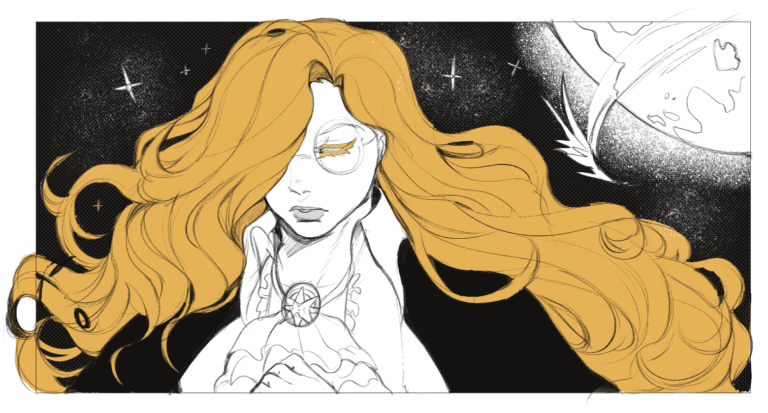
“Are you lost, Death?” I ask. “This is Earth, a provincial stage for a performance of your size.” I draw one measured breath, and the Aphelion drinks enough composure from me to steady her descent. “Begone.”
The command crosses the distance between us and returns with its insult intact.
A sensible enemy would tear through the pilot first. This one chooses the Aphelion instead, taking her apart section by section, forcing me to watch the beloved vessel that carried me across the stars become wreckage.
Very well; if Death wants to make terms of impact, I will meet them. The crash will not kill me, though being unmade molecule by molecule would be an inelegant exit, and I am reluctant to give Death a joke it has not earned.
Magic stirs in my veins. First, I draw the Aphelion into obscurity, smearing her across the corners of every perception that might look up. Second, I muffle our descent. Third, I fold the point of impact.
“Prepare for emergency touchdown, my dearest girl.”
The Aphelion dislikes crashing. The panels flash in clipped red sequence beneath my hands, each warning bright with her wounded dignity.
“I will read your complaint in full,” I promise.
We strike. A collision of this magnitude should open the crust and teach the surrounding islands a new coastline. My warping swallows the worst of it. The Earth keeps its shape. If the planet maintains a department for gratitude, it may write later. For now, the ship lies cracked across hidden space, luminous organs cooling under torn plating, auroral veins dimming in embarrassed pulses.
“Aphelion,” I say, “location.”
The Aphelion waits half a second before answering, long enough for me to know the delay is not damage.
“Kita,” she answers. “One of the eleven wards in Kyoto, Kyoto Prefecture, Japan.”
In a vessel bound this closely to my mind, even silence can acquire manners; this one arrives as a reprimand, and I have earned it.
“Time?”
“04:00 Earth time.”
The Aphelion opens for me with visible reluctance.
The Aphelion’s exterior panels loosen from the hull and fold aside, sending scorched air across the wet pavement. I step down from the captain’s threshold into a sleeping Kyoto ward where rainwater threads the gutters and climbing roses crowd the narrow arbours. Over black garden ponds, weeping willows lower their branches until the leaves comb the surface. Fruit trees lift pale blossoms behind low walls, catching what little streetlight remains. Along the sidewalks, pink shrubs gather beneath Japanese maples and ginkgoes that stand watch beside the wooden homes.
“The lion kills none,” I murmur, for Aphelion through the bond and for the ward around us. “The wolf does not steal the lamb. Unknown is the child-devouring wild dog.” In Spectra, the phrase marks a place where death is not invited.
The Aphelion’s panels fold back into seamless black. I adjust my cuffs and taste the magic Death left behind.
By every Spectrian metric worth trusting, Earth should remain beneath Death’s notice. Magic has not entered its soil deeply enough to teach the planet self-defence; its cities stand without spellwork in their bones, and its nations keep no covenants old enough to trouble the divine. Its wars are loud, blunt instruments of hunger, border, and blood, enormous to those trapped beneath them and pitifully small from orbit. Its animals are tender enough to make violence feel obscene, their soft throats and milk-warm bellies carried through a world they still expect to explain itself before it strikes.
Death would not come here for the planet. She would come for someone on it.
My thoughts settle on the single asset here worth such pursuit: the Summoner of Time. Spectra’s future General. A weapon sharp enough to alter eras, still hidden somewhere in this ward, presumably asleep behind a human door.
Death and I came for the same girl.
It is a race.
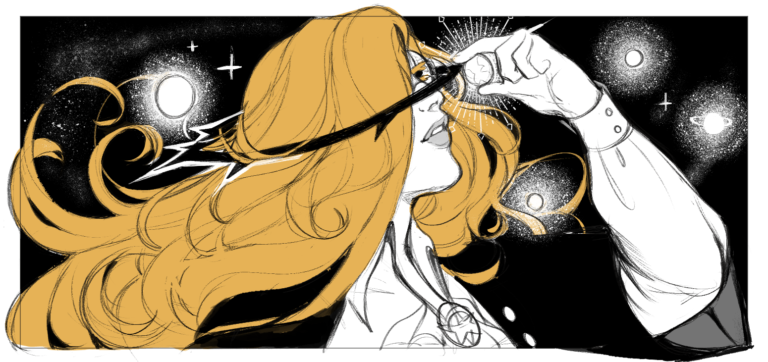
After I clear the worst of the Aphelion’s unstable wreckage and pin a perimeter around the impact site, I tap two fingers to my temple. The communicator unfolds into a pane of light.
D’ivoire answers from his desk with both legs propped over one corner and one arm hooked behind his head, his chair tipped so far back that only arrogance, balance, and a long career in Espionage keep him from disgrace. The connection finishes rendering around his smile.
“Well,” he says, letting the word stretch until it becomes a ribbon he means to tie around my throat. “A shipwrecked Advisor in need of rescue. Had I known, I would have dressed for triumph.”
He has, of course, already dressed for triumph. The open throat of his shirt is too careless to be accidental; the fall of dark lashes over his brown eyes was arranged by either vanity or providence, and I have never trusted providence where D’ivoire is concerned. His skin catches the low light like old brandy held to a candle. We have known one another for thousands of years, yet he still finds ways to steal breath from me before I can pretend I meant to give it.
“Was it the debris field that betrayed me?” I ask.
D’ivoire’s gaze slides away from me and into the telemetry. For several seconds, he says nothing. The chair eases forward on all four legs, and the change is more alarming than any alarm the Aphelion has raised.
“Debris is vain,” he says. “It leaves evidence in angles, in heat signatures, in the little tantrums metal throws after impact.” His eyes move line by line through the damage report, and the mischief drains from his face without haste. “Your hull is not wounded where the field touched her. She is wounded where something remembered she could end.”
I let the silence answer first.
“Hiroyuki.”
“I had hoped you would notice quietly.”
For once, D’ivoire does not reward me with charm. His fingers move through the telemetry Aphelion sends him, drawing damage reports into the air between us until red light washes over his hands.
“Quietly is for enemies I mean to let keep breathing.” His mouth curves, though no amusement reaches his eyes. “Try again.”
I let the warning panels flare and fade before I answer. The ward remains asleep, rain-dark and fragile, while Death’s mark still works its way through the ship beneath my feet.
“I had hoped you would begin with strategy.”
“Better,” D’ivoire says. He plants both feet on the floor and braces one hand on the desk while the other draws Aphelion’s wound-map wider, until red light hangs between us like a curtain of cut glass. “Death followed you.”
“Yes.”
“Is she alive?”
“The Aphelion is injured, offended, and presently deciding which of us deserves blame.”
Relief moves across his face before he can dress it back into beauty. “Tell her I apologise for beginning with the wrong question. A ship with a temper has earned better than triage meant for machinery.”
“She will accept the apology only after sharpening it.”
“Of course she will. The last time I offended her, she assigned my escort the slowest dock in Vissitude and called it traffic.” His fingers cut through another set of commands. “I’ll track your field from here. The Commander will want a full report, and by full I mean the version you do not give when you think everyone else has mistaken urgency for competence.”
I lower my gaze to Aphelion’s wound-map. “How uncharitable.”
“Cruel world.” His eyes move once to the sleeping ward beyond my feed, and when they return to me, all play has gone out of them. “Summoner?”
“Nearby.”
“Awake?”
“Unknown.”
“Human-raised?”
“Likely.”
His mouth closes around the next question. In the red light of Aphelion’s damage reports, we both recognise the shape of it: whether the child will survive first contact with the thing inside her. Neither of us enjoys asking questions whose answers may already be bleeding into the street.
D’ivoire’s fingers move again, slower this time, sorting rescue routes, jurisdictional locks, treaty ghosts, and all the little administrative teeth Spectra hides in its mercy.
“I can extract you,” he says. “You and the Summoner of Time. Not tonight, and not cleanly.”
“How long?”
“On our side, perhaps a few days, if the Commander decides impatience is a legal argument.” His eyes flick through another column of data. “Earth will feel it as months. Unaligned planet, Summoner contact, damaged Celestial vessel, Death’s residue on the field, and every department with a seal will want to prove it knows how to bite paper before it bites a crisis.”
“An elegant use of government.”
“A traditional one.” His mouth curves, but the worry does not leave him. “Keep her alive until I can make the paperwork admit extraction is the only sane conclusion.”
“If anything tries to eat you,” he says, making himself lighter because the alternative would be affection in its least useful form, “let it choke on the attempt.”
“If anything tries to eat me, I will consider your advice.”
“Keep channels open.” He leans closer to the pane. “Hiroyuki.”
“Yes?”
“Do not perform nobility alone down there.”
The call cuts out before I can answer. For a moment, only Aphelion’s damage reports remain, bright and accusatory, along with the old inconvenience of being known by someone who has earned the right.
For one breath, I remain under the trees while the ward sleeps around me, because danger is not the only thing that follows a man through the dark.
D’ivoire and I met long before the Academy congratulated itself for discovering us.
I was young by Spectrian measure, sent into the Simulacrine Enclaves under the respectable name of observation. The assignment was cruelty dressed in pedagogy: gold and doctrine lowered into manufactured squalor so an instructor could record which part of me learned pity first. The streets there had been built to study desperation. Even the gutters served a curriculum.
D’ivoire found me at a broken water kiosk with one hand in his pocket and a smile too sharp for the age of his face. He offered, for a price, to make the machine believe it still had mercy in it.
I let the water answer instead.
It rose from the cracked spout in bright beads, circled my wrist, and hung between us in a small constellation that refused the ground. Any sensible child would have stepped back in wonder, or fear, or calculation.
D’ivoire stepped back once and said, very quietly, “You do not belong here.”
“Neither do you,” I told him.
We did not trade names. Names would have made the moment ordinary, and neither of us had survived our childhoods by mistaking ordinary things for safe ones. What we traded was attention, the first kind I had not been taught to offer, and the first kind he had not been taught to trust.
Ten thousand years later, outside the Academy interview chamber, we sat side by side on hard benches beneath lights bright enough to interrogate bone. He told me then that he wanted the Advisor’s post because Spectra’s maps ended too early, and he had no intention of confusing a border with the end of the world.
I thought the reason frivolous. I also understood, with perfect clarity, that he would reach what lay beyond those maps or leave the institution limping behind him.
I am still thinking of the boy at the broken kiosk, and of the man who has just ended my call before I could object to being understood, when the night drops a child at my feet.
The sound is not graceful. A heavy thump breaks through the ward’s sleeping quiet, followed by the smaller indignities of leaves, petals, and one loose twig surrendering to gravity after her.
A girl of perhaps fifteen summers lies on her back a few metres away, staring up at the sky. The angle of her limbs argues for a fall rather than a collapse. The tree above us shivers faintly, its branches still unsettled by the crime of being climbed and then abandoned at speed. Blossoms turn loose in slow spirals. Her hair buns have begun their surrender, threaded with petals and twigs; a scratch crosses one cheek, and one boot has slumped halfway down her ankle.
I smile before discipline can reach my mouth.
Of all the ways Earth might have chosen to greet me after an attempted execution in its upper air, it sends a child out of a tree.
I did not expect anyone outside at this hour. Four in the morning is an hour for urgent business, guilty errands, and children who have learned that obedience does not always lead them somewhere safe. A girl does not climb a tree in the dark for sport while Death’s residue still curdles the ward around us; either she is running from something, hiding from someone, or simply reckless.
“You have chosen an ambitious hour for horticulture,” I remark, stepping closer. “Do you require assistance, or are you conducting a private argument with the pavement?”
Her reply begins with a grimace, passes through a pout, and culminates in histrionic suffering. “Is it naptime already?”
“Not quite. It is four in the morning.”
“Four in the—”
The unfinished sentence dies in her mouth, and when she looks at me properly, the night changes shape. Acid green burns through the dark, bright enough to make the garden forget its own shadows. Feline pupils cut the colour. Celestial is the first word my mind reaches for, and the first word to prove insufficient. Her magic answers mine from too deep a place, raw and untrained with a force no ordinary bloodline could survive carrying.
She jolts upright, props herself on both hands, and crab-scuttles away with such offended speed that I nearly forgive the lack of dignity. Once she has placed what she considers a survivable distance between us, she points at me with indignity.
“You saw nothing.” She winces and glances toward the sleeping houses before lowering her voice to a furious whisper. “Actually, you saw a tree. A normal tree, minding its own business, with absolutely no girls falling out of it. If you tell my mother, I will deny everything, accuse you of slander, and haunt you.”
This level of dramatics at four in the morning is admirable.
“Lively, regardless of the hour.” I glance up at the treacherous tree. “Is it reasonable to assume you are a morning bird?”
Her eyes narrow. “Yes?” Then suspicion catches up. “No. Wait. Why are you asking like that?”
“Curiosity.”
“Adults always say curiosity right before they do authority.”
“A fair indictment.”
She studies me harder. Fear gathers in the corners of her mouth, in the way her fingers press white against the pavement, in the quick little measurements her gaze makes past my shoulders.
Behind her, the tree groans. A branch that held green a moment ago curls inward at the leaves. Blossoms brown from the stem outward and drop one by one into her hair. The bark around the place her hand must have gripped has begun to pale with the exhaustion Death leaves in living things after she has touched the air around them.
“Are you plotting against me?” she asks.
“Currently, I am deciding how long that tree remained alive after you climbed it.”
She blinks. “Remained?”
“It was healthier when you fell.”
Her eyes dart up. More petals come down, shrivelled at the edges.
“Stupid tree. Of course it would wait until I was on top.”
“It held you as long as it could,” I say, watching the leaves wither. “That may be more kindness than this night intended to allow.”
Tenderness finds her face before she can bar the door. She resents it at once. Her attention cuts away from the dying tree and fixes on me, gathering evidence with the severity of a little magistrate: the long coat, the cuffs, the fall of luscious hair, the gold light gathered in my eyes, too bright and too old for any ordinary human face. Suspicion returns to her in haste.
“You’re dressed like a Victorian vampire.”
“I will try to survive the injury to my craft.”
“You made that?”
“Every stitch.”
“You look like a Victorian vampire, too.”
“A pity,” I say. “I was aiming for bereaved aristocrat.”
“And your eyes are glowing.”
“So are yours.”
She touches one cheek, alarm breaking through the performance. “They are?”
Before I can answer, the cold arrives behind her.
Death borrows a mother’s outline and stands behind the girl in the wet street: a gaunt woman with one hand cradling an expectant belly, grey ribbons braided through hair that might once have been black, and flowers dying slowly between fingers too thin to have gathered them gently. She smells faintly of old linen, rainwater left in a basin, and the sweet rot beneath funeral blossoms.
The girl does not turn. The child has no reason yet to understand that some hungers learn to speak in the voices that should have protected them.
Death leans into her ear and offers the oldest cruelty in the world as comfort. Rest, little one. You have been brave beyond the point of usefulness. No one will ask you to do another task here, and no one will hurt you after you come with me. Sleep can be a country if you let me carry you over the border.
A Shadow reaches us before Death’s hand does.
She throws herself backwards before thought can catch up, palms tearing through wet dirt, heels kicking for purchase. Fear opens her mouth but does not empty her body of sense. She tucks her chin. Turns one shoulder away from the strike. Keeps her knees under her even while she scrambles. Her fingers hook into the earth with such force that the soil fractures beneath her nails.
A child should not know how to fall away from Death so efficiently.
The creature drags itself out of the dark after its failed strike, an eyeless mass of slick black, faces blooming and sinking across its surface, tendrils lashing, mouths opening in the slime it leaves behind. The air around it curdles. Blossoms collapse to ash before they touch the ground.
The girl stares at it, shaking so hard the cracked earth trembles beneath her hands. Then she screams, and morning tears open around the sound.
I do not go to her. The Shadow understands me well enough to spend its violence elsewhere. It lets its blind faces turn past me and fixes every mouth, every tendril, every slick and hungry surface on the girl instead. She notices. Betrayal moves through her faster than terror. Her eyes flash to me, furious and wet, and for one instant she looks less like a child who expected rescue than a child confirming, bitterly, that rescue has failed before.
“You must stand,” I tell her, and my voice cuts through the creature’s shrieking. “Your planet will not protect you.”
The Shadow tears its arm free of the earth; Death blooms from the wound in a black ring.
It rolls through the grass, drinking colour as it goes. The flowers bow first, their bright heads caving inward, petals loosening into grey meal before the stems can finish falling. Pollen turns to ash in the air. Beetles seize beneath the leaves, legs tucked tight, their lacquered bodies curling into small black commas. Ants vanish in place, leaving only pepper-fine specks in the tunnels they spent their brief lives building.
The ring reaches the roots.
A nest hidden in the branches gives one frantic shiver. Tiny beaks open without sound. The fledglings drop together, soft and unfinished, gone before their feathers touch the soil. Above them, the tree receives the rot from below and cannot refuse it. Grey climbs through the bark in branching veins, root to trunk to crown, swallowing sap, leaf, lichen, fruit. One breath ago it held shade, shelter, green weather. Now every leaf pales at once, curling inward like burnt paper, and the whole tree stands dead around the place she fell, a monument raised in the colour of old bone.
I lift one hand.
The ring stops at the garden walls. It presses there, hungry and offended, unable to pass into the sleeping houses beyond. I will not save the girl from the test before her. I will save the ward from becoming an altar around her.
She sees the gesture. She sees the boundary. She understands enough to hate me with accuracy.
“You can help,” she says.
“I can.”
“And you’re choosing not to?”
“I am choosing the mercy that may leave you alive after I am gone.”
Her face twists around the answer, fear and fury pulling in opposite directions. “What does that even mean?”
The Shadow raises one arm.
At first, the limb is only a column of blackness, slick and jointless, dragging threads of itself from the pavement. Then it begins to remember shape. Tendons of tar braid together. Faces flatten along the length of it, mouths pressed wide and silent into the forming handle. Teeth surface where an edge should be, thousands of them arranging themselves with the awful care of ornament. The weapon grows heavier as it becomes understandable, broadening into an axe too large for any human hand, its blade scalloped like cathedral ironwork and wet with the same hunger that killed the tree.
The girl’s eyes follow every inch of its making. Fear holds her still; recognition keeps her from wasting the breath on denial.
“It means,” I say, “you must stand.”
Any ordinary creature would die when the axe falls.
She throws both arms over her head with a strangled noise. The axe descends, and the ground answers by trying to empty itself. Pavement buckles beneath her knees; cracks race through the rose arbour and split it down the spine. The nearest streetlamp bends until metal screeches, then glass sprays outward in a bright little burst. Farther off, a parked car lifts, rolls once through warped space, and slams back to earth with smoke spilling from its seams.
The girl remains half-sunk in the widening chasm, arms unbroken, skin unmarked, face pale with shock. My earlier conclusion proves itself with unsettling grace: she is nearly impossible to kill.
She peeks between her forearms, and every mouth on the Shadow opens at once. Its surface ripples with appetite. Faces crowd upward through the black, pressing over one another for a better view, while tendrils patter against the broken pavement with quick, eager strokes. The first axe lifts again, slowly this time, granting the girl a full view of the teeth along its blade. While it rises, the other arm begins to change. Tar pulls into a handle. Mouths flatten along the grip. Teeth arrange themselves into a second edge.
The axes come down from both sides, and the garden breaks into a cratered anatomy: split arbour, dead tree, cracked pavement, streetlamp stuttering overhead with a bulb that cannot decide whether it survived.
Every impact shoves the girl deeper into herself. I watch for the moment fear becomes pattern. If I save her now, I preserve the child and endanger the Summoner. If she survives herself, she may survive what Spectra will ask of her. It is a cruel arithmetic. It is also the kindest sum available.
She drags in a breath and glares at me through flying dirt. “You really think I believe you can’t help?”
“I never said I could not.”
Her mouth opens. Closes. Opens again in pure disbelief. “You’re terrible.”
“When the work requires it.”
“And calm about it.”
“Calm is not the absence of concern,” I say. “It is what I can offer you while concern would only teach my hands to shake.”
The Shadow changes tactics. It seizes her by the shirt with tar-dark fingers and hauls her up to its many faces. Her hands pass through its wrist. She kicks, claws, and swears in a language this neighbourhood would prefer not to learn at four in the morning. The buns in her hair finally give way; dark hair spills loose, full of petals and black slime.
“It has stopped trying to kill you quickly,” I say.
“What a comfort,” she snaps, twisting hard enough to tear one sleeve at the seam.
“It is choosing a slower curiosity. That is worse.”
Her eyes flash toward me, wild and wet with panic. “Then do something!”
“I am.”
“You are standing there!”
“I am watching where it reaches.” My voice remains level because hers cannot. “It cannot keep your body dead, so now it is looking for what else can be taken.”
The Shadow lifts her higher. Faces crowd through its surface, each one blind and hungry, mouths working around sounds that have not yet learned language.
Kohana goes very still.
“What else?” she asks.
“Breath. Will. Memory. The little hinge in the mind where a person agrees to stop fighting.”
“I’m not agreeing to anything!”
“Then make your body prove it.”
The Shadow flips her upside down by one ankle and lowers her over a forest of mouths. Its body widens beneath her, becoming a drooling cavern.
Her scream catches once, shudders, and turns furious.
“How?!”
“Do not let it eat you,” I advise. “Being consumed by a Shadow will kill even you.”
“Thank you,” she snaps, curling upward with considerable effort, “for the thrilling update from the murder weather report.”
To her credit, she listens. She bends against the drag of her own suspended weight, catches the tendril at her ankle, and starts pulling herself up it hand over hand. Petals and black slime slide from her hair. Her teeth bare; her breath tears rough through her nose. The Shadow lowers her inch by inch, mouths opening wider below, savouring the insult of making her climb toward the hand that means to feed her to the dark.
“Perhaps your talent lies in enduring the worst rather than dealing it,” I muse. “I am running out of time to confirm which.”
“You’re wrong.” Her voice forces its way out from the knot of limbs and teeth, scraped raw by fear and sharpened into fury. “I can fight.”
“Then make it regret teaching you how.”
Provocation suits her better than comfort. Comfort asks her to trust the hand offering it, and she has not survived this long by handing trust to strangers in beautiful coats. Anger, at least, belongs to her.
The Shadow opens wider. She disappears into the mouth. For one terrible second, the garden holds only the creature’s triumph. Black mass folds around her with the satisfaction of a fist closing over a captured bird. Its many faces press outward through the slime, blind mouths working at the shape of her name without knowing how to pronounce it. Behind her, Death smiles through borrowed flowers, one maternal hand resting on the curve of her stolen belly.
I step back to widen the field, giving the ward room to receive whatever her magic breaks loose. The choice feels cruel in the body. It remains correct.
Time tears out of her.
Seconds spear through the Shadow’s centre in warped, acid-green shards. One mouth ages into dust before it finishes closing; another rewinds into shapeless tar, teeth sinking back beneath the surface that made them. Tendrils freeze mid-lash, then jerk through five failed futures at once. The creature’s body cannot decide whether it has already eaten her, has not yet reached her, or died around the attempt. The contradiction rips it open.
Shadow bursts across the crater in ropes of gelatinous dark. The garden receives pieces of it with obscene little impacts: over the split arbour, across the dead tree, along the cracked pavement where her fingers had broken the soil. The girl staggers out of the collapsing body, coated from hair to boot in black, eyes narrowed against the smoke of ruined seconds. She scrapes a gob of Shadow from her forehead with two fingers and flings it aside in brisk disgust.
Pride rises in me before I can smooth it into doctrine.
“There,” I tell her. “That was yours.”
“My everything,” she pants, bent over one knee, “has filed a complaint about your teaching style.”
“A fair beginning.”
The Shadow howls and tries to gather itself. It cannot remember the correct order. Pieces crawl toward one another, overshoot, recoil, and shudder through broken intervals where form should have been. A face blooms backwards into a hand. A tendril becomes a mouth, then forgets hunger and slumps into tar. Around the garden boundary, Death presses harder against my warding; the walls answer with a low gold flare, and the night hisses where it fails to enter.
“End it while its shape is still arguing with itself,” I tell her.
“That sounds fake, and I hate that I understand half of it.”
“A thing rebuilding its body must choose what it is before it can choose where to bite. Interrupt the choosing.”
The Shadow answers before she can curse me for the instruction. Pieces of it snap outward from the torn mass, black beads slung through the air with teeth opening along every curve.
Her body moves. Time thins around her, and I feel the change press behind my eyes. Falling dust begins to descend in separate grains. The streetlamp’s flicker stretches until each pulse of light hangs by itself in the damp morning air. The Shadow’s teeth travel toward her in slow, crowded arcs, and she slips between them with a grace too sudden to belong wholly to instinct.
Her left hand cuts two fingers downward, then closes into a fist before I can decide whether the gesture meant anything. A habit, perhaps. Or the first shape a frightened body makes when it remembers a lesson the mouth has no intention of admitting.
A black bead passes where her throat had been. Another grazes loose hair and leaves frost glittering along one strand. She turns, stumbles, catches herself against the cracked lamp post, and sucks in air through her teeth, furious that her lungs still require cooperation.
The barrage falters. She plants her feet. The position is clumsy enough to be believable and familiar enough to trouble me.
“I don’t know what I’m doing,” she says.
“You know enough to lie about knowing nothing.”
Her eyes flash toward mine, fear bright under the insult. “I’m not lying.”
“No. You are surviving around the truth.”
The Shadow drags more of itself together, one mouth folding into another, tar knitting over exposed hollows.
She wipes her mouth with the back of her hand and leaves a black streak across her cheek. “How do I make it stop?”
“You are asking the wrong question.”
“Because that has been so helpful for me.”
“You are not moving faster than it,” I say. “You are choosing which seconds are permitted to reach you. Look at the moment it commits itself. The instant before the strike becomes inevitable. Take that from it.”
Her fingers flex near her side, arranging themselves for less than a breath into a shape her face immediately denies knowing. She drops the hand before I can name the habit, which is, of course, an answer of its own.
“There’s magic in me?” she asks.
“There is power answering you.”
“I don’t have magic.”
“Then give it another name until honesty becomes convenient.”
She may not know the Spectrian word for what rises in her. She may not know any word that would survive translation into this small, rain-dark street. Yet her body knows more than her mouth intends to confess.
Her fingers flex near her side. Two fingertips skim the pulse inside her opposite wrist, counting something no ordinary child thinks to count while a monster gathers itself for the final strike. When she catches the direction of my gaze, her hand drops flat against her thigh.
The Shadow drags every surviving piece of itself into one weapon. Its mouths seal along the length of it. Its faces sink beneath the surface. Hunger narrows until it has the shape of a spear.
Kohana sees it coming, and the performance leaves her. Terror remains, stripped of costume. She knows the creature’s hunger, the dead tree, the broken lamp, my refusal, and the impossible fact of her own bones still holding after every blow meant to erase them. Beneath all that, older than the morning and sharper than fear, she knows the humiliation of being moved by forces larger than her and expected to call that movement fate.
Her breath enters slowly.
The garden begins to listen.
Her breath leaves, and the next second fails to arrive.
Cracked pavement rises from the ground in heavy plates, soil dripping from broken roots beneath. Rose petals stop mid-fall with rain trembling along their edges. The dead birds hang inches above the dirt they never reach. Streetlamp glass remains suspended in a glittering arc, each shard holding a small trapped version of the morning. Even the clouds above the ward pull taut, stretched thin by pressure rolling outward from her body in widening rings.
The wave strikes my boundary.
My warding bends. It does not break, but it bends, and that is answer enough.
The Shadow reaches the edge of her at the same moment Kohana opens her eyes. She lifts one hand, palm out, not like a child begging for mercy, nor like a student performing a lesson exactly as taught. The gesture is rougher than training and older than speech, a refusal her body has been saving for a day when terror finally came close enough to touch.
“No farther,” she says.
The words enter the world and take the creature’s future away.
Time locks around the Shadow mid-lunge. The spear-point stops less than an arm’s length from her chest, its black surface cracking into hard green intervals, seconds made visible in jagged layers across the tar. One mouth remains half-formed beneath the frozen surface. A tendril hangs behind it, caught in the act of becoming violence. The air drops cold enough to sting the lungs, though the ground still floats and the sky still strains above us without moving.
This is not ordinary chronokinesis. A temporal command alone would arrest motion, perhaps aging or unmaking what it touched. It would not lift stone, suspend debris, stretch weather, and force my warding to bow around the shape of its passage.
Time has obeyed her.
Space has made room.
I file the distinction away with care.
She stands with her hand still raised, black slime drying on her sleeve, petals caught in the ruined spill of her hair. Her knees tremble so violently that the floating stones around her answer with small shivers. For a while, she only stares at the Shadow, as though waiting for the world to confess the trick, then she looks at her own hand. The smile that starts to form is too bright and too quickly hidden.
“I did that,” she says.
“You began it,” I tell her. “The rest will take teaching.”
“I told it no.”
“You took the moment it meant to use against you and made it answer to your hand.”
Her mouth opens around some fresh accusation, then falters as her gaze moves past me and finally understands the garden. The pride in her expression tightens under consequence: the broken arbour, the dead tree, the birds held above the soil, the circle of death contained inside the reach of my ward. Her joy dims by increments, and each increment hurts to watch.
“Are there people?” she asks.
“The houses still hold their sleepers. I stopped the ring at the garden walls.”
Her shoulders lower by a fraction.
“But animals died.”
“The smaller lives were nearest the breach,” I say. “I could not draw the ward fast enough to spare them.”
She looks at the birds. A child cannot carry the whole world at once; she tries anyway, because some forms of power announce themselves first as grief. Her fingers curl against her palm, then open again with careful restraint.
“Can I fix them?”
“Not today.”
The answer wounds her. She swallows it whole and makes herself look elsewhere.
“You’re an alien,” she says.
“An extraterrestrial, yes. I was born in another universe.”
“I knew it.” Excitement breaks through before she can stop it, bright and traitorous beneath the horror of the suspended garden. She catches herself almost immediately and glances back at the birds. “Sorry. Bad timing.”
“Wonder rarely waits for a clean room.”
She studies me with renewed suspicion, weighing the gold hair, the formal coat, the eyes that have not dimmed enough to comfort her. “Are all aliens this annoying?”
“No,” I say. “I have cultivated the distinction personally.”
She snorts, then immediately pretends she did not.
“I need to contain this before your planet begins asking questions it cannot survive having answered,” I tell her. “After that, I must return to my ship and persuade the Aphelion not to express her disappointment through permanent silence.”
Her eyes brighten at once.
‘Ship,’ apparently, is the word that survives every catastrophe. I take the opening and dress it as courtesy.
“My name is Hiroyuki D’Accardi,” I say, inclining my head. “You may call me Hiroyuki, Advisor, sir, or any insult that demonstrates imagination.”
She looks me up and down. Suspicion regains its throne. “That sounds like a trap.”
“It is an introduction.”
“Introductions can be traps.”
“An excellent instinct.”
She glances toward the folded space where Aphelion lies hidden, and longing betrays her before caution can pull the curtain back into place. Her home still waits somewhere beyond the ward: mother, door, curfew, school, a life that has no room for frozen Shadows or ruined gardens. For a moment she looks fifteen in a way no prophecy should be allowed to use, slime on her sleeves, twigs in her hair, power still humming around her like the aftertone of a bell.
She lifts her chin.
“And if I tell you my name,” she says slowly, “you show me your ship?”
“The Aphelion is not a toy.”
“That wasn’t a no.”
“It was the portion of a no that courtesy allowed me to begin with.”
Her eyes narrow. “You talk like a museum plaque.”
“I have survived worse accusations.”
She bites her lip, considering me, the hidden ship, the frozen monster, and the terrible seduction of being the sort of girl who can tell time to kneel in the street. The grin returns, smaller than before and braver because she has had to rebuild it by hand.
“Ohuang-Zhùróng Kohana,” she blurts.
The family name reaches me before the given one.
Ohuang-Zhùróng is a name one learns young if one’s work requires listening at the sealed doors of Spectra. It belongs to appointments made before childhood, to bloodlines that turn cradles into offices, to corridors where adults lower their voices around the word destiny. I keep that knowledge from my face. She has given me the name with mud on her knees, Shadow slime drying on her sleeves, and ship-greed brightening her eyes, unaware of the machinery she has set moving in my mind.
“Kohana,” I repeat, choosing the part of it that still belongs most to the child.
She points at me. “Tomorrow. After school. Same spot. Ship tour.”
“I made no such agreement.”
“You negotiated badly.”
“I did not negotiate.”
“That’s why you lost.”
Despite myself, I smile. “You are very confident for someone standing inside an active temporal crisis.”
“And you’re very judgmental for someone whose ship crashed into my neighbourhood.”
“A fair criticism.”
She backs away with all the dignity a child can manage while coated in Shadow remains, then lifts one finger in warning. “You saw nothing.”
“So you said.”
“I mean it. No tree. No monster. No glowing eyes. No me.”
“I will endeavour to forget with appropriate seriousness.”
“You better.”
She turns and bolts down the street, then remembers stealth halfway through and becomes a small, furious ghost slipping between garden walls. I watch until the last petal in her hair disappears around the corner.
Behind me, the Aphelion hums through broken metal, weary and alive. Around me, the stolen second waits for judgment. Above, the morning holds itself back from becoming day.
I crossed universes for the Summoner of Time and Space.
I found Kohana instead: twigs in her hair, Shadow ichor on her sleeves, grief already learning the shape of her hands, and enough nerve to bargain for a ship tour while time stood around her like a conquered court.
I do not expect to forget her.
15 responses to “i.) is this darkness in you, too? / have you passed through this night?”
From the first chapter I do really dig the scope of how things are leveled. The characters and the scope of their sheer existence and what death can mean for the universe by their own destruction. The ship being treated almost like a character itself was also a nice touch. Death as the antagonist is very eerie and the way it’s moving about causing darkness is very cool.
Once the shadow battle starts the descriptive nature of it’s being and precense is well detailed. Knowing Hiroyuki was to just stand there and not intervine to seek if she truly was the summoner really seels on her demeanor and her role as an assassin. The level of destruction in this is so wild. Like dang these battles are taking out cities lol.
Her realtionship even in the first chapter is like that of siblings with a big age gap, well at least when she’s not watching her fight on her own lol.
Outtaike whole battle with the shadow was pretty cool. Watching her triumph over her fear and her need to prove she is more than just a weak child which eventually helped her win the fight was great. She really plays off as the kid who doesn’t want to be looked down on trope quite well.
I just want to say I really digged the first chapter so far. I’ll try to read out the rest whenever I get the time. A good read and a good concept you have here so far.
Reading something narrated by Hiroyuki is SUCH a treat. You can really see how charming he is with his wit and confidence, carrying himself with so much composure that comes with all of his experience. Even the way he talks is so nice and soothing, I’m a little envious of Aphelion!
‘Death and I are two sides of the same coin. It knows I am a being of unhinged slaughter beneath my self-possession.’ Also this line, I absolutely love it. It’s so raw, a line from a story and what feels like a poem at the same time.
And D’ivoire!!! He made me snicker when he said ‘send my apologies to the lady’, it’s so amusing. He seems like a character just as charming as Hiroyuki with an open mind to things and I’m so excited to eventually see more of him.
Hiroyuki’s interactions and observations of Kohana are really entertaining. Kohana is such an adorable girl, and seeing him be so interested by her and her ways makes my heart so warm ♥ I admire his resilience to stand by so calmly and watch her go through it, and teasing her all the while.
And Kohana – gosh, she really is so adorable. She has so much energy and a hilarious way of going back and forth between handling situations so well, then bantering with Hiroyuki in such a humorous way. Her personality really is so refreshing and gives me so much excitement as I watch her story begin!!!
I am just love, love, LOVING how you describe things and how vibrantly the characters personalities were described,,,,
Thank you so much! I’m glad you’re enjoying yourself! <3
I love the choice that you had in switching the first chapter to Hiroyuki‘s point of view. It allows us to really view the action without the chaos that Kohana feels!
I think a lot of it very well paced and I enjoy how the fight scene felt super fluid !
*** “Death drags its spindly fingers against the hull of my ship, but death shall have no dominion.” & “I can hear each grain of sand fall from the hourglass of my life, the hands of time ticking softly.”
i weep these are such beautifully constructed sentences
*** “Had the Earth been a sentient planet […]”
LISTEN
*** ““Merely curious. Speaking of curiosity… How is it that you managed to climb this worse for wear tree?” I do not remember the tree being this sickly a few moments ago.”
AAAAAHHHHHH i love this small sentence, with haunting foreshadowing
i really love the new description of the shadow’s attack, how it blends brilliantly into the conversation and their interaction; it may be sudden, but effective, and gross i’m still disgusted by the shadow and always will be. but i’m not gonna post spoilers (i hope) just know it’s still disgusting and i’m still in love
*** “Fortunately for this girl, she possesses an immunity to almost all forms of harm and ailments, including extreme force and high temperatures.”
so has she never gotten sick? never scraped a knee while climbing or twisted her ankle? :thinking emoji:
*** “It cannot maintain cohesion, ergo, it keeps falling apart and is largely distraught by it.”
WHY DO I LAUGH EVERY TIME AT THIS SENTENCE WHY
okay so I’m sure I’ve mentioned this before but you have this rare ability to form sentences without reusing words or while using different words that most people wouldn’t consider …. like describing the battle, you kept a certain pace which flowed like actual fighting, and i didn’t have to stumble over words like someone just cracked open a thesaurus to sound more intelligent, your diction /makes sense/, like these are sentences I’ve waited my whole life to read
“Death shall have no dominion” is probably one of my new favourite quotes now because of just how fate defying it feels. Finally got around to properly read the first chapter and I do have some things to say:
I love how detached Hiroyuki seems from things initially, save for his poor ship. As a being who’s been alive for so long and have seeing all kinds of things and planets, him being unfazed by this creature and Kohana’s initial outburst is not only funny, but a bit endearing. I’ve always been really interested on his characterisation a lot by the bits you tweeted before and needless to say, I’m not disappointed to know that he’s far on becoming one of my favourite characters.
As for Kohana… What more can I say about Kohana. She’s always been a pretty intense character and seeing this side of her and how at first she’s in denial about the Shadow and Hiroyuki just watching over her being “I’m not helping you” made me a bit frustrated, almost as if I could feel what she was feeling.
I died when Hiroyuki got offended by Kohana judging his clothing, it brought such a light mood for an unusual meeting like theirs. Also, bad Kohana. You shouldn’t wander around alone at 4am, that’s too dangerous. 🙁
I think Kohana is a great protag. It gives me a lot of magical girl vibes, and her being an unusual one! She’s such an interesting character, it’s hard to not fall in love with her. Her glowing eyes are such a subtle, nice touch that it also serves as a warning that despite her being a dramatic, intense young lady, it’s fair to remember that she can also be dangerous and deadly. I love this contrast so, so much.
I am also very interested on what things might come from Hiroyuki and Kohana’s relationship. They look like opposites and I am very, very excited for the things to come.
Overall, this was a fantastic chapter.
Being finally able to read a/0 after such a long time and hearing bits and bits about the characters on Twitter feels very, very satisfying and… I don’t know how to put it. It feels amazing, that’s for sure.
Good work as always, Sol. There’s something so special about your writing that it’s physically impossible for me to put it down unless I finish reading it completely. It has been like this ever since when we first met and it will never change. I can’t wait to see more and more of a/0 and your writing. I’m sure it’ll be one of the best stories that will ever be written. ♡
Finally got to catch up on this update! The professional editing helped a lot. It really added more structure while keeping your writing style and even brought out your penchant for intense imagery which is a huge strength. The imagery became even better and the greater insight into Hiroyuki’s disposition is also a plus.
The scene where we see Kohana having a wider range of abilities to hint at later revelations is brilliant. I also snorted at the mental image of Kohana trying to do like a tah-dah! Magic gesture with nothing happening. I think a/0 really benefits from the humor you put into it.
Your imagery is intense and gripping and at times bordering on the horrific to the horrific when you want to go there. Rereading chapter 1 is honestly a great refresher and helps me contextualize things and foreshadowing with what is shown later.
One thing I think this chapter does incredibly well is contrasting Hiroyuki against Kohana then highlighting how they come together. The narrative structure of Hiroyuki’s calm disposition in the worst later with Kohana’s introduction in her sheer lack of composure is fantastic. But best above those things is the coming together and bonding at the end of the chapter and the starting of common ground we see.
I’ve always like your writing a lot but with the professional editing, you really are at your best with the fine polish and the fact we get to see more intense word choice and imagery come from it!
I’m also very enthusiastic to see what else comes out of a/0 and seeing more lore and conversation happen on social media is super exciting!!
Hiroyuki is one of my favourite characters and with only the first few paragraphs you have managed to establish just who he is as a person, but also, who the Spectrians are as a whole. While Hiroyuki seems mostly apathetic to the whims of a world which is something he has seen many times before, having him alongside a character like Kohana, who is naive and dramatic, really makes both their personalities stand out and establish their position in the universe.
Again, the dialogue is very fun to read, the story flowing so well between each interaction, and keeping one on their toes. The way in which Hiroyuki and Kohana bounce off each other makes way for a lot of information to be given without seeming too overwhelming.
Keep up the good work and I look forward to the next update!
I really really like how clear Hiroyuki’s disposition is, and the personality in just the first couple paragraphs. The transition between the race with Death/the crash and the like, almost bored “ah its just Tuesday” way that Hiroyuki addresses his own predicament in, and the familiar and casual way he talks to D’ivoire about being stranded on an alien planet is so great imo. It really establishes early that the cosmic is basically nothing to him or Spectrians at large because it’s literally Their Business. And again the apathy when he tosses a child he just met to the wolves. Hiroyuki goes hard
Chapter update YES! I think the introductory paragraphs were beautifully terrifying. I absolutely love how it transitions from turmoil to peace, but also setting up whats to come! Hiroyuki has always been a favorite character of mine, so seeing his personality flourish in this chapter feels like i’m being fed!
Ok so I’m gonna fistfight Hiroyuki behind Denny’s because some instinct is like NO THE EARTH IS ALIVE IT IS BRILLIANT IT IS — but I digress.
This chapter flows more easily than the original first. That you’ve compacted these events into one chapter is admirable without lessening their impact. We learn of Spectra from introspection first before being plunged headfirst, like Kohana, into a Shadow. Military mantras are heard but not fully understood. You cannot read this without a visceral reaction to your wording.
SHE’S SO DRAMATIC MY FACE HURTS FROM SMILING. I laughed, even while entire neighborhoods perished. This chapter endears us to Kohana at first glance, a requirement for me when reading novels. I need someone or something to latch onto, to keep my interest, and she does so effortlessly.
I want to sort of begin this maybe-not-so-eloquently-put comment that the impact of characters is what I look at the most every time I pick up a novel. If the characters themselves are not vibrant enough, not compelling enough, or do not inspire my own imagination in the ways of which I imagine them as I read, then I find myself getting lost in the narrative.
I am introduced to Hiroyuki in this chapter, who even in the first sentence exposes me to the way his mind works– an analytical man who thinks through his current plight in logical steps, who is undisturbed by other happenings around him and who goes beyond just being a normal engineer, but a man who loves his ship and is genuinely upset by what the crash has done to it. I think what makes me like Hiroyuki so much isn’t so much how much he loves his work and has all this passion, but moreso how he doesn’t become pale or flurried by the apparent destruction around him when Kohana faces the Shadow, which immediately tells me that this man is powerful by nature and by ability, who, in contrast to Kohana who is far more emotive, has a lot of experience under his belt that only future reading could tell me. I begin to wonder what Hiroyuki has been exposed to in the past during the little treats I’m given of his experiences, and I can already feel that this event is merely a taster, a ripple on the surface, of what is to come to Kohana in the future. This teasing is what compels me to read, and I envy every writer that can do this so subtlety, which you have successfully pulled off.
Kohana’s general naivete in this chapter is so endearing and alongside Hiroyuki, who is far more reserved and poised, just frames her entire being and she becomes a focal point who is easy to follow. Her gestures are excellently portrayed and written, playing on her dramatism and jubilance, and in a way her energy seems to carry me through each word and sentence because she is just that vibrant. Seeing Kohana through Hiroyuki’s eyes is what makes this all the more humorous. Here is a man, shaped by his work and unperturbed by the moodiness of a teenager, watching Kohana as she literally steps into a new life and who takes it all in so childishly, and yet even with all her stubbornness and inexperience, he is convinced that she will be able to pull through and prove to him that she is worth it– something she almost failed to do, but how lucky he is to be right.
Their personalities bounce off each other so well, and this to and fro between these two extremes is what animates this chapter, and even when when the Shadow appeared and the area around them began to get destroyed, with Hiroyuki not even moving in to help her, it was still about them. The camera was still on them. Because what is happening now is nothing compared to what is to come and the reader is immediately introduced to this notion. There are far bigger things in store for Kohana and Hiroyuki has a lot to teach her. How powerful will she become? What are her enemies going to be like if this is but a test?
I’m just excited to see where their partnership takes them, and beyond those things I’ve conveyed above, I really like the warm nostalgic feeling Kohana gives me of a magical girl ready to take on the universe. I just don’t want anything bad to happen to her because she is so adorable …
I’m looking forward to finding out more!
The chapter opens up with Hiroyuki lamenting his ship – and uses his upset in order to reflect on how Spectra, as an institution, and a planet, would have taken advantage of and used his passion for engineering until there was nothing left of him. It helps give the reader an idea of what Spectra is like before Kohana ever has to personally speak to any Spectrian. It’s only a small taste though, and as someone who knows more about Spectra than a first-time reader would, it’s an appropriate glimpse into their structure. It definitely helps drive home the point that Spectra is militarised in every fashion, without betraying just how fucked up they are. It keeps up with the otherwise innocent tone of the rest of the chapter too despite how messed up the Shadow is when it shows up.
Hiroyuki is an extremely fun perspective to read from! He’s so unperturbed by anything save for the destruction of his ship – I feel so bad that it got wrecked, he worked so hard on it?? – but that glimpse into his backstory intermixed with how it affects his current situation is definitely what made me really like him. Even as he’s reminiscing he’s focused on his mission but he still retains a personable and welcoming voice. His narration is very smooth and intelligent and you get the impression that he is extremely respectable. His reactions to everything are also extremely amusing, and it makes it super fun to read — and I really laughed with Kohana’s introduction because it was so silly.
Kohana is so unbelievably cute and her moodiness is really funny and it’s such a ride reading it because you’re right there in Hiroyuki’s shoes as he’s witnessing all of this. How they play off of each other is super entertaining and I really, really enjoyed it because Hiroyuki is so personable. HIROYUKI IN GENERAL is really likeable and how amused he becomes when Kohana is in peril and she just stubbornly refuses to back down from the Shadow and instead chooses to get upset at him was so funny I was losing my mind.
IT WAS SO JARRING AND OUT OF PLACE, the way she was acting in spite of it all, and the fact that Hiroyuki literally just stands there and calmly gives her advice and goads her from the sidelines as she’s being tossed around and eaten by an amorphous blob had me trying to keep from laughing out loud. I felt so bad because honestly it’s serious and you shouldn’t laugh but her attitude was so funny and Hiroyuki’s just standing there with his hands folded all neat and polite in front of him like “die then”. HIROYUKI’S IS SO GOOD .. he’s like, really brutal, even though he’s so polite.
I think my favourite thing is that it really does remind me of like, 90s shounen anime where everyone’s friend is up on stage getting the shit beat out of them and they’re losing their minds while the old master is like “I know they’ll make it soon” and the whole episode is just the person getting beat up only for them to eventually have enough and KO their opponent in one blow. (It really reminded me of Yuu Yuu Hakusho Dark Tournament .. like I was reading it and I was getting those vibes and that’s great because that evokes so many feelings in me lskfl).
BUT IN GENERAL I JUST REALLY APPRECIATE how the whole chapter comes together as well. The sequence of events is literally one unexpected thing (Hiroyuki’s ship crashing) proceeded by another (Kohana falling out of the tree) and another (the Shadow showing up) and even more (Hiroyuki not lifting a finger to help and instead being content to just make commentary and chat with her) AND JUST. EVERYTHING in the chapter is unexpected from every single event to character. And normally I would be concerned that putting so much into a single chapter would result in it coming out as forced, but this does the exact opposite. There’s enough backstory and new information to keep everything interesting while expanding on some of the information we’ve already gleaned from the first chapter.
I also got a super magical girl vibe as well that was really nostalgic .. especially since I know where the whole series is headed, it’s going to become a sort of reference and feel that’s going to sour along with the rest of the character’s lives and I feel as if it’s a really artful touch that counts on people being nostalgic. That’s not to say that it doesn’t stand on it’s own – only that it definitely has a classic flavour and I’m excited to see how that gradually changes and becomes more and more sad the more the series goes on.
I HAVE SOME MORE THAT I COULD SAY TOO but in general I just really appreciated it a lot and it felt “innocent” even though there’s the contrast of entire neighborhoods being destroyed and Kohana clawing the ground so hard she makes like. chasms and just doesn’t notice it.
Like there are a lot of references to her power and starting off with something that’s so powerful and Kohana — a child — destroying it without even really knowing what she’s doing is like. Really setting the bar I feel for how dangerous everything is and how much it’s going to devolve in terms of power and how strong all of the newest enemies are going to be. I’m like really excited for it and I just feel like this was a good solid foundation !
Thank you for such a comprehensive comment, I really appreciate it!