Steam lifts from the neatly folded towels on Hiroyuki’s travel coil, beads of heat standing on the cotton like dew. Eucalyptus hangs faint in the warm air, the kind that opens the chest and tells the hands to unclench. I stand with my toes on the boundary tile where the sentō floor begins—white-blue squares worn smooth by years of feet—and watch the Fuji mural breathe. It picked up a second cloud sometime in the night. Yesterday it showed a single white plume near the summit; now there’s a smaller one drifting lower, like the mountain exhaled twice and is trying to pretend it didn’t.
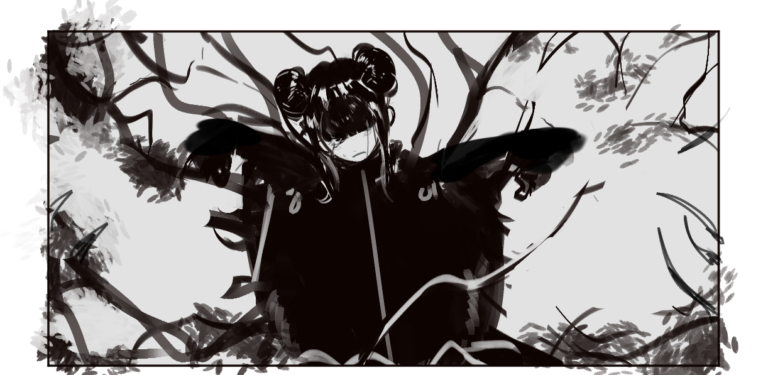
Isleen stays at the threshold. The door latch is an obedient little soldier that clicks once and once only. She inclines her head, and the red eyes braided into her hair close in a ripple, then reopen as if tasting the room. “Behave,” she says, one small word laid on the wood like a palm. The door behaves. Of course it does. In this house, even hinges have manners.
Hiroyuki arranges the tea with apology-shaped grace—kettle, cups, a tiny bowl of rock sugar he never expects anyone to use. The porcelain makes a soft clink that lands like a courtesy in the steam. He pours, and the rising scent is ink and rain, calm written down. He watches it settle instead of watching me.
“Tell me where to stand today,” he says in that low, careful voice that makes a room remember itself.
The mirror above the soap shelf is ringed in black caulk that used to be white. My reflection has slept but not rested. There’s damp in my hairline and a freckle on my wrist that reads paler than it did last night, as if someone scrubbed it with a cloth soaked in tomorrow. The starlit minute hand tucked into my belt-knot hums louder whenever the second hand threatens :56, louder still at :58, a bright ache that gathers around :00 like a mouth wanting to finish a word. I pretend I don’t notice. I pretend many things. This is one of them.
Through the frosted glass, the street ticks. The block is a clock that skips every fourth beat. A delivery driver stops, face emptied of everything but peace, then moves on in a glide that isn’t quite step, isn’t quite roll. Across the way, an elderly woman lifts a bucket with both hands and the water inside refuses to slosh. A mother’s voice descends a stairwell and breaks into polite fragments, each syllable laid down in equal measure like tiles.
Wren is weather. In, out, the kind of movement houses forgive. They cross the bath’s outer hall with a Polaroid between two fingers, bang a magnet onto the wall above the bamboo shoe rack: THIS STAYS A HOUSE. The photo paper is still warming up, flecked with a white that will soon admit it’s a window. “Accounting,” they say, palming yesterday’s image into a pocket deep enough to hold a neighbourhood. “Noon lies. Morning rehearses.” The advice doesn’t even slow down for me. It passes overhead like a bird on an important errand.
“Under-day will visit at bells,” Isleen notes, soft enough not to disturb the cups. She is reading the weather by watching where the steam refuses to curl. I try to catch the way the lips of the steam flatten and memorise it, because I want to be the kind of person who knows a forecast by scent. Her tone holds no drama, only a consequence already scheduled: lunch chimes, passing periods, that trained surge of bodies. She looks at the door again, and the door makes itself simpler.
The phone on the shelf buzzes; the buzz sits obediently on the wood. School alert: Classes resume. A rectangle of insistence wearing polite font. I feel my bones practice the weight of a backpack. I feel the minute hand at my belt lean toward the notification like a cat toward a patch of sun. “Of course,” I tell the air, which owes me nothing. “Of course you do.”
Hiroyuki passes me a cup and the steam paints my face with a quiet heat. He has already placed himself where I’d put him: near the arc where the inner door would swing, close enough to intercept a thing that shouldn’t come in and too far to be mistaken for a threat. He holds his saucer with the careful equilibrium of a man who learned as a child that cups are treaties. There is a small wet circle under his index finger from a drop that preferred skin to saucer; it is the most human thing in the room.
I could tell him to stand by the window instead. I could tell him not to speak to the woman with the lilies at the corner flower stall at precisely :12 because her voice smells like erasures. I could tell him twelve other things and he would do them. The wanting to say it is unbearable. I keep it behind my teeth. I drink.
· · ─ ·✶· ─ · ·
Masae, two blocks away, kneeling on the tile of her own kitchen, touches a cracked line in the grout. I remember, she thinks, just once, like a stubborn match struck in the wind. The thought burns small and bright, then keeps burning. I remember what the city tried to fold and file. Her kettle screams; she doesn’t move until she finishes the sentence.
· · ─ ·✶· ─ · ·
I watch the Fuji mural. The second cloud has drifted a little lower, as if it wants to eavesdrop on the towels. I count how many breaths it takes me to accept that it will remain. The steam curls around my fingers when I lift the cup and writes a thin cursive of eucalyptus onto my skin. The heat sinks into my knuckles and tells them we’re alive.
“Lunch,” Wren calls from the entryway, already halfway out. “Bells at :24. The girl with the striped backpack does not exist today; don’t stare at the place where she would be.” They are talking to the house as much as to us. The house listens. Houses like Wren. Wren smells like developing fluid and stubborn hope and the last third of a laugh.
“Thank you,” Hiroyuki says, the words carried on steam, and whatever god lives in kettles nods along. He doesn’t face me when he asks, “Uniform?” because he doesn’t need the answer; he needs the rhythm of me giving it.
“Uniform,” I echo. The syllables line the cup like tea leaves. My mouth shapes a girl I wore last week: skirt, socks, the neat buttons that always pretend not to notice my hands. Every school morning is a costume party thrown by a city that worships routine. I tie my hair back, and the elastic snaps against my wrist with a sting that tells me I am not a ghost.
Isleen ghosts her fingertips over the doorframe. The red eyes in her hair half-lid, then brighten. “The latch will act like wood,” she murmurs to it, “even when it wants to act like a mouth.” She hums a short bar of nothing. The hinge corrects its posture.
I love her for this, the way she speaks to the things that could become worse things and persuades them not to.
The phone pings again. The alert doubles down: ATTENDANCE MANDATORY; COMMUNITY REASSURANCE. The words sit there, clean, uncomplicated, untrue. My thumb swipes, and the minute hand nested at my belt thrums in sympathy. :56 is near, then past. :57 is a narrow bridge. :58 arrives with a taste in my teeth. :59 is a held breath. Everything in me leans toward :00 like a plant toward a window. I press my thumb flat against the metal. The hum leans back.
In the mirror, I look like a person who slept under a towel at a sentō and woke with a neck that forgives nothing. There’s the line my mouth makes when I’m interested in not saying what I want. There’s the tiny nick just under my jaw, souvenir of a sword I sharpened with a thought and put away before it could look at anyone else. I catalogue everything I can stand to catalogue. The rest, I grant to steam.
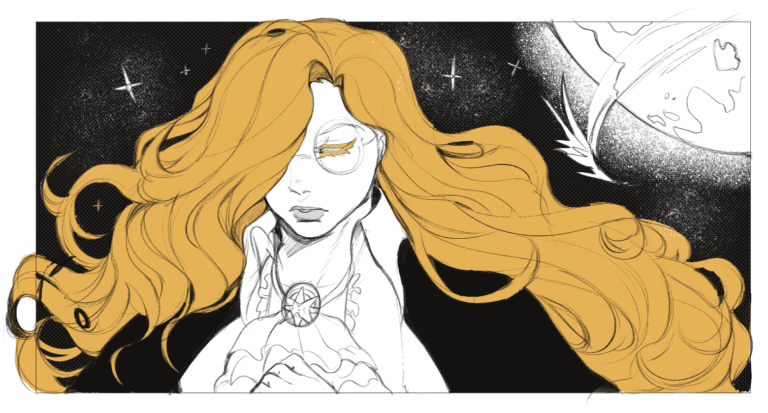
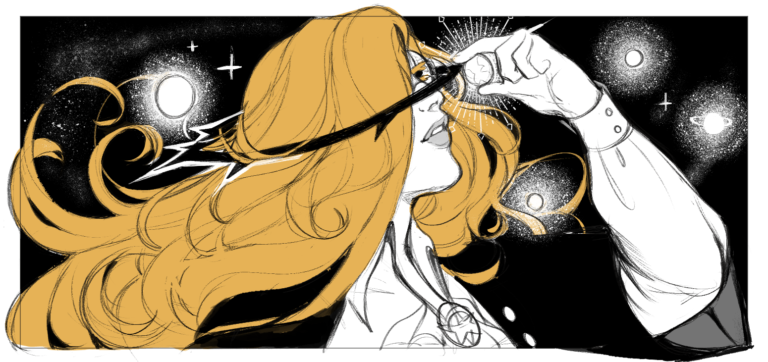
I tip my face and let the light find the place where an eye would live. The socket is smooth skin, a quiet circle that remembers being open. My fringe falls over it in a violet cloud, fluffy and stubborn; the purple is loud even when I am not. Somehow I coaxed all that hair—well past my ankles now—into a low ponytail, and it surprised me by obeying. The length gathered like a tide drawn to a moon, heavy and soft in my hand, banded twice, then again halfway down so it wouldn’t drag like a comet’s tail. It should feel impossible. It feels like a promise I can carry.
Hiroyuki offers the sugar bowl. I shake my head and he sets it down without that little breath of disappointment adults have when you refuse the thing that proves they provided. He lets me keep the refusal. He has learned the algebra of me: how a no laid gently on the countertop is really a yes to standing up straight.
“Under-day at bells,” Isleen repeats, not because we didn’t hear, but because repetition lays track. She tips her chin toward the frosted glass. Outside, the block inhales. I can almost hear the students the city plans to conjure at the crosswalks, the ordinary arguments the speakers will broadcast, the crossing guard’s whistle that will insist the world is stitched back together. You can stitch glass; it remains glass.
The minute hand at my belt hums like a patient insect. It would be so easy to cut a quiet slit in the morning and pass through it, come out somewhere less fragile, somewhere further from a woman with lilies who never blinks at the same speed twice. It would be so easy to tip the hour forward three degrees and watch the block adjust like a bird flinching midflight. I slide the hand deeper under the knot. Hiroyuki’s eyes move, not to me, but to the knot. He knows. I know he knows. I look down at my cup as if it just told a secret and I am granting it mercy.
· · ─ ·✶· ─ · ·
Masae stares at the steam above her own kettle. Today, I will say the name out loud, she thinks. I will say it even if the air throws it back at me as a mistake. Her chest feels full of needles. She sets two cups anyway.
· · ─ ·✶· ─ · ·
The towels finish being warm. The little cloud near Fuji decides to be a little lower still. I breathe in through my nose, out through my teeth, and the room answers with a soft hiss that means we are not in danger, we are only near it. The city beyond the frosted pane moves with that careful cheer traffic lights demand. A hairline crack runs across a square of tile near the drain; I hadn’t noticed it before. It gleams faintly in the steam, a fine white vein.
The phone offers one more ping—an itinerary for the day: homeroom, headcount, reassurance session, lunch. The word reassurance makes a fist inside my mouth. I unclench it. I rub my thumb along the line where the freckle pales and pretend it was always this colour.
“We’ll go,” I say, and it sounds exactly like a promise kept to a teacher I have never liked. Hiroyuki lifts the cup to his mouth and nods with his eyes. He folds the empty towel into thirds and places it where I would have placed it. The smallness of that is what steadies me.
Isleen touches her throat, feels for the note she will give the doors between here and homeroom, and finds it waiting. She nods, already mapping the route, already bribing the locks with good behaviour.
I steal one last look at the mirror. I look like a girl in a house pretending it is only a house. Wren’s Polaroid makes a square of insistence near the shoe rack, still deciding how much of the window to confess. THIS STAYS A HOUSE. Papers can say many things; Wren knows how to make paper believe them.
Outside, a bell tests its throat with a single note. The minute hand warms against my skin like a coin kept for luck. I tuck it deeper. I lie to myself. I tell the lie well.
We step toward the day—Hiroyuki with his cuff straight, Isleen with the door on its best behaviour, me with the minute hand pretending to sleep. The house exhales eucalyptus and steam, as if blessing us, as if counting with us. And somewhere two blocks away, a girl named Masae prepares to step into a school that will try to erase her memory and discovers she has already sharpened remembering into a blade.
· · ─ ·✶· ─ · ·
The hallway decides to be loud the way weather decides to be wet. Chair legs screech across linoleum like gulls. Lockers hiccup, metal mouths swallowing and spitting notebooks. Someone shakes a soda before handing it off; the tab shivers, the can remembers manners at the last second. Candy changes hands in wrappers that whisper. My phone buzzes against my thigh in a thread that reads WELCOME BACK WELCOME BACK WELCOME BACK, and not a single line mentions the dead. Five desks in homeroom sit occupied by new transfers with faces that feel borrowed from a stock room: haircuts a shade too plausible, smiles that hold like pre-printed signatures.
The clock over the whiteboard loses one beat every ninety seconds and then catches it on the next swing. It’s small, but it’s a tell, and I count the misstep as if the room is offering me a place to hide a breath.
I pick the seat by the window because light is easier to argue with than people. My desk carries a faint orange ring from a drink someone set down last fall. The polish under my palm is smoother where a left hand rested for thirteen weeks and then never came back.
Homeroom’s bulletin board wears a fresh border of scalloped paper—mint-green with daisies—and the printer ink of the nameplates has a shine that says it’s still wet in its heart.
“Phones away,” the teacher says with the cadence of morning announcements. Her smile lines are real; the smile is rented for the hour. “We’re going to centre ourselves with gratitude.” The word gratitude lands like chalk dust. No one coughs.
I pretend to centre by aligning the edge of my notebook with the desk’s front lip. The minute hand tucked in my belt hums, soft and steady, the purr of something that could bite if asked nicely. I press my thumb against its metal skin and it hums back with the dignity of a cat refusing to purr louder for an audience.
The door opens with a hinge-sigh and there she is: an asymmetrical bob that swings like a flag, track medals winking from the open mouth of her backpack, and a grin bright enough you can almost squint and mistake it for morning. She stands in the doorway as if she had outrun something and is still moving toward it with her whole body. “Attendance?” she says when the teacher glances up, already halfway to laughing.
“Masae,” the teacher reads from the roster. “Welcome.”
She slides into the empty desk two rows over, diagonally forward—the seat people take when they want to be reachable and unremarkable. The grin drops three degrees as she scans the room, not disappointed, not overwhelmed, only making a map. Her gaze skims past the window, past the whiteboard, past the transfers like furniture, and pauses a heartbeat too long on the chair in the back left. I imagine for a second that the human who used to live there drops a pen just to be petty. The thought tastes like copper. I swallow it.
Phones live under desks like secret gardens. A boy to my right watches a shaky vertical clip of last week’s drill: grey smoke where a cafeteria should be, students huddled, a fluttering ribbon of hazard tape. Where Isleen moved through the frame, the pixels smear as if the camera flinched. Across the aisle, a girl rewinds a different angle—courtyard, the gap between two buildings, a meteor of nothingness falling slow as permission. Where I stood, the resolution collapses into static. The city’s new filter at work: erase the trigger, leave the shape behind to prove we’re safe.
Masae looks at the same videos. She doesn’t make the face everyone makes at static. She goes very still in that precise way runners have before the gun—the body learning silence as a starting block. Her thumb taps the space bar to freeze a frame where nothing shows, and somehow she finds a silhouette. Her mouth doesn’t open. The stillness is the speech.
A pen hits my shoe, clacks once, and rolls to the place my hand will be if I reach without thinking. I didn’t know I’d dropped one. Masae nudges it toward me with her sneaker like it’s a secret being smuggled across a border. When I take it, her wrist turns, and a scar shaped like an unclosed parenthesis flashes, pale as an erased instruction.
“Thanks,” I say without moving my mouth much.
She leans a millimetre in, enough to be heard and not seen. “You saved me.” Whisper, steady. Not awed, not hysterical, not a question. The sentence lands in my chest like a bell rung inside an empty church: one clean note, nothing to confuse it.
The flinch happens in my throat; I turn it into a cough, then into a swallow, then into a breath I pretend I needed for some other task. “Get to class on time,” I murmur, more breath than words. “Don’t look at puddles twice.” That comes out in the borrowed cadence of Hiroyuki’s instruction voice, the one that fits any container and makes the container think it chose to be that way.
She nods once, eyes opening a fraction, not brighter—clearer. She is listening in the exact way doors listen to Isleen.
“Agenda,” the teacher says, tapping the projector remote. A slide blooms blue. HOMEROOM REASSURANCE: COMMUNITY. The word reassurance tilts in my head like a frame hung slightly wrong. The screen shows three bullet points: Attend. Breathe. Commit to Moving Forward. The class exhales all at once.
“Wasn’t there smoke?” a boy asks, throwing his voice so the room can catch it and toss it back.
Laughter comes, polite and unbothered. “The fire department ran a drill,” someone says. “My cousin’s girlfriend’s story said so.” Another adds, “It was just fog machine stuff,” and a third, “The school posted a statement.”
“Yes,” Masae answers, not to them, but to the air just left of where a question would stand if it had a body. Quiet. A confirmation that no one hears her except the clock and me.
The guidance counsellor sticks her head in the door to collect forms and radiates lavender oil and the relief of being needed. The tablet in her hand shows the grid of cameras—hallway, courtyard, cafeteria, stairwell—and for one sliding instant, every frame fuzzes at once. The fuzz is appetite. The counsellor shakes the tablet twice like an Etch A Sketch and the images sharpen obediently.
In the corridor glass, Isleen passes. She doesn’t move fast. She doesn’t move slow. The corridor moves around her in courtly agreement with whatever speed she chooses. Her presence eats panic the way salt eats ice. Locks that planned to misbehave forget to be ambitious. A paper sign that wanted to curl at the edges lies flatter. The frames would blur whether or not any camera were pointed; the corridor itself resists documentation out of respect.
Masae’s head lifts. Her eyes track Isleen through the glass as cleanly as hunters track gulls. No double-take. No squint for focus. It is recognition without drama, the kind that could break a story’s back if anyone else possessed it. She doesn’t smile. The muscles at the hinges of her jaw relax by a measurable degree, and somehow that says more than a grin would.
Attendance rolls down the aisles like a low wave and leaves a foam of yes-here and present behind. When the teacher says my name, the room pronounces it the way rooms do: correctly, and not like me. I raise my hand and put it down again, a semaphore no one knows how to read.
The new transfers whisper to each other about cafeteria options and which bathrooms never run out of soap. They text under their desks with the effortless belief that tomorrow will look like this if they perform today convincingly enough. One of them glances at me and doesn’t see anything to hold. That’s on purpose; I polished myself into “student” well before the first bell.
My phone vibrates once more with the class thread pinging. Someone posts a photo of the courtyard, kids moving through the sun as if nothing ever argued with light. WELCOME BACK!!! ten times, an extra for luck. A sticker of a blushing peach blows a kiss. The peach’s cheeks have the same colour as the blush in the sky the morning after the drill, and the coincidence is loud to me and inaudible to everyone else.
Masae scratches something on the corner of her notebook—small, swift—and then tears the corner free like it offended her. The scrap migrates toward my desk during the soft shuffle of collecting permission slips. It carries four words and a line: I REMEMBER / —M.
The handwriting floats above the paper by a hair; the ink lifted, as if refusing to sink into cellulose. My pulse punches my gums in a once-twice. I don’t look at her. I fold the scrap into my sleeve and it weights the cuff exactly as much as a second will when I am ready to use it.
The teacher turns on a video from the district: smiling administrators, a montage of murals, and an instrumental track that pretends to be sunlight. The captions assure us this is a resilient community. Half the room leans back and lets itself be rinsed. The other half pretends to be part of the first. I watch the bottom right corner of the screen where glitches go to breed. At :24, the timestamp drops a frame and then returns it, already chewed. I lay that chewed second on my tongue like a sacrament and save it.
Masae’s gaze finds me in the glass of the window’s reflection rather than directly. She mouths thank you again, smaller than breath. I let my head turn one degree left and shake it once. Not a refusal. A rule. No debts tallied in public. No names spoken to the wrong air. My index finger leaves my lap and points—one quick flick—to the clock. This is the only mercy I can afford: instructions that keep a throat clear.
She doesn’t pout, doesn’t push. She nods like someone who has just been given a mission and would prefer to have it written on stone. Her shoulders settle into a posture I recognise from starting lines: relaxed enough to explode.
A girl in the back row cracks a joke about the transfers’ shoes. It slips off the bulletin board like water. Laughter follows, as if laughter could pass for proof. In the leftmost column, a boy practices a card trick badly and is applauded as if he were kind. The kindness is real, even if the applause is a lie; I hold onto that because the day will require it.
The teacher covers the rules of the new schedule like they matter. Fire drills are postponed indefinitely. The building’s HVAC system has been inspected and passes with excellence. There will be counsellors available for students experiencing lingering anxieties. The word lingering hangs a moment longer than the rest and then tucks itself away.
Someone asks about the memorial. The teacher’s eyes do a thing people’s eyes do when the message in their earbud changes mid-sentence. “We’re focusing on moving forward,” she says, and then adds, as if bribing us with sincerity, “We’ll share information when we have it.” No one throws a desk. A boy near the door sighs like a slow leak; the sound remembers a trumpet but can’t afford one.
On the screen, the superintendent’s smile widens a millimetre at the edges. The video fades to the school crest. The teacher claps once, lightly, to return us to the room. Papers shuffle. A pencil breaks, tidy as a twig. The clock twitches, then recovers. I uncap my pen and draw a line in the margin of my notes where a person might write the date if they trusted dates. I write nothing, let the line be a street I will cross later.
In the seat beside me, Masae thinks: Say it again before it thins. Say her name. Say it even if the air blushes and tries to pretend it misheard. She doesn’t speak it aloud. Her hand closes around her own wrist like it belongs to someone else who needs steadying.
Isleen’s shadow passes the door once more; the guidance counsellor’s tablet fuzzes in sympathetic devotion, and then the pixels behave. The room exhales that collective breath classes take right before a bell—the one that tastes like gum and graphite and civic compromise.
When the bell finally rings, it’s not the school’s tone. It’s a better one Isleen left behind in the vents: clear, exact, kind to throats, stern with heels. For a second, everyone stands the same way, as if the floor gently reminded them they are balanced creatures. We spill into the corridor. The lockers practice being mouths. The candy wrappers whisper. The chat thread keeps being cheerful with a fanatic’s stamina.
Masae moves toward the door, then pauses to let me go first. It’s etiquette, yes, but it’s also fealty disguised as hallway logic. I step through, thumb brushing the metal at my belt. The hum there is a yes I pretend belongs to someone else.
In the corridor glass, our reflections braid and unbraid with the crowd’s. Her eyes meet mine there, not asking, not pleading—aligned. She taps her watch face once with a fingernail, the smallest salute to the god of intervals, and then turns down the left hall toward a life that expects her to memorise locker combinations and trig identities. I let my hand fall to my side. It feels like a promise I didn’t make and will keep anyway.
· · ─ ·✶· ─ · ·
Third period smells like dry-erase solvent and mandarins flattened in the bottom of a backpack. The blinds slice the light into polite ladders. Someone has drawn a smiley in the dust on the radiator and given it fangs. My desk has a fresh sticker under it from a brand that sells water bottles in colours named after moods. The air feels stubbornly ordinary, the way it always does when it’s about to be anything but.
Hiroyuki steps in with a stack of handouts and a soft knock that persuades the room it invited him. Cuffs unremarkable, jacket school-appropriate, hair tamed into a shape that might hold still if you asked nicely. He is golden anyway. Not gilded—native ore under winter light. Every girl near the windows inhales with the same surprised delicacy, and three boys sit up straighter for reasons they will assign to posture later. The air folds itself around him like it remembers etiquette it forgot for everyone else.
“Good morning,” he says, the vowels warmed by tea and travel. He writes on the board in an even hand: Hours That Refuse to End. Chalk drags once, then obeys. A piece breaks, neat as a snapped twig, and he pockets the fragment as if he might need to make another word in a narrower place.
My irritation arrives on schedule. Of course they fall for the face. It’s a good face. It’s also a mask he learned to breathe through. The class can have their sighs; I have the root system.
My mother, Kaede, stands at the lectern with the attendance sheet. She holds the pen like a reed in a careful current. Her voice is even and kind. It folds each name into the room instead of simply calling it into existence. The district wipe crept through the city like bleach through cloth, thinning what it touched. Kaede is a cloth that refused to fade. Every name means. When she says mine, my mouth finds a shape that fits both daughter and student without tearing. She checks a box. I watch the fraction of a smile that belongs to the work, not the relationship. That small loyalty settles my stomach; I didn’t know I needed it.
Then the notable thing: Kaede lifts her head and meets Hiroyuki’s gaze. It’s the kind of acknowledgement people exchange when a train platform has two officers on it and only one uniform. He inclines his head a degree. She gives the degree back. Anyone else might label it polite. They are not talking about school.
“Class,” Hiroyuki says, turning from the board with the marker still uncapped in his hand, “we’ll spend today with poems that keep time. Some hours refuse to end. They keep standing in doorways and asking to be counted again. We have words for that.”
Someone actually giggles. Another whispers, He’s like in a drama. My nerves try to stand and clap, just to break the spell; I sit on them.
He asks for images of time that felt long. The room offers the line at the DMV, Sunday dinners, the last two minutes of a game, refresh circles, and funerals without bodies. The last one actually softens the row by the pencil sharpener. Hiroyuki catches that quiet and sets it down gently. “Suppose the city forgets the smoke,” he says, without decoration. “What then is the duty of a witness?”
Kaede does not move in a way most people would notice. Her hand stops above the attendance sheet for one heartbeat longer than script. “To bury correctly,” she answers, her voice a clear thread through the classroom’s cloth. “Even forgetting deserves a grave.”
They look like a teacher and a visiting teacher trading syllabus lines. They feel like something older exchanging seals. He offers a line about mercy that edits; she answers with mercy that remembers. He is giving the room a language that will not harm it. She is refusing to let language be the only burial.
I file it under professional rivalry and grief and promise to ask him later why he was so theatrical about a seminar on verbs. My head writes a memo: Mother correcting a guest. New temp being too shiny. Move on.
He writes kanji to anchor the talk—時, hour—and then variants from poems and signage. He draws a vertical stroke with modern economy, then sweeps the horizontal with the restraint we owe chronologies. Kaede lifts her pen and, with that sideways flick I know from grocery lists and scolding notes taped to fridges, she “corrects” one stroke by two hairs. The character shifts older by a century. Hiroyuki notices and thanks her in a tone with more linen than cotton. The thanks has a folded edge. I read it as new-teacher politeness that has not yet learned to relax.
A hand goes up near the back. “Sensei,” a girl asks, “isn’t it cheating to call something mercy when it just… edits?”
Hiroyuki smiles like someone arranged to meet that question here at this hour. “Editing is a kind of mercy, yes. It can also be harm. We measure by what the living need and what the dead deserve. Some things should be corrected. Some should be carried.”
Kaede picks up that thread. “And some should be left unlaundered because stain is proof. Have you ever come home to a shirt that remembers a place your mother asked you not to go?”
Half the class laughs; half winces. A boy in a varsity jacket looks exactly at his sleeve.
Hiroyuki sketches a small table on the board: keep / release / mark. He lists examples the teenagers can live with. I watch him choose kidded-down versions for public consumption and remember the graveyard of the real ones he keeps behind his tongue. Kaede’s eyes track his choices and refrain from critique by a millimetre. I decide they’re doing pedagogy flirtation and check out of that lane on purpose.
· · ─ ·✶· ─ · ·
Masae, two rows over, presses her thumb into the corner of her desk until the soft hurts. They are both sharp things, she thinks, letting the words slot into the bones behind her eyes. Sensei is a picture frame. Her mother is the nail. The image settles. It has weight.
· · ─ ·✶· ─ · ·
“Examples from your lives?” Hiroyuki prompts, patient. “Hours you tried to end and they refused to go?”
“My mom’s chemo,” someone says. “My dad’s court date,” another. “That morning the power went out and we had to wait for the bus in the dark.” The room fills with small brave offerings that don’t stab themselves too deep. He praises each like a craftsman checking joints. Kaede writes nothing, because she doesn’t need ink to memorise.
He puts a poem on the doc cam, and the poem is more scaffold than building: staggered phrases, breath marks, a clockface drawn by hand with the twelve shaved down to a thin crescent. He asks us to annotate where the poem holds on and where it lets go. The class bends over its pages like worshipers who forget the name of the god and light the candle anyway.
Masae writes fast, unpretty, as if speed pays the toll. I see her circle a comma and label it door. She underlines an adjective and writes lie above it in neat capitals. She is not good at hiding. The wipe slides off her like rain off a good jacket. I try not to look relieved.
“Suppose,” Hiroyuki says, reaching for the marker again, “the city forbids us to carry certain images. Suppose it replaces them with cleaner ones. What permission can poetry grant that policy refuses?”
Kaede caps her pen with the same neat finality she uses on grief and says, “Eyewitness is a tradition. It outlives policy.” Her shadow behaves too well, crown-teeth tucked, and she gives me a brief, unornamented glance, a practical check of ballast: are you anchored? I sit a fraction taller before I know I’ve moved. My heart lands one slow punch, then a second for measure.
Hiroyuki nods. “Eyewitness has rules. We do not look away at the exact moment the world asks us to look down.” The marker ticks on the board; the room tracks the sound like a metronome. He adds another line beneath the title: We keep the hour company.
I feel the minute hand at my belt hum thinly, interested. It would enjoy this discussion. It would like to stake claim to the hour and see who argues. I lay my palm flat over it, shading a scale that always wants to tilt.
The subtext in the room keeps playing its quieter duet. Hiroyuki says something about the mercy of editing a child’s memory so she can sleep. Kaede counters with the mercy of letting the stain stand so the child knows not to return to the stove. He offers a line about trimming a photograph to keep a family in the frame. She answers with leaving the broken edge to show what was cut. The students hear craft talk. The adults in the building who still own their names would hear policy. I hear my mother politely arguing with a man who can move a parliament by pouring tea.
Near the door, the guidance counsellor passes with her tablet tilted. The corridor glass keeps its own counsel. For a heartbeat, the reflection wobbles like heat over asphalt. In that distortion, I catch the red glint of eyes braided into black hair. Isleen’s profile glides past—smooth, unhurried, a calm that eats panic before panic can learn its letters. Her mouth shapes a verb that vanishes at the glass, a sound too small to register as speech.
“Hold,” I hear, but only because I am tuned for her. The bell takes a long breath and delays the toll that would cut the period in half. Only Hiroyuki registers the gift; his hand stills mid-stroke, and a smile folds the corner of his mouth he saves for the cooperative universe. He inclines his head—no one to see—and finishes the sentence he needed the extra breath to write: Witness is a burial that refuses rot.
Kaede caps her pen with a click I know from nights when she put me to bed with a story made of lists. She looks at the clock and then away with deliberate grace, granting the bell the dignity of arriving on time even as she knows it is late. She slides the attendance sheet into the folder. “Homework,” she says. “Bring me one hour you believe no one will believe. Label it kindly.”
The class groans in the polite way they learned from sitcoms. Hiroyuki distributes his handouts with his left hand while righting a stack of vocab cards with his right thumb. Two students brush his fingers on purpose; they will text about it later using star emojis. A boy in the front row thanks him as if he had handed over a life raft. Hiroyuki bows a fraction, makes the body of the boy feel taller from the inside, and the boy straightens accordingly.
Masae gathers her notebook and looks at me as if we are already in the hallway with the decisions. It is not a request for reassurance. It is the simple question of who leads and who blocks doorways if the door refuses to be a door. I angle my chin toward the clock—one last rule. She nods with that runner’s shrug that loosens the blades under the skin. Mission accepted.
As we stand, I catch the board again. Hours That Refuse to End chalks across the top like a dare. Under it, Hiroyuki has left a smaller word in the corner, written where only people who clean boards tend to see: keep. The chalk dust around it shines like the faintest frost. Kaede sees it too. Her mouth softens. A treaty with the hour.
The bell finally rings. It rings in the tone Isleen lent it—clearer, kinder, truer than whatever the manufacturer shipped. We file out. The hallway receives us. Behind me, Kaede and Hiroyuki exchange one more nod I can package and put on any shelf. I tuck it next to professional rivalry. I tell myself no deeper story lives there. I am very good at telling myself that, and for one more hallway length, I get away with it.
· · ─ ·✶· ─ · ·
The bell tries to be a bell and stutters into a breath. One beat, then a swallow, then a thin, apologetic ping that dies in the vents. The hallway interprets it as freedom anyway. Doors unclasp. Students spill with the clatter of lockers learning their own names, the rip of zipper teeth, the paper sigh of late homework relocating to safer pockets. The stairwell wears its usual shade—wet concrete, chalk, old chewing gum that has seen more elections than any of us. Light breaks on the landings into panes of cloudy glass; each pane prints a pale rectangle on the opposite wall, as if the building is reminding itself how to count.
I take the left corridor because left gives me an extra second at the atrium bottleneck. The minute hand at my belt hums the way a quiet throat hums to keep from screaming. I want the comfort of a rule to write in the air, but rules burn fingerprints on days like this. I keep my palm flat and pretend to be a girl who lives by passing periods.
Masae hovers at my six like someone deciding if a ledge is a view or a danger. She fits inside the crowd’s weather and then steps out of it with the audacity of someone who picked her answer hours ago. One stride, then she is at my shoulder—close enough that our elbows might learn each other’s height by accident.
“You don’t have to say yes,” she says, words low, for me and the concrete. “Just—let me help.”
Her voice carries the grit of a runner who threw up in a trash can last week and finished the workout anyway. The grin is gone; in its place, a thin straight line of intent. Medal weight clinks in her backpack like small punctuation.
We pause in the funnel where two corridors pour into the stairwell. The shade smells like wet eraser and a gym shirt someone forgot in autumn. Bodies stream past, each of us an obedient river stone the water must work around.
“Crowds keep you,” I say, not unkind, not soft. “Stay inside bodies. If something blinks, give it one look and cut the second. If a crosswalk sings, you run. If a man says he is my uncle, you kick his shin and find a janitor. If a drain hums, you take the long way and you don’t follow me into anything with stairs that go down.”
I mean I can’t carry you too. It sits between us, unsaid and heavy.
Masae nods. “I’ll carry what I can.” There’s no bravado on it, no plea. She does not reach for my sleeve. She doesn’t ask my name. She stands next to me the way sand stands next to a post after the tide has introduced them twice.
Give me a corner of the sky, her mind says—clean, fierce. I will hold it up until my arms tear.
I slide two steps toward the wall so the crowd can move. The wall leans back like an old friend with sore feet. “Test,” I say, quietly. “What do you remember about yesterday?”
Masae’s mouth opens like a drawer that never sticks. “Sugar on faces,” she answers immediately. “Powder, not glitter. It already clumped at the corners of their lips. The cafeteria used bags that had been open too long.” Her eyes lift as if she can see a film on the ceiling. “A bell-string that wasn’t from any bell… not the school’s tone. Higher. It lived in my teeth. It made the gum on the underside of the desk get shy.” Her hand comes up and sketches a shape above the air between us. “Your hand here—this high—cutting time like a conductor. Two beats held longer than my coach would tolerate.” No flinch. Her breath doesn’t hitch. The memory is a map she would drive at night with the headlights broken.
The wipe ran through the city with clean-labelled teeth. It took paint, signage, warm names. Most people slide off its wake like marbles off a table. She stands in the middle of the room and calls out what the furniture used to be. Something in my chest unknots and resents untying.
We pour with the others down the stairwell; the steps are worn in the middle like a spine. A poster about kindness wrinkles at one corner and waits for a stapler that never arrives. The second-floor landing hosts a garbage can with a plastic bag that breathes, a bulletin board announcing clubs for people who like robots and people who like words, and a door to the maintenance hall that unlocks for the correct lies. The crowd eddies. The air has that swallowed-bell taste, metallic and embarrassed.
Isleen arrives by agreement. Doors on either side of the landing quiet for her. Their hinges shift from mouth to hinge, wooden again, dutiful. She stands at the rail one step above us, the corridor’s slope making her taller. The light does the courtesy it refuses others. Panic in the building remembers how to sit with its hands folded.
She gives me one sentence. “She is near.” The word near drops through my stomach and stops right above a seam I have not mapped yet. It can mean many things: near the seam, near Change, near a choice that eats the colour out of rooms. No name attached, because names pull threads you can’t rewind.
To Masae, she says nothing. Silence from Isleen is permission that doesn’t need to rehearse itself. Masae straightens the way people straighten when a stranger in a uniform speaks to someone beside them: not curious, not nosy—composed to be unobstructive, or useful if called.
“Upstairs,” I say to Isleen. She inclines her head by the width of a thumb. The doors at either end of the landing settle into a patience that smells faintly of library paste. A teacher pushes through with a stack of attendance slips, and the stack keeps its shape out of respect.
We take one more step down with the crowd and then bleed into the quieter arm of the hall. The noise decrescendos. Vending machines glare their tropical blues. Posters that say GO LIONS clip to cork. A lost scarf sleeps on the railing like a pet that got bored of being held.
“Listen,” I say to Masae, and watch her shoulders lower a fraction, readying for a list. “If someone knocks at your house and their voice is the right pitch but the wrong word, you call the number on the back of your student ID from outside the building. Not inside. Even if it rains. If a puddle shows you the ceiling instead of the sky, you walk around it. Three steps, minimum. If you find a coin and it’s too warm, put it down. If a violin plays from a basement, you do not admire it. If you dream of stairs, wake up and drink something sweet.”
Her eyes flick once toward the clock, then back to me. This is the way runners listen to splits. “Okay.”
“Your coach,” I say. “Tell her you’re switching routes for a week. Take the one with more dogs.”
“She’ll ask why.”
“Tell her the hill work made your ankles complain. That’s true enough to stick.”
“Okay,” she says again, and it settles into her like salt into broth.
The stairwell breathes. The bell that failed to be a bell earlier sends out a late apology in a clean, single tone. The crowd redistributes.
“Why me?” I ask, not testing her, not baiting, just curious where courage thinks it should live.
“Because when the cafeteria filled with smoke that wasn’t smoke,” she says, “I counted the freckles on the back of my own hand and they stayed in the same place. I figured if something held, I should be the thing that holds.” Her mouth makes a quick sideways tilt. “Also, I run long distances. It’s a stupid skill until it isn’t.”
The corner of my mouth betrays me. It moves. “It’s a good skill.” The admission tastes almost sweet.
“I can carry messages,” she goes on, barely above the hallway’s sigh. “I can mark doors for people who read marks. I can stand somewhere so others don’t have to. I can keep my mouth shut or open it on command. I can learn routes. I can memorise songs the air likes.”
She says it with the cheerlessness of a job interview she intends to pass by bone. No romance, no flair. She presents herself as a tool, and I hate how necessary that is.
“Names,” I say, because we need a rule about that too. “There are days when the city eats them and spits out nicknames like gristle. On those days, you can call me ‘you’ and I’ll answer. On the days with bells that feel like rain, you can call me ‘Kohana’ quietly, once.”
She nods. “Masae,” she offers, finally giving me the true thing. “On all days. If the city deletes it on paper, I’ll write it somewhere more stubborn.”
I pull my hand from my pocket and find what I put there after lunch because a future-me would need it: a cheap pear-soda cap with serrations that catch skin. The enamel is chipped where a thumbnail did violence earlier; the green is the domestic kind, the colour of convenience-store candy that pretends to be fruit. I take her palm—the right one, the one with the fine, faded blister line from starting block friction—and press the cap into it.
“Worry this,” I tell her. “If it warms, go home.” I don’t say why warmth could be wrong. She doesn’t ask. The cap sits there like a small oath pretending to be trash.
She closes her hand over it. Not tight—right. The cap’s teeth dimples her skin into a crown. “Okay.”
We rejoin the current. The stairwell opens its mouth and swallows another class change. Posters about college line the wall and pretend everyone will live that long. A kid near the railing practices whistling and only produces air; the building approves the effort anyway. Someone’s perfume tries to be peonies and settles for clean shirt.
At the landing, Isleen is still there, less a person than a phrase the corridor is repeating to itself to stay linear. “She is near,” she told me, and I measure the word against every door between us and the next safe room. The minute hand at my belt warms one degree, then cools; a cat’s breath against my fingers. I tuck it deeper and choose to move at the room’s speed. The bright thing in my chest hammers to be used; I make it wait in its pen.
Masae edges one toe forward, then the other, syncing to my cadence. The soda cap in her pocket clicks delicate teeth against her phone screen. A ring of soft green shows under the fabric when light kisses it, and then even that decides to be coy.
We pass a window that claims to show the courtyard. The glass carries a ghost of pale sky and a smudge of cloud that could be a finger or a wing. In the reflection, Masae’s gaze touches mine. Thank you sits on her mouth without escaping. I give her nothing theatrical, only a small nod that points at the clock—a rule offered like a handrail.
She nods back like someone receiving a baton that doesn’t look like a baton. The crowd swells. The bell tries again and lands it this time. We step into the next hour together, side by side, two bodies carrying more than backpacks, her palm a pocketed sky with teeth, my belt humming like a tame star, the corridor behaving out of respect for a promise it overheard.
· · ─ ·✶· ─ · ·
The notice board breathes at the edge of my sight, pinning the hallway’s chatter into a flat hum. Layers of paper turn their corners up like tongues after a long sermon—CLIMATE ACTION MEETUP, ROBOTICS TRYOUTS, a flyer for a bake sale where the cupcakes smile too widely in grainy colour. A club sticker—blue with a mascot paw—has decided it is tired of being part of anything. The adhesive sighs. One edge loosens, curls, peels itself back with the righteous patience of tape escaping skin.
Underneath: a pressed sprig of juniper, flattened to near-transparency, a little prayer of needles arranged by a steady hand. Library tape straps it down at three points, yellowing at the edges, the way old kindness turns tea-colored but refuses to leave. The scent rises, sharp and remembered, as if the hallway reached into a drawer in a winter kitchen and crushed something between thumb and forefinger. Pencil, under the sprig, in a neat slant: later.
The word lands like the click of a latch two rooms away. I know that handwriting from a season of my life that hid in pockets—thin, stubborn, unwilling to soak into anything it wasn’t invited to. My breath takes a small step forward inside my chest, then another. Around us, bodies stream toward algebra, toward lunch, toward the gym where courage pretends to be sweat. The board waits with an etiquette I recognise from graveyards and libraries.
Isleen touches my sleeve. Her mouth gives me one small murmur, a ledger entry more than a promise. “After.”
The syllable is bookkeeper-clean. It carries no mercy, only order. Behind my ribs, a ten-minute ache opens—a sting shaped like the interval between :50 and the bell, a hollow with its own clock. I try to name it. Some aches reject names. This one smells like pine smoke and a ferry crossing.
The trophy case across from us keeps a museum of triumphs no one dusts properly: cups with engraved dates, a track shoe on a velvet block, a sun-faded photo of a relay team, their batons bright as knives. The glass shows the hallway stitched into a longer version of itself, kids flowing, a teacher’s hand sketching air, my face edited down to student. In the glass, a slim girl stands where the space behind my shoulder should be. Paper-cut smile, too-still posture, a calm that looks rehearsed until the rehearsal starts to look like the thing. Her hair is the brown that rivers wear when they decide to keep secrets. She watches the watchers with courtesy, like a guest who arrived early and is pretending not to mind. My skin prickles in neat lines from elbow to wrist.
I turn.
The corner is a corner again: beige paint, a bulletin about dental hygiene, a scuff where a cello case kissed the wall last fall. A draft slips under the trophy case frame. It smells faintly of cold river and salt sugar—the kind of sweetness you get from hard candy left open near the sink. Somewhere, a window thinks about opening and changes its mind.
Juniper. The name presents itself without permission. Not the shrub on the board—her. A different Juniper than the plant, though the plant fits her like a borrowed coat. The thin ache behind my ribs widens a hair. I press my palm to the minute hand at my belt until the metal warms under my skin.
· · ─ ·✶· ─ · ·
Masae watches the board. The pencil word sits under the taped sprig like a deadline too polite to shout. She thinks: I know the shape of a test when it walks past. If I study, I will pass. She lifts two fingers and brushes the edge of the juniper. The needles whisper against nails.
She leaves it there. Not yet, her hand says to the part of her that loves trophies. The scent snaps her posture straighter and then releases it, like a coach with hands on their hips and patience for only one more question.
· · ─ ·✶· ─ · ·
We drift with the flow toward the stairwell. The bell recovers from its earlier shame and rings clean once, then folds silence over the hall so instruction can hear itself think. My ten-minute ache compresses down to eight. The crowd thickens near the atrium where sunlight recognises itself by the plants in the planters, and the floor tiles shine with the modest pride of being mopped before dawn. A guidance counsellor waves papers shaped like permission. A fourth-grader from the other building holds his mother’s hand and studies the vending machine with a desire restrained only by coins.
Hiroyuki stands at the end of the hall beneath a banner that promises a college fair. Hands folded. Gaze soft enough to be read as neutral from far away, precise enough to place a person at ease at arm’s length. The air around him remembers etiquette again. Teachers glance over, borrow stillness, and continue onward. He catches my eye, just once, then lets it go as if it were a leaf he had admired briefly and returned to the river.
“After last bell, the rail yard sends permission slips,” he says to no one and everyone. The sentence rides the hallway’s current and settles in heads that do logistics without realising it. The words carry no urgency. He has spoken them in the tone reserved for doorways and lifeboats.
The minute hand at my belt sings a small :58 and quiets, the hum of a distant engine through a floorboard. The shape of the hour sets its teeth. People step around us and blush when they realise we took up a little more space than we required. A girl from biology class ducks under the banner, counts the colleges out loud under her breath, and smiles when she finds the one that matches a sweatshirt at home. Two seniors in theatre black pass with scuffed tap shoes in their bags; the sharp metal smell of those little plates makes the hallway feel staged.
We are the calm knot in the flow for a heartbeat longer. Isleen has already walked her verb to the next threshold, doors obeying her as they always do. Masae moves a half-step closer to the board again, the way a moth returns to the porch light a second time to make sure it deserves such devotion. She surveys the sprig, reads the pencil, looks along the corridor, then plants her feet as if she plans to turn into a post and let the tide announce itself on her shins. She doesn’t take the sprig. Not yet. Studying can look like reverence from the wrong angle.
The trophy case offers us our mirror again. Light from the atrium falls into it and becomes a faint sky over glass mountains engraved with names. In the top corner of the reflection, the slim girl occupies the negative space one more time—the posture clipped, the smile thin enough to cut your finger if you tried to pocket it. Her eyes slide over the crowd with the exhaustion of someone counting doorways. When I pivot this time, a paper on the floor flutters and ends the magic. Footsteps make the long sound that says rubber and chalk have a truce today.
Later, the pencil had said. The word tugs at me like a sleeve caught on a nail. I touch the tape’s yellowed edge. The paper under the sprig has bled oil from the plant, a small print of green, the stain shape of breath held close to cloth in the cold. I want to lift it. I want to tuck it into the place in my wallet reserved for proofs of existence. I keep my hands where Isleen would be proud to find them.
Hiroyuki’s line about the permission slips winds back to us as rumour and practicality. Students repeat a version to each other in hallway grammar—Something’s going to the yard. I heard field trip. Bring the papers. The sentence bends as it moves, stays itself anyway. He sees to that without showing his hands.
Masae tilts her head, measuring distance to the end of the day like a runner eyeballing the last lap. “Later,” she reads under her breath, testing the graphite against her teeth, committing the angle of each letter to a muscle memory that rarely fails. Her backpack shifts on her shoulder; the medals inside click again. The sound lives in my ear for a beat longer than it should.
The bell takes a breath in the vents, gathering itself for the next period. My ten-minute ache finds its mark. The minute hand hums :58 again, patient, interested. It knows the joy of thresholds. I let my palm settle over it. “Not yet,” I tell the metal, and because it belongs to me more than I belong to it, it listens.
We move on. The crowd swallows us as kindly as a mouth that learned not to bite. The juniper scent lingers in the seam where the board meets cinderblock. In the trophy case, the engraved names keep their shine at the corners, dull in the middles where fingers touched. The draft returns, a ribbon of cold river air that tastes faintly of hard candy and wet stone. Someone laughs too loud, and the sound makes a shelter for softer noises behind it.
Later, the board declared. After, Isleen said. The hallway performs ordinary with devotion, and under the performance something sharper keeps time. I touch my belt once more, the quietest promise. The hand answers with the warm tick of a yes I am saving.