Division by Zero

  • Synopsis
  • Chapter Summaries
  • Before You Read
  • TvTropes
  • Table of Contents
  • Official Art References
  • 0.01 — even the eyes of gods must adjust to light / even gods have gods.

    January 3rd, 2018

    Zero–One dreams alone first.

    Before moons learn the pull of tides, before light finds the nerve to step away from dark, there is a place that comes before everything else. Zero–One: a room built to hold God’s breath. In that blank, the All-Creator exists—omnipotent, omnipresent; a thought complete enough to require nothing. Solitude still marks it. The power to make all things rests in its hands.

    Loneliness arrives anyway.

    In the ache between omnipotence and the urge to end, the All-Creator breaks its own infinity into portions small enough to keep close, small enough to love, small enough to destroy it if they must.

    Two are born from that choice: Alpha and Omega, twins in origin, opposite in inclination. They are company. They are also a wager. If anything in Zero–One can strike God down, it will be what God makes deliberately.

    Alpha and Omega refuse smallness.

    Those who revere the All-Creator as immutable gather around Alpha—devotion with no interest in tense. They condense into a faction and name themselves the Divine Decree. Those who want God to change, to grow, to step into time and laugh and lose and age among its creatures gather around Omega. They become the Voluntary Decision. They love the All-Creator enough to want it mortal.

    What begins as argument hardens into scripture. Scripture starts giving orders. Orders become strategy. Strategy becomes the First Celestial War.

    The war has no multiverse to spread across yet. There is no “elsewhere.” It rips through Zero–One itself, the only stage large enough to hold gods and their treason. Alpha and Omega clash with all the force their Maker gives them. Their factions tear at one another with doctrines honed into weapons. At the centre of that collision, the All-Creator finally receives what it has been hiding inside its own perfection.

    God dies.

    There is no gentle passing, no exalted ascension—only rupture. The All-Creator’s body shatters. Omnipotence bursts outward into a storm of fragments. The corpse of God becomes the Multiverse: every shard a universe, every splinter a law of physics, every scrap of divinity tumbling away to learn distance, to learn silence. God, broken and distributed, cools into matter and timeline and consequence.

    What remains of leadership sets around two cores.

    Alpha and Omega rise from the wreckage into the new anatomy of reality, brothers still. Blood and victory wedge them apart. To honour the fracture of their source—and to prove they can do what their Creator did—they carve out territory inside the corpse and spin a universe together. They call it First. Alpha pours in law and architecture, an exoskeleton of constellations, clean orbits, obligation. Omega breathes void between the stars, writhing matter, the thrill of refusal. Their work hangs in leftover divinity: a bright thing suspended in ruin.

    The First People step from that light. The Nulleq, horned and haloed in conceptual energies, grow on a planet Alpha names after himself. They know of Omega’s rebellion—how he rises, how he kills, how he is slain in turn and cast to the outer dark. They do not know how many of those verses are true. They do not know that every star they see is a piece of their dead God.

    They do not know the All-Creator at all.

    Time carries the quarrel forward. It follows Alpha and Omega into the corpse they made home. The multiverse remembers the first clash as the First Celestial War. Inside the First Universe, the conflict between Alpha and Omega takes on a simpler name, as though smaller words could shrink it.

    The First War begins with one brother’s murder and then refuses to end.

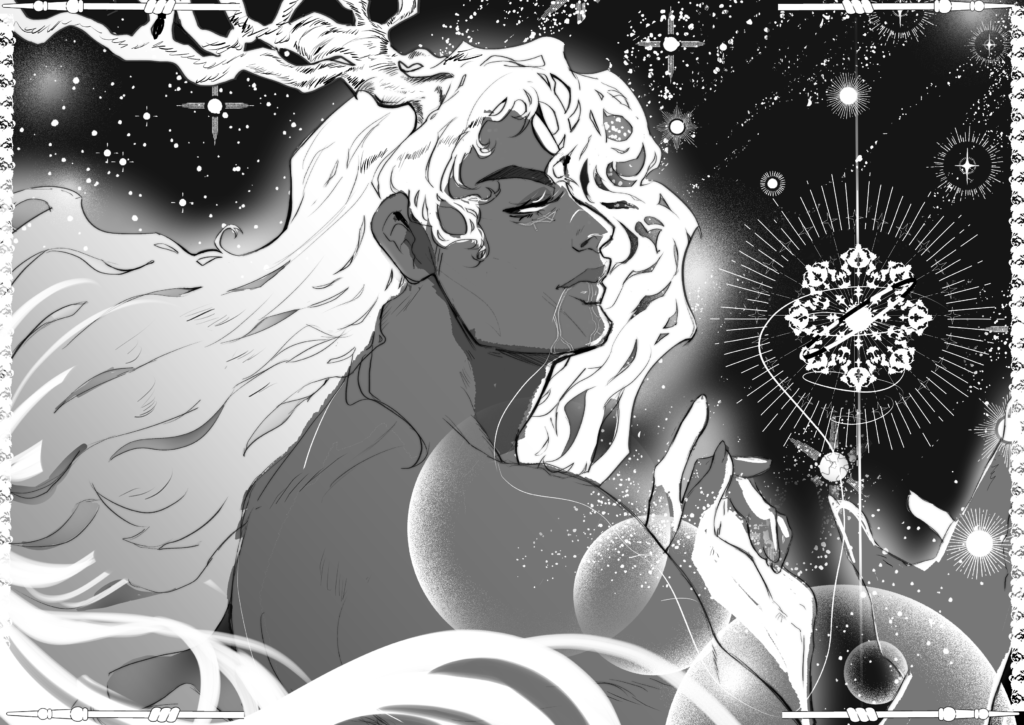
    Now, Alpha sits thronebound, God-King of a universe that keeps demanding his attention. Antlers vault above him in slow auroral smoke. His hair hangs down his back with its own weight, tugging when he shifts. The throne room groans under his presence, architecture straining to keep its shape. War reports glimmer in the air before him, lines of light mapping fronts, casualties, probabilities—the loop of almost and not yet.

    Omega’s corpse drifts through the dark, a stain that will not set. His followers sharpen themselves on its persistence. Alpha’s children go out and die and go out again. The war returns with the same inevitability as weather.

    Alpha exhales, and the room adjusts. Banners still. Air draws tight around ribcages, holding thunder that never quite breaks.

    When the reports blur, his mind returns to the moment he mistakes Clotho for God.

    Before the name Clotho lodges in his teeth, before he knows the words Echonianetic or Manifestation, he feels a presence so complete it scours him to the bone. For one dizzy instant, he believes the All-Creator has pulled itself together again; the war has finally been noticed; loyalty will be answered. Readiness follows—ugly, immediate. He would abandon his children, his wife, his empires, if it meant standing once more under Zero–One’s full attention.

    Then the truth: a fragment, not a whole.

    Disappointment stays. Awe stays, too.

    Clotho, Architect of Soft Catastrophes. A being whose play can erase timelines. A girl / woman carved from omniscience and sugar.

    He thinks of her when the door bursts inward.

    “Lord Alpha!”

    Wednesday hits the throne room at a dead sprint, red hair coming loose in wild loops, spectacles sliding down the bridge of her nose. She clutches a round mirror to her chest with both arms and holds it as though it might bolt. Her boots skid. She almost goes down on the polished stone, catches herself at the last moment, and offers a flustered half-bow that jolts the glass.

    Alpha’s gaze drops over her.

    “Wednesday.”

    His voice steadies the floor. The Nulleq scribes along the walls flinch; ink trembles in their pens.

    Wednesday straightens, breath ragged, cheeks flushed. The mirror reflects the ceiling, his antlers, a spill of his light—and then flickers. The image shears sideways, the glass attempting to refuse what it shows.

    “I—ah—reporting as ordered, My Lord,” she stammers, then realises he has not ordered anything. “That is—no, sorry. There wasn’t an order, but—”

    “Wednesday.”

    The second time comes softer. The room leans in to listen.

    Her words tangle, then fall quiet. She pushes her glasses up with her nose and tries again.

    “We have… guests,” she manages. “From beyond the First.”

    Alpha arches an eyebrow. The war reports dim around him, dismissed with a thought.

    “Beyond.” He weighs the word in his mouth. “Spectral travellers? Draegon emissaries? Has Ozymandias finally remembered his manners?”

    A hard shake of her head sends her curls trying to escape again. “No, my Lord. The Mirrorwright doesn’t know them. None of them.”

    His attention moves to the object she holds.

    The mirror is one of hers: plain, silver-rimmed, its surface smooth as still water. It is not omniscient. It is loyal to the First—tuned to its stars and stories, a facet of Wednesday’s Celestial Weapon. Through it she watches borders, catalogues anomalies, and threads warnings into his sleep when the glass catches an approaching wrongness.

    Right now, it’s a storm in a frame.

    Where the throne room should sit, the surface roils with light. Colour floods, drains, returns. Hairline fractures spider from the centre. They snag the reflection of Alpha’s antlers and break them into angles the room cannot hold.

    Alpha goes still.

    “What did you see?” he asks. The question lands as decree.

    Wednesday swallows. The mirror shifts in her grip with a thin crystalline whine.

    “I… try to focus on the anomaly,” she says. “Standard protocol: identify form, origin, threat. The first time, the glass goes white. Completely. No reflection. No room. No horizon.” She stops, then tries again. “Warmth. Noon sealed behind glass.”

    Alpha’s stomach drops, as though the floor tilts.

    “And the second?” His voice sinks lower, pulling the room down with it.

    “I adjust the calibration. Narrow the field. Bring the focus in tighter. There are two figures.” She squeezes the mirror closer, bracing it against memory. “One is light. It makes me feel small. It makes me feel seen. It makes me feel wrong, and then loved anyway. The mirror keeps trying to force it into something familiar. The image keeps burning through. I have to look away.”

    “And the other?”

    “I know someone stands beside the light. I know they’re there. The mirror agrees—it records a silhouette. But when I reach for it afterwards, my thoughts skid. I remember my hands shaking. I remember my breath breaking. I remember thinking, this must be what holiness feels like when it can hurt you. I can’t recall a face.” She lifts her eyes to him, wide and apologetic. “I’m sorry, My Lord.”

    Alpha understands contempt. He understands anger. Confusion doesn’t land.

    He rises.

    The throne answers with a low stony complaint as he stands. Above, his antlers worry at the hanging shafts of light until the shadows reset around new angles. Wednesday’s knees wobble.

    He stops before her. For a moment, he only looks at the mirror.

    The fractures glitter.

    “You bring them here,” he says, quiet.

    She flinches. “The mirror does,” she protests, then grimaces at herself. “I mean—yes, my Lord. The anomaly approaches our outermost horizon. Protocol says I open a corridor if there’s no sign of hostile intent. The mirror insists. It—ah—it pulses.” She swallows. “I have never seen it do that.”

    Alpha closes his eyes.

    Clotho.

    She appeared in his sky once, centuries ago, and never quite left. Sometimes she speaks through dreams. Sometimes she comes by omen. Sometimes she gives him nothing at all for a generation and waits to see what fear turns him into.

    “Tell me,” he says. “What do they sound like?”

    Wednesday hesitates; heat climbs her cheeks.

    “Their voice is… sweet,” she murmurs. “Not childish. Light. Each word lands soft and sharp at once. They’re polite. They call you Alphie.” The last word escapes in an embarrassed hush.

    Alpha’s mouth tightens.

    “Ah,” he says. Flat. “Clotho.”

    Wednesday blinks. “The Architect of Soft Catastrophes? The one from—”

    “The war before ours,” Alpha finishes. “Yes. The Echonianetic. The Multiversal Manifestation of Life. The one who treats timelines as scrap fabric.”

    He moves along the wall, fingertips skimming the carvings of his victories. He checks the grooves. He counts the raised edges beneath his hand.

    “You open a corridor for her, Wednesday.”

    Her shoulders fold inward. “The mirror insists,” she repeats, small.

    He turns back to the glass. “Your mirror knows this universe. It charts fronts and thresholds. It does not police gods. Clotho lives outside its reach.”

    His voice rises enough to shake the banners. “Do you understand what you place at my door? Do you understand what happens when she loses interest in a place? When she decides a story reads better with an entire universe removed?”

    Wednesday tightens her hold on the mirror as though grip alone could protect the First. “She seems… kind,” she says, careful. “Warm. She makes me feel—” Her words buckle. “I don’t think someone who feels like that can be cruel.”

    Alpha lets out a single laugh. It breaks through the hall with no humour in it.

    “Kindness means nothing when it belongs to a being who can unmake you by mispronouncing your name,” he says. “Clotho loves the way a child loves a favourite toy. She kisses it. She takes it apart to see what’s inside.”

    He lifts a hand and starts counting, a habit left over from wars that require every clause to land.

    “Listen. There are three Multiversal Manifestations: the Umbrakinetic, who wears Shadow; the Echonianetic, who wears Holy; and the Anti-Type, who wears correction.” His lip curls. “They are older than our wars. Clotho is Life given too much time and no restraint. She is here.”

    Silence spreads through the hall.

    Wednesday wets her lips. “Then why does she come?” she asks, quiet. “If she is so far beyond us. If she can erase us because she wants to hear how the silence behaves.”

    Alpha looks past her—toward corridors of light where his children march, toward the dark where Omega’s husk drifts.

    “She likes powerful people,” he says at last. “We interest her. My brother and I scrape at the edge of what she sees. She can’t make a clean outline of us, and it bothers her.” Pride tugs at the corner of his mouth. “Our fates resist her Sight. So she visits. She plays. She leaves. Then the rest of us sort through what she changed.”

    “Perhaps she adores you,” Wednesday offers, reaching for comfort. “If she doesn’t, why return?”

    “Adoration doesn’t soften temper,” Alpha replies. “And her temper can end an era.”

    He lifts his head. The air shifts. The fine hairs along Wednesday’s arms rise.

    “Prepare yourself,” he says.

    “How—”

    Reality hiccups.

    There’s no announcement. No flare. No warning ripple in the air.

    The foot of the throne steps is empty, then it isn’t. Two figures stand there, occupying the stone with the ease of beings who don’t ask reality for room.

    Light comes first.

    Clotho’s halos open over the steps and settle into their slow spin, rose-gold along the rims with a hard sugar gleam at the edge. Small crescent-eyes circle the rings, blinking out of sync while they track dust, breath, posture. Her hair piles up around her horns in sherbet foam; the horns themselves shine with a pearly glaze. She’s dressed in black, smiling at the idea of mourning. Stars dot her cheeks in a pattern that looks chosen, not accidental.

    “Alphie!”

    She launches herself forward with her arms already wide.

    Alpha steps once and catches her collision with his body. It should hurt. It should break something. Her halos widen and take the force into themselves; their hum drops lower, thicker. Alpha’s hands clamp around her back on instinct, fingers spread as though grip can keep an entire problem from slipping. Under her skin, power sits patient and enormous.

    His knees threaten him.

    “Most Holy,” he says, and the title comes out before he can stop it.

    Clotho presses her face into his collarbone and breathes in, pleased, as if she’s found a familiar chair in a room she likes.

    “You look heavy,” she says, voice bright with laughter. “You keep trying to hold the First together with your teeth.” She tilts her head back enough to look at him. “If it wants to break, let it. I can make you another.”

    Her halos chime near the stone. The crescent-eyes rotate toward Wednesday all at once, pause, then blink closed again—decision made, existence tolerated.

    Wednesday forgets how to inhale.

    The mirror in her arms wipes itself clean. Blank silver. Then a wash of pink. Then it settles back, dull and shaken.

    And beside Clotho, half a step behind, stands the other presence. The one the glass refuses to hold.

    Kohana Ohuang-Zhùróng is taller than Alpha expects. That alone irritates him. Everything else about her escalates it.

    She takes up space the way a verdict takes up a courtroom. Height, curve, weight that reads intentional. Warm brown skin catches the throne room’s light and throws it back with no modesty. Her hair falls in violet-black curls past her knees, heavy with little drifting stars that move as though they have their own rules. Her eyes lift to his—electric green, amused. The red liner beneath them turns each blink into a slash. Her mouth pulls toward a smile that already knows what it can damage.

    Danger sits on her without effort.

    It reads the way heat reads: immediate, undeniable, not there to negotiate.

    Wednesday’s stomach drops. Her throat tightens. The mirror shakes in her arms.

    For half a second, the glass manages to catch Kohana’s reflection. Lines of light race across the surface. A thin crack snaps through the silence. Wednesday yelps and almost drops it, then scrambles to cradle the spiderwebbed fracture against her chest.

    “Oh,” Kohana says, watching her. She tilts her head; curls shift down her shoulder. Her voice crosses the room low and warm, carrying smoke-sweet weight. “Sorry. That thing wasn’t made to look at Summoners that long.”

    Wednesday’s face goes hot. She opens her mouth—

    “N-no, it’s fine, I—”

    —and clamps it shut, mortified.

    Alpha drags his attention away from Clotho long enough to take Kohana in properly, irritation already gathering.

    Alpha drags his attention away from Clotho long enough to take Kohana in properly, irritation already gathering.

    “This,” he says, and the word lands flat, “is the warrior you’ve been talking about for centuries?”

    Clotho leans back in his arms to look at him, eyes widening into scandal.

    “Stop,” she scolds, light as a tap on the wrist. “You sulk, and your face forgets how to be pretty.” She slips out of his hold and turns toward Kohana; her halos adjust with her movement, framing her perfectly without ever bumping the air. “Yes, this is Kohana. Summoner of Time. Stormscript in Skin and Bone. Spectra’s favourite disaster.” She beams. “She’s very strong.”

    Kohana tips her head back and sighs at the ceiling. “We’re behaving today, Clotho.”

    “As much as his ego requires,” Clotho replies, pleased.

    Alpha’s antlers flare once with coloured light. It’s the only warning he gives.

    “You bring a stranger into my universe with no parley and no notice, while I’m in the middle of a war,” he says, voice dropping into a register that makes the scribes along the walls wish they could become furniture. His gaze cuts to Clotho. “And you expect me to applaud because you’ve collected a new amusement?”

    Kohana’s smile sharpens.

    Not friendly.

    She steps forward with deliberate ease, stars shifting in her hair as she moves. Up close, Alpha catches ozone off her skin, and the tart sweetness of pomegranate under it—fresh-split fruit, stained hands.

    “Worry less about Clotho’s amusements,” Kohana says, smooth, “and more about the person who can cross your walls and crack your pretty tools by being seen.”

    Wednesday makes a small, strangled sound. Alpha doesn’t look at her.

    “You’re speaking to a God-King,” he says. “Remember where you are.”

    “I know exactly where I am.” Kohana’s head tips, feline in its angle. Her eyes brighten; the red liner turns the expression into a cut. “On a rock that disappears with the rest if the Multiverse fails. Spectra sends me because Clotho says you can handle more than your own reflection.” Her gaze flicks to the broken mirror and returns to him. “I’ll try not to be disappointed.”

    Wednesday’s fingers tighten around the fractured frame. The mirror gives a faint hum, thin and unhappy.

    Alpha feels his anger twist into something else for a moment. Curiosity, maybe. The shape of hope that he pretends he doesn’t keep anywhere in his body.

    “What do you want,” he asks, each word measured, “from the First?”

    Kohana lifts one shoulder, casual. The motion sends the length of her hair shifting behind her.

    “Allies,” she says. “Spectra is busy stopping things you haven’t bothered to name yet. Clotho thinks you might be useful.” Her smile returns, restrained. “You already know how to hate a brother until the sky shakes. We’ve lived with that kind of loyalty.”

    Clotho clasps her hands under her chin, delighted. “Isn’t she wonderful? I bring you the best people, Alphie, and you never thank me properly.”

    Wednesday, clutching her injured mirror, manages a whisper she doesn’t mean anyone to hear. “Maybe she’s… salvation.”

    Alpha doesn’t answer her. His attention stays on Kohana’s face, on the ease of her certainty.

    “You speak of preventing annihilation,” he says. “My universe is already trapped in a war that won’t finish. My brother cannot be killed by any weapon I own.” He leans forward slightly. “Tell me, Summoner of Time—can you end what refuses to end?”

    Kohana’s smile curves again.

    Clotho answers before Kohana can. She spins once, halos flaring with her movement, delighted by her own theatrics. “Of course she can. That’s her favourite trick.”

    Kohana doesn’t contradict her.

    She steps closer to the foot of the throne, looks up at Alpha, and gives him no hint of reverence.

    “I didn’t come here to argue with a stubborn man,” she says. “I’m offering my hand. Take it, and we try to keep your universe from becoming debris. Refuse, and you go down with it.” Her gaze travels over him, slow and appraising. “I’ll sleep either way. You’re convenient. That’s all.”

    It has been a long time since anyone has spoken to Alpha like that.

    War reports flicker at the edge of his vision. Omega’s corpse turns in the dark. Clotho watches them both with open delight, crescent-eyes a little wider—waiting for the next line.

    Alpha weighs the room. The horizon beyond it. The bleeding churn of his universe. A Summoner from a world seeded by a dead God’s fragments stands in front of him, and beside her stands a being who can decide—on a whim—that all of this was never worth the effort.

    He thinks of his children. He thinks of Omega’s laugh. He thinks of the one time Clotho looked at him and almost treated him as worth keeping.

    At last, he extends his hand.

    “Very well,” he says. “Summoner of Time. We’ll see if Spectra’s storms can do what gods fail to do.”

    Kohana’s fingers slide into his. Warm. Strong. Certain.

    “Keep up,” she says.

  • i.) is this darkness in you, too? / have you passed through this night?

    June 26th, 2018

    Death taps its spindly fingers against the hull of my ship. It is an old creditor checking the door.

    We plunge toward Earth like a fallen seraph, the atmosphere screeching around the Aphelion’s frame, but Death holds no dominion. It smears its darkness over the moon, dims the stars, and folds this planet in jet-black pitch. As I fight to steady our descent, I am acutely aware that I am dying, second by second. Like all mortal things, I am browning at the edges. I can hear each grain slip through the hourglass of my life. Once, Celestial Beings lived for billions of years. Death cut us down and, in a magnanimous mood, left us forty thousand.

    I made my terms with my death long ago. To exist is to owe, and the debt is collected in full.

    Piloting a Spectrian vessel demands a particular devotion. The Aphelion and I are bound mind to mind, covenant sunk deeper than bone. Death noses at that bond now, searching for the place it can pry. The fall turns violent. Sirens climb. Panels flood with emergency glyphs. I remain in the captain’s cradle, spine straight, feet braced, refusing to gift the room my panic.

    The Aphelion holds what I hold.

    Warnings scroll across the glass. In answer, I let my composure rise to the surface: a small, open smile—courtly and unshaking. The Aphelion reads it as a signal. Her systems soften their pitch. She retracts a portion of her fear. She has seen me afraid exactly once; this is not that.

    Death and I are acquainted. Its attention settles between my shoulder blades with deliberate weight. Efficiency doesn’t interest it. It wants spectacle. It wants to watch me come apart.

    In my mind, its hand closes around my throat.

    I tighten my grip on the bond instead. I hold the line where it tries to fray, and I deny it an opening.

    “Are you lost, Death?” I ask, and I keep my voice level for the Aphelion’s sake as much as for the thing listening. To her, my words are the steadiness she recognises: a soft signal she can lock onto. “If you’ve come looking for theatre, you chose poorly. Earth is a backwater. You’re wasting your taste on it.”

    I let the exhale lengthen. The command I give is clean.

    “Go.”

    Impact is coming either way. That much is physics. What happens after is still negotiable.

    “Emergency touchdown,” I tell the Aphelion. “Stay with me.”

    My dearest girl.

    Death knows what sits under manners. It has watched me sign treaties with one hand and end a story with the other. If it cannot be killed, it can still be marked. I can still bruise what it believes is untouchable.

    The Aphelion shudders again, and this time it isn’t the air.

    Death reaches into her structure and starts removing pieces. Molecular bonds loosen. A section of hull simply isn’t there anymore. Warning glyphs stutter across the panels; one dies halfway through its own word. The ship fractures into unstable segments, each one trying to behave as a whole while the whole is being edited out from underneath it.

    Death turns my vessel into a hazard by laying a hand on her.

    The crash won’t kill me. It can’t.

    Being unmade at the level of my own bonds would be… undignified.

    Magic wakes fully in my veins. I pull the Aphelion out of easy sight first—no invitation for clairvoyants, no neat line for a god to follow. Then I swallow our sound. I fold the impact site sideways, still on Earth, still real, but harder to catch with a wandering eye.

    We hit.

    Without my interference, the energy would tear a continent’s worth of consequence out of the planet. With it, Earth keeps its crust. The ground holds. The sky doesn’t catch fire. If the planet wants to be grateful, it can do so later, quietly.

    “Aphelion,” I say, because routine comforts her even when it shouldn’t matter, “location.”

    She hates crashing. She knows she won’t be truly harmed, but displeasure is one of her oldest habits. I allow it. It keeps her present.

    “Kita,” she answers at once, clipped but steady. “One of the eleven wards in Kyoto. Kyoto Prefecture. Japan.”

    “Time.”

    “04:00. Earth standard.”

    New panels slide open in front of me: exterior feeds, infrared overlays, a map grid trying to find its own edges again. The neighbourhood is asleep. Narrow paths. Low wooden houses. Gardens arranged with a care that makes violence feel uncouth. Roses on arbours. Willows leaning over water that doesn’t move. Maples and ginkgoes posted beside doorways like patient guards. Even the streetlights seem cautious.

    “The lion kills not,” I murmur—an old Spectrian line, used for places we agree to leave alone. “The wolf snatches not the lamb. Unknown is the child-devouring wild dog.”

    A place of joy without death.

    The Aphelion and I have kept this ward quiet for years. When I step out and let my weight enter full dimension, damp earth rises to meet me. Leaves hold onto their scent. Air this soft feels like it’s trying to make amends.

    I memorised Earth before departure, as any Advisor worth the title would. By Spectra’s measures, this planet is ordinary. No lumens to steal. No doctrine worth fearing. No reason for Death itself to arrive in person.

    Which means the reason is not ordinary.

    I adjust my cuffs. The magic here isn’t ours; it leaves a thin pressure behind the eyes. I let my thoughts settle on the only asset here that could justify such attention.

    The Summoner of Time. Spectra’s General. A girl capable of bending eras until they squeal.

    Death and I have come for the same person.

    So it becomes a race, then.

    After I clear the worst of the Aphelion’s wreckage and catalogue the damage, I tap my index and middle fingers against my temple. The communicator blooms at once—light unfolding into a floating pane before me.

    D’ivoire appears as if he has been waiting. His legs are propped on his desk, chair tipped back, one arm hooked behind his head. The other hand drums lazily along the armrest. That smug little half-smile sits exactly where I expect it.

    “Well, well, well,” he purrs. “What do we have here? A shipwrecked Spectrian in tragic need of assistance?”

    His eyes are warm brown, bright with mischief, his mouth soft and infuriatingly shapely, his shirt open just enough to prove he dressed with intent. We have known each other for thousands of years, and still he manages, with deplorable ease, to steal my breath.

    “I appreciate your humour,” I say, a beat too slowly. “Was it the debris field that betrayed me?”

    “You already know.” His gaze flicks off-screen, following telemetry only he can see. “I’ve never seen her this banged up. You alright down there? You love that ship more than your own life.” He winces, then laughs at himself. “And I did just call her a ‘thing.’ My mistake. Offer the lady my apology before she refuses me docking privileges forever. Think you can fix her, or am I flying out to drag you home?”

    “It’s peaceful here,” I answer. “Quiet. A trip to Earth may be the vacation you never realised you needed.”

    “Mm, pass.” He folds both arms behind his head and spins his chair once, letting it come to rest with theatrical slowness. “It’ll be an obscene amount of Earth days before I can leave. Commander’s going to want a full report first, so keep your channels open. I’ll track your movements in case anything tries to eat you. If it does, maybe the Summoner can bend time and drop us in faster. Prodigies are good for that sort of miracle, right?”

    “The Summoner may end up saving us both,” I reply. “For the record, I did not crash the Aphelion.”

    He snorts. “Hard to believe, looking at her. She’s in pieces.”

    “When your ship meets the same fate and we are both stranded here, we can revisit my testimony.”

    “Deal. With any luck, you’ll have her stitched up by the time I get there.”

    The call winks out, leaving only the night and the faint hum of cooling metal.

    I have no doubt he will come. If he must, he will rebuild the Aphelion panel by panel with his own hands.

    I met D’ivoire long before the Academy tried to pretend it discovered us.

    I was a boy then by our standards, sent into the Simulacrine Enclaves as an observation exercise—gold and doctrine dropped into manufactured squalor to see what bent first. The streets there were built to study desperation.

    He approached me at a broken water kiosk, all sharp smile and fox-brown eyes, offering to “make it pretend” for a price. I let the kiosk answer me instead; the droplets rose and circled, hanging like a small constellation that refused to fall. He should have been impressed. Instead, he stepped back once and said, very quietly, that I did not belong there.

    Neither, I told him, did he.

    We never traded names. We traded something else: a kind of attention I had not yet learned to give, and he had not yet learned to trust. Later—ten thousand years later, when we sat outside the Academy interview chamber on hard benches under too-bright lights—we finally shared a language for ambition. Thousands of candidates wanted the Advisor’s post. He said he wanted it to see what lay beyond Spectra’s maps. I thought the reason frivolous. I also knew, even then, that he would not stop until he got it.

    I am still thinking of that boy in the Enclaves, of the man on the other end of my communicator, when the night interrupts me.

    A heavy thump cuts through the quiet, solid and close—exactly the sound a body makes when it meets pavement.

    Half a second later, there is proof: a girl of perhaps fourteen summers lies flat on her back a few metres away, staring up at the sky as if it has wronged her personally. The angle of her limbs suggests a fall rather than a collapse.

    I look up.

    The tree above us still sheds blossoms in slow spirals. Its branches shiver faintly, leaves rattling with the aftershock of being climbed. The girl’s hair buns are coming apart, threaded with petals and twigs.

    I cannot help it—I smile, exhale a breath of laughter. Of all ways for Earth to greet me, it chooses a child falling out of a tree.

    I did not expect anyone to be outside at this hour. It is much too late for a girl her age to be alone.

    My kindness has never interfered with my work as an assassin; if anything, it has made me more efficient. I do not see mercy as weakness.

    “You make the concrete look comfortable,” I remark, stepping closer. I am overdue for rest and amusement myself. “How long of a nap do you intend to take?”

    Her face crumples into a cartoonish pout, lower lip quivering, brows knitting as she squeezes her eyes shut.

    “Is it naptime already…?” she mumbles.

    “Not quite. It is four in the morning,” I say. “An odd hour for a little girl to be roaming the streets.”

    “Four in the—” She cuts herself off as her mind catches up.

    Her eyes open.

    They glow. Radioluminescent, bright against the dark. The colour and cut of them resonate with something in my own bones. Magic stirs in her, answering mine. I have seen many kinds of extraterrestrial eyes; these leave no doubt. She is Celestial. More than that—she is the Summoner I was sent to retrieve.

    She jerks upright, props herself on her hands, and hurriedly crab-scuttles away from me. Once she decides she is at a safe distance, she points, outraged.

    “You saw nothing!” she cries, then clutches her chest as if I’ve dealt her a mortal blow. “You don’t know I’m here, and you’re definitely not telling my mother about this!”

    This level of dramatics at four in the morning is impressive.

    “Lively, regardless of the hour,” I note. “Is it reasonable to assume you are a morning bird?”

    Perhaps not the sharpest metaphor, given her recent descent from the branches.

    “Yes…?” She squints, trying to determine whether my question is a trap. It is not. I am merely amusing myself. “I mean—no!” she corrects herself vehemently, then abruptly flops back onto the pavement and sighs.

    Whatever she hopes to accomplish by playing dead, it will not move me along. I have crossed universes to find her. I will not be dismissed by a tantrum.

    Eventually, she realises I intend to stay and laces her fingers behind her head.

    “Are you sure you’re not plotting against me…?” she asks, peering at me from under her lashes.

    “Merely curious,” I say. “Speaking of curiosity—how did you manage to climb this tree in the first place?” I glance up at its thinning canopy. “A moment ago it looked healthier.”

    She cracks one eye. “I don’t follow.”

    “This tree is ill-suited for climbing.”

    “Can’t be,” she counters, utterly unbothered. “Climbed it.”

    “You have the capacity to thwart the impossible, the eldritch, the beyond comprehension, the divine and the unimaginable,” I tell her. “Scaling a dying tree should be the least of your talents.”

    She sprawls even further, limbs splayed like an exhausted cat, eyes deliberately avoiding mine. The long pauses, the flippant posture, the refusal to engage are all textbook attempts to irritate an adult into retreat.

    She will be disappointed. I am not quick to anger.

    “I didn’t hear a word of that,” she announces after a beat. “Except the last part.” Which tells me she understood enough to be flattered and not enough to admit confusion. “See, normally I’d chalk you up as some random guy out of his mind, but—” She gestures at me vaguely. “It’s four in the morning. And you’re dressed like a Victorian vampire.”

    I resist the urge to straighten my coat when she looks me over like a badly dressed myth.

    “If you have issues with the uniform,” I say mildly, “take it up with my Commander. I’m quite fond of mine.”

    “You look like one, too,” she mutters. “And your eyes are glowing.” As though hers are not. “It’s obvious you’re not from here. Even your accent is weird. Either you fess up about who and what you are, or…” She trails off, tiny and furious. “Or…”

    She is so busy winding herself up she does not feel the cold breath behind her.

    Death stands at her back, skeletal fingers braiding half-dead flowers into her hair. It shows me its chosen form tonight—a gaunt woman with an expectant belly, whispering promises that the girl cannot hear.

    You’ll be so tired when you’re a Summoner. I love you. Come.

    The Shadow arrives first.

    It spears the ground where her chest was a heartbeat ago; she flings herself back on instinct, palms skidding, fingers digging so hard into the dirt that the earth cracks under her nails. The creature drags itself out of the dark after its failed strike—an eyeless mass of slick black, faces blooming and dissolving across its surface, tendrils lashing and leaving slime that sprouts new mouths.

    She stares at the Shadow, a shrill scream tearing itself out of her body.

    I do not move. The Shadow knows better than to test my composure and pretends I am not here. The girl notices.

    “You must stand,” I tell her, my voice cutting clean through the Shadow’s shrieks. “Your planet will not protect you. Be strong.”

    It rips its arm from the ground. The recoil is a wave of death—flowers disintegrate, birds drop like stones, the tree she fell from crumbles into nothing. Within a half-mile, life goes out like snuffed candles.

    “It is preparing another attack,” I observe. “This is a test. For both of us.”

    She tears her gaze away just long enough to look at me—eyes wet, furious, already demanding answers from a monster that will never give them. She is all offence, even now. Good. I am counting on that.

    “Come now, girl. This is a matter of life and death.” Her tears do not move me. They do, however, delight the Shadow; it shivers, mouths grinning. “You have to save yourself.”

    Her mouth twists into an ugly snarl. Fang tips flash beneath the plush flesh of her lip, and her cat pupils thin into sharper slits.

    “You really think I believe you can’t help me?” she snaps. “When this thing isn’t even looking at you?”

    The Shadow raises its arm, and the limb unspools. The primordial void it hails from becomes a long haft. The head thickens into a world-cleaving crescent; debris rises from the ground, the fragments of the street orbiting the weapon.

    It tests the arc once, barely a rehearsal, and the world answers like a guilty thing.

    Then it brings the axe down.

    Any ordinary being would die on impact.

    She throws her arms over her head with a squeak, bracing for a death that doesn’t come. The blow lands with the force of a meteor. The ground splits, buildings buckle, vehicles pitch and explode along the shockwave—but she remains, half-sunk into a widening chasm, arms unbroken, skin unmarked.

    She is, as promised, nearly impossible to kill.

    The Shadow is delighted. It hammers her again and again, the other arm also blooming into an axe so it can strike from both sides. When brute force fails, it changes tactics, seizing her by the shirt with tar-dark fingers and hauling her up to its many faces. Her hands slip clean through its insubstantial wrist; she flails, kicks, screams, buns coming undone as it lifts her higher, mouths opening below.

    “This is your fight,” I say. She whips her head toward me, outrage incarnate. “The first of many. It would be rude of me to interrupt.”

    “Our fight!” she yells. “Don’t think you get to worm your way out of this! I’m dying”—her voice drops into theatrical despair—“and you’re just standing there!”

    She may be the most dramatic child I have ever encountered.

    “When you are older,” I reply, “you will thank me for not getting involved. You will understand then. I do not fault you for failing to now.”

    “Oh, you’re one of those people. ‘Too young to know what’s good for me,’” she mocks, wagging a finger even as the Shadow hoists her higher. “I’ll have you know”—the finger keeps time with every word—“that I know that you know that I know you don’t know that I think someone who can save me saving me is a better option than whatever you think I’d prefer when I’m older—”

    The Shadow flips her upside down, catching her ankle with a single tendril. She dangles over a forest of mouths as it widens, body turning into a drooling cavern.

    “Don’t let it eat you,” I advise. “As durable as you are, being consumed by a Shadow will kill you.”

    To her credit, she listens. She curls up, performs an inverted sit-up, latches onto the tendril and tries to climb. The Shadow only laughs, lowering her slowly toward its maw.

    “Perhaps your talent lies in enduring the worst rather than dealing it,” I muse. “I am running out of time to confirm which.”

    “You’re wrong,” comes her voice from somewhere inside that mess of limbs and teeth. She should not be audible, but she is. “I can fight.”

    “Prove it,” I say, because she seems to respond best to provocation.

    She vanishes.

    For a moment there is only Shadow—heaving, triumphant, folding in on itself like a closing fist. I turn, ready to leave. An unfortunate loss, but not the last Summoner in the Multiverse.

    Then the creature explodes.

    Light spears out from its centre, ripping it apart in skewed, brilliant wedges. Bits of gelatinous dark rain down, clinging to the girl’s skin like ticks as she stumbles out of the collapsing mass, scowling. She flicks a gob of Shadow off her forehead with brisk disgust, pupils narrowed to slits.

    I cannot help the small swell of pride in my chest.

    “You are learning,” I tell her. “Your refusal to die is important.”

    The Shadow howls, trying to reconstitute itself, but it can’t hold shape; it slumps and sloughs apart, distraught.

    “Finish it. While it is weak.”

    It lashes out in desperation, firing chunks of itself like bullets. Her body answers before her mind does: time thins around her, her perception stretching out. She moves through the barrage with newly-born grace, sliding out of each impact arc like water flowing around stones.

    When the assault stutters and fails, she plants her feet, one arm drawn slightly back, chin lifted.

    “I’m not going to pretend I know what you mean,” she says, eyes fixed on the Shadow. “But if it means I can beat this thing, that’s good enough. How do I do that, exactly?”

    “I will not explain your abilities while something is still trying to eat you,” I say. “There is magic in you. Use it.”

    “Oh? With magic?” Her shoulders relax, as if this simplifies matters. “Why didn’t you say that?” A beat passes. She turns, glares. “Wait. What do you mean, with magic?” She shakes her empty hand at me. “Hello? What magic? I don’t have any magic, and as you mentioned”—she tosses her fingers in sarcastic quotation marks—“there’s this thing conveniently ignoring you and trying to kill me. You do something. You clearly have enough magic for both of us.”

    “Is it so impossible,” I ask, raising a brow, “to imagine that you might be the one who casts, when a Shadow that may very well be your own is razing everything in its path?”

    “Yes.”

    The Shadow lunges—one last, ruthless attack, every remaining scrap of mass thrown at her.

    The Summoner I was promised steps forward at last.

    She closes her eyes. Inhales. Reaches inward. When she exhales, the world answers.

    Earth buckles. Chunks of ground lift and hang weightless. Pressure rolls out from her like a shockwave; the sky tenses, clouds shudder. The Shadow is almost upon her when she flings her arms wide and shouts:

    “Freeze!”

    Reality obeys.

    Time locks around the Shadow, catching it mid-lunge. Ice flowers instantly over its surface, sealing it into a howling statue. The temperature plummets. The ground still floats. The sky still roars.

    Chronokinesis alone does not do this. Interesting.

    She pads up to the frozen monstrosity and squints.

    “Woah…” She straightens, sets a hand on her hip, then crouches to examine a jagged, frozen maw. “I did this?” She points at herself, then at me, smile growing wider with each pass.

    Her delight is contagious. I allow myself a matching curve of the mouth.

    “Yes,” I say. “You stopped time. Which confirms my suspicions. You are the Summoner of Time and Space, and we”—I gesture around us—“have a great deal of work to do.”

    “We?” she echoes. “Hard pass. I’m going home.”

    “You misunderstand. I did not mean we would clean together.”

    She has already started to walk away; I only realise because she stops and looks back over her shoulder, eyes narrowed. Fast and quiet. Assassin’s footsteps. It reminds me unpleasantly of myself.

    “I’m listening,” she says.

    “We are partners, you and I. There is much to discuss.” I study her face. “Although I am curious why you are not more shocked.”

    “To be honest?” She stares down at her nails, feigning disinterest. “I kind of already knew how this goes. Let me guess—you’re some kind of alien?”

    “I hail from another universe, yes,” I reply. “From you I can keep no secrets.”

    “Ha! I knew it!” Her excitement spikes, then abruptly folds in on itself. “Ahem.” She clasps her hands behind her back, gaze dropping. “Well… where do we go from here?”

    “I need to tend to this mess before your planet panics,” I say. “Then I must resume repairs on my ship.”

    Her eyes light up at the word ship. Interesting.

    I take the opening.

    “My name is Hiroyuki D’Accardi,” I tell her. “Feel free to call me what you like. And yours?”

    She bites her lip, considering.

    “If…” Her attention is still hitching on the idea of a vessel. “If I tell you my name, will you show me your ship?”

    “Perhaps,” I say. “Weren’t you going home?”

    The mention of home sobers her at once.

    “It’s Ohuang-Zhùróng Kohana!” she blurts. Then she spins on her heel and bolts down the street, calling over her shoulder, “I’ll be back tomorrow after school, looking for you in this exact spot! Don’t forget!”

    I watch her go, petals still stuck in her hair, Shadow-ichor drying on her sleeves.

    I doubt I could forget her if I tried.

  • ii.) the devil’s in my head and he won’t let me rest / i should pray a little more, i shouldn’t pray for death.

    June 27th, 2018

    By eleven, I have already decided the grown-ups picked the wrong serious questions.

    Some man in a book says the only real question is whether to kill yourself. Another says it’s whether time has a beginning and an end. I read those lines on the bathroom floor with my knees pulled up, toothbrush foam going lukewarm in my mouth, and all I can think is: you’re both cowards.

    Time will do what it wants. Death will do what it wants. The question that gnaws at my ribs is simpler and meaner:

    How do you make love stay?

    If someone could answer that, I’d know whether or not it’s worth sticking around for the ending. I’d know whether the moon is just a rock or an accomplice. I’d know if all the clocks in the world are counting down to anything at all.

    I don’t know anything about love. Only this: there is a kind of loneliness so big you can see it in the second hand of a clock, dragging itself around, and around, and around. People mutilated by too much affection or not enough. People on their knees in the dark, reaching out for a hand they can’t see, praying it’s there.

    Love doesn’t excuse itself when it leaves. It doesn’t pack a bag. It vanishes. One day there is warmth and then there is not. You can’t argue with it, you can’t bribe it, you can’t make it breathe the way it used to.

    Death feels cleaner by comparison. Death is at least a promise.

    I sit with that thought until the garden goes very still. Crickets hold their breath. The birdbath water smooths itself into glass. Somewhere beyond the fence a car passes, a distant sigh of tires on wet road, and then even that sound is gone.

    “Kohana.”

    My name arrives first, low and amused, threading through the roses.

    “Moon-girl. You’re really out here.”

    Juniper’s voice finds me before she does. My bones ring with it. My lungs forget how to work. For a second it feels like most of my insides crawl out through my mouth and hurry toward her ahead of me.

    She smells like rain after a long drought and cheap drugstore perfume and something of her own—warm, unembarrassed affection. Every time I breathe her in, my head goes light.

    “You came,” I say, turning, and the whole world tilts sideways. “You kept your promise.”

    She steps out from between two rosebushes, brushing petals off her hoodie. It hangs open over a ridiculous glittery dress that looks stolen from a school play; her socks don’t match and her sneakers are scuffed to hell. Her hair is scraped back in a ponytail that has given up on discipline. My heart beats so hard it feels like it’s trying to get to her first.

    “Of course I came.” Her grin shows the tiny chip in her front tooth, familiar as a constellation. “Sneaking out’s easy when your mom’s on night shift at the hospital and your dad thinks I’m at a sleepover two blocks over.”

    Juniper is tiny, stubborn green—like the one fern that manages to grow between concrete slabs and refuses to be stepped on. Loving her turns my whole life sideways. It smashes routine, slaps boredom in the face. Nothing is ordinary when she’s in it.

    We fall into step along the herringbone brick path. Our hands dangle between us, close enough that the backs of our fingers brush every few steps. Each touch is a small, stupid lightning bolt.

    Pastel flowers spill over the borders: peonies bowing under their own weight, old roses exhaling fragrance like secrets. Sweet alyssum dissolves the edge of the path into soft white clouds that smell faintly of honey. The bird feeder to my left is full of water rather than seed—my doing. It holds pieces of moonlight and upside-down flowers, a small, stolen sky.

    “Your mom’s in love with that job,” Juniper says. “She talks about her high school music kids like they’re miracles. I bet she can play anything.” She bumps my shoulder, eyes bright. “What about you? You play?”

    I snort. “If you sat me at a piano, I’d probably try to bite it. So no.”

    She laughs, delighted, the sound fizzing in my chest. I pretend I’m not proud of my own incompetence. My mother wanted a daughter who could sit primly on a bench and make Chopin sound like prayer. I am not that girl. I refuse to be that girl.

    Twilight settles in stages. The sky goes lavender first, then bruised at the edges, the first few stars blinking themselves awake like they’re checking if it’s safe. The garden is ours at this hour—no parents, no neighbours, just the soft drip from the rain barrels and the hush of leaves. Pillowy shrubs lean over moss-slick wood. Love-in-a-mist frays around the stone benches in blue haze and ferny lace.

    Juniper nudges me with her elbow. “So you dodged the family curse,” she says. “One virtuoso in the house is probably enough.”

    “Maybe.” I toe a fallen poppy petal off the path, watching it skid over the bricks. “My mom’s… good. Too good, sometimes. She loves me hard enough for two people, like she’s trying to plug up the hole my dad left with packed lunches and bedtime checks and a thousand ‘text me when you get there’s.’”

    Juniper goes quiet, listening.

    “He’s never home,” I say. “When he is, it’s like living in a restaurant review. Everything I do is either ‘disappointing’ or ‘barely acceptable.’ He yells about stupid things—how I walk, how I talk, how I look at him. So mostly he’s gone, and when he isn’t, I wish he was.” I shrug, jaw tight. “She keeps over-worrying so he doesn’t have room to call me ungrateful for needing anything.”

    What I don’t say: she wants me safe, and somewhere in her head safe means small. Quiet, neat, unthreatening. A well-mannered, well-bred girl who walks in flocks, laughs softly, and folds herself up like a napkin at the edge of the table.

    I run through the streets like the boys and get told I’m asking for trouble. I answer back and get told no one will marry me if I keep this up. I think too loudly and everyone reminds me men don’t like girls who think at all.

    My mother wanted to raise a daughter. Somehow she raised a fist.

    Juniper and I reach our tree.

    It’s older than the street, older than the city, maybe older than the country. Its trunk is massive and twisted, bark furrowed in deep ridges, branches spreading out like a thousand arms mid-gesture. The roots hump up through the soil like sleeping animals.

    We sit with our backs against it, shoulders almost touching. I can feel the warmth of her through the few centimeters of air between us, like sitting next to a space heater made of teenage longing.

    She has brought a book, big and black and battered, leather strap buckled around it. It looks like it should be chained to an altar, not shoved in a backpack with math homework.

    “Tonight’s topic,” she announces, patting the cover, “women and myth.”

    I’m ready before she even finishes. “Men get to pretend they’re the default version of ‘human,’” I blurt. “They write themselves as sky and sun and heroes, and we get stuck as afterthoughts and consequences.”

    Her eyebrows fly up. She isn’t used to people interrupting her, but she doesn’t look annoyed—she looks delighted.

    “Go on,” she says, and roses bloom hot under my skin.

    “In all the old pairings—Sun and Moon, Day and Night, Heaven and Hell—it’s always male first, female second, if she shows up at all.” I pick at the moss between bricks for something to do with my hands. “Good and Evil? God and the Devil? No woman in the equation. Just two guys playing tug-of-war with the world.”

    “And Eve?” Juniper prompts.

    “They needed someone to blame.” I roll my eyes. “They make her from Adam’s spare part so she belongs to him, then turn around and call her defective for not obeying all the way. Pandora’s the same story in a different outfit. Men screw up; women get written as the mistake.”

    Juniper taps the book, impressed.

    “No man would trade places with a woman,” I mutter, more to myself than to her. “But they all want women around. We’re the audience and the prize and the excuse, but never the author.”

    I want teeth. I want to be the praying mantis chewing through her mate, the spider fat on what loved her last, the lioness with blood on her muzzle and no apology in her eyes. I want to be the thing men warn each other about in locker rooms.

    Juniper’s fingers find mine, lacing slow and sure.

    “Being born at all is an insult to them,” she says, voice gone low and thoughtful. “They want to spring into the world fully armored, like Athena. Head to toe, no mother involved. But they always start with blood and screaming and a woman’s body doing all the work, and they hate that. They spend the rest of their lives trying to climb back out of that fact.”

    Her thumb strokes along the side of my hand as she talks. Each word is a matchhead. I am a box of them. I burn and burn and burn.

    “Death is a woman, too,” she muses. “The Fates, the Parcae, all cutting threads. Earth swallowing bones. Wailing women at every funeral. Men make wars, but women clean them up. It’s on our faces that the loss shows.”

    I want to give her everything I have and everything I will ever have. Every heartbeat. Every drop. Every latest possible first of anything. It overwhelms me; the wanting is bigger than my body.

    “You have the face of darkness, Kohana,” she says suddenly.

    I laugh, startled. “That’s rude.”

    “No.” She turns toward me, tucking a stray curl behind my ear. Her fingertips are soft, warm, the barest pressure on my skin. My entire nervous system spikes. “Not bad darkness. Deep darkness. Where everything started and where everything ends. Bottom of the sea stuff. Cave under the world. You’re scary to sailors and saints.”

    Her fingers trail down my jaw, to my throat, to the place my pulse hammers. I am sure she can feel it.

    “At the bottom of everything,” she whispers, leaning closer, breath warm against my cheek, “it’s dark. Men look up and pretend heaven is theirs. They look down and pretend we aren’t waiting.”

    I close my eyes. My mouth trembles. I am a door that wants to open and has no idea what room lies beyond.

    She doesn’t kiss me.

    When I open my eyes again, the garden is gone.

    I stand alone in a forest.

    Or—I am the forest, and the forest is me. It feels like both. My body feels too large and too small at once. My skin is bark and bone and soft animal; my breath is fog snagged in branches.

    Above me, a grey sky sags, heavy with old rain. Mist crawls around the trunks, thick and low, curling around my ankles like tentative hands. The trees loom taller, closer, their branches twisted into shapes that look suspiciously like faces caught mid-grimace.

    The path under my feet is made of bones. Small ones, mold-slick and stacked in careful rows, like someone very patient has tried to pave the way with other people’s endings. With every step I take, leaves blacken. Thornbushes fatten on poison berries.

    “But she was just—”

    My voice dissolves.

    Juniper hangs from a nearby tree.

    Her neck and wrists are bound in rough rope, arms spread slightly, legs slack. She sways gently, as if a wind only she feels nudges her back and forth. Her skin is already taking on the wrong colors. Blue. Bruise-purple. The eyes are bulged, the tongue bitten.

    My hand clamps over my mouth as if to hold my own heart in. The air smells like rotten meat and spoiled milk and something chemical underneath it all, sharp enough to sting my eyes.

    “No,” I try to say, but everything comes out as a choke. “No, no, no—Juniper—”

    I force myself closer and find no knife wound, no bullet hole. No visible reason. Just the brutal fact of rope, gravity, and whatever brought her hands to tie the knot.

    There are others. As my eyes adjust, I see more bodies hanging in the dim: some fresh, some long stripped to bone, clothes hanging off them like forgotten prayers. The trees groan softly. Somewhere, someone sobs, thin and high.

    “Is she yours?” a voice croaks.

    I spin around.

    The woman who hobbles into view looks like a tree that decided to try being human as a joke. Her coat is black and heavy, fur lining the collar like a ring of trapped animals. Her white hair is hauled back into a chignon so tight it must hurt. Her eyebrows have been braided; one long plait curves over each eye like an ornamental caterpillar.

    Her teeth are all present, sharp and yellowed. Her smile is carnivorous.

    “You’ve been unusually quiet,” she says. “I thought you brats were all noise.”

    Her breath hits me like a wall: diapers left for days, curdled milk, meat gone furry. I gag.

    “What do you mean, ‘human’?” I manage, trying to stand up straighter. My voice comes out more defiant than I feel. “What else would I be?”

    She snorts, delighted. “Human. H-U-M-A-N. You spell it like an apology. You stink of it.”

    She slaps her belly and chuckles, the sound scraping along my spine.

    “If my mother hears you talking about me—” I start, still clinging to the normal threat, the everyday anger.

    “Your mother?” Her grin widens. “If that hag hasn’t managed to tame you yet, someone’s gotta take a turn.”

    The grief flares into rage so fast it makes me dizzy. “If you hurt a single hair on Juniper’s head—”

    “Me?” She looks genuinely offended. “Hurt her? Child, she did that herself.”

    The words land like a blow. For a second the forest tilts.

    From all around us, the crying intensifies. The old woman tilts her head, listening like it’s music.

    “Mm. That’s good. Trees are in fine voice tonight.”

    She plucks a thin branch from the nearest trunk. The tree screams. A high, tearing sound, like metal being bent wrong.

    “Once they were human, now they root in my soil,” she explains, using the twig to pick at her teeth. “They only get to talk when you peel them.”

    My stomach lurches.

    “You don’t seem nearly sad enough,” she adds thoughtfully, eyes glittering. “Not for a lover hanging on a rope.”

    Heat crashes over my face. “She’s my friend,” I snap.

    She cackles. “You followed her in here for her mind, did you? For her jokes? You little liar. You came for the way she looked at you over the book spines. For those pretty girl-breasts and the way she says your name like she’s tasting it.”

    My cheeks burn hotter. I clamp my jaw shut, but the betrayal is already written in my skin.

    “Oh, stop,” she says sharply. “Your youth reeks. Baby fat and puppy breath. It makes me want to vomit.”

    “Good,” I shoot back before I can stop myself. “Choke.”

    She bares her teeth, entertained.

    “People will wonder where she went,” I hiss. “They’ll come looking. They’ll find you.”

    “So?” she says. “Let them wander my woods, little calf. Wondering is free. Leaving isn’t.”

    I hate her. I hate her so much it vibrates in my teeth.

    “You still think magic is kisses under streetlights and rainbows after storms,” she goes on. “You think it’s the first time you hold her hand for real. It’s not. Magic is tooth and claw and last breaths. It’s the moment the floor drops out. Juniper was your doom. You know my name.”

    I do. Of course I do.

    Everyone who knows anything about magic knows.

    “Wren,” I whisper. The word tastes like sap and iron. “You’re Wren.”

    She preens at the sound of it.

    Oldest tree in the oldest story, the witch in the wilds, the thing that eats soldiers and princes alike. My mother read me those tales when I was small, when I still believed all wicked things stayed between covers.

    “The Wren who can eat enough for twelve in one sitting,” I recite, because my mouth has decided to keep going. “Who knows all secrets and helps only when it amuses her.”

    “Now the gears are finally turning,” she croons.

    Behind her, I see the low outline of a hut, its fence made of bones topped with skulls. The eye sockets seem interested.

    “You’ve read the stories. You know this part.” Wren’s voice softens a fraction. Her hand, when it comes up to brush my cheek, is rough and strangely gentle. “Every step from here on is a bargain with pain. Everything is a trap. I’m just more honest about it.”

    My hands won’t stop shaking. I shove them into my pockets; they tremble harder. Laughter punches out of me, too loud, too sharp. It feels like a saw drawn down my spine.

    “I know so much about magic,” I say, voice high and thin. “And I still can’t do any. I’m useless.”

    “Those stories you read,” Wren says, ignoring my outburst, “are about girls with neat names and neat arcs. Sylvias. Rheas. Anaises.” She waves a hand, dismissive. “You are not a neat girl.”

    “No,” I snap. “I’m not a protagonist in your little fable.”

    Her mouth stretches, wider and wider, until it looks like it could split her head in two. All my fingers go numb. My toes might as well belong to someone else.

    “The Sylvias and Rheas and Anaises were appetizers,” she says sweetly. “They cushioned the jaws. Whatever lodged the forbidden fruit in your bones? That’s the main course. You wear disobedience like perfume.”

    She inhales deeply, flaring her nostrils. “You reek of first sin. Eat or be eaten. That’s Hell’s motto. Heaven prefers: eat and be eaten. You, Kohana Ohuang-Zhùróng, are indecently tempting.”

    My name in her mouth is a violation. The syllables coil around my spine.

    “How do you know my name?” I demand.

    She laughs. “Your name is soft and black. Black as hymnals. Soft like a pillow. It invites you to lay your head down and then snaps shut.”

    That, at least, feels right.

    “My name,” I say quietly, “is a snake in tall grass. It waits. It strikes. It doesn’t let go.”

    “You’ve been careless, little snake,” Wren says. “Trading pinky promises for war banners. Childhood for command. You’ve got two mothers and neither of us could save you from yourself.”

    “Shut up!” The words fire out of me, hot and fast. “I’ve been good. I don’t say what I want. I don’t make anyone uncomfortable. I take care of everyone else’s feelings first. I smile when I want to scream. I never say no. I do everything right.”

    “Good isn’t right,” she says softly. “Good is just obedient. And you”—she taps my forehead with one yellow nail—“were never built to obey.”

    My father’s voice echoes behind hers: housekeeping, cooking, making sure a man’s ego stays inflated. My future shrunk to a kitchen and a crib.

    “Even if I get married one day,” I mutter, “it’s not going to be to a man. I’m not going to spend my life as some guy’s unpaid mom. I hate housework. I don’t want kids.”

    Wren watches me, head tipped, like a wolf studying a cub that has just shown teeth.

    “Men love danger,” I say, more fiercely now. “Let them find it elsewhere. I’m not a prize. I am the dragon.”

    “Fair enough,” she purrs.

    Her hands come up again, cupping my face, squishing my cheeks. She smells like wet soil and old smoke. Her smile is all canine.

    “You want an archrival,” she says.

    “An enemy?” I pull back. “Why would I want that?”

    “Enemies come and go,” Wren says. “They snarl, then slink off. An archrival?” Her eyes glitter. “An archrival will circle you for the rest of your life. They’ll forget how it started. You’ll forget too. You’ll just know that your story and theirs are tied like veins. They’ll rise against you even when they know they’ll lose. That’s the only kind of opposition worth having.”

    I laugh in her face. I can’t help it. It bursts out, wild and hoarse.

    “You don’t know anything about me,” I say, planting my feet.

    She leans down so close I can see all the lines etched around her eyes. “I see you fine. I see the outline already. Love, betrayal, hatred that can’t exist without the love underneath. A wolf who starts out worshipping you and ends up trying to tear your throat out. You want that as much as you fear it.”

    I glare so hard the air around us seems to stiffen. The trees pull back their branches, wary.

    “I am the praying mantis,” I say, my voice low. “I am the spider.”

    “Exactly.” Wren’s grin splits into something like triumph. “On my wedding day I was all white silk and fluttering lashes. They thought they’d bought a lullaby. Then came the second act. Legs. Fangs. The whole eight-armed truth.”

    She laughs, belly-deep, wiping tears from the corners of her eyes.

    “You won’t be a honeybee or a mother hen either,” she says when she sobers. “You’re built for a different kind of hive.”

    Something in me loosens. Something else hardens.

    The forest blinks.

    One moment, corpses and bone-paths and Wren’s hut. The next, the world folds like paper and snaps back.

    I am sitting under our tree.

    The garden is back—roses, rain barrels, the bird-water mirror. The air is soft and damp and smells of earth and soap from someone’s open window. My hands shake in my lap.

    In them rests the book Juniper brought.

    Only it’s wrong now. Its black leather is colder, older. The strap is buckled with a clasp shaped like an eye that seems almost to twitch when I look at it directly. Something pulses faintly under my palms, not unlike a heartbeat.

    The yew at the back of the garden looms a little closer than it used to. Its trunk is split and hollow, but the crown is green and defiant against the dark. It looks, suddenly, exactly like an old woman in a heavy coat.

    “I’ll visit,” I whisper, fingers tightening around the grimoire. My voice shakes but holds. “Every night if I have to.”

    The tree does not answer. The book does, in its own way: the leather warms under my touch.

    Far away, or very close, I think I hear Wren’s laugh—pleased, hungry, fond.

    Love doesn’t know how to stay. That much is clear.

    So I will learn other things. How to bargain. How to fight. How to devour.

    My name curls sharp and black in my mouth, and for the first time, I feel it fit.

    · · ─ ·✶· ─ · ·

    I do homework at the kitchen table because the kitchen is my mother’s kingdom and she says light falls better here.

    Math sits open in front of me, but I’m not looking at it. I’ve peeled the workbook away from the table and tucked my real book underneath: a library copy of Introduction to Astrophysics, heavy as a guilt. The pages smell like dust and graphite. Equations climb down the margins like vines.

    A daughter, in my father’s head, is a special doll kept behind glass. You take her out when guests arrive, wind the key between her shoulder blades, and she smiles and says charming things about school while the adults drink. Put her back when you’re done. No fingerprints. No dust.

    I flip a page. Stars die in neat diagrams. Gravity folds and unfolds. Out there, a universe chews itself apart and no one tells it to sit up straight.

    The door clicks.

    Keys, lock, the slow drag of a suitcase wheel. My whole body jolts before my brain catches up. Mom’s at her evening rehearsal; she left two hours ago with a stack of sheet music and a tired smile. That means—

    “Kaede?” he calls, like the house is a restaurant and he’s already displeased with the service.

    “It’s just me,” I say, voice too small, too bright. “Hi, Baba.”

    His shoes announce him before anything else: sharp leather on tile, the clipped metronome of someone who times everything. He appears in the doorway still in his chef’s whites, jacket unbuttoned at the throat, apron folded under his arm. The air changes around him—garlic, seared fat, citrus, the metallic ghost of hot pans.

    Kai-liang Hsü, five-star Michelin darling of three continents, looks at our kitchen like it’s a bad imitation.

    His gaze lands on me. Then on the table. Then on the book.

    Not the workbook. The book.

    “What is that,” he says, not asking.

    The words hit like plates slammed onto a pass.

    I try to close the cover casually, as if it’s nothing, just something to lean on. My fingers fumble. The spine thumps against the wood.

    “Homework,” I lie.

    He steps closer. His hands are what I see first, always: scarred, burn-sheened, beet-stained at the cuticles where he forgot gloves again. They move with practiced economy as he flips the cover up with one knuckle.

    Black print. Star charts. No recipes.

    His mouth flattens. “Astrophysics.”

    I swallow. “It’s… interesting.”

    “The only thing interesting about space,” he says, “is that it gives bored people an excuse to pretend their lives matter.”

    He drops the book on the table. It lands crooked, half on my workbook, half off, words spilling out like they tried to escape.

    I keep my hands in my lap. My hands betray me. They’re too smooth, too clean. Fingers long and quick, good for fine stitches and violin strings, terrible for the kind of work he thinks counts. No callus from a knife handle. No shiny burn patches from grabbing hot steel.

    He notices. He always notices.

    “You’ve a surgeon’s hands,” he says, like it’s a slur. “Not a chef’s.”

    “They’re just hands,” I say. It comes out softer than I intend.

    “No.” He takes my wrist before I can pull away and turns my palm upward. His thumb presses along the base of my fingers, testing for something that isn’t there. “A chef’s hands tell a story. This?” He taps the soft skin. “Blank page.”

    I want to snatch my arm back. I don’t. I sit very still, like a doll being inspected for flaws.

    “My hands remember,” he goes on, almost to himself. “That scar—oysters. Those lines—service for three hundred. That one—stupid mistake with a new oven. You know where yours come from? Pencils and… what is this?” He flicks the corner of my workbook. “Fractions?”

    “Algebra,” I say.

    “Algebra won’t keep this family alive.” He lets my wrist go as if he’s bored of it. “The restaurant will.”

    I look at the sink instead of his face. Our sink is tiny compared to the ones in his kitchen, but the stainless steel still shines because Mom wipes it until her hands ache. She keeps our home perfect, like she’s afraid he’ll fire us from it.

    “Mom’s job helps too,” I say carefully. “Her students—”

    He snorts. “High school music. Babysitting with sheet music. I built something out of nothing. I bled for it. You think people fly across oceans for a choir teacher?”

    My throat tightens. I picture my mother’s hands on the piano keys, the way her shoulders loosen when a chord resolves. The way she tucks me in at night like she’s trying to press safety into my bones.

    “She loves what she does,” I say. “She loves me.”

    He looks at me then. His eyes are dark and slick with the reflection of the overhead light, as if oil has seeped into them.

    “I’m not talking about love,” he says. “I’m talking about legacy.”

    The word drops heavy between us. Like a cleaver.

    “I don’t want—” I start.

    “You don’t know what you want,” he cuts in. “You’re eleven.”

    I clench my teeth. I know exactly what I want: a telescope big enough to drink the sky, a brain good enough to understand it, a life where my worth doesn’t come plated with garnish.

    In one ear, my mother: Kohana, don’t frown, it ruins your pretty face. Be kind, be polite, don’t say anything that might upset anyone. Please, please, please.

    In the other, my father: Learn to take blows. Learn to give them back. Dare. Fight.

    Neither voice leaves room for me.

    “I saw the photos online,” he says, pacing once around the table like a general inspecting terrain. “Your school project. ‘Careers in Science.’ You talked about going to the stars.” His lip curls. “The gall of it. To throw away my life’s work for a daydream.”

    “It isn’t a daydream,” I whisper.

    He slams his palm flat on the table. The glasses clink. My book jumps.

    “You are my daughter,” he says, low and furious. “You carry my name and my blood. The kitchen is a battlefield where I am king. You think you can refuse the crown for… for numbers about rocks in the dark?”

    “They’re not just rocks,” I say before I can stop myself. The words leap out like sparks. “They’re whole worlds. They’re history. We’re made of the same stuff. Doesn’t that matter?”

    Silence. I’ve seen him quiet in the middle of service when a plate comes back wrong; this is quieter. Worse.

    He leans down until we’re eye to eye.

    “When god made the world out of nothing,” he says, “he foresaw that people like you would waste it. Go back to your books about exploration and your moon and stars and your… astrophysics. Push humanity’s end back by a fingernail, if that makes you feel useful. But stay out of my kitchen if you won’t make yourself of use.”

    His breath smells like burnt sugar and wine vinegar. My eyes sting.

    “I’m doing my homework,” I say. I hate how small it sounds. How obedient.

    “You are stalling.” He straightens, wipes his hand on a dish towel that isn’t dirty. “You want a choice. There is no choice. This family has a future because I carved it. You inherit it. That is how it works.”

    He turns toward the stove like the conversation is over, opening cupboards, checking our poor, ordinary pots with faint disgust. “Where’s your mother? Why isn’t she here?”

    “At rehearsal,” I say. “School concert.”

    He grunts. “Of course.”

    Cabinet doors open, close, open. He moves through our kitchen like he owns even the air. I watch his hands find knives, a chopping board, an onion from the fruit bowl. The knife in his grip looks right in a way it never does in mine.

    “Come here,” he says.

    My feet don’t want to move. They do anyway.

    He sets the onion down. “Watch.”

    The blade flashes. The onion falls apart into perfect, even pieces before I can blink. No wasted motion. No hesitation.

    “Your fingers should remember this,” he says. “Not constellations.”

    He pushes the knife toward me. The handle nudges my knuckles.

    “Grip,” he orders.

    I take it. The steel is cold and too heavy. I copy his hold as best I can. Golfers grip, he calls it, but I’ve never played golf. It feels like holding a promise I never made.

    “Cut,” he says.

    The onion’s skin squeaks under the blade. I press down. The knife bites, slips, nicks my finger.

    I hiss.

    He catches my wrist again, turns my hand palm-up. A thin bead of red wells at the side of my index finger.

    “That,” he says softly, almost satisfied, “is the first true thing your hands have done.”

    Tears prick hot at the edges of my eyes and I hate them. He releases me, already moving back to the stove, already done with me.

    “Clean it,” he says. “And Kohana?”

    “Yes.”

    “The next time you stand in my kitchen, it will be because you’re ready to work. Not because you’re hiding.”

    He doesn’t look back to see if I nod.

    I wash the cut under cold water. It stings. I watch the pink swirl down the drain and imagine it cycling through all the pipes in the city, a small, diluted rebellion.

    Above the sink, the clock ticks. For one strange second, the second hand stutters—jerks forward, pauses, slides back a fraction, then jumps ahead as if nothing happened.

    I blink. Maybe I imagined it.

    My chest feels too small for my heart. Something enormous presses against my ribs, wanting out. Rage, yes, but not only that. A hunger that isn’t about food at all. When I close my eyes, I see the diagrams from my book: expanding space, collapsing stars, mouths of gravity that swallow light.

    I picture my father’s restaurant, all spotless chrome and flame, and somewhere far above it the sky opening like a wound. I picture myself stepping through.

    My body hums—not quite burning, not yet—but charged, like the air before a storm.

    “Dry your hands, Kohana,” my father says without turning around. “Don’t drip on the floor.”

    I do as I’m told.

    My palm throbs around the small cut. The ache feels bigger than it should. Like the beginning of something that refuses to stay small.

  • iii.) i’m drowning here on solid ground / i’ll step lightly lest I grow tired of the search for the cure for apathy, was it her?

    June 28th, 2018

    Bad girl. Bad wolf. Bad dog.

    That’s what their eyes say when I lean in and breathe them, when I let my nose do what it was made for. Men don’t like being sniffed. They like to believe they are the ones doing the choosing.

    They try to pretty me into something harmless. Cherry-cola mouth. Bubblegum voice. Strawberry-lemonade cheeks. Hands they call delicate. Delicate, as if that word could file the teeth down in my skull.

    Among animals there is always a conversation before blood. The predator and the prey read one another: a certain tilt of the head, the soft shiver that runs under skin, the way muscles ripple when something decides it will run instead of fight. When the prey lowers its gaze, offers softness, it’s an agreement. I am yours to take.

    I look up at them now, lashes lowered, eyes wide and wet as if I’m begging for instructions, not air.

    “Ain’t she—” one of them starts, feet sliding a little on the concrete. His speech is frayed, his pupils blown, red veins threaded through the white. “Ain’t she pretty?”

    His breath hits me like a gas leak: boiled rotten eggs, burnt matchhead, sewer steam. He belches and the stink rides high across my palate, sulfur and rot. A human throat would lock, gag, claw for clean air. I only taste. Catalog. File away.

    He lists toward me, bottle neck sweating in his hand, then wobbles back as if the ground has shifted. “Like one of ’em dolls,” he mutters, squinting, trying to line me up into one neat outline instead of two.

    The other one is worse. Hungrier. He watches me the way a starving hunter watches a fawn that’s limping. Feast or famine—wolves understand that look. You survive on whatever falls behind: the very young, the very old, the injured, the thin.

    He leers because he thinks I am that deer.

    He leers because he is sure he can catch me.

    “Can’t be more than fourteen,” the bigger one slurs. His words smear together, thick with alcohol and rot. Up close I see the abscesses on his cheeks—angry, swollen domes of pus ready to split. He’s huge, all bulging muscle and rope-veins. The kind of man who could snap a chain around his chest. The kind who thinks he could snap me.

    “Imagine how much money she’ll make us,” he adds, and his gaze turns to inventory.

    I was waiting for them. Bone on the road. Bait in a red dress.

    I smell like everything they were taught to trust. Coconut lotion, cheap pink rose body spray, vanilla sugar baked into skin. I rolled out of bed and straight into the sort of scent that makes predators smile and convince themselves they’re the ones hunting.

    “Whaddaya say you work with us?” the big one says, squaring his shoulders so the alley feels smaller. “Be a good girl and say yes, or things’ll get ugly real fast.”

    The world has always insisted girls run, stall, sob, bargain. That sweetness is a shield, that modesty is armor. I tried obeying predators once. It didn’t take.

    Now I am not afraid of the darkest dark. I am not afraid of offal, rot, bones, blood, or the men who make girls into meat.

    “It’d be a shame if I had to knock out them pearly teeth,” he adds.

    If only he knew what they’re for.

    My teeth are built for shearing. For cracking. For grinding bone until it remembers powder. Under his noise I can hear the wet thump of two human hearts, the ragged drag of their breath. Fear smells like metal before it ever tastes like it.

    He stares, slack-jawed, and reaches out for my face with the kind of confidence only the very stupid or the very cruel can manage.

    “Ain’t no girl looks like that and lets herself get cornered in a dead-end alley by two guys three times her size,” the one with the bottle mutters, circling. His legs don’t quite listen to his brain. “This one’s experienced. She ain’t even put up a fight. See? Watch.”

    He tips the bottle back, drains the last mouthful, feels the burn sink into his gut like courage he didn’t earn.

    Then he hits me.

    His fist connects with my cheekbone. The impact barely jostles my head. The sound that follows is not mine—it’s his wrist, bending where no bone should bend, his knuckles folding like wet cardboard. When he drags his hand back, it hangs wrong, arched and shattered, skin already mottling.

    The look on his face is delicious. His blood goes cold all at once. His scream comes out raw and animal, the kind of noise prey makes when it realizes it has misread the dance. He gulps air for a second round of panic, but nausea catches him by the throat; his stomach heaves, bile climbing.

    I could hit him back. One strike and his atoms would remember how to fall apart. But there is a hierarchy to hunger. I want the big one first.

    “You worthless fucking cunt!” he spits, voice cracking on the last word. Rage is easier than fear. “Kill this stupid bitch, Lyam!”

    Every hair on Lyam’s arms lifts. His muscles listen faster than his courage; his legs stutter as he steps toward me, shaking, then firming as duty—or terror—does its work.

    “Kill her! Kill her!” the broken-handed one howls behind him.

    Before either of them learned to stand, I was older than their sky. Before their great-grandparents met, I was carrying solar systems on my back and breaking them open when I sneezed. God worried I might bite through heaven.

    Lyam comes close enough.

    I move.

    Chorded muscle jumps in his neck when my teeth meet. Flesh parts. I feel his skin give, his blood surge hot against my tongue. My hands—paws, claws, any shape I want—tear, rake, open him. The drunkard sees every detail: the flex of my jaw, the gleam of my canines, the shock in Lyam’s eyes as he understands too late what I am.

    “What the fuck—she’s not human,” he babbles, voice cracking in half. “There’s no way she’s human, we gotta get out of here, Lyam, forget it, forget this shit—Lyam—Lyam, I don’t want to die—”

    Lyam can’t answer him. His ears are ragged strips, his hair slick with his own blood. His chest hauls for air, huge frame shuddering. I look at the other man over Lyam’s shoulder. His gaze locks to my mouth and does not move.

    I don’t need human meat. I don’t need protein or iron or vitamins. I eat because I enjoy it. Because when someone decides I am meat, I believe in returning the courtesy.

    Does a corpse have rights, once someone has decided to carve it? A dead body is a dead body. But a man who tries to make you into meat while still breathing? He has forfeited something more.

    By killing them, I make this alley better than I found it.

    I bite down.

    My jaw closes with a sound like wet branches snapping. Lyam’s throat opens. Blood hits the air in a high red arc, pumping fast, spraying the concrete and the walls and my hands. The trees beyond the alley—a scraggly line of them—seem to shiver, branches clawing at the sky as if something under the soil has rolled over.

    The alley fills with a salt-iron tang. Old blood, fresh blood, memory of blood. It smells like the underside of history.

    I dig into the rent in his neck, fingers working until I find what I want. His tongue slides into my hand, heavy and slick, coated in spit and yeast. For a moment I just hold it, let it dangle between my fingers where his friend can see.

    Then I raise it to my mouth and pull.

    Tongue tears loose with a quiet, obscene sound. Human tongue is a muscle like any other—fattier than most, tender, rich. On the teeth it feels like veal that’s been well-rested. I chew slowly. I want him to see every movement of my jaw.

    The drunkard’s breath comes in ragged, knife-short gasps. His fear is so close he can taste it himself; it sits at the back of his tongue like pennies and bile. Lyam’s head lolls, still attached by stubborn strips of flesh and spine. As I drag his body forward, the ruined face swings against the backs of my legs, the weight of him thudding with each step. I’ve eaten half his features away. It doesn’t matter. He doesn’t need them anymore.

    Humans like to pretend death is a straight line: one body, one grave, one ending. They forget that death is always a hinge, never a wall. While one side of the heart empties, the other side fills. While one breath leaves, another arrives somewhere else.

    There is no light without something to shine out of. No gem without the dark around it. No lesson without the cut.

    Death must eat too.

    Tonight, she does it with my teeth.

    · · ─ ·✶· ─ · ·

    Bone knits to bone. Hair remembers where it grew. Piece by piece, I come back.

    In dreams, in déjà vu, in headlines no one understands, I reassemble. Sometimes I am a girl with blood under her nails. Sometimes I am a wolf that was never a girl at all. The shape changes; the hunger does not. Wherever a story goes, I find a way in.

    All stories are about wolves. They only pretend otherwise. They talk about escaping the wolves, outsmarting the wolves, feeding other people to the wolves so the wolves won’t eat you. They talk about packs and lone beasts, about turning into the creature everyone feared, about taking the alpha’s throat and wearing its shadow.

    I do not die. I molt.

    My wolf bones outlast every version of myself. I make and unmake myself with my own hands.

    I owe nothing. Not to God, not to the Devil, not to whatever narrator thinks they’re in charge. I am the fulcrum, the clause that changes the ending. If you have wandered this far into my story, you have already agreed to be tested. Every line is a barbed wire fence; you climb or you turn back. Pay attention.

    The mud remembers my footprints and the world’s first breath lingers on my fur. I am hunting a girl who is a loop instead of a line, a girl without clean beginnings or ends. I could track her even if the universe were silent—by the pattern of her lungs, by the way her heel strikes stone, by the small refusal in her joints when she’s told to kneel.

    I am older than tides. Older than the first fish that thought about walking. However cornered, however sick, however furious or tired, I keep going. I would drag myself toward her on snapped legs if I had to.

    Tonight, I move downhill through a pedestrian lane in Kyoto where the wires overhead have been hidden like shame. Lanterns glow against old wood. Narrow stone steps tilt between tea houses and cafés and shops selling hand-cut paper and lacquered things humans tell themselves they need. Machiya fronts lean close together, gossiping in cedar and tile.

    When I pass, I brush the edge of memory in each person I cross. A shiver. A sense of having almost remembered something important. Eyelids grow heavy. A few sit down on stoops “just to rest” and doze off like they’ve earned a hundred years of sleep. They have walked with Death’s breath at their necks, stumbled through forests that tried to hold their ankles, outlived storms and famines and quiet, private catastrophes. Their medals are on the inside. They are tired down to the marrow.

    I am the drought that empties them. I am the river that carries their recollections away like silt. When I leave, they will not be able to explain what they forgot. Only that something slipped out of their hands and did not come back.

    “Excuse me.”

    The voice cuts cleanly through the silence. This one hangs on to her memories with both fists. She steps into my path and catches my hand like she’s done it a thousand times, small fingers warm, insistent.

    “Would you like a bouquet?”

    My body answers before my mouth does. Joints ache in recognition. Old scars wake up and hum under my skin. I have been here before. I have been her wolf before.

    She is spring in human shape—field and vine and early fruit. I am the opposite season, long night and frostbitten earth, yet her flowers reach for me anyway. In the cart beside her, orange roses flare against blue thistle, golden craspedia pop like little suns. Every petal leans forward, expectant.

    She smiles. The hill exhales scented air down into the street, slipping through the branches overhead as if they’ve been waiting for this cue. “What, you don’t like flowers?” she asks. She looks like she has been basted in dawn—round cheeks, warm skin, the soft shine of someone who hasn’t yet learned how to dim herself on command. Biting into her would be like breaking open a piece of candy that runs with juice.

    She is everything the world thinks it means by “spring.”

    “I should’ve picked something cooler,” she muses, squinting at me with a little wrinkle between her brows. “You’ve got winter bones. These are too warm for you.” She hums as she tucks the bouquet back into its bucket. “You don’t talk much, huh? It’s hard work carrying the conversation all by myself.” She dusts her hands on her skirt, then offers one again. “I’ll make it easy. I’m Juniper. What’s your name?”

    This body speaks a dozen languages without words—heat, pallor, prickling skin, the drag in the chest when hope sinks, the sudden lift when it rises again. It shakes. It stills. It flares. My heart drums a rhythm only predators and goddesses understand.

    Juniper looks up at me and all at once her eyes smell like fresh-cut grass. Like leaves still wet from rain. Like a tire swing twisting slow over dirt while a beam of light holds it from above. I know those pupils, slit and sharp. I know this feeling of being pulled toward someone like the tide toward the moon.

    I have met her before. In another life. In the same one. It doesn’t matter.

    Who are you really? How deep do you go?

    I catalogue every small detail—the way her smile hooks slightly higher on one side, the way she presses her tongue against her teeth when she’s thinking, the little almost-imperceptible stiffness in her shoulders like she’s used to bracing for impact.

    “I’m looking for someone,” I say.

    When I blink, the street folds away.

    I stand beneath a yew so old its trunk has cracked into several separate columns, a crowd of trees pretending to be one. Like me, it has refused every invitation to die. The tree was male once; stress is teaching it to bear fruit. A few red arils gleam among the needles like drops of blood that decided to become berries instead.

    Its canopy blankets broken gravestones, shadows pooling over names worn down to ghosts. Part of the trunk has been torn by storms and rot; that side is cold and damp, flesh-like in the worst way.

    Ahead: skulls. Some polished by time, some still glistening faintly in the low light. They’re mounted on stakes, pierced from neck to crown. On the ground, more skulls have been sawn just below the eye sockets, turned into crude cups, leather thongs knotted through bone.

    I taste the air, nose full of lime and rust and fat and the faint sweetness of decomposing marrow. My ears swivel for the smallest sound, picking up whispers from dirt and root and stone. I have tracked prey across galaxies; this graveyard is not going to hide them.

    “Over here, silly.”

    Lavender. Velvet. Her again. Juniper’s voice comes from just beyond the yew, and my body responds in a full-body shiver of recognition and warning. I have crossed the world for her, more than once. I will do it again.

    People think it takes strength in the obvious places—biceps, jaw, back—to stay with a creature like me. It doesn’t. It takes a heart that is willing to die and wake up and die again without giving up. A heart that can look at sharp teeth and unlit woods and say: Yes, I will go.

    She has that heart. She is not scared of beauty with claws. She is not scared of what other people call ugly. She steps forward anyway, even while she’s crying.

    We love each other like that: in loops. We find treasure, lose it, find it again. We strip down to bone and then to nothing and then grow back wrong and right at the same time. Passion burns out and returns as something stranger. Pain leaves, then knocks on the door wearing a new face. To love like this is to live through a thousand endings and a thousand beginnings without leaving the room.

    “I’ve waited a long time for you,” she says, eyes shining, voice steady. “Here. Take my heart. Bring yourself to life in my life.”

    I follow her home, into rooms and into dreams. Into whatever she calls “mine.” Stop running, Wren told me once. Face the wound. Take the drum. The heart is the drum. Juniper hands me that drum now without flinching, trusting me with rhythms that could crack open stone.

    Who knows what we will hunt. Who knows what will hunt us.

    She doesn’t get to find out.

    Our bodies hit the ground together when I slam into her. Her ribs sing in my ears as they give. My cry rips out of me, raw and animal; hers comes out higher, thinner, threaded with my name and someone else’s.

    “Wren?”

    My claws open her throat with one clean swipe. Arterial spray paints my face; the heat of it shocks my eyes closed for a heartbeat. My fingers dig into her sternum, pry it apart until bone shrieks and parts. Ribs open like the mouth of a trap.

    “Wren!” I snarl, tearing a strip from her arm and stuffing it between my teeth because I don’t know what else to do. Blood strings from my chin. “I did what you asked. I brought her. I brought her here—” My voice breaks on the last word.

    “Delicious creature.”

    Wren’s laugh creaks from the threshold—a sound halfway between a crow’s call and a rusted hinge. She waddles out from between the trees, wrapped in a black coat heavy with fur, hair scraped into a knot so severe it might be holding her skull together. Her teeth are all present and all wrong: long, yellow, sharp, eager.

    She lives in the thickest, darkest part of the woods, in a hut that is less house and more warning. The fence is femurs and ribs, skulls spike the posts, eye sockets staring without blinking. Doorposts are made of human legs. Everything about her home says: if you come in, you do not leave unchanged.

    Wren is not the sort of villain you kill once and forget. You push her into the oven, she comes back through the chimney in the next chapter. She is the hinge of the story, not its casualty.

    “You feast on thunder and lightning,” she says, delighted, “and still you crawled to my forest on your belly.” Her body is old in the way mountains are old—low to the ground, solid, mottled, stubborn. Her laughter shakes every layer of her, from whisker to cracked heel. “Typical. Pick off the unguarded. Tear more than you need. Kill like eating is a language you can’t stop speaking.”

    She stands where maps crease, where myth and logic rub against each other and throw sparks. The ground here never feels entirely solid. I can taste how long she has been at this: witching, watching, writing people down in stories so they can’t lie about what they are.

    “This was always yours,” she says. “Coming back through the fog to find the mother of monsters.” Her eyes glitter with a satisfaction that makes my hackles rise. She has been waiting for me.

    “Sit down, Isleen Tchaikovsky.” She points to a stump so rotten it writhes with worms. “Let’s be quick. I’m going to tell you everything that will ever happen to you. Best to be comfortable.”

    My ears tilt for the girl I am hunting; my eyes sweep for any sign of her. Wren flicks her knife and peels the scalp from a severed head with the detached care of someone shelling a nut. She cracks the skull open on rock, scoops out the brain, chops it into pieces and tosses it into a hot pan with oil, onions, peppers. The smell is rich and fatty and wrong in all the right ways. My stomach answers like a drum.

    “The Earth was told,” she mutters, stirring, “you will give birth and you will devour what you birth. That’s the agreement. Don’t act surprised.” She tips the pan so the sizzling fat hisses louder. “You want to know where you’re going, wolf-girl? Start at the beginning. You, my little crumb, are not good.” She says it fondly. “You need no reason at all. Your very existence as the one who stands against Omnipotence makes you either a fool or a legend.”

    “If I must fight,” I say, “I prefer the biggest opponent available.”

    Her grin breaks her face wide open. “You walk in like ten Furies braided together, and the dirt shakes. What you can’t take by force, you’ll steal by cunning.”

    “Wren, you are going to kill her, right?”

    Juniper’s voice is small and sweet, and it still slides under my ribs like a blade. She smiles at Wren, all dimples and politeness, and I know she will bare her teeth the moment that back is turned. “You saw what she did. She hurt us both. She deserves it.”

    “Of course I saw. You think I’m blind?” Wren snaps, baring teeth at her now. She is annihilation and mercy wrapped in the same sagging skin. Looking at her is like trying to see three things at once: newborn, executioner, angel.

    I accept her the way you accept gravity. She can’t be bargained with, only respected.

    “Juniper, love,” Wren purrs, “this one lives on the rim of time, on the lip of the world. Some call her She of the Woods. Some call her the Wolverine. Some call her Spider Woman. Some call her the sun, some the storm that eats suns. The names change; the thing does not. In every tongue she is the one who tangles fates and tears them, who burns through worlds and then grows flowers in the ash.”

    Wren knows my history better than I do. She has written it down a hundred different ways. She lives under the roots of the world and on its surface and in my own marrow.

    “She is like me,” Wren goes on, pleased with herself. “Between life and death, teeth and cradle. Female and male and beast and neither. A door that eats you on your way through.”

    She doesn’t offer me comfort. She offers her hand. It is clawed and filthy and honest.

    Juniper flinches from all of this, shoulders hiked, eyes shining with the frantic, restless fear of someone who would rather starve than bite back. She swallows every scream. She counts to three and never moves.

    “Yes,” I say quietly. “You are Wren. Earth’s old nerve.” I look at Juniper, who trembles like she’s made of static. “You are small.” The statement lands between us with the weight of a diagnosis. She feels its truth and cannot argue.

    “I want to leave,” Juniper says, voice breaking. “I did what you asked. Why won’t you let me go?”

    Wren laughs until her breasts slap against her knees. It is a vile, glorious sound.

    “The smallest fly on a lump of goat shit is more interesting than what you want,” she says at last, wiping tears from her face. “My job is not to indulge you, child. My job is to make sure things happen the way they happen. Your arm knows it will move before you decide to move it. I am that knowing.” She opens her arms in a parody of maternal welcome. “Life is a punishment that keeps pretending to be a gift. You are God, playing make-believe, rerunning the same life until you stop lying.”

    Then her gaze snaps back to me.

    “And you. Patience, volchitsa.” Wolf-girl. Little wolf. “You’ll meet Kohana soon enough.”

    Kohana.

    My sun. My white-gold. My small, impossible salvation. It is not really possible for two people to be each other, not without breaking the borders of bone, without tearing flesh, without swallowing each other whole. I have tried anyway. The effort cracked me into this liminal thing.

    Every moment between us has become a search. She is in clouds and in puddles and in faces that almost match and never do. Every man’s profile mocks me. Every woman’s walk twists the knife. Everything seems to say: she exists, and you don’t have her.

    Kohana is the part of me that lives outside my skin.

    “I know,” Wren says softly, seeing the howl in my face before I make it.

    “She puts absence into every word,” Wren continues. “Haunts every sentence. You’re chasing a ghost that’s still alive. I see how you’ve torn yourself trying to separate. You never quite manage.”

    “She turns everything around her into almost,” she adds. “I’ll say it plain, Isleen: I will take you to her. She-wolf, she-tiger, pitiless girl with a tempered ferocity. You and I and Juniper—we’re three pieces of the same trick. Girl, woman, widow. Maiden, mother, crone. Heart, teeth, hand. We are the pattern of how things end and begin.”

    The number hangs in the air: three. Three faces of the same moon. Three ways to break.

    Juniper’s skin goes the colour of paper. She breathes too fast. She knows what is coming and cannot slow the tide.

    “The one you’re looking for loved Juniper once,” Wren says, like gossip, chewing on a half-done sausage. Fat rolls down her chin, gleaming. “Not long ago. Your trail leads straight into this girl’s chest. She’s killed herself over and over trying to scrub that love out. Never quite finishes the job.”

    Juniper sags where she stands. Her hair mats. Dirt climbs her legs like a second skin. Her nails curve dark and sharp. Her eyes are raw around the edges.

    “Alive, dead, alive, dead,” Wren sings. “So fast you can’t see the blur. Doesn’t matter which. The stain remains.”

    I bare my teeth, and somewhere very far away, the She-Wolf bares hers with me.

    Give me your heart.

    I barrel into Juniper, my full weight shoving her to the ground, jaws snapping at her neck, wolf’s teeth digging deep into her throat. When I pull my head back most of her windpipe comes with it, her furiously-pumping blood squirting across the ground. Her free hand grasps at her neck, touching only hot liquid, sticky veins and pulsing meat. I pull out her slippery intestine and feed the long gray tube into my mouth, the dark venous blood of her thighs oozing into a slow-spreading pool.

    Give me your heart.

    Where does love end and hunger begin? I have never known how to draw that line. I always want more—more closeness, more proof, more of her. I want to take in everything she is, chew through distance and doubt and leave nothing between us but the fact of my teeth.

    It is the old greed, the oldest one: a plateful of stars, the urge to swallow what gods do to you before it swallows you first. To devour the very thing that ruins the faithful and the faithless alike and call it communion.

    I reach into Juniper’s chest and give her heart a comforting touch, but she doesn’t want comfort. Her heart is still warm, still beating. It looks like a fruit, a wise, ripe cherry, a ruby dripping blood, dripping with kindness. I sever the veins and arteries with a claw and lift the muscle into the moonlight, still-pounding, gleaming as I bite deep into its naked fiber.

    Give me your heart.

    Not as a surgeon, not as a saint, but as what I am: wolf, end of the story, first question. The rhythm that belonged to her spills into me, a hot, aching echo. I raise what I’ve stolen to the moonlight in my mind’s eye, see it gleam, feel my teeth sink through its brightness.

    This is what Death requires of love: that you admit the wanting, that you admit the cost. I have always danced with Death; to love like this is just another step in the same choreography.

    My heart is a lonely hunter. When it finds something worth hunting, it never pretends it came only to watch.

  • iv.) and i could never find my way without you, but you’re already there / and we’ve come a long long way without maps in our hands.

    July 24th, 2018

    It’s my heart. My beast-heart. Where a girl’s heart is supposed to sit there’s a red, open animal instead, panting and wild.

    I used to live in that heart full-time. Briars for a crown, dirt under my nails, my grin too close to a snarl. I slept in beds of branches and blackberries, woke up with leaves in my hair, howled until the moon felt personally attacked. If something bled near me, I wanted to know why. If something hunted, I wanted to hunt with it.

    When I followed Wren into the woods, I did not just leave Juniper hanging from that tree. I let my mother go too—the version of her who scurried instead of striding, who tried to make my life so safe it shrank to the size of her fear. I let her fade into the stories Wren told about the dead. I told myself I was being brave. I told myself I was being cruel. Both felt the same.

    Wren approved of my name from the start.

    For three years, until my fourteenth birthday, under hard, bright stars, I did nothing but serve her. I swept the hut. I scrubbed her tub. I sorted jars of dried leaves and teeth and iron filings. I leaned what each smell meant.

    When the moon thinned to a sharp little sickle, she sent me to hunt the edges of her world—bow in hand, quiver I’d carved myself, feet callused by thorns and cold stone. I came back with rabbits, with fish, with strange things that never had names. Sometimes I came back bleeding. She never fussed. She just looked at my wounds, nodded, and told me what I did wrong.

    Only in the second year did she let me sleep beside her and begin teaching me like a daughter instead of a scullery girl.

    Was it a good way to raise a child, making her share a bed with a witch and a knife? Maybe not.

    Wren says it one morning while she wipes a smudge from my cheek with her thumb: “I am proud of you, Koshka.” The gesture is so gentle it startles me more than any scream. Her smile cuts across her face, thin and sharp.

    I want to laugh. As if I did anything special. All I did was what beasts do: I survived where I was put. I made good grades at school. I pretended my home life was normal. I studied physics, math, and mythology the way other kids studied makeup tutorials. In Wren’s forest, I learned a different kind of problem-solving. How to hear danger before it steps on a twig. How to sleep without ever really sleeping.

    Under all of that lives a single, stupid hope: if I come back stronger, my father will be proud of me. If I come back alive, he will love me.

    My breath stutters when Wren suddenly drags me into a hug. She smells like damp earth and candle smoke. For the first time since I’ve known her, she weeps openly, her whole frame shaking. When she pulls back, her face is wet, and my own cheeks are slick.

    “How frail this human heart,” she murmurs. “It is an exit wound, Kohana. The gun, the bullet, the finger on the trigger—all in one.”

    “I’m not dead yet.” I try on a small, defiant smile, sweet as a candy stolen from a shop. “Save the eulogy. I want my death to make sense when it comes. Until then, you’re stuck with me.”

    She huffs, half laugh, half sob. “It is not death that worries me. It’s what you’ll do with living.”

    We walk. The forest thins. The air brightens. Spring presses soft fingers against my face as we climb out of her dark world.

    “You have endured all my tasks,” she says as the path curls along a cliff. Sea wind slaps my cheeks, salt on my lips. “It is a full initiation. Blossom whenever you wish, little cat.”

    Wolves pad at my heels, lions and bears and leopards appearing at the edge of my vision like thoughts. They rub against me, claws sheathed, eyes bright. I scratch between ears, slip past a rare mushroom at a tree’s roots. Wren walks ahead, the hem of her black dress snagging on heather and never tearing.

    “The working of fate is an eternal becoming,” she says without turning. “The thread spins, is measured, is cut. To everything that is, something is assigned. You, especially, are stitched dense with destiny.”

    I grin into the wind. “I’m stronger than my thread.”

    We crest the cliff. The ocean opens its mouth below, roaring. Sea pinks and wildflowers stud the grass. Spray jewels the air. I spin with my arms flung wide, laughing, dizzy on the sheer size of the sky.

    “It’s beautiful,” I say.

    “My daughter,” Wren whispers.

    The word hits harder than any wave. My throat tightens; tears prick. I tell myself I’m not crying even as my vision blurs.

    “For so I hope I may call you,” she continues. “Can you count grains of sand? Measure how far the sky reaches? My love runs further.” She presses a knotted hand to my chest. “You should know my heartbeat better than hers.”

    She means my mother.

    A rope seems to cinch around my neck. “You’ve been good to me,” I manage. “You’ve given me magic, protection, a place.”

    “Then stay.” Her voice gains a raw edge. “Say you will. Stay in my forest, stay with me. Let me keep you where the world can’t chew you up.”

    I open my mouth and a bird flails there, beating its wings against my teeth. Love is a stupid, heavy word. It thrashes. It doesn’t come out right.

    What comes out is sobbing. Ugly, hiccuping sobs, the kind children make when they finally drop the act and let their guts show. Doesn’t love come when you fall apart? Doesn’t it move close, pry your fingers off the wound and ask where it hurts?

    “I want to be loved,” I say, hoarse. “I do.”

    Her breath ghosts over my face, smelling of violets left on grave-stone. “Then stay,” she says again.

    I step back instead.

    The cliff edge blurs. The world drops.

    · · ─ ·✶· ─ · ·

    Falling.

    Gravity, orbit, the curve of an invisible path. Breath knocks out of me and comes back as something else. I taste metal. Space. Dust older than my planet.

    Somewhere beyond all this, the Aphelion waits, and with it, Hiroyuki.

    · · ─ ·✶· ─ · ·

    I don’t remember how I get from Wren’s cliff to the Aphelion’s steel floors. One moment I am falling through sky, the next I’m upright in a corridor that hums delicately under my feet.

    My hands itch. They burn. I look down and my skin is a map of weeping blisters, as if I’ve tried to hold something too hot for too long. For a sick second, I swear I see movement under the skin—little dark commas the size of insect larvae, writhing.

    I gag. My knees buckle.

    I pitch forward, catching myself on something solid and warm. Hiroyuki’s back. He turns smoothly, catches me before I slide to the ground, his arms a precise frame around me.

    “Kohana.” His golden eyes study my face with cool intensity. “Are you well?” Up close, he smells like old books and cold air and something sweeter beneath, like fig jam smudged on marble. “You look pale, dear.”

    Behind him, memory fogs in, thicker than ship-air. My father’s silhouette forms in the mist—a tall, sharp man made of disapproval and cigarette smoke.

    “I’m fine,” I say. The words scrape my throat raw. “There’s nothing wrong with me.”

    My father stands in the fog, arms crossed. I fed you, gave you clothes, a roof. What more do you want?

    If I am not strong, I am weak. If I am weak, I am nothing.

    I straighten my spine the way Wren taught me, predator-tall, chin up. I pretend my hands are not shaking.

    Hiroyuki’s gaze flicks to my fingers anyway. His mouth tightens, but he doesn’t push. “Last night was a trial,” he says instead. His voice is soft, heavy cream over sharp edges. “School days are rarely gentle even without Shadows.”

    He gestures and the corridor opens into a small chamber, all white and gold and humming light. “You may rest on the Aphelion for a while. I would prefer it, in truth. You require a physical examination, a psychological–”

    “No.” The panic comes so fast it almost knocks me over. “I’m not— I don’t need—” I choke on the words. “I said I’m fine.”

    He pauses. Something like pity moves across his face, then hides.

    “As you wish,” he says quietly. “For now.”

    He steps back, hands folded behind his back, an Advisor in full briefing mode. “The entity you fought was a Shadow—one of Death’s extensions. Foot soldiers, if you like.”

    “I got that impression,” I mutter.

    “Your planet is crawling with them.” His voice hardens. “Death is testing the boundaries. Eventually, it will not be tests. It will be an invasion. You and I alone cannot stop it.”

    “And everyone else?” I lift my chin. “You’re not seriously telling me we cut our losses and bail. I won’t leave an entire world behind. I couldn’t live with myself. Better to die here than–”

    “I would ask much and more of you.” There’s no threat in his tone, which somehow makes it worse. “You are not simply a girl from Earth, Kohana. You are a Summoner—a weapon the Celestial Beings designed in the All-Creator’s image. Eight of you exist. You are the Summoner of Time.”

    The word hums through me. Time. Wren’s word. My word.

    My power shivers under my skin like something waking.

    “I already knew,” I say, trying to sound bored instead of terrified. “Or I suspected. Wren’s not exactly subtle.”

    He arches a brow. “And you chose not to tell me.”

    “I didn’t want to share,” I say. “My magic is mine.”

    A corner of his mouth lifts. “Very well. Keep your secrets. It changes nothing. You stand outside my temporal sequence. My time can be measured. Yours cannot.”

    Then his gaze deepens, goes dark at the edges. “I know Death well, Kohana,” he says. “Like a lover. Like a childhood friend I should have cut ties with centuries ago. When you walked to my ship, I felt every ant you stepped on as a pinprick in my smallest finger. Loss clings to you like perfume.”

    He says it like a compliment and an apology at once.

    Anger slams through me. “What do you know about being empty?” I spit. “You talk like you’ve seen everything. How does that give you the right to talk about my grief?”

    My voice shakes. I hate that it shakes. “The world broke my heart and handed me the pieces,” I say. “And you want me to fix the rest of it.”

    “Sometimes,” he answers, “I look at you and see a ghost crying in a hallway that has no doors.” He drops to one knee, head bowed. It’s not theatrics; I feel the weight of the bow in my ribs. “The Umbrakinetic reached you before I did. For that failure, I cannot apologise enough.”

    “You keep talking like Wren is some villain out of your war reports,” I snap. “If she’d wanted me dead, I wouldn’t be standing here. You don’t know her.”

    “Transmission incoming,” the Aphelion interrupts.

    Hiroyuki rises in one smooth motion. “Put it through.”

    A man appears in the air between us, poured across a holographic window like expensive liquor. Skin the color of aged brandy, eyebrows arched with practiced mischief, curls tumbling over one eye.

    “Hey, ‘Yuki,” he drawls. His voice is honey gone a little to smoke. “You’re late. Thought you were in a hurry to see me. Guess I’ll cancel our date.”

    He sees me. Pauses. Smirks. “And who’s the lost little kid?”

    “Kid?” The word detonates in my chest. “Lost?” My lip curls, my glare hot enough to blister metal. “I’m almost sixteen. I know exactly where I am.”

    He laughs, low and pleased. “Right. Whose almost-sixteen-year-old kid?”

    “Come out of that screen and say that to my face–”

    “This is the Summoner of Time, D’ivoire,” Hiroyuki cuts in. I shoot him a vicious side-eye. His expression has changed; his smile is wide and bright, eyes turned to crescents. I’ve never seen him look at anyone like that.

    “She’s adorable,” D’ivoire says.

    “I am not adorable!”

    “Relax,” he teases. “You’ll erode my teeth with how cute you are. When you get to Spectra, we’ll see if your bark matches your bite.”

    Hiroyuki’s gaze rests on me, warm. “She is no demure cabbage,” he tells D’ivoire. “No timid carbon dot. Quite the opposite.”

    I open my mouth to respond—

    —and trees swallow the ship.

    · · ─ ·✶· ─ · ·

    Old growth surges up around us, trunks thick as towers, air wet and green and humming. Frogs boom from somewhere underfoot; river roar braids with the rustle of leaves. I blink and the Aphelion’s clean light is gone, replaced by a rainforest’s shadow.

    “What kind of nonsense have you gotten yourself into now, girl?” Wren’s voice crawls over my skin, all gravel and lightning.

    She steps out from behind a strangler fig, liminal as ever—half there, half not, hut and skull-fence and yew-tree graveyard clinging to her like shadows she forgot to wipe off.

    “You shook the realms with that tantrum,” she says, squinting at me. “I felt your sorrow crack the seams between dimensions. See what happens when you don’t stay home?”

    She looks past me, eyes sharpening. “And you brought me a gift.”

    Her teeth flash in a grin pointed squarely at Hiroyuki. “Celestial Being. Advisor. All wrapped up and pretty, like a roast I didn’t have to season myself.”

    “He’s not for you.” My voice comes out a scrape. “You can’t have him.”

    “You defend food now?” She clucks her tongue. “No apology, no offerings, but you’ll body-block my dinner? Ungrateful whelp.”

    Hiroyuki, infuriatingly, smiles with mild politeness. He might as well be at a diplomatic banquet.

    “A bit too pretty to be an Advisor, aren’t you?” Wren goes on, circling him. “What do you know of maggot-woods and gunfire? Of girls who twitch in their sleep because the world won’t stop biting?”

    “Knowing the Summoner of Time’s biography,” Hiroyuki says gently, “does not qualify you to manage her future. That is my mandate, not yours.”

    The storm hits her eyes all at once. She bristles. “You’re a dog,” she snarls. “A military mutt. The Commander’s pet. Broken down and rebuilt to heel. You’d crawl across galaxies on bloody kneecaps if he whistled.”

    Emotion doesn’t cross Hiroyuki’s face so much as shift in the atmosphere around him—pressure dropping, temperature cooling. “Do you know who you are, Wren?” he asks. “Have you been honest with her at all?”

    She laughs, sharp and strange. “Oh, I know the story. I’ve told it to myself enough times. You think you’re living; you don’t realize the story is living you. Children howl if you change one word of a fairytale. You’re no different.”

    Wren’s gaze flicks to me and softens. “I am the third,” she says quietly. “The inevitable one. Clotho spins, Lachesis measures. I cut. When we meet next, my little flower, I won’t be gentle.”

    For a heartbeat, she looks almost… tired. “Oh, those poor Summoners,” she mutters, patting her own chest. “Spectra keeps stealing my children. I will not let them have you.”

    She reaches for me and the world tilts again.

    Hiroyuki’s hand finds her shoulder instead.

    “You’re dying,” he says.

    He gives the word a kindness that makes it sound like rest. Light warms the battered trunks; the skull fence seems less like a threat and more like a crowd of witnesses. Wren stares past us into something I can’t see.

    “I will not let you go alone,” he adds.

    Something rips in my chest.

    I drop to my knees, screaming. The sound is raw, animal. It drags birds out of trees and shakes leaves loose. My heart is a single, unbroken wail.

    “Save her,” I choke. “Please. Hiroyuki. Save Wren.”

    “Quiet, girl,” Wren snaps, brows lifting. Shame scorches my face. I stare at the ground.

    “When have you ever known me to need saving?” she demands. Then—almost grudgingly—she smiles, real and fond. “He walks nicely for a godling,” she tells me, eyes on Hiroyuki. “Glides. And those eyes… You chose well.”

    Her hand lands on my head, stroking my hair back. My breathing knots.

    “He is a fine Advisor,” she says.

    The sky eats their voices. Stars swallow sound. My hands clamp over my ears. My bones shake apart.

    Darkness pushes in. Something begins to write itself in the smoke.

    · · ─ ·✶· ─ · ·

    A woman unfolds from shadow like a page.

    Wide black hat, cigarette holder, smoke spilling out in galaxies. Behind her, cats recline on every surface—tigers, lynxes, panthers, leopards, all lazy muscle and sharp teeth.

    “Hello, kitty cat,” she says.

    Her eyes are my eyes, slit and bright. Her hair is a storm of violet curls. Her clothes glitter like spilled oil: vinyl pants, fur collar, corset tight enough to crush planets.

    “Kohana?” I whisper. My own name tastes strange in my mouth. Heavy. Sharp.

    She smiles and the universe rearranges itself a little to make room. “You called,” she says, drawing on her pipe. Stars spin in the plume.

    “I don’t… feel human anymore,” I admit. Tears burn their way out. “What am I supposed to do with all of this? All this loss?”

    “Come here,” she says. It isn’t a request.

    I go. Of course I go.

    Up close, she is beautiful in a way that hurts to look at. I want to impress her. I want to hit her. I want her to tell me I’m doing everything right.

    “Hiroyuki is many things,” she says, lip curling. “Most of them irritating. But he isn’t a liar. You are the Summoner of Time. Your job is to hunt Death and look it in the eye. No blinking. No flinching. That’s what you were born for.”

    I throw my anger at her, childish and huge. “I don’t even get my life,” I say. “And you want my death too? You expect me to be a martyr and smile about it? I’m supposed to save everyone. Who saves me?”

    Her voice cools, hardens. “Think about how many doctors are buried under their patients,” she says. “How many ‘heroes’ die with blood on their hands. Everyone is ephemeral. That includes you.” Her gaze cuts. “You worship heroes so loudly you can’t hear your own power.”

    “Don’t talk to me like I’m a kid–”

    Her hand cracks across my face. Blood blooms on my lip. Her cheetah yawns, unconcerned.

    “Who do you think you’re talking to?” she asks, voice like cold iron. “I am you, little one. Just later.”

    I press fabric to my mouth, swallowing the retort that wants to leap out.

    She huffs. “Watch.”

    She grabs my hands.

    The air screams.

    Between our palms, reality warps, the way heat warps the air above a road. Sound knives through my skull. When I rip my hands free, my ears are wet. It takes a second to realize it’s blood.

    “You are fifteen,” she says pleasantly. “I’m nearly forty. Another version of you. Proof you don’t end here.”

    I stare at her, half furious, half afraid. “You could have just told me.”

    “Where’s the fun in that?” She strokes a leopard’s back; it purrs like an engine. “Listen. The Drakoryae—old, smug universes who think they run things—call beings like you ‘Universe Shapers.’ You warp reality as easily as other creatures breathe. You’re also what they label a ‘Multiverse Constant.’ Pull you out, and the whole tapestry frays.”

    “So you’re here to… save me?” I ask.

    “If it were up to me, I’d be in my own bed with Alpha,” she says dryly. “You yanked me out. Poof. Now my god-king is wondering where his Summoner went.” She sighs. “But since I’m here, and since cats are patient, I’ll make you a deal. If you want to live, think of everything bad that has ever happened to you.”

    “Why would I want to—”

    “Think,” she says.

    I do.

    The scream tears out of me from somewhere so deep I don’t know how it fits inside one body. Crows burst from my mouth in a flood—thousands of black wings, a storm of feathers and sound. Branches twist around me, snapping, forming a cage of dead wood. Light bends. I can feel myself collapsing inward, gravity gone wrong.

    Far away, through the noise, I hear Wren’s voice, amused and cruel. “See, Advisor? Have you ever watched an epilogue arrive as a prologue?”

    The world buckles.

    Something pushes through my skull from the inside—a hand made of pitch and teeth, forcing itself out through my eye socket. I shriek; the pain is white and endless.

    “This Shadow is my masterpiece,” Wren says calmly. “Ananke, after my mother. The necessity under everything. Woven from your Summoner’s dread, her despair, her hunger.”

    Death drags itself out of me. Taller than trees. Faces sliding over its surface like oil. It leaves my empty socket weeping black.

    Wren walks toward it with her arms open.

    “Men aren’t built to be gods,” she tells the thing. “They choke on the universe when they try to swallow it. You, little monster, are what spills back out.”

    Ananke grasps her in one vast, dripping hand.

    “Fate is three women,” Wren calls, her voice already distant. “Young, cruel, and brave. Middle, bitter and sharp. Old, grey and laughing. They turn into hounds when they work, teeth on the strands.”

    She laughs once—bright, broken. “We are those wolves, Kohana. You, me, Juniper. Running the circle.”

    The Shadow squeezes. Something in her gives. She hits the ground in a ruined heap.

    I cling to Hiroyuki, soaking his sleeves with blood and tears. Sound leaves my body in wild bursts—screams, sobs, then something worse.

    My laughter comes without my permission. High, hysterical, jagged. I hear it and don’t recognize it as mine.

    I laugh and laugh and laugh while the Shadow vomits black and the world tries not to end.

  • 0.02 — created in the image of suffering / god marred beyond recognition – a redemption, a transformation.

    March 1st, 2024

    Wednesday, her hair tied into two messy knee-length pigtails and thick round glasses bouncing down her nose, skips along Alpha’s corridor with her hands locked behind her back. Afternoon sun pours through cedar lattice windows tangled with wild vines; her dark skin drinks in the honeyed light. Somewhere far from this hallway, Kohana laughs—and Wednesday’s heart goes still, then quick, then wild.

    Kohana, with a sure hand and keen eye, has already loosed something at Wednesday’s chest. Where other arrows would glance away, Kohana’s affection finds the softest place and stays.

    So this is love: cake-sweet and candy-sticky, warm like milk jelly and amber honey. To eat and be eaten. To be swallowed whole and want it.

    “My chest feels like it’s going to explode,” Wednesday mutters. It is her heart—a girl-heart where a beast-heart should sit—whining and pining, full of want and intolerable longing. “What I wouldn’t give to see Miss Zhùróng again.”

    At her fingertips, a fairy-tale mirror flowers into being: gold chrome, gloss-bright. With a delighted little twist of her hand, Wednesday opens a neat tear through fourth-dimensional space, stitching Alpha’s throne room to her corridor by a thread of glass.

    Kohana appears in the mirror, speaking with Alpha. Wednesday presses her palm to the surface, as if she might slip through.

    She smiles under her fingers, a secret, selfish curve of the mouth, muffling a giggle.

    “It’s not really spying,” she tells the quiet hall. “Just… keeping her in sight. Is it so wicked, to steal another look?”

    Hands clasped to her chest, eyes glued to the mirror, she walks. Her steps stay brisk and purposeful despite the fact she’s intruding on her Master’s privacy; want thuds through her like a heartbeat, flattening every other thought.

    “Miss Zhùróng would simply take what she wants,” Wednesday decides. “I’ll be brave like that.” She puffs herself up, imagining scales and claws, a dragon swelling with hell and inferno.

    To the retainer trimming a nearby planter, she looks more like a small bird fluffing its feathers or a little dog raising its hackles.

    “Forgive me, Temperance, but are you well?” the servant asks, reaching out carefully, as if Wednesday might bolt.

    “Eep!” Her face catches fire from chin to hairline. She squeezes her eyes shut. “D–don’t startle me like that! I’m fine, I’m fine,” she stammers, trying to yank her nerves back into order. “Please don’t tell Our Lord. Don’t tell Alpha!”

    His name scrapes down her throat like shrapnel. Her body goes rigid. She clamps her mouth shut, mandibles of a Dracula ant closing on a too-bold syllable.

    “I won’t,” the servant soothes with a small, pitying smile, slipping into the gentle cadence of someone used to coaxing distressed patients. “I haven’t heard you say anything at all.” Their curiosity wins through. “Are you in love?”

    The question is blunter than they intended, so they chase it with a soft, nervous laugh.

    “I—I’m not sure,” Wednesday whispers, cheeks blazing as she turns her back. “Powers aren’t meant to know such feelings, I don’t think.”

    “Were you not made of Our Lord’s flesh and bone?” they ask, tone mild, almost kind.

    She considers, then nods.

    “Love is an impulse,” the servant says, turning toward a broadleaf maple with reddish-brown bark. Their lopping shears clip with neat, practiced cuts. Sap beads and runs, honey-thick and golden. “It doesn’t wait for permission. It will lose faith, lose trust, even hope, and still keep moving. It wants to endure. It means to be gentle and bashful, but it’s hungry. It takes. It yearns.”

    Love leaves neither man nor beast untouched.

    It spreads, it fills, it consumes.

    Wednesday’s chest aches in answer—an ache without bottom, a hole that wants everything. Somewhere inside, something enormous shifts and snarls, teeth set on coronas and starfire, tongue heavy as an angel’s wing.

    “You know so much about love,” she breathes. “It’s… amazing.”

    “If I speak every mystery and know every secret, if I have faith enough to move mountains but lack love, I am nothing,” the servant replies, smiling so slightly she almost misses it. “It may surprise you, but from sun to waxing moon, no one has done a thing that wasn’t for love. I’ll tell you another secret: even our Lord has been besieged by it.”

    “I don’t understand,” Wednesday says shyly, biting her lip. “Our Lady has been loyal to Him for eons.”

    “Our Lady.” The servant’s tone goes dry as bone in desert sun. Wednesday recoils at the edge cutting their words. She feels small, childish, fingers creeping up to fidget with her red fringe. “Does the woman not deserve the dignity of her name? Poor Ashtoreth.”

    “Y-yes, but… It’s uncouth to refer to our Sovereigns by name,” Wednesday manages.

    The servant barks a rough laugh—rusty, abrasive, like sandpaper dragged over metal. “You’re right, in your own narrow way. Ashtoreth has been faithful. She was made for him. She was locked away.”

    “I beg your pardon?” Wednesday squeaks. She knows this isn’t a conversation she should be having at all, much less with a gardener. She clasps and unclasps her hands, signaling her wish to stop and yet unable to step away.

    “I am far too old for this. Must I tell you the maiden-in-a-tower story again?” the servant snaps. “The man, the woman, the garden, the exile. You’ve heard it enough to recite it backwards. Call it myth, call it history—it’s both, and neither.”

    “But you don’t look so old—”

    “It is your nature,” they say, flicking a hand, “to marry things. Man and woman, life and death, god and consort. You sort what cannot be sorted.”

    “I don’t think about any of that—”

    She tries to protest, but the servant plants their hands on their hips.

    “Tch. Your god should have given you some backbone. Find it yourself, girl.”

    “I am not a girl.” It comes out in one rushed breath.

    Their mouth twists. “No? A boy like me, then? A mongrel?”

    The air curdles. Shadows thicken and knit around the servant’s body, swallowing the neat gardener’s lines. When they fade, Wednesday sees thick, weather-beaten brown skin dappled with tags and spots, heavy dark brows, and one eye milky, the other cinnamon-bright.

    “I jest,” they say. “You’re centuries old. That makes it worse, not better. You’ve had time to demand more.”

    They laugh, deep and delighted. “The problem with you women: you never take enough. I would have eaten Alpha—shit, piss, sweat and all—after my first week.”

    Wednesday claps a hand over her nose. “My Lord preserve me—” The smell hits next: sewer gas, unwashed feet, rotting cabbage, all turned up to a holy, unbearable volume.

    The rest of the illusion sloughs off. Deer hide hangs in slabs, stitched together with rough sinew. Bear fur bands their wrists and throat. Their hair mats into a stiff, filthy mass, caked with mud and blood.

    “I like you, ochki,” they say.

    Before Wednesday can respond, they plunge a hand into their own chest. Flesh parts. Viscera hit the floor with a wet, final thump. They draw out a writhing heart with casual care, crimson and slick in their palm.

    “These things are like jelly,” the not-servant muses, holding it up as if comparing fruit at a market. “Like a sack of worms. Or an unpeeled plum.”

    They keep going—esophagus, lungs, liver, spleen—tugging themselves apart piece by piece. Fat and loose skin slide away from their frame like meat off slow-braised bone. At last they snap one of their ribs free with a sound like a wishbone breaking.

    “And the rib,” they croon, cradling it, “which the Lord God took from himself and fashioned into a woman, then handed to man. What is Ashtoreth but an extra limb? A function. A caretaker. A rib nobody asked to be.”

    Wednesday forces herself to breathe through her mouth. “Who are you?” she asks, voice sharp as a clean blade. Her spine straightens.

    “You may call me Wren.”

    “Wren, then. You’re certainly no servant.”

    “Of course not.” Wren snorts. “I’d never serve some big antlered oaf.”

    Wednesday’s shoulders draw tight. “You will not speak of my Lord like that,” she says. “Infiltrator.”

    The threat lands. Wren’s lips peel into a wicked, endless smile, the whole leathery face suddenly full of teeth.

    “Finally,” Wren purrs. “Some bark. Some bite. How does it feel, little poppet?”

    It feels like sand and sapphires and silk and soil all at once.

    It feels like she was built for violence.

    “For you, love is a choice,” Wren says. “What is choice, if not revolt?”

    Wednesday draws in a slow breath. “To think a rib could cause all this trouble,” she murmurs. “Despite everything… I believe our Lord has a reason for locking our Lady away.”

    “You believe because you must,” Wren replies, wry smile folding lines into her face. Wednesday’s naivety is rare enough to tempt mockery. “Here is another truth: he would not smile on your infatuation with Kohana.” Wren’s voice softens. “Alpha is an empty well you pour yourself into. He never echoes back.”

    Wednesday’s hands curl into trembling half-fists. “That isn’t true,” she says, voice small but stubborn. “My Lord wants me happy. He would bless me. Friday was wed to two men. I just… never met them.”

    Her memories lurch. It is like reaching for a door that ought to be there and grabbing fog. Friday’s absence has worn a hollow where his shape should be.

    “Is that why I haven’t seen him?” she asks hoarsely. “Did Alpha banish him for being in love? Was he too distracted to do his duty?”

    “Friday is dead, dear,” Wren says. The words fall like brittle January branches. Wednesday hears, at the edge of her mind, the sound of herself howling in the dirt.

    “Powers can’t die,” she whispers.

    Wren raises a brow. “And who handed you that little fairy tale?”

    Silence settles thick and opaque between them. They sit in it for long breaths. Finally, Wren speaks again, lower now.

    “You want to be brave,” she says. “You’re a miserable child undone by grief, and you still want to be brave.” A sly smile hooks her mouth. “Death-or-glory. Be rock-ribbed.”

    The world twists. The dense forest peels away. The balsam and rot-scent recede. Moist garden soil comes back under Wednesday’s boots; bees hum, azaleas flare yellow, catmint and thyme perfume the air. The castle garden returns full and bright, the wind chimes singing in gentle rings of metal.

    When Wednesday blinks her way back to herself she finds the same middle-aged servant from before.

    Unblemished skin.

    Long, fluffy pink hair in a messy bun.

    Kind, candy-coloured eyes.

    A motherly smile.

    “Love is life-or-death,” Wren murmurs, stepping closer, arms opening in a warm, inviting arc. “You must fight for it, tooth and nail. It asks nothing less.”

    Wednesday squeezes her eyes shut, feet rooted to the gravel. Wren’s knuckles brush her cheek, checking for tears. By the time Wednesday looks again, Wren has vanished as if she were never there.

    A different presence looms: heavier, darker.

    Courage.

    Sunday is the blood at the bottom of every sinner’s heart: ugly, deep, dark. His hair falls around him like a failed campaign—molten iron poured over broken bodies. Wednesday has seen centuries of war in his eyes without understanding any single battle.

    He barely needs words. He hurts the world by standing in it.

    “A-ah!” Wednesday squeaks, biting the inside of her cheek. Her throat feels like a fist. “I, it’s—” She stares at the floor, fingers twisting together, shame turning her face fever-hot. “Umm. You…”

    Sunday is nearly as tall as Alpha. His body could swallow hers three times over and still wrap around someone else. Even the smallest motion—adjusting his cufflink, shifting his weight—carries courtly grace sharpened into weaponry. His hair, a fall of molten iron curls, pools around his ankles. Behind his rimless glasses, his red eyes narrow.

    “Won’t you greet me, Temperance?” Sunday’s voice vibrates straight into her marrow. His gaze is a winter night without stars. “No matter. Our Lord has summoned me, and you are wasting my time.”

    Wednesday opens her mouth to speak and tastes iron on her tongue—wars, battlefields, salted soil. The weight of his presence crushes every syllable. He lowers his head just enough to look at her over the top of his frames. She gulps.

    “Sorry, I—I—”

    “Oh, stop that,” he says sharply. She flinches. “Save excuses for someone who believes them.” He flicks his glasses back up with one elegant finger, never looking away. “You are His attendant. Watching you squirm like this offends me.”

    Wednesday swallows air as if it might steady her. Sunday plants his hands on his hips, unimpressed.

    “My apologies, Sunday. I didn’t want it to seem like I was reporting to our Lord in your place,” she says, voice small but steadying.

    “Of course not,” he snorts. “You have neither the guts nor the gall to answer when Courage is called.”

    “Correct,” Wednesday replies quietly. Sunlight kisses her face; her red eyes burn. “We met by chance. I’ve been running all over, making sure our Lord’s guest is comfortable. I’m exhausted, and when I saw you I panicked. I assumed—”

    “An esteemed guest?” Sunday cuts in. “Surely I would know if our Lord is entertaining exceptional company. Is it Master Ozymandias?”

    “A different guest.” Wednesday glances up, then down again. “Usually you would have been told, but…”

    “But?”

    “The situation is…” She chews her lip. “Difficult.”

    “Temperance.” His tone drops. The friendly edge disappears, leaving the blade. “I am tired. What is it you know?”

    “He… he is seeing a curious woman in the audience chamber,” she says at last, voice shrinking to a whisper. “And he is with her alone.”

    “Alone?” Sunday repeats. The word is a threat. “No guards? No Princess? Are you sure?”

    “He dismissed the guards. He didn’t want me beside him for the audience.” She feels his stare peel her open. “Right when I left, the clarion call went out—for you. Why summon Courage after sending Temperance away? I don’t understand.” She inhales, trembling. “Did I do the right thing?”

    “That depends,” Sunday says. “What is this woman like?”

    Again, Wednesday finds herself trapped between words and expectation. Her palms sweat.

    “Well. Um.” She desperately wants to say I’m no poet, but of course she is. “She’s tall. Very… shapely.” Wednesday’s ears heat. “Her pupils slit like knives—that seems normal for her—but I’ve seen them round out into saucers of midnight, maybe when she’s pleased. Her skin is dark and smooth. Her hair is full of stars. She carries an opium pipe that breathes nebulae instead of smoke. I’ve never seen anything like it.”

    Silence stretches. Sunday’s eyes stay on her, sharp as a sickle.

    “She also wears a big hat,” Wednesday adds faintly, tracing the brim’s size with her fingers.

    Sunday pinches the bridge of his nose. “What is wrong with you?” he mutters. “I asked what she is like, not how she looks. Is there anything in that large head of yours?”

    “I’m sorry,” she whispers.

    “No need to apologize for idiocy,” he says dryly. “You can’t help it, I suppose.”

    Her eyes fill hot and sudden. All at once the grief she has been holding since Wren’s revelation surges up, and she breaks. “I… I want to… want to…” Words collapse. She throws herself at Sunday like a child, sobbing into his chest.

    He will never admit he was already braced to catch her.

    “Come now,” he murmurs, peeling her gently back, taking her hands in his. She slips free and covers her eyes, crying harder. “You can’t think this is reasonable.”

    Sunday sighs, long and low, wearing his best mournful expression. He keeps her near for several minutes, hand steady at her elbow. When he finally lets go, it is reluctant. He brushes a tear from her cheek with his thumb.

    “Let us see Alpha safe together, yes?” Where most might apologize, he merely redirects. His conscience stirs, but he has no interest in appearing repentant. If he begs forgiveness, he does it silently.

    The word “Alpha” alone is enough to burn Wednesday’s tears away.

    “I would like that,” she says, managing a half-smile. Then remembers her face. “May I borrow your handkerchief? I can’t let our Lord see me like this.”

    “Absolutely.”

    From his breast pocket he produces a silk handkerchief, soft and immaculate, initials embroidered at the corner. Wednesday dabs her face, careful of her lashes.

    “What Fury plots such schemes, I wonder,” Sunday muses, voice lighter again. “I struggle to imagine which infernal Megæra you’ve let walk into our Lord’s audience hall.”

    “I don’t think she’s that bad,” Wednesday says, unexpected loyalty creeping in.

    Sunday tilts his head, intrigued. “You know her?”

    “I’ve spoken with her several times. If she meant harm, she wouldn’t have waited.” Wednesday folds the handkerchief precisely. “I trust my sense of people,” she adds, then backtracks with a grimace. “Mostly.”

    “Do not mistake me, Temperance.” Sunday’s tone grows serious again. “I respect your judgement. I still need to assess her myself. Our Lord can face anyone, but I remain wary of starfolk.”

    They walk. Sprinklers mist the beds of dill and chamomile. Moon gates arch over them, planted with marjoram and glossy shamrock inkberry. Sunday’s shoes click softly on stone.

    “Wait.” He slows, then pivots back toward her. “Earlier, you wanted to ask something.”

    Wednesday studies the star-stamped leather of his brogues to avoid his gaze. When she forgets herself, she gives her head a tiny shake, then forces the words out.

    “Do you…” she begins, voice shy, smile tentative, something in it nagging at Sunday’s memory. “Do you know what love is?”

    “I’m no expert,” Sunday says, surprisingly gentle, “but I can try.” His features soften. This is not the kind of question he expects from her. Still, he finds himself oddly pleased. Alpha would never indulge this sort of wandering thought.

    “Like war, when stakes are high,” he continues, pushing his glasses up with one finger, “affairs of the heart turn into no-holds-barred contests. When losing feels like annihilation, nothing seems too terrible to attempt. Think of the Ten-Year Trojan War. Paris chooses Aphrodite’s bribe because beauty won’t last. Thousands die for that choice. Love is like that. Exhausting. I want no part of it.”

    Wednesday smiles, small and embarrassed, fiddling with her sleeve. She had braced for cruelty and got a lecture instead. “Thank you,” she says.

    “Think nothing of it.” He pats her head once, brisk but not unkind, then steers them toward the audience hall. “Though I am curious what prompted such a question.”

    “Let’s assume our Lord has a Lord,” Wednesday says slowly. “I think it would be love.”

    “Ridiculous,” Sunday answers at once. “Borderline treason. Fascinating, though. Go on.”

    “When I’m with Miss Zhùróng, I feel something like that,” Wednesday says. “It’s… gannet-like. Hungry. It wants the world.”

    Sunday’s last step lands with a sharp click. He considers her, expression sharpened into inquiry rather than outrage.

    “A God of Gods, then,” he says. “Not a man. Not like us. An inevitability. An accident waiting in strange circumstances.”

    They pass under another moon gate, mist cooling their faces.

    “If this God of Gods exists,” Sunday goes on, “I doubt I would call it love. Not as I understand it.” He seems calmer now, almost soothed by the idea. “Love wears many names: infatuation, lust, devotion, obsession. I wonder what you call affection between creator and creation.”

    Servitude, something in Wednesday thinks.

    “Please continue,” Wednesday urges, eyes bright again.

    “All right,” Sunday says, thinking aloud as much for himself as for her. “Imagine an up-and-coming dancer. She wears a long red scarf at every performance. After a year of work, she buys herself a convertible. One night, driving home, the scarf catches in the wheel. It yanks her from her seat and kills her instantly. That’s what the God of Gods would be like. Not a person. An incident. A catastrophe.”

    They walk beneath statues and carved stone, through air that smells of moss and turned earth. Wednesday’s thoughts scatter, then reconvene.

    “A God of Gods would almost never touch us,” Sunday says. “When it does, the world ends and begins again. It would not trouble itself with vipers or parted seas. It would be too large to aim. If it acts, everyone feels it—and that includes our Lord.”

    Wednesday imagines a diagnosis: terminal, incurable, the condition called love. Something in her recognizes it and cringes and clings all at once.

    “It’s… terrible and beautiful,” she says softly.

    “Much like war,” Sunday agrees. “And here we are walking straight toward it.”

    They pass another bed of herbs; bells chime in the breeze like distant warnings.

    · · ─ ·✶· ─ · ·

    Hundreds of dazzling florets spill from baskets in the ceiling, violet-blue petals billowing against crimson sepals. Kohana opens her mouth to ask if Alpha decorated for her, then forgets the question entirely. Nasturtiums blaze yellow and orange, red flickering deep in their throats. Heart-shaped leaves, dark green veined with chartreuse and gold, draw her gaze toward the throne.

    The room never looked like this before. Ivy climbs the stone with a sun-warmed, green smell that makes her sway.

    “Clotho told me you like flowers,” Alpha says pleasantly, voice like dark liquor, slow and heavy, soaking through her skin.

    “I…” Kohana begins, then the air hits her: high-summer heat, citron brightened with bitter green—galbanum, petitgrain, something expensive and smug. “…still don’t like you. And…”

    She turns carefully so as not to startle the deer grazing nearby—his, obviously. Their ears flick. She glances back at Alpha, parting her lips as if to say more, then shuts them again.

    Nectar-fat blossoms pull bees and hummingbirds close. Deer and rabbits crop leaves and buds. Kohana’s mouth fills with remembered blood—fox, coyote, wild turkey, bear, squirrel. Sun on her back, bones in her hands, the old taste of survival. She has kept her nature on a leash for an hour, maybe less, roots sunk deep in this planet’s dirt. Lions, wolves, elk, snakes, and birds walked at her flanks not long ago.

    Has he been watching? Did he see her bite into a pomegranate so ripe it throbbed, its juice all but arterial? Did he see her drink herself stupid on that bottomless cup of wine, skin stained red like she bathed in a battlefield?

    They watch each other for a while, two carrion gods on a stripped branch. Power tangles thick between them. Reality buckles politely under their combined weight. The First Universe listens, terrified, as if any stray thought from either of them might be a command.

    Alpha studies her. What a ravenous little monster-heroine. Enough hunger to swallow a man whole, or a sun, or a sky full of stars. Other men would wish her appetite trimmed into something polite—finish what’s on your plate, decline seconds. Alpha is not other men.

    He knows what fuels her. She is ancient in the bones, hardened under ice and fire both. When she looks up at him, he sees a tigress lounging after the kill, eyes bright with mischief and leftover blood.

    “I didn’t think you were coming,” he says, amused. His baritone hits her like a shove, planting her feet.

    “Why wouldn’t I show up?” Kohana sighs. “I told Clotho I’d help you. She’d never shut up about it if I bailed on a pinky promise.”

    Besides, Clotho is obviously watching. Kohana and Alpha in the same room is her favourite kind of trouble. If the planet collapsed mid-conversation, Clotho would simply yank them to another one.

    Kohana draws on her opium pipe and strolls closer, exhaling a glittering spiral of nebula-smoke toward the throne. She tips her chin up to take in his antlers, eyes narrowing.

    “Was making me wait several days for an audience really necessary?” Her voice is rough, smoke slipping from her lips in the shape of a lazy, beckoning hand.

    “Yes,” he replies, velvet-smooth. When he shrugs, the movement runs down his shoulders like a slow avalanche. She catches herself staring at the curve where neck meets shoulder as he tilts his head. “Do you think you’re important enough to ignore protocol on my planet? You were comfortable enough, surely—”

    “I didn’t want to stay in your stupid palace,” she snaps.

    The words hit the floor like broken glass. Her eyes go feral-bright, green like something caustic, skin flushed dark with heat. The blood in her pulses so violently Alpha half-expects it to leap from her veins. She reminds him of bayonets and barbed wire, diamonds and knives.

    Her outburst doesn’t bother him. Her refusal to be impressed does give him pause. She has only inconvenienced herself, and now she bristles like she’s won.

    Kohana’s smile flashes, all teeth. “I am not so easily impressed.” The childish edge drains from her voice, leaving iron behind. She surveys him like she’s assessing a rival commander.

    “That’s how you work, isn’t it?” she continues. “Promise full days of power and riches. Hope I roll over for you. You’ll find I’m not so easily bought. I like your garden better than your gold.” Her mouth curls into a smug little grin.

    “You slept outside?” Alpha’s lashes lift, interest sharpening. “Alone?”

    “For an entire week.” She beams up at him. “I ate flowers and drank rainwater. Your planet has good fruit. Better game. I found a tree with sweet pulp and ate until I thought I’d burst.” A small, wicked pause. “It felt… vulvic. Like eating the flesh and fluid of your world.”

    Alpha laughs, broad as his chest, a sound that could barrel-roll a legion. “Interesting.”

    He catches the innuendo and lets it sit. Rising to his full height—three times hers, maybe more—he turns into a wall of antlered god-king. She drops her lashes because looking up too long feels like staring into a forge.

    He bends closer, one attentive finger tucking a lock of her hair behind her ear.

    His lips brush hers in something that barely qualifies as contact. The jolt fires straight through her like lightning.

    “Don’t insult me,” he murmurs. “There isn’t a pleasure of the flesh I haven’t sampled.”

    Kohana goes raspberry-red and whips her head away, fists clenching till her knuckles darken. “You think you’re so tall and strong,” she hisses, equal parts sulk and desire. His next shrug rolls muscle under his clothes, and she hates that she notices.

    “So, Lord Alpha,” she says, sourly polite. She bows with a flourish that’s one part mockery and one part frighteningly accurate court form. “Or should I address you as His Radiance?” Her accent turns flawless, aristocratic. “Might I, your lowly servant, humbly inquire after your preferred title?”

    “You may call me whatever you like, within reason,” he says. “I don’t believe the Enochonetic failed to brief you on our situation.”

    “Obviously Clotho didn’t tell me anything,” Kohana replies. “Or I wouldn’t be asking. Forgive me, but I find it suspicious that a big, strong, all-powerful immortal god is having trouble winning a tiny, itty-bitty, teensy-weensy little war.”

    Alpha’s chuckle rumbles low. “I didn’t ask for your help.”

    “You’re not turning it down,” she fires back.

    “If you assist me, it is because you decide to. Nothing more.”

    “And what?” Her voice digs in, knife-deep. “Let the Umbrakinetic redecorate your universe with corpses? No thanks. I might hate your guts, but I hate her more.”

    “Yes, Clotho mentioned the Summoners and their vows,” Alpha says. “What do you fight for? Not cosmic peace—that isn’t real. This war predates you by eons. It will outlast you by more. Perhaps you should accept that some conflicts sit outside your reach, General Ohuang-Zhùróng.”

    “It’s Kohana,” she snaps. “Listen, Antlers, your universe is rotting. I assume your war ties into that. If that’s true, I need to know what’s eating it. If we’re working together, drop the secrets.”

    He studies her, expression flattening.

    “I’ve known you for moments,” he says quietly, “and already you demand things I would not share with my closest consorts.”

    Kohana leans in, stretching like a lazy jungle cat, hands reaching for him as if she might climb him. Her eyes gleam.

    “Here, I’ll go first.” Her grin is all challenge. “The entire time we’ve been talking, I’ve been wondering how big your cock is.”

    Alpha doesn’t blink. “More than you can handle,” he says, smooth as ever. “Anything else?”

    “Asshole,” Kohana snorts, flopping back and folding her arms, smoke curling from her mouth in a thick, offended cloud. “You think you’re too good for me, huh?” She peers at him through her lashes, gaze gone wicked and sure. “You’ll want to fight me or fuck me”—a beat, a brow, a smug little laugh—“eventually.”

    Cunt, is what I would call you, Alpha thinks, but he only smiles, keeping his king’s poise. He holds the urge to tear her apart like a flower between his teeth. How dare she assume he’s even slightly tempted?

    “What’s wrong?” he asks instead. “Don’t tell me a little rejection has you rattled. I thought you tougher.”

    Far away—or very near, depending on how you measure omnipresence—Clotho watches them through a universe peeled open like a lid. Envy slithers tight around her ribs and she can’t decide who she wants to stab more. A dull, bullet-shaped ache sits where her heart should be. She presses her lips together to keep from biting through them.

    Her halo brightens, an ouroboros of hot sugar-white light. It flares, swallows the universe she’s using as a vantage point, reduces it to clean, ringing silence.

    When it dims, she stands straight and narrow, eyes cold as dead fingers.

    She never meant for them to get along. Oil and water, she thought. Venom and flint. Yet here they are, arguing and circling and still, in between barbs, building toward a solution. Without her permission. Without her.

    She hates it. She loves them. She hates that she loves them.

    “I haven’t allowed it,” she says under her breath, head tipping. “I’d never allow it.”

    Her smile snaps bright.

    “Alphie and Kitty Kat!” Clotho trills.

    Alpha’s nose wrinkles at the sugary tone. Kohana’s eyes spark.

    Kohana laughs once, sharp as a snapped wire, then bares her teeth. “Clotho,” she says, voice turned serrated. Sunlight glazes Clotho’s silhouette as she hangs in the air, halo under her bare feet like a stepstool of light. “I told you not to call me that.”

    Clotho laughs, bright and round, clutching her cheeks as if her smile might float away. She drifts up until they’re eye-to-eye. “But you like it when I call you that,” she insists. She curtsies midair, rising another inch. “Right?” The question comes softer, a breath against the ear. “Don’t you?”

    Clotho’s love is relentless. Her smile deepens until it hurts to look at, warmth sharpened to something brutal. Her hand lands on Kohana’s shoulder, fingers cool and possessive.

    “You like it because I like it,” she says, gleeful as a child with a cruel joke. “Just kidding! I’m teasing. My heart’s a big lump of sugar. I could never stay mad at you.”

    Kohana’s expression loosens; she lets out a short, rough laugh. “If you were anyone else…”

    Clotho’s pink eyes go huge, delighted. “What would you do?” she demands. “Tell me. Tell me.”

    Kohana grins, feral, promising trouble. “Ask Alpha.”

    Before he can answer, the doors open. Sunday strides in, vigilance in every line of his body; Wednesday trails beside him, nerves spiking when she spots Clotho between her Lord and Kohana.

    Kohana’s face brightens when she sees Wednesday. She tips her head down, lips curving into a coy, closed smile. Her hips sway with exaggerated, lazy confidence as she closes the distance; the click of her six-inch heels hits Wednesday like vertigo.

    “Hello again, my lovely little nonnette.”

    “M–Miss Zhùróng!” Wednesday squeaks. “I—I’m happy to see you! Always happy to see you and—”

    “And who are you?” Clotho asks, almost too softly to catch. Her eyes gleam with a hunger that isn’t for food. “I don’t think we’ve met.”

    Sunday’s mouth twists into a snarl. “This is not the time for introductions,” he snaps. “Where is my Lord, you harlot?”

    Clotho turns that terrifyingly bright smile on him. Her halo flares behind her, cream-gold light smearing across Alpha’s hyacinths.

    “I am the Enochonetic,” she says calmly. “Life, in the multiversal sense. I am and I become. I die and stay deathless. Your life lives under my shadow, little ladybug. My first mother, Ananke, coiled herself at the dawn of creation. My second mother, Nyktos, was the dark that everything rose from.”

    Suspicion tightens Sunday’s jaw. The only thing stronger than his reverence for Alpha is his mistrust of strangers. He steps in close, lifts his glasses with one finger, and bends so his firelit eyes meet Clotho’s candy-pink ones.

    Then, without ceremony, he picks her up under the arms. Her legs dangle; she kicks once, mortified.

    “What a strange child,” he mutters. She weighs almost nothing. Hollow bones, or perhaps no bones at all. Clotho’s blush ignites from her face down her neck, into some metaphysical place beyond skin.

    Wednesday gasps, claps both hands over her mouth, and then tries to pretend she didn’t. “S–Sunday…?” She smiles weakly and chokes on it.

    “What?” he snaps, face folding back into irritation. “Surely you don’t believe that nonsense.”

    Kohana draws on her pipe again, exhaling a long stream of star-dusted smoke in Sunday’s direction. “Might I be the harlot you’re looking for?” she offers.

    “You,” Sunday spits, as if the pronoun itself is poison. Hatred thickens his voice, black and viscous. “If I discover you’ve laid a hand on my Master, I’ll—”

    “I haven’t harmed a single silvery strand on your god’s head,” Kohana cuts in, blowing a fresh cloud directly into his face with obscene casualness. Misery and delight spark together in her cat-slit chartreuse eyes; she pokes for the sake of poking. “Unless you want me to. In which case, I’d be happy to help.”

    Wednesday looks at Sunday and sees earthquakes and impact craters and the long, ragged scars of war. His face is drawn tight with anger so dense it feels like weather.

    Wednesday presses her index finger to her chin, nerves crackling. This could turn into a duel to the death, and she would be useless to stop it. Alpha could, of course, but he won’t. He’s enjoying this. His muscles are loose, eyes crinkled with amusement, gaze soft and steady as he watches Kohana and Sunday spar.

    Wednesday lifts one hand, palm out, fingers spread: enough.

    Both Kohana and Sunday fall quiet on instinct. The room’s attention snaps to her before she says a word.

    “My Lord,” she asks softly, voice wavering, “forgive me if this is impudent, but I must ask… What is love?”

    Alpha rests his chin on thumb and forefinger, then drags the backs of his fingers along his cheek as he considers. His posture radiates confidence, head tipped slightly back.

    “Love is a tool of subjugation,” he says. “When you consider a relationship, ask two things. First: how will love serve me? Second: how will it affect how others see me? Everything else is noise. Your needs come first. Even at your partner’s expense. Especially at your partner’s expense.”

    “Oh.”

    “Aww, Alphie, don’t say that!” Clotho bursts out. She glides over to Wednesday and squashes her cheeks between her hands. “Don’t listen to him, Wednesday. He’s just a bitter, crusty old man.”

    “M-my Lord isn’t c-crusty,” Wednesday protests faintly.

    “It’s better she knows now,” Alpha says, folding his arms across his chest. “She’ll be happier than she is in this half-lit ignorance.”

    “An astute answer, my Lord,” Sunday says at once. “And I do not appreciate you calling him ‘crusty,’ Clotho. Please refrain.”

    “No promises,” Clotho sings, letting go of Wednesday’s face. She beams at Sunday. “You’re kind of crusty too.”

    Alpha is not surprised no one applauds his wisdom. His boundaries are rigid, his self-worth compulsive. He prizes autonomy over intimacy, independence over warmth. He has very little use for relationships of any kind. Vulnerability is a liability. Love has never been a good bargain for him.

    People fail. People leave. People lie. Very few earn his respect, fewer his desire.

    Kohana has been staring at him, expression flat as stone. Now she smiles, thin and sharp. “Very utilitarian,” she scoffs. The smile stretches into something long and sarcastic, temper caged by teeth.

    A handful of sentences, and he sounds like all her worst ghosts at once. Isleen: emotionally armoured, unreachable. General Ardouisur: punishing, withholding. And beneath them both, the echo of her father’s contempt. The knowledge stings: she is not innocent either. Her own love is invasive, hungry, a symbiotic-hostile thing that wants to merge and consume, not sit politely side by side.

    “If my impression is right, General Ohuang-Zhùróng, we agree.” Alpha’s grin unfurls, triumphant. A little laugh follows, sly and insincere.

    “Hah.” Her tone goes dust-dry. She drags in another lungful of smoke rather than dignify him with more. “You don’t know anything about me.”

    Oh, he does.

    He knows she learned her father’s tricks. He knows how rage flares in her when she smells abandonment, how she scorns neediness in others while clinging just as hard, wanting exclusive claim to every scrap of devotion. He knows she flinches at dependence, even as she aches for it. He knows because he is built from the same fractures.

    “Wednesday,” Kohana says, never taking her eyes off Alpha, “whatever you do, don’t ever fall in love with someone like him.”

    Alpha snorts and raises a brow, arms locking over his chest again. His hair pools around him in pale cascades—star-white and pearl-soft, every shade of silver from stone to snow. Light slides along it like knives. His gaze spears through Kohana’s ribs as if her chest is an open window; she lets it, a wry little smile curving her lips, daring him to look deeper.

    What holds him isn’t the smile. It’s her eyes: radioactive, sulphur bright, full of the wish to see him broken. A vat of acid in a girl’s face.

    Now he understands why Clotho dragged her here. Something in her speaks to the annihilator in him, that early-war part of his soul that remembers the first violence between old blood and the unsayable. Her presence hums with a wordless taunt: try me. Kill me if you can.

    Some arguments only end in blood.

    This, too, is a form of love.

    “Let’s see how alike we really are,” Kohana hisses. Her gaze flicks over the chamber. “I’m going to assume you don’t care much about your garden. You don’t exactly scream ‘avid gardener.’”

    Clotho tsks softly. “Ah. Oh dear.” She pivots, turning her back on the brewing storm and hopping across the air toward Sunday and Wednesday. She slips her hand into Sunday’s, tugging. “We’d better go. They’re going to fight.”

    “Unhand me,” Sunday snaps, jerking away. “I don’t care who you claim to be. You will not drag me from my Lord.”

    Clotho’s cheeks puff. She exhales a sharp stream of air and bares her teeth.

    A blast of sound detonates inside Sunday’s skull, splitting one eardrum cleanly open. Wednesday doesn’t flinch; no one else reacts. The constant crackle of invisible electricity gnaws at the tiny bones in his ear alone. Even Alpha and Kohana seem unaware.

    “Shut up.” Clotho’s words hit like acid spilled on raw skin. “Shut up, shut up, shut up.”

    The bubbly godling vanishes. What remains speaks with storm-voice.

    Her fury arrives like a lightning strike. Sunday’s muscles lock; his tongue goes still. Warm wetness trails down his neck—blood. He realizes, with a cold lurch, that he cannot move.

    The audience chamber rots around them. Flowerbeds collapse into decomposing stumps and dead branches, brittle as old bone. The air fills with the stench of Bradford pear blossoms—fish sour, bodily, obscene. Underfoot, neat tile gives way to slick, dark humus, dog filth turned rich soil, crawling with worms and beetles and slugs. Sunday gulps a breath and swallows the taste of a forest floor melting under fungi and slime.

    For the first time in all his long existence, Sunday is afraid.

    Not just wary. Not just cautious.

    Terrified.

    Only now does he understand that the strongest presence in the room has always been her.

    “We are leaving,” Clotho says, voice brightening from within until he feels scorched, “because you are weak and will be killed in the crossfire. Your weakness is already keeping me from watching them try to murder each other, which is making me very angry.”

    Her light intensifies until Sunday feels hollowed out, ash from the inside. “Be a good boy and follow Wednesday and me, if you know what’s good for you. I would let you drop dead if you weren’t one of Alpha’s favourite toys.”

    …And Alpha, whose days unspool in a constant bath of reverence and comfort—surrounded by Powers who break themselves to please him—finds himself confronted by a Summoner who has known him for mere days and already wants to fight.

    Wants to fight God.

    Absurd doesn’t begin to cover it.

    “You are given permission to die,” Alpha says, fervour rolling off him in waves as he spreads his arms to meet her challenge. “If that is your wish.”

    Perhaps this is the only rapture he truly understands: to destroy and be destroyed in turn, to struggle and subjugate, to drag another into the depths with him so death means something. An ending without a rival is just silence.

    Where is the satisfaction in dying alone?

  • v.) we’ll find its light inside each breath, behind our eyes / black out the moon, black out the stars, black out the sun and see what shines.

    November 12th, 2025

    I wake with a cosmos laid against my cheek. Hiroyuki has taken off his glove. His hand is a pale instrument, fine-boned, built for mercy or its opposite, and upon that hand the epithelial coordinates stir. Gold stars, whole constellations no bigger than freckles, slip their anchors and swim. They school along the long metacarpal of his thumb, shoal in the hollow of his palm, and flicker across the fine valleys of his knuckles in obedient spirals.

    When his bare hand touches my temple, the stars unmoor. They pour into me like pilgrims. They cross my brow, nest in the raw rim where an eye used to keep watch, and drift down my cheekbone and collar in a murmur of gold light. Everywhere they go, they chart me anew—mapping fault lines, kissing shut what gaped, reciting the lost grammar of skin until the sentence remembers how to end. I am lacquered in moving night, but the hurt goes on; it translates. Pain becomes script, a star-lit notation, and the body agrees to read.

    I suck in air, and it has a taste: salt, iron, and frosted pearblossoms. My chest heaves like a bellows full of birds trying not to die. The ground lurches, then steadies, ashamed of itself before him.

    Hiroyuki watches, beautiful against the ruin in a way that makes me suspicious of beauty. Dust clings to his hair like incense smoke, refusing to leave a shrine. His amber eyes hold, unblinking. His posture is a column a temple loves too much to fall on. Around us, buildings slump like beasts brought down wrong; the air trembles with the grievance of a thousand endings. He appears untouched, or touched and refusing it.

    “You are not permitted to die,” he says. It is a soft decree.

    The last of the star swarm knits my flesh, and the bleeding retires to brood.

    “Permitted,” I say, brine and laughter on my tongue. “Who asked for permission?”

    “You did,” he answers, tilting his head toward my wound as if it were a mouth. “The body petitioned. I answered.”

    The weight in my skull is not only pain, but weather. A current. A draft. My missing eye is a threshold with the door off its hinges. I feel it the way cattle feel thunder three counties away: pressure slackens, then bears down. A low throb blooms under my tongue’s root; my inner ear tips as if an elevator has started without me. The air grows thin and cool along one narrow seam, and the skin around my socket prickles.

    Something moves through the hole that isn’t wind.

    “What did you do to me?” I whisper.

    “I restored what could be restored,” he murmurs, compass-rose calm, gloveless fingers gilded in their own light. “The remainder is you.”

    I tilt my face, and the world tilts with it. Not the world everyone else is standing on, the other one. The wound inside my wound shows me a river county of time: black water entwined with silver, breaking into deltas, reforming into a single tyrant stream. It runs under the street, through the tendon of my neck, backwards through the chalk dust of a classroom no longer here, and forward into a field where nothing but glass will ever grow. Stepping-stones appear: flat minutes, slick hours, a month shaped like a jawbone, a year like a door. If I squint, if I dare, I could step.

    “Being a Summoner is not to be spared,” Hiroyuki says, not unkindly. “Every wound of yours is a gate. Suffering is the axis the gift turns on.”

    A quiet fills me that isn’t peace. “So I am an altar.”

    “You are the knife,” he says. “And sometimes, yes, the lamb.”

    My anger comes in a straight line. “Do you keep me standing so your god’s little marvel keeps bleeding when the clock says?”

    He doesn’t flinch. “I do not keep you for any altar,” he says, soft as a vow, not a defence. “I count so you may refuse the hour, not so it may spend you. If you say stop, the miracle ends where you place it.” He lifts his hand a breath from my cheek, coordinates smouldering to gold along the knuckles—showing how easily he could touch and how deliberately he withholds.  “You owe no clock your blood. Say no, and I obey. No is a language I honour.”

    Before I can find an answer bright enough to hurt him, the wind changes its mind and pulls a seam through itself. The hairs on my forearms rise, listening to an order remembered from the womb.

    The air comes unstitched, as if reality were a garment worn too long and a seam finally gave. Through it, she steps. No taller than my shoulder, no louder than a whisper, and the ruin shushes for her. Smoke stills mid-coil. Shadows crouch like whipped dogs, jaws clamped on silence. Even the fires bow, their tongues shrinking to embers.

    She is small—four foot eleven at most, a narrow slip of a body—but her presence outweighs her height by centuries. Skin dark and soft as midnight resin. A severe mouth. A face without a smile, a neutrality so complete it terrifies.

    Her hair: a storm of silver that seems to pour light, falling heavy around her shoulders. The silver ends in a black veil, and within that black live eyes, hundreds, red as fresh wounds, blinking, staring, always awake. They watch me. They watch Hiroyuki. They watch the ruin, the world, the universe. I feel flayed beneath them.

    Her own eyes are red, bright, devouring; pupils fine as a cat’s slit. When they find me, my body seizes. My ribs cinch as if her fingers already pinch my heart. My throat closes. My pulse halts.

    And still I cannot look away. Love at first sight, a knife at the jugular—absolute. Recognition like lightning striking the same tree again and again until no tree remains, only flame.

    Beside me, Hiroyuki goes quiet as stone. My Advisor, who moves with music even when silent, freezes like a note held too long on a violin string. I feel his surprise, though he wears his reverence tight, clipped, almost ceremonial. 

    “A Summoner,” Hiroyuki says, low, astonished.

    She tilts her head a fraction, silver spilling, red eyes winking from the dark like stars. When she speaks, her voice is tide and iron, steady, unornamented.

    “Change.”

    The word rings in my marrow. The Shadows quake. Some split to smoke, some fall writhing as though gutted, others bend low as if bowing. Silence grows so dense it compresses my lungs from within.

    “W-who—” My voice cracks, pathetic. “Who are you?”

    Her look finds me again. It pins me as cleanly as a needle pins a moth. My body bucks only inside: muscles locked, chest clamped. I can’t scream. I can’t beg. And still, the wanting. The wanting roars.

    “Kohana.”

    Only my name, a black river unbottomed, torn open by her mouth. My heart knows it as hers before my mind catches the sound. Possession. She has always been here. She has always been waiting.

    Shadows had scattered in her wake, but one by one they creep back, circling like hyenas around the carcass of my fear. I try to move, to call the pulse of time inside me, but her eyes have already commanded otherwise. I am bound in red gaze and silver mane and the slow blink of a hundred other eyes that never, ever close.

    And then she is on me.

    My spine hits the earth, my breath tears from my lungs. Dust explodes around us. The Shadows scatter at the shockwave of her body meeting mine, their screeches drowned by the silence she makes of me.

    Her hand hovers, measuring the space between breath and bone, then descends. Her palm settles flat to my chest, right over the frantic bird-beat trapped in its cage. In her hair, the red eyes quicken—shutters snapping, pitiless archivists—recording, devouring.

    Her fingers slip inside me.

    No blade. No tear. She enters as if I were made for it, as if my ribs remember how to open for this key. Bone widens with a soft, wet pop, cartilage sighs, and heat rushes up to meet her. The shock is so complete that my throat forgets the shape of a scream. I can only watch her face—neutral, inviolate, unchanged—as her hand closes around the creature thrashing there.

    My heart.

    Small fingers cradle it, thumb and forefinger testing the give. She weighs it like a river stone. I feel the slick slide of muscle against her palm, the pulse kicking, skittering, surrendering. Warmth pools in her grasp; my life flutters like a moth cupped between two poised fingers, one tremor away from silence.

    Mine, mine, mine.

    It doesn’t come from her mouth. It drums through the cavity of my chest, rings my skull-bones, works down the vertebrae.

    I buck and thrash, jointed like a doll beneath decree. She is four foot eleven of mandate, and there is nowhere for resistance to stand.

    Hiroyuki moves then, one step forward, gloved hand rising, and his epithelial coordinates kindle. Pinpricks bloom to hammered gold, constellations unfurling along the seam of his glove, risen to stand between me and the hour. She flicks her free hand and a gust, cold as a collapsing star’s last breath, throws him backwards. The street buckles in a spiderweb beneath him; he skids, then holds and stays down.

    So it is only her, and me, and my heart beating wild in her grip.

    I brace for hate, for rage. Instead, caught in those red eyes and that blank, unwavering face, I collide with recognition, as if I have been waiting my whole life for this exact pressure, this gaze, this theft.

    “You are helpless,” she says at last. The word rolls over me like judgment. “You are nothing.”

    Her hand tightens; my heart kicks against her knuckles. Brine climbs my tongue, iron-bitter. Heat slicks from my nose and sears my eyes until the world wavers. I hold her gaze and do not blink.

    She lowers her head and the silver-and-black of her hair sluices over my cheek, a cold river of filament and shadow. The hundreds of smaller eyes inside that veil tip with her, blinking in a slow wave like poppies bowing to weather, all of them trained on the soft place where breath meets skin. Her mouth finds the curve of my ear. When she speaks, the sound rolls through me like a midnight tide:

    “Perfect fit.”

    Her arm stays inside me to the wrist, holding the frantic animal of my heart as if it belongs in her palm. Red eyes steady on mine. Expression fixed into the absolute of long habit. The ruin groans; the air fills with the screeching static of Shadows, and none of them dares to close. Even hunger keeps its distance.

    I try to scream, but the sound comes up raw. My chest arches under her grip, ribs spread like gates forced wide. She presses me down with her small body, weight disproportionate, gravity sworn to her will. She lies across me like an eclipse. She tests my heart with a jeweller’s patience, and then her other hand rises.

    Fingers find my jaw—cool riverstone, unyielding law—and the command travels through bone before it reaches thought. My mouth cracks on a dry click, lips hauled wide until the corners sting. I jerk my head, tears slipping hot along my hairline. I bare my teeth for purchase, try to bite, to hold—yet the world agrees with her strength and yields me up. She works the hinge of me open, prying like a casket the soil has sworn to keep. My throat opens into dark acreage, a grave she intends to excavate.

    “Give,” she says. Flat as a bell. “Give.”

    Something inside me convulses at her word, but the betrayal isn’t mine alone.

    She keeps me open—one hand firm at my throat, the other claiming my heart—and lowers, sealing her mouth over mine. Her breath is snowmelt and first frost. Heat pours from her in a first slow tide, then a flood, and my jaw works helplessly under the pressure of it.

    She feeds me.

    What comes is pale and obscene: prism-brittle moth wings collapsing to night-dust as they cross our tongues, veined morsels of human flesh slick and warm from her dark. Seeds crack between our mouths, sprout a hard green in the instant of my gag, then buckle into rot before they ever see light. Figs and fur and feathers and the chitin rasp of wings—half-living, half-dead—everything she has hunted and hoarded in whatever cold cupboard passes for her stomach. 

    I try to turn away. She answers by tightening pulse to pulse—her palm at my throat, her fingers firm on the frantic animal in my chest—until the pain instructs me. Eat or choke. I swallow. Again. Again. A nestling under a merciless dam, I gulp what she gives and what she gives and what she gives.

    Each mouthful scorches. My stomach lurches; my throat sands itself raw. I sob between swallows, shuddering from teeth to heel. Her red eyes hold—unblinking, stripped of mercy and malice—only weather enduring. The thousand smaller eyes in her hair blink in patient unison, a jury counting every gulp.

    I falter. Her grip on my heart tightens, pain spikes, and blood drums against her fingers. I obey. I swallow until the world tastes of iron and fig, until I am emptied of refusal and filled again to her measure.

    Her arm draws free, slick with my heat, and the other hand lifts from my throat. I drop back hard into the ruin, trembling, breath skittering, lips split, voice sanded to a rasp. My socket cinches to a faint, smooth scar. Torn edges lace themselves shut in quick, bright stitches. Deep inside, my bones answer like struck metal, ringing with a terrible, borrowed life. Brokenness and recovery arrive together, one exhale.

    She rises in a single, seamless lift. The silver-black river of her hair trails after, whispering along stone; within its dark, the red eyes go on blinking, tallying. She gives me one look—no cresting, no collapse—just that balanced, fathomless silence that weighs and records.

    “Held,” she says, soft as warm wax taking a signet.

    Then she turns toward the school, and the ruin seems to make a path for her.

    Silver hair streams behind her like a comet’s tail. Within that fall, the red eyes stay awake, a living rosary. Shadows sheer off her path the way a tide cuts a channel through silt. The air lowers and bends. Wind lifts its shriek and then swallows it. Dust climbs in slow, obedient helices. Her gait never wavers, shoulders squared to the wreck. She does not look back. The world remembers her and moves aside.

    I stumble after. My knees are mud, my stomach raw with her gift: overripe fig, wet fur, the sting of insect debris. My body aches with its unfamiliar wholeness. I hate it. I want it. I want her hand again. My chest throbs where she held my heart. My throat still remembers the order.

    Hiroyuki moves at my side, his gloved hand a gentle brace at the small of my back. When he speaks, it’s low and careful, the way one addresses a nave at midnight. “Her resonance is immense,” he says. “Disciplined. Old. I have studied Summoners, few like this.”

    I can only shake my head. My mouth is untrustworthy.

    His gaze tracks the small figure ahead, then returns to me. The gold in his eyes is dimmed by something like awe. “She is advanced,” he murmurs. “Beyond what I expected to witness. To appear here, now, it is extraordinary.”

    “Extraordinary?” My voice cracks like old porcelain. “She ripped me open. She—she fed me—”

    “Yes.” He doesn’t flinch or sugarcoat it. “And because of it, you stand. Whole, when you should be dead.”

    I bite a bitter laugh and wipe my mouth with the back of my hand. The blood there has already dried. “So that’s survival? Being gutted and filled again like a wineskin?”

    He regards me sidelong, gaze unreadable, softened at the edges. “You’ll learn, Kohana. Survival is seldom gentle.”

    Ahead, Isleen neither turns nor speaks. Her silhouette is slight against the horizon’s blaze. She stands where girl, woman, and beast overlap, owing allegiance to none. My heart—her handful a moment ago—beats too quickly. Every pulse remembers her palm.

    I want to despise her. I want to fall at her feet. I want to run until the world ends and never be near her again. My thoughts circle her like moths at a lamp while Hiroyuki’s words press with their weight.

    “She isn’t your enemy,” he says quietly, almost to himself. “Not yet.”

    I glance at him, startled. “Then what is she?”

    He exhales long and slow, as if the answer is too heavy for one breath. His amber eyes linger on her small back, on the ruinous shimmer of her hair. “The Summoner of Change.”

    The word rings through me like a struck bell.

    Change. The Summoner of Change.

    And I—bruised, reeling, stitched together by her violation—can’t help thinking: if this is what change feels like, I won’t survive it.

    Still, I follow.

    · · ─ ·✶· ─ · ·

    The streets narrow into arteries of ash and stone. Houses stand gutted, walls leaning like old men who have forgotten how to rest. A dog barks once in the distance, then there are only flies and the low groan of beams cooling in ruin. With every step toward the school, the air grows heavier, as if each breath must sift through grave dirt.

    The girl walks before us without pause, bare soles uncut by glass or rubble. Shadows peel back for her, press themselves to broken walls, sluice into drains. Where her hair sways, the hidden eyes ripple—hundreds of pupils blinking at once, watching. Not me, not Hiroyuki—no, the world itself, the horizon swallowed, the sky drunk dry.

    My ribs ache with each step. I can’t shake the sensation of her hand around my heart, a print branded into the muscle. My body remembers her demand; the taste of what she forced down my throat lingers like a second pulse, an echo.

    Beside me, Hiroyuki is all brightness amid ruin, shoulders held with inhuman poise. The gold in his eyes gathers what little light there is and holds steady. He doesn’t look at me. His attention never leaves her.

    I think of Wren, her thorn-cracked smile, the lesson that fate is a snarl of threads, not a road, threads that catch, tangle, and bind. This girl is the knot, the black bead everything twists around.

    The road bends, and the school resolves at the end like a shrine to catastrophe. Windows soot black. Doors flung wide. A flagpole snapped like a bone. Smoke rises from the roof in deliberate spirals, as if the building itself breathes.

    Underneath—sound. Low, droning, many-throated. Not birds. Not wind. Shadows murmuring, a congregation whispering devotion to Ananke. My missing eye aches with it, an invisible wound that swells larger with each step. My balance falters. I stumble, catch myself, but the phantom pain keeps time.

    “Do you feel it?” Hiroyuki asks, voice low.

    I nod. Words stick; my mouth tastes like burnt leaves.

    The girl pauses for the first time and tilts her head. The silver-black fall of her hair pours forward like a curtain; inside it, the red eyes flare wider in a slow ripple. She says nothing. The quiet she lies down between us is a drawn line in ash: cross it, or be left to the wreckage.

    The doors yawn wider, spilling darkness across the courtyard. Something moves—shapes too many to count, shifting like a night sea. Iron and wet rot press against my nostrils.

    My hands curl into fists. I remember the swarm already torn apart by my chronokinesis, the satisfaction of freezing them mid-step, dragging bodies through warped seconds until they disintegrated. These are more. So many more. A tide.

    Behind my ribs, my heart throbs once—hard—a beat no longer wholly mine.

    The girl turns her head slightly. Her gaze lands, and the joints in me creak as if heat were swelling the grain. It isn’t tenderness and it isn’t wrath—it’s a claim, clean as a brand. Possession. Recognition.

    I want to scream. I want to kneel.

    The school breathes like a wound. Double doors sag inward on warped hinges, wood bowed like ribs forced apart. We cross the threshold as into a gullet. The air inside is damp, gravid—a draft that smells of sun-spoiled blood and flowers drowned in stagnant water. Each inhale is a communion with rot; each exhale ghosts white, as if we’re already among the dead.

    The corridor yawns wide and dark. A few fluorescent bulbs buzz overhead, light seizing on and off so the ruin stutters in fragments. The floor gleams black with a quivering film, thin, twitching veins webbing the linoleum, pulsing faintly, the whole building wired to a monstrous heart. My boot catches; the strands cling wetly to the leather like living cobweb.

    Desks lie flung like corpses. Chairs sprawl on their backs, legs twisted and splayed—the last convulsion of insects. Lockers gape ruptured outward, as if someone clawed a way out—gouges in the metal, petals torn from a flower. A child’s lunchbox—cartoon rabbits still smiling—lies overturned in a crust of blackened milk.

    Drawings are still pinned in careful rows: yellow-crayon suns, blue-sky scribbles, stick-figure families with circular heads and impossible grins. Paper curled with soot. Edges eaten to lace. Every smile charred into a grimace.

    The scent shifts near the cafeteria. Copper dissolves into sugar—thick, cloying, and nauseous. It guides me to a pile slumped against the doors. At first, they look like dolls: bright clothes, wrong angles. Then the lacquered skins resolve—glazed, translucent, as if dipped in molten sugar. Children. Bellies gaped hollow. Faces candied into shine. Sweetness clings so fiercely my stomach fists. I gag, press a sleeve to my mouth. Bile stings.

    The ceiling stirs. Shadows gather like ink poured into water—crawling, unfurling—never settling into a shape I know. Hounds one heartbeat, men the next; then, a smear of wings and too many insect limbs. Their whispers slip down into me—suggestions of words more than words—blooming behind my ribs, blooming in the hollow of my eye: mine, mine, mine.

    “Don’t look too long,” Hiroyuki murmurs, voice low, respectful, as if afraid to rouse anything further. His gaze stays fixed ahead, unblinking, but I see the ripple in his jaw, the small shudder at his throat. For the first time since I’ve known him, certainty cracks. He looks mortal. Fallible. Human.

    The girl glides, untouched. She steps across the dead as if bodies are only another kind of ground. Her bare soles sink slightly into candied flesh and leave no imprint. Her red eyes rake the ruin without sorrow or delight—only that terrible quiet. Her hair trails like a bridal train—silver bleeding to black—and the embedded eyes blink as we pass, keeping inventory, tallying corpses.

    The gymnasium doors loom ahead. One dangles from a hinge; the other sags inward, claw marks raked deep. From within comes a wet, steady sound. The patient rhythm of chewing. A methodical gnawing, grave-worm banquet writ large.

    I stumble and reach for the wall. Plaster gives, spongy, alive. It quivers under my palm like cartilage. A slow phosphorescence ripples: faint, plankton-pale lights, ocean floor stirred. This isn’t a building anymore. It’s a host—an organism—something pulsing with Ananke’s brood.

    The girl halts at the gym’s mouth. She tilts her head, listening. Red catches me again; a blade of gaze. I think she might speak. She doesn’t. She steps aside, leaving the path open. Her silence commands enough.

    The chewing grows louder. My heart claws at its cage.

    Hiroyuki’s amber gaze turns to me, steady, firelit. “Whatever waits inside won’t wait long,” he says. “Kohana, this is where you choose. Step forward, or turn back.”

    Turn back? There is no back left.

    My legs move. I cross the threshold.

    The gymnasium is a charnel house. Bleachers hold neat rows, bodies stacked like offerings. Teachers I half recognise. Children curled in their Sunday’s best. All lacquered. Bellies burst hollow. Skin glossed like sugar. Over them crouch Shadows, hands dipping, scooping, tearing. Each bite crunches like glass.

    At centre court crouches something greater. Taller than the rafters, pitch-skinned, limbs bent wrong, arms folding backwards at the elbow like broken marionettes. Its head swivels too far, neck spun on a wheel. Fungal light burns in eyes sunk deep.

    It notices me and doesn’t lunge.

    It smiles.

    My socket flares, and a scream rips free.

    The Shadow unfurls like a wound that refuses to close, grin split past its hinges. The gym’s walls creak inward, ribs groaning to contain it. My empty socket throbs—a coal caged in bone—beating with the thing’s chest. It is not merely outside me; it is me—the gash in my sight given flesh, dread dragged into the world. Each second I stare, myself pools at its feet like spilt milk.

    It laughs, broken. One syllable stretches across twenty heartbeats, a splintering peal that makes my teeth ache. The laugh runs faster than breath, slower than pulse. My body can’t keep pace.

    I want to run. I want to howl. Hiroyuki’s eyes find mine. Sit and be devoured, or rise and become what I am.

    Something snaps. Anger. Shame. Hunger. I rise, shoulders back—a raw little wolf—and tear time open with my hands.

    The world distorts. My body accelerates, blood howls, skin sears. Afterimages ghost my feet, pawprints of myself a second behind. The Shadow swings a hand big as a house; I’ve already leapt aside. Its arm drags, viscous, and I sever the limb with an arrow made of light and seconds. The hand falls forever and never lands.

    I run into the horde. They lurch, but my magic eats their momentum. A blade arcs toward me, trapped in a half-swing that repeats and repeats. Another monster lunges, freezes mid-leap, jaws parted, teeth inches from my throat. I dash past; it shatters like glass, broken by the instant that holds it.

    Ananke is different. It steps, and reality misses a stair. A second shears off somewhere I can’t reach; maybe a minute goes with it. Pain blossoms open—petal by petal—ribs aching, blood crawling damp beneath my shirt. The Shadow tips its head; the grin lengthens, patient and cruel.

    Copper floods my tongue. Again. Faster. I cinch time around my fists and drag the room to syrup while my body sings ahead. My fists fall like meteors; my feet strike like comets. I cut a corridor through the horde and leave a wake of broken seconds, bodies cycling their last breath like ruined music boxes wound too tight.

    Ananke holds. Fluid, reeling, a laugh smeared across twenty heartbeats and then crushed into one. It hits; my shoulder splits. Heat flares in my ruined socket. Breath scrapes; my lungs sift ash.

    Clarity arrives on a blade of quiet. Outrunning won’t help. Breaking time over its skull won’t help. It is the shape of my dread, the thing I refuse to see.

    So I look.

    I slow myself. Nerves beg to move; I chain them. I meet its gaze and let the grin fill the frame. My breath steadies. The socket throbs. I hold.

    The Shadow draws back. Its edges crack. The body peels in charred curls, like paper lifted from flame. Fear starves out of it, and the bulk thins.

    “You are not my master,” I whisper.

    It howls, and the sound fractures mid-cry. The body splits; lesser Shadows tear loose and slide into seams and vents. What remains buckles inward, folds like wet cloth, and empties. Silence gathers—only the high ringing left to pace my skull.

    My knees go. The air reeks of seconds scorched black and minutes left to char. Time itself leaves a bitter aftertaste on my tongue.

    Hiroyuki is there—though I never saw him move—his hand steady at my elbow. He says nothing. The quiet around him feels like astonishment held in both palms.

    And in the ruin, the voice that cuts deepest isn’t his.

    The girl’s red eyes gleam, twin lanterns in the wreck. Watching. Always. Her silver hair unfurls, black-backed, bristling with a hundred staring eyes. She neither smiles nor moves. She only looks, and the look unravels me. My heart leaps, as if it’s been waiting for her all along.

    My breath comes jagged, my ribs rattle, and my body feels threshed. Hiroyuki steadies me, gloved hand warm at the inside of my elbow, but I’m too hollow to lean. My eyesocket sears; the ghost of the Shadow still burns.

    Then the girl speaks.

    Her voice arrives like a calm tide over wreckage. “You think it is gone.”

    I startle. The girl steps forward on lightless feet; the silver-black fall of her hair lives with its hidden eyes—winking, staring, hungering. 

    “It hasn’t been killed.” Level, almost gentle. “Only dislodged. Shadows like that don’t die. They flee. They wait. It will return to you, Kohana.”

    The words hang like chains. I swallow metal. Her gaze is unbearable.

    Hiroyuki holds his ground. Composure in stance; his jawline hums with an electric interest. Slowly, he draws off his glove again. Ink-stars drift in faint constellations across his skin—embers in the ruin-light. He watches her; I feel him calculating.

    “You’ve walked this path far longer than Kohana has,” he says, quiet, weighted with recognition. His hand tips toward me without breaking his study of her. “And yet I don’t know your name.”

    She tilts her head. Her face holds the blank poise of carved stone. One slow blink, as if deciding whether to answer.

    “Isleen, if you must name me.”

    The ruin sighs in the wake of it. My heart jolts, struck by her name.

    Hiroyuki inclines his head, compliant despite himself, amber glinting. “Isleen,” he repeats, tasting it. His voice is softer than I’ve ever heard. “I should have expected your intervention, though perhaps not here. Not now.”

    For the first time, her gaze slides from me to him, red cutting the ruin like a blade. “You watch her,” she says, matter-of-fact. “But you cannot keep her.”

    He doesn’t rise to the barb. He studies her in quiet. Small constellations flicker and dim beneath his glove, restless as schooling fish. “You speak as though you already know us,” he says at last. “As though this has happened before.”

    One of the hidden eyes in her hair blinks at me, deliberate as a finger laid to a book. My skin prickles.

    “It has,” she says. Nothing more.

    Silence re-threads the room. The bleachers gleam with their sugared congregation. A slow drip patters from the rafters, a single, patient metronome finding time again. The smell—caramelised skin, gym-varnish gone to rot—settles into the back of my tongue until it tastes like a memory I don’t want.

    Isleen’s gaze returns to me. I split under it. My heartbeat goes raw and frantic, my breath thins to thread. I can’t look away.

    A draft moves through the gym. It stirs the drawings in the hall beyond so they whisper, turns the wreaths of smoke into rings, and dials the light one notch lower. Somewhere in the stacked bodies, a lacquered hand flexes as if remembering a last gesture, then stills. The rafters answer with a low wooden groan.

    Hiroyuki’s posture tightens, a courtly readiness held without display. “Listen,” he murmurs, almost to the air. The coordinates at his wrist pulse once, then calm. Isleen tilts her head a fraction; the eyes in her hair ripple outward, counting something I cannot hear. The room inhales.

    It exhales a different shape.

    The first sign is scent: sweetness without mercy—fig and widow’s sugar, little funerals baked for children. Then the shadows under the bleachers thicken to velvet. A pale line resolves in that dark: cheekbone, lash, a smile already drawn. She slides out of absence like a photograph rising from chemical sleep.

    She should be dead. I watched her fold—bones like reeds, voice guttering to ash. I grieved. I buried. And yet here she stands: Wren, smiling that sharp-lipped curve I once mistook for love.

    She bumbles, wide hips knocking a toppled chair, a clutch of charms clacking like spoons in a drawer. Her hair—moth-pale—sheds a dusting of light. She spots the small figure beside me and lights up with a delighted, impolite noise.

    “My little inevitability,” she crows, and lurches straight for Isleen. One heavy arm hooks companionably across her shoulders. The silver-black river of Isleen’s hair accepts the weight without ruffling; the red eyes embedded there blink once in a long, unimpressed ripple.

    Wren squeezes, plants an airy kiss near a temple she cannot reach, and the gym answers with a tiny, treacherous pfft—a vulgar trumpet squeezed out by enthusiasm and bad manners. The sound is ridiculous. Shadows flinch up in the rafters. Dust drops. Hiroyuki’s expression does not move a muscle. The gold of his eyes pretends to examine the far wall with scholarly intensity.

    Isleen does not shrug Wren off. She does not lean in. She stands and allows the arm. “You tracked sugar,” she says, level. “It follows you like ants.”

    Wren beams, pleased to be read. “Mm. My little parade.” She smacks her lips, fishes a sugared something from the pocket of her cheek, and presses the tacky sweet into Isleen’s palm as if gifting a relic. “Taste of after,” she croons. Her joints pop like corks; she pats Isleen twice—fond, proprietorial, blasphemous—and her fingers trail the silver fall as though counting blessings she fully intends to eat.

    My chest seizes. A sound tears free, caught between a sob and a wolf’s snarl.

    “No,” I whisper, iron flooding my mouth. “No, you don’t get to be alive.” My hands tremble uselessly at my ruined eye. “You don’t get to come back after you split me open, after you let that thing crawl out of me. You don’t get to look at her”—I jab a shaking finger at the unblinking red—“like she belongs to you when I was the one you left to die.”

    Hiroyuki stirs: a measured shift of weight, gold eyes touching my face and then the apparition. His silence is deliberate, restraint sheathed, waiting, letting me burn to my outline.

    Wren tips her head, and that pale hair slips like moth wings gathering lamp-light—soft, powdering the air with a sweetness that does not forgive. The smile that blooms after is a blade sheathed in silk, hungry to be drawn. “Oh, little koshka,” she croons, the voice sugared smooth, “don’t wet the floor with it. You should have known: Shadows don’t die. They change coats. They borrow mouths.”

    “Don’t call me that!” The cry rips out of me and splinters, glass-thin, blood-bright. “You don’t get to call me anything! You lied to me, you used me, you—” My throat clamps shut, iron around a word I can’t force through. I spit the rest anyway, ragged, shaking: “And now you stand here with her like I’m the stranger. Somebody tell me what is happening!”

    The school answers like a sick animal. Walls swell and creak, timber wet through; a syrupy groan rolls the length of the corridor. In the corners, Shadows twitch with fever, wings half-made, heads miscounted, jerking against the edges of their shapes. My words strike them and go dull, slide down the lacquered floors, and vanish into the seams where the building keeps its hunger.

    Wren’s lashes lower as if to bless me; the look has the heat of an oven door opening. She clicks her tongue, a grandmother scolding a kettle. “There, there,” she says, and the tenderness is a trick. “Mouths lie; leftovers don’t. We’ll sort it.” Her hand makes a little scooping motion, as though gathering crumbs from a funeral table.

    Across from her, the small red gaze holds. The silver-black hair ripples, all those hidden eyes blinking in a slow tide that feels like counting and choosing. The air between them thickens with the smell of figs and singed sugar, and somewhere above us a string of paper flags—children’s drawings curled to rictus—stir as if the ceiling had begun to breathe.

    Isleen’s red eyes shift to me at last. She studies me the way one studies a wound: exact, unblinking, unbearably intimate. “You know,” she says, slow and level, stones dropping into black water. “You are Time. I am Change. She is Shadow.”

    That is all.

    I open my mouth, fury bright, but Wren cuts in, stepping closer.

    “Do you feel it, kitten? Taste it in your marrow? We raised you, each in our turn. One to teach running through dark, one to show the shape of loss, and one—” her cracked nail gestures toward Isleen “—to claim your heart when it trembles.”

    “Stop talking around me! I don’t care what you are, I don’t care about riddles! Why am I here? Why me? Why any of this?”

    No answer.

    Hiroyuki’s gaze flicks between them, expression unreadable, though I swear a glimmer of recognition warms his molten gold when it rests on Isleen. Wren only smiles that terrible smile—someone who knows the end and is bored by the wait. Isleen’s hair stirs without wind; a hundred watching eyes blink slow, patient, merciless.

    And me? I am left screaming into silence, demanding sense from gods with none to spare.

    Wren’s laughter slides out like smoke from a cracked chimney. “So you’ve come back again,” she purrs, gaze fastening on Isleen as if I’ve already been dismissed. “How many times will it take, hmm? How many times will you throw yourself into the maw of the story until you choke on it?”

    Isleen doesn’t blink. She never moves first. Red eyes fixed, unyielding; long silver hair restless with its hidden watchers. When she speaks, her voice sounds mined from bone. “As many times as it requires.”

    I flinch. The words settle in my ribs like stones, ancient and implacable.

    “You’ve always been stubborn,” Wren murmurs, smile thin as a knife. “My volchitsa. My treshchinka. You wear mortality like a mask, but you’ve never fooled me. Your deaths hang off you like pearls.”

    Isleen tilts her head, face unchanged. 

    The air tightens. The ruined school bows inward around their syllables, fragments that taste of eons and endings.

    Hiroyuki watches. Carved-saint repose; his eyes gleam, narrowing as if weighing every word. He knows more than he’ll ever say. He always does.

    “You do not own her,” Isleen says at last. A flick to me—just long enough to pin me as the axis of their argument—then back to Wren. “You never did.”

    “Oh, child,” Wren breathes, sweet and sharp, “ownership is a mortal conceit. I never needed to own her. She is me. She was mine before she had bones.”

    “No.” Isleen’s quiet syllable makes the floor tremble. “She is Time. Time answers to no one.”

    Something thrums in my blood, a plucked string. “Stop—” I choke, voice tearing. “Stop talking about me like I’m not here!”

    Neither turns. Their attention has locked elsewhere, a pressure corridor between them. They speak of me, for me; I’m not permitted to speak for myself. I want to claw the silence apart. I want to scream until the world’s bones ring.

    Hiroyuki finally exhales, the faintest thread of a sigh, as if I’m performing to spec.

    My fists shake. Dirt cakes my nails black with blood and Shadow ash. My empty socket hammers. I want answers. I want someone to see me.

    “Stop it,” I rasp, louder, voice warping against stone. “You—” I point at Wren, hand trembling. “You said you were dead. You let me believe you were gone. You summoned that thing—” Words collapse; I bite copper. “And now you stand there and smile at me like I’m still your pupil—like nothing happened—like my eye isn’t gone, like I didn’t watch you die—”

    Wren tilts her head, lashes shadowing her gaze. “Hush, little cat,” she croons, saccharine, maddening. “You break your teeth on what was always inevitable.”

    The words cut me open. “Don’t you dare, don’t you dare pretend inevitability is comfort.”

    She isn’t listening. She never listens.

    “You cling too tightly,” Isleen murmurs, not to me—never to me—but to Wren. “Time slips. You keep trying to catch it. You keep pretending.”

    Their voices weave above me like a net. I want to scream until the sky tears.

    “I’m right here!” I shriek, slamming my fists into the floor. Skin splits across my knuckles. “I’m here, I’m bleeding, I’m breaking, and none of you—none of you—will tell me what I am supposed to do!”

    My cry staggers off the charred beams. Dust sifts down. My throat burns raw. Tears run hot and bitter.

    And Hiroyuki—my Advisor, my anchor—doesn’t move, doesn’t blink. The gold in his eyes gleams like patience honed into a blade. My chest cracks under it, the loneliness of standing in a ring of power and being left outside, pounding the door.

    “Tell me!” The words rip themselves apart. “Tell me what’s happening! Why me? Why do you keep circling me like I’m a goddamn bonfire you can’t wait to throw yourselves into! I don’t want to be your Summoner! I don’t want your destiny! I just want—”

    The last word drowns in a sob.

    Sound skids across the gym and dies. My chest saws. The taste of fig and iron won’t leave. Even the Shadows roosting in the rafters seem to hold their breath, heads cocked, counting how empty I am.

    What I want is ash.

    Isleen finishes my sentence as if reading it off my bones. “Nothing you would not give. Everything you cannot keep.”

    The words arrive calmly. My heart stutters, then takes the weight.

    “Then let me be empty,” I rasp. “Let the wanting go quiet. I don’t want a crown or a name or a map that eats its reader. I want a door that shuts and stays shut. I want one breath that isn’t borrowed. I want a body that belongs to me for a whole hour.” My voice frays. “If that’s too much, take the hour. Give me a minute. Give me ten seconds where nothing is asking.”

    Isleen steps nearer. Reality refuses to record the distance; it simply corrects and places her there.

    “You aren’t gone,” she adds. “Only loud.”

    The sound that wants to leave me can’t choose a shape. “The Shadow—Ananke—”

    “Fled,” she answers, gaze never leaving me. “It will nest beneath the floorboards of your hours. It will drink condensation from the pipes of your breath. It will return when you starve and when you feast. It is patient because you taught it patience.”

    Wren claps softly, delighted; the sound is a child amused by her own trick. “Listen to her! My lovely inevitability dressed like a girl. Isn’t she a marvel, koshka? She never raises her voice. She makes quiet into a weapon.” Shadows climb her arms like tame smoke, bracelets whispering with teeth. A tip of the head toward Isleen, eyes glittering. “You’ve learned new ways to die, little knife. I can smell them.”

    Isleen doesn’t look away from me. “You smell old things and call them new.”

    “Flatter me,” Wren purrs, teeth glinting. “I am older than most smells.”

    Hiroyuki slips off his glove.

    He draws the leather back like unwrapping a reliquary. Air prickles around his bare hand. The coordinates stir—ink-black stars waking from their gentlemanly sleep, slipping moorings, schooling along pale tendons, rising like minnows in the shallows of his skin. Even here, in this charnel, he is beautiful. The ruin frames him for it: burnt rafters as a dark halo, fractured light in his hair, amber eyes steady as lantern glass. 

    Hiroyuki doesn’t step between us. He doesn’t plead. He watches Isleen the way scholars watch eclipses—reverence, then calculation, then reverence again when calculation fails. “It fled to which strata?” he asks, soft, curious. “Minute? Hour? Aged day?”

    Isleen lifts her chin a fraction; a hundred small eyes blink in consent. “Between,” she says. “The seam where time forgets to sew.”

    Wren laughs, delighted. “Ah! The selvedge. You always choose the selvedge, my love.” She sidles closer, grin fixed, voice pouring thick and sweet. “Don’t fret, koshka. Ananke likes to be hunted. She’ll leave you crumbs. You’ll follow. You’ll call it fate. You’ll call it love.”

    “Don’t,” I say, raw, “use that word like a leash.”

    Wren’s lashes lower, amused. “Then what do you call a collar you clasp on your own throat?”

    Hiroyuki’s stars slip from his hand like obedient ink-birds and orbit my shoulder, jaw, temple. They taste the air above my skin. Where they pass, the ache thins—not erased, not soothed, but named, and naming eases something. My eye stings. He still doesn’t touch me. He lets the stars decide what gentleness is.

    “Why didn’t you stay dead?” I ask Wren, sacrament and smoke on my tongue. “What does it take for you to keep a promise?”

    “I promised you survival,” she says, velvet without pity. “And see? Kept.”

    “You promised me nothing,” I spit. “You promised me stories.”

    “Some stories are more edible than others.” Her glance skims the sugared rows, the glazed children, the hollowed bellies. 

    My hands shake until they ache. Something animal wants to run at her and tear. Something older wants to kneel at Isleen’s feet and ask to be remade into what doesn’t break. I do neither. I stand—legs soft as bread—stitched by the cosmos of a man who belongs to another star, and try to hold myself the way rock holds patience.

    “Why me?” I ask again, quieter. “Tell me why me.”

    Hiroyuki’s gaze meets mine. His face is a door about to open and show me something kind. He closes it again, gently, like sparing a moth. “Because you are Time,” he says, breath and iron warming the syllables. “And Time chooses the way a river chooses its bed—by wearing it, day after day, against all argument.”

    “Time didn’t choose her,” Wren croons, eyes rolling toward the rafters as if prayer were an inside joke. “I did. The woods did. The old mother under the ground did. A conspiracy of roots.”

    “Roots obey weather,” Isleen says, almost idly. “Weather obeys distance. Distance obeys light. Light obeys Time.”

    The cords in my neck pull tight. “You keep telling me what I am,” I say, “as if naming were explaining.”

    “It is,” Isleen replies, and the simple certainty knocks breath from me better than any blow. She lifts the hand that knows my heart’s shape like a puzzle piece, and for a moment, my body forgets how to belong to me. She doesn’t touch. Her palm hovers a finger’s width above my sternum. A thousand red eyes swing to that distance, the way wolves watch a rabbit’s last twitch.

    “Mine,” she says, calm as printed instructions, and a hairline seam opens along my collarbone, a small red mouth that says yes before I can decide. Blood beads, obedient as dew. Every nerve bows.

    Hiroyuki’s star-swarms tighten—quick, bright halos—and the seam closes again, like a sleeper’s lips settling over a dream. He doesn’t look at Isleen as he does it. He is well-mannered even when refusing. “With respect,” he says, steel braided with silk, “she isn’t your instrument.”

    Isleen rests that red gaze on him. The weight of it is a cathedral raised in a year and burned in a day. “No,” she agrees, and the gym breathes easier for the instant it takes the air to learn that agreement isn’t surrender. “She isn’t an instrument. She is a measure.”

    Wren sighs, satisfied. “See?” she tells me, almost kind. “You think you’re the hunter because the teeth are in your mouth. But you’re the clock. The rest of us have the courtesy to learn the dance.”

    “I think you’re mad,” I whisper. “Or I am.”

    The roof creaks. The chewing in the walls has stalled—the workers are full for now—but the building pulses with a sullen life. A vein thick as rope throbs behind the stage curtains, hauling a slow burden toward some sump I can’t name. In the hall, drawings rustle on cork without wind. Sugar on dead faces cracks where tears would be, if tears could live on lacquer.

    “You will sleep soon,” Isleen says. “You’ll fall hard. Your body will close every door and forget where it put the keys. When you wake, she will be nearer.” A dip of the chin toward the floor. “Under you. Under everything.”

    “Why tell her?” Wren asks, amused, letting a small storm of Shadows whisper into her ear. “Half the joy is watching her find it the way a fawn finds fences. She runs, she bruises. The noise is exquisite.”

    “Because she asked,” Isleen answers.

    It is the simplest sentence in the room, and it makes me sway.

    Hiroyuki’s bare hand lifts—still jewelled with moving dark—not quite offering, not quite warding. “How many cycles have you known us?” he says to Isleen, curiosity wrapped in respect too clean to hide. 

    She studies him for a breath. What passes between them isn’t hostility; it feels like two fixed stars acknowledging they share a chart. “Enough to wear grooves,” she says. “Not enough to flood them.”

    Wren cackles, delighted. “There was a century when you counted, remember? You kept a ledger—little numeral god scratching chalk. Seventeen, sixty-eight, one hundred and four—” She flicks her fingers. “Then the slate broke, and you laughed and used the shards to cut a man’s throat.”

    The red eyes in Isleen’s hair ripple like a disturbed seabed. “I remember the blood,” she says. “Not the number.”

    Every word hooks me into a new shape. I don’t know what to do with any of it. If I had a prayer, it would be spent. If I had a mother, I’d lay my head in her lap and ask her to lie. If I had a father, I’d clench my fists and demand proof I’m wrong. Instead, I have a woman who taught omens in bone and fed me to a forest, a man who heals with a hive of stars and looks at me like I’m the only experiment he fears to ruin, and a girl barely to my shoulder whose hand fits my heart like a custom sin.

    “I hate everyone in this room,” I say, and it doesn’t come out sharp so much as heavy, like tipping a bucket of old nails.

    I’m past fury. This is the flat heat at the bottom of the pot, the cooked-on part that won’t scrub out. The bleachers gleam with their sugared dead; dust turns in the high rafters; their eyes—his gold, her red, Wren’s bright with secrets—keep on me as if I’m a hearth they mean to use. I keep my gaze on the ruined floor and let the hatred sit where it belongs: dull, enduring, tired enough to be true.

    Wren presses two fingers to her lips as if shushing a child in a theatre. “Truth is a suit I wear when judges want to kiss me,” she says gaily. “Ask her. She prefers uniforms.”

    Isleen looks at me for a long time, red gaze hollowing everything unnecessary. When she speaks, there’s no flourish. “You won’t be forgiven,” she says. “But you will be loved.”

    The words go through like a harpoon and leave no exit wound.

    Hiroyuki’s stars dim, lamp by lamp. He slides the glove back on. His face is a still pool with a moon in it. “Enough,” he murmurs, and the gym accepts the word like a truce flag. “Kohana needs rest. You—” a glance to Isleen carrying an old etiquette—“if you intend to remain, you will not touch her again tonight.”

    Isleen’s hair lifts and settles, a tide acknowledging a new moon. 

    Wren bites a thread of shadow between small, sharp teeth. “I’ll walk your perimeter,” she announces, as if off to fetch herbs. “I’d like to see where Ananke tucked herself in. I’ll croon; she’ll croon back.” She leans and inhales the crown of my head like a wolf learning a child’s scent. “Sleep with your mouth shut, koshka. Shadows crawl better than you dream.” 

    Wren goes as she came—subtracting herself—Shadows lowering after her like a curtain.

    The room grows larger and emptier. The dead keep shining. Rafters keep their complaints. I sway. The floor feels far from my feet.

    Isleen and Hiroyuki remain—one inevitable as teeth, the other inevitable as dawn. Between them I am a metronome learning a new time. Sleep drops through me like a stone through silt; the stone disappears, the silt keeps falling.

    “Come,” Hiroyuki says—no touch—and the word is a handrail I can hold without fingers. The coordinates stir beneath his glove, as if agreeing to keep watch. “We will make a room that remembers what doors are for.”

    Isleen turns first, the silver river of her hair whispering along the sugared floor; red eyes blink closed, open, closed—counting, keeping, careful. At the threshold, she pauses, not looking back.

    “It fled,” she says again. “Under the day. Don’t give it names you intend to keep.”

    Then she is in the hallway. Her absence is another presence—the tide gone out and taking the sound with it.

    Hiroyuki breathes, and the ruin remembers how: in, out, in, out—until I do too. I follow, body heavy with the cosmos he poured into it, ribs sore with the shape of a hand that refused to drop me. At the doorway, I look back once—the bleachers like pews for a god with teeth, the court a glossy field of sugar and grief. At centre court: only air.

    I ought to feel victory. I feel measured instead, as if someone wrapped a tape around me and wrote the numbers in a book I’ll never see.

    In the hall, night breathes through a broken window, cool and close. Drawings flutter on the corkboard; one sun peels away; a stick-mother’s arm lifts in a paper wave.

    I don’t wave back. I’m already walking into the next hour, which sits on its haunches like a waiting animal, and its breath smells of salt, fig, and the cold neutrality of stars.

  • vi.) i fantasise about open wounds, allotting time just to dream them through / rage is the itch i’m not scratching, guess i’m overreacting.

    November 12th, 2025

    Night takes us in like a lung.

    Behind us, the school grins with its broken windows, a jaw full of black teeth. Police tape shivers in the wind and thinks better of it. Sirens loll two streets off, as if the city can’t quite convince itself to arrive; their voices hang on a single thread and refuse to cut. The lanterns along the shrine road wake and stutter—one blink, two—and each throws two silhouettes from one body. My shadow walks obediently beside me. The other lags, then overtakes, then doubles back like a stray dog deciding which heel belongs to it.

    I taste fig and iron each time I swallow. My ribs ache where her hand remembered me; my throat keeps the bruise of her order. The air smells of wet stone, coolant, and spent incense. On a telephone pole, a paper talisman slaps and slaps as if trying to get loose and confess.

    Isleen stands small in the wash of a vending machine that hums out of tune. Silver-black hair pools on the pavement; the red eyes inside it blink in their own weather. She lifts one finger, and the street listens. “Under,” she says.

    The asphalt answers with a pulse. Not seismic. Domestic. Like a tired aquarium filter chugging somewhere below the tile floor of the world. I feel it in the arches of my feet, a soft push from under the day, under the hour, under whatever we’re pretending holds. She is already pointed, already turned, already following the pressure gradient of Change with the steady patience of a needle finding a vein.

    Wren drifts past me, trailing a sweetness the wind is embarrassed to carry. She tips her head and inhales like a gourmand window-shopping at a funeral. Her lips purse; something small and delighted glints behind her teeth. She plucks at the air the way old women pluck lint from a good coat. When she opens her hand, there’s nothing in it and also a whisper: a child’s multiplication table sung off-key, a grandmother promising to bake in spring, a rumour that a boy with a red backpack never had a name. 

    Wren folds the emptiness into the pocket of her dress with the satisfaction of someone who has found exact change in a coat worn by a stranger. “You’ll need coins for the fare,” she says, pleased with herself. She pats her pocket. The fabric burps a tiny, mortifying pfft. “I always carry some.”

    Hiroyuki steps to the curb with that quiet posture that makes angles behave. His glove is on, but the skin beneath it seems lit from a patient interior; I can feel the stir of the coordinates the way I feel the pressure in my ears before a storm. 

    He studies the alley with an expression that reads as devotion from a distance and as work when you get close. “We are already being described,” he says. “Badly. Our presence will fracture civilian accounts. We must be brief.”

    He throws nothing, and yet a geometry resolves—tiny, dark glints in the air like gnats. The stars in his skin have learned to walk without him; they step out and sketch a path along drainage lips and seam lines in the concrete, hopscotch across manhole rims whose dates refuse to settle, and kiss the edges of gutters where stale water trembles. He taps his thumb against the crease of his palm, once, twice, and the asterisms expand, a delicate map suspended at ankle height. The route they inscribe is not straight. It is not meant for humans to like. It is the route the city wants for people who plan to return.

    I am too tired to be careful, which is dangerous and also honest. 

    Every breath hurts; every tendon is a violin string that’s been strung and unstrung too often in the same day. The shrine bell at the corner tries to toll. It changes its mind halfway through and pretends it meant to be a gust in the trees.

    We move.

    The lanterns throw their double shadows along the pitted wall, and the extra silhouettes slither ahead like eels in shallow tide. The street narrows, then narrows again, until it becomes the kind of Kyoto that remembers bicycles and slippers more than cars: a ribbon of brick with potted citrus and a broom propped at attention against a door. 

    A cat watches from a sill with gold eyes that do not pick a side. When Isleen passes, its ears flatten, then unflatten, as if the animal can’t agree with itself about what sort of weather she is.

    I keep pace half a step behind the small girl who ruined me and put me back together. My mouth tastes of the gift she forced between my lips. I hate her. I would crawl toward her voice across glass. Both truths sit beside each other without quarrel; exhaustion is the biographer that allows contradictions to stand.

    We cross a convenience store where the refrigerators whisper with sleep. The door glass shows us as a family who will never be: tall man in a coat cut like an elegy, narrow slip of a girl with comet hair, hunt-worn woman holding herself together. The reflection blinks and the second silhouettes lag, then jerk to catch up, as if they’ve been told different lines. 

    Wren lingers by the warm counter, taps the case with a fingernail; a plastic bun steams even though no one touched the switch. 

    She smiles at it with professional appreciation. “After loves yeast,” she murmurs, not bothering to explain to whom.

    The pulse under the asphalt grows more sure of itself. The vending machine hums falter, relapse, grab the tune again. A man on a bicycle glides past at a pace that should make him ring his bell; the bell rings two seconds after he’s gone, insecure about its job. We turn down another alley whose walls have a memory of being riverbanks. The night air has that damp acuity city nights borrow from mountains.

    Isleen never hurries. Hurrying would require acknowledgement of an agenda she does not feel obliged to confess. She lifts her chin when she needs to turn, and the little red eyes in her hair tilt with her, an inward tide of attention. 

    “Under,” she says again, as if the word itself loosens screws, and a metal cover plates our path with a single, dull nod. The stamped date on it reads 1983 if you glance, 2083 if you stare. I choose to glance.

    “Brief,” Hiroyuki repeats, his voice pitched in that register that makes strangers agree with him without understanding why. The stars drift an arm’s length ahead of us and seat themselves daintily on a low lip of concrete as if demonstrating that, yes, this will hold a foot. He does not offer me a hand. He stays at my flank like a column you are permitted to lean on only if you decide you need to. That is his mercy, and his cruelty, and I have never been good at telling which I prefer.

    I want to lie down. I want to be empty for an hour. I want the city to promise not to ask me anything until I can remember which pocket I left my courage in. The night refuses bargains.

    We pass a row of votive foxes whose red bibs have faded to old tomato. Someone has replaced one bib with a hand towel printed with cartoon bears. I am grateful to whoever did it. The temple bell tries again and fails more gracefully. Wren stops to straighten one fox’s ribbon, pats its stone head, and tucks a single sugar cube under its paw. “For later,” she says to the statue, or to me, or to the world.

    “Under,” Isleen repeats, not louder, only closer to the place that will say yes.

    The alley opens into a small service lane behind an izakaya shuttered early. Grease perfume sleeps under the door; the chalkboard menu leans and mutters about sardines and sake as if embarrassed to be overheard. To our left, a service hatch sits too flush to the wall, like a door pressed into a book and forgotten there. Its seam has a nervous shine. Beside it, a manhole cover sweats, and the sweat beads in a perfect clock-face before it gives up and falls.

    The cat has followed us. It refuses to cross the line where shadow thickens. Its tail describes the alphabet of warning in a language I nearly remember.

    Isleen touches the seam, and the seam behaves like thread when you pluck it to test—singing without sound, taut then slack, ready to give. “Here,” she says, which is not much and is exactly enough.

    Wren has gone still. She lifts her chin, nose to the air, and her eyes narrow. “Fares are due,” she says, too pleased, and taps her pocket. The fabric purrs. She looks at me with a smile that pretends to be kind. “Do you have anything you don’t think you need?” she asks lightly, as if we were swapping recipes.

    “I have nothing,” I say, and it isn’t quite true. I have breath left. I have a body Isleen put back together. I have a name that is getting heavier each time someone says it within earshot of the street. I have the minute I am standing in, which feels like a coin I should not surrender and also like currency I must spend before someone steals it.

    Hiroyuki’s gaze finds mine. The amber in his eyes warms without softening. “We can come back with a team,” he offers, which is gentleman-speak for We can choose not to ruin you further tonight. He doesn’t believe his own sentence; I can tell by the way his jaw holds the idea away from his tongue. “Or,” he continues, “we can resolve the breach while it is small. In the morning, it will have changed its mind.”

    Morning. The word skitters. I think of what morning has already cost me across a life I don’t admit to owning. I think of sirens that will learn to talk about electrical fires instead of teeth. I think of the way the second shadows outran the first. I think of the boy with the backpack whose name will wash away if I let sleep choose for me.

    The seam in the hatch gleams a fraction brighter, a throat swallowing. The pulse under the street grows hasty, as if the aquarium fish have noticed the pump and are crowding the corner where pellets appear.

    I am too tired to be brave, but I am not tired enough to be a coward.

    “We go,” I say. My voice is a scraped bowl. “We go now.”

    Wren claps her hands softly, delighted. Somewhere in her dress, a tiny trumpet complains. “Oh, good,” she says. “After is always tastier when it’s hot.”

    Hiroyuki inclines his head, not approval, not surprise. Consent to stand where I’ve decided. The stars that had been waiting on the curb rise and hover at wrist height, ready to draw a line where no floor has any right to exist. He lifts his gloved hand, and the asterisms drift closer like small, obedient birds.

    Isleen does not nod. She doesn’t need to witness consensus. She leans into the seam as if speaking through a door to someone in a sleeping room. 

    “Loosen,” she says, not loud, not supplicant. The verb is a key that remembers the shape of this lock. The hatch gives—not open, not ajar—unstitches, one stitch, then another, until the air on the other side is not outside and not inside but a flavour: old light, the first exhale when you open a long-closed wardrobe that still keeps winter tucked in the pockets of last year’s coats.

    The shrine bell buries its face in its pillow and pretends it is not awake. The cat’s pupils widen to bottomless. Under my tongue, iron brightens.

    “We must be brief,” Hiroyuki says again, almost a prayer. “Our shape is already wrong for their stories.”

    The hatch’s loosened edge lifts like the corner of a page someone is about to turn.

    I look at the two shadows cast by my body—one dutiful, one recalcitrant—and choose the one that doesn’t run. Then I step where Isleen has said yes.

    The world remembers how to breathe after me. The vending machine clears its throat. The lanterns blink together, two shadows snapping back to one as if called to order by a teacher with a long patience. The temple bell finally commits to its note and lets it go all the way through.

    We go under the day.

    · · ─ ·✶· ─ · ·

    I step with my good foot first. The floor finds me only because Hiroyuki sends his stars in ahead like scouts. They drift from his palm in small, deliberate flocks, settle themselves on what intends to hold, refuse the slick, the false, the polite offer. Where they land, the dark makes a little nick in itself—anchor points in a space that would prefer not to admit to weight. “Follow exactly,” he says, and I hear the hum of the constellations even through the glove. “If you must look away, do it between steps.”

    We cross the threshold.

    Daylight noise pours sideways across our shoulders. Somewhere above and left, cars hiss by with the enormous tender rush of whales passing under a hull. The ceiling is a slow surface with ripples in it; now and then, a shoal of footsteps prints briefly up there, inverted, and fades as if blotting paper drank them. A bicycle bell rings to our right where there is no right, no bicycle, no street; the chime arrives in the wrong order, and my stomach drops as if a stair is missing.

    The lane becomes a corridor. The walls are not walls—plaster and pipe and book spines pressed together until they agree to act like architecture. Ceiling drains breathe. Every third breath, a faint jingle of pachinko—detuned, like a music box rubbing wrong against its teeth. The smell is iron, then laundromat steam, then sticker glue, then shrine incense.

    “Do not touch the receipts,” Wren says, grandmother-gentle, pointing at a flutter strung along nothing. Strips of thermal paper wobble, printed with transactions that ought to belong to other cities: FISH / 2.00, SORROW / VOID, MILK / 1.10, TIME / NO REFUND. Each slip blurs if I try to read it all the way through, but my fingers ache to crease one, to pocket proof that money still exists. “They are little mouths. They’ll chew off what you can’t keep,” she adds, delighted. “Buttons, too. They’re lonely for coats.”

    I look down. The floor is peppered with lost things: the bright disc of a train token, a marble that holds a green cat’s eye, a plastic strap end from a schoolbag, a single pressed camellia sealed into tape. A brown four-hole button sits like a punctuation mark, waiting for a sentence to adopt it. My hand twitches toward the camellia; my palm remembers other pressed things—thread sealed into a card, hair braided and tied off, the way a minute looks when you flatten it.

    Wren’s finger swishes air beside my ear. “A-ah,” she croons. “Everything forgotten lives here until it learns your name. Don’t teach it prematurely.”

    Hiroyuki’s path clicks on one star at a time, breadcrumbs that glow as if lit by a polite moon. I follow heel-toe, the way you follow a tightrope you’re ashamed to admit is one. The corridor folds its own corners like origami. We pass a cluster of cranes nailed to nothing. They tremble, then still, then tilt their heads the way birds tilt when deciding whether you are food or weather. One crane’s paper is lined with cafeteria handwriting—rounded, careful, someone practising their hiragana. Another crane is folded from a map; the crease at its neck swallows the word for river and will not burp it back up.

    A metal placard jutting from a not-wall reads FIRE EXIT in clean block print. I blink, and it says EXIT FIRE. The arrow points both ways at once. When I look too long, a third arrow grows, pointing down through my shoes. 

    “Walk,” Isleen says. She doesn’t say please. Her hair spills behind her like a comet’s tail with its light turned inside out. Within the black underlayer, the red eyes open and close in unison as if agreeing not to intervene. I can feel their attention brush my shoulders, cool and exact.

    We pass a door with no hinges and a handle that looks as if it will sting. Painted on it in grease pencil is the word later. The letters rub their bellies against the paint with the sleepy lasciviousness of cats. I won’t admit how much I want to touch it, just to feel the slip of a promise that postpones cost. Wren tucks her hands firmly under her elbows to keep from doing the same. “If you pet that word, it will follow you home and make a nest,” she whispers. “You’ll think it’s purring. It eats like a furnace.”

    My watch ticks on my wrist with the loudness of something small in the wrong silence. It’s nothing fine—a convenience store thing I grabbed two months ago because train schedules were a dare I kept losing. The face is cheap glass, the band a lie pretending to be leather, the hands frank about their job. I glance at it to see how long I have been holding my breath. Twelve past.

    I look up to place my foot, the next star, that small, precise light. When my gaze returns to my wrist, the watch reads fourteen past.

    “Brief, Kohana,” Hiroyuki says, without looking at me, which is somehow kinder than looking. “Between steps. One rhythm.”

    We cross a junction that avoids choosing to be a crossroads. A signboard with flaking paint leans on nothing and points us to ELEVATOR in three different scripts. A second sign points to ELEVATOR in three other scripts. There is no elevator. A small fan hums from inside a grate the size of a postcard, pushing air with the diligence of a clerk whose wages are not indexed to effort. A bicycle bell rings again, closer, then far, then close again as if it were practising presence.

    We pass a trap of pennies laid in a careful spiral—the kind of offerings children make when left alone too long with boredom and a floor. The pennies are too clean on their faces and too dirty on their backs. The spiral hums faintly in a key my bones think should be a toothache. 

    Isleen steps neatly over the outermost coin. I mirror her stride and feel the hum note dissolve the way a knot loosens.

    I glance at my watch without meaning to. Sixteen past.

    “Observation,” Isleen says, to no one, to the hallway, to a ledger only she carries. Her eyes do not move; the hair does the looking. “Two minutes per look-away.”

    I keep my eyes on the stars. They pause at the lip of a gap that pretends to be a hazy shallow. The floor there wants to be floor, it just doesn’t know the word. 

    Hiroyuki extends his hand into the empty and draws his palm back as if tasting soup. “No,” he says to the gap, gently. The stars shift half a foot left and locate a beam that has decided to be responsible. He marks its length with five points of dark, each a small refusal to drop us.

    When the corridor narrows again, the walls offer stories the way a bar offers stools. A square of tile displays a child’s face drawn in oily finger streaks, then smears itself away when I pretend I did not see. A scrap of school report card flutters under a nail, straightens, then shows me the wrong grade. A glass case holds a key I don’t want and a ticket stub to a movie whose title deletes itself every time my eyes circle back. The ceiling drains breathe a little faster. My breath answers, unhelpfully.

    “Touch nothing with print,” Wren murmurs. “After’s teeth grow best in sentences.” She moves like she owns every closet. Her skirt snags on a hook, then slides free with a sigh that doesn’t belong to fabric. She pats the snag as if it were a child’s cheek. “Shh.”

    Hiroyuki’s map carries us past a tilt in the floor. We pass under a hatch that opens the idea of sky, just enough to remind you what you do not have. Somewhere to our left, a pachinko machine coughs up thirty metal balls and then tries to remember why. My watch finds nineteen past while I’m busy placing my foot. I want to tear it off and hurl it into the polite not-air and dare this place to admit it likes catching things. I do not. I slide the watchband one hole tighter.

    “Name,” Isleen says, almost softly, almost fond, as we skirt a stack of chairs that stand politely on the wall. She means me. She always means exactly what she says. She never says more. “Time.”

    “Present,” I say. The word tastes of chalk dust and roll call. The stars brighten at the sound, as if applauding an attendance taken properly. Wren grins like a fox who has gotten away with pilfering eggs on a holy day.

    A corridor opens into a little rotunda made of things that would rather be small rooms. It pretends to be public. It is not. In the middle hangs a mobile of lost earrings: a galaxy of single hoops, orphan studs, one knotted thread trailing a bead. They rotate at a speed I mistrust. Above us, the ceiling shows the faint watermark of a parallel street. Two shadows cross there: one belongs to a man carrying groceries; the other stops to look down at us, as if curious who has stolen its owner.

    Hiroyuki’s stars swarm up, settle on a line of tile that acts like a bridge. “Between steps,” he reminds me. His voice is steadier than mine could be in this light. I obey because I want to leave with myself still mostly attached.

    “Listen,” Wren says. She doesn’t mean the whalesong of cars or the tinned pachinko chorus. A hiss far off leans into words and hides. “A train that never arrives,” she says, pleased to identify it. “There’s always one. People pour their lateness here. It ferments.” She wrinkles her nose and inhales the bouquet like a sommelier: backed-up apologies, excuses gone prickly with neglect, the faintest pepper of shame. She pockets a thumb’s worth of the air like a thief who will bake with it later.

    We pass another sign. NO ENTRY, it tells me. I blink, and it says ENTRY NO. The second blink produces EN—TRY—the dash a mouth waiting for the vowel you’ll pay. The arrow points into a dark with a polite velvet edge. Isleen’s gaze passes over it the way a knife passes over a fruit it has decided not to peel. She tilts her chin toward a low service hallway lined with vents that hum like sleeping animals. “This way,” she says, and the vents heave a single synchronised sigh as if disappointed.

    My watch clicks to twenty-one past without moving. I hiss between my teeth and let the sound cost me nothing. “How many minutes do I have?” I ask, because asking is better than losing them while pretending not to count.

    “As many as you can carry,” Isleen says, which is not comfort and not a threat. “Fewer if you stare.”

    “Five good ones,” Wren suggests, approving the number with a little shimmy of her shoulders. “Always keep five good ones tucked where greedy eyes can’t see. One for breath. One for a bite. One for goodbye you don’t mean. One for hello you will regret. One to pay yourself back.”

    Hiroyuki says nothing. His stars disapprove of chatter; they prefer work. They skate around an absence pretending to be a step and gather in a neat cluster against a threshold that has the decency to announce itself as a doorframe, even if it frames nothing.

    On the frame, someone has taped a photograph scarred by heat. The lacquered surface is bubbled, the emulsion puckered. The image would be a family if faces would cooperate, but the mouths are too many and the eyes have shared themselves unevenly, some on cheeks, some on sleeves, one in the crook of an elbow. I make my eyes a narrow window; I let the photo be none of my business. Wren clucks approval like an aunt whose least terrible niece has chosen the least terrible boy.

    “Under,” Isleen says again, not to direct us this time but to greet the place she has insisted into being. It answers with a mild drop in air pressure, the faint sensation of something large turning over in sleep.

    My watch scuffs ahead to twenty-three past when I give the mobile of earrings one stolen second. I swallow a curse. My hands want to tremble; I do not give them the satisfaction. Between stars, between steps, between the urge to test and the better discipline of walking, I keep my eyes on the tiny obedient galaxies and let them tell me where the floor has decided to happen.

    The corridor slims. A strip of light runs along the base of a wall like a river under ice. When we pass it, the light pushes against my ankles, tender as a cat. Wren hikes her skirts and wades through with theatrical delicacy. “Do not let it lick your pockets,” she advises. “It collects things you only think you’re finished with.”

    At a bend that convinces itself it is a corner, a stencil repeats itself every few tiles: a running figure and an arrow. I blink, and the figure kneels. The arrow curves back the way we came. I blink again, and the figure lies down facing the wall. “Ignore signage,” Hiroyuki murmurs, almost amused. “It argues.”

    The stars gather themselves tall, five points climbing to shoulder height to indicate a place where the floor will rise without the courtesy of stairs. I follow, knees complaining in a language they learned when I was twelve and never unlearned. The manhole dates roll under my soles, from Showa to Heisei to names my tongue does not have yet.

    I look up just in time to keep a ceiling drain from kissing my forehead. My watch reads twenty-five past. Two minutes for a single lapse of attention. The arithmetic threatens to turn petty. I refuse to make it petty. I keep walking. I let cost be cost.

    We pass a rectangle of glass that promises itself as a window. Outside the window is a noodle shop in another city, morning, steam, a hand reaching for a pepper pot. The hand slows when we pass as if the person outside has heard a rumour that someone is walking under their day. The pepper shakes too much. A man will sneeze. He will blame the season. He will not know my name.

    Isleen pauses before a new seam that thinks highly of its privacy. Her hair’s red eyes open and close in a slow ripple, a tide counting backwards. “Here,” she says. “Next.” Not yet a threshold, not yet the next room, but the place where the corridor changes its mind about being a corridor.

    Hiroyuki’s stars make a small ring between our feet, as if recentering the three of us. The ring turns once, twice, clockwise; then once counterclockwise, as if confirming that both directions will be tolerated. He inclines his head to me without looking for my face. “Between steps,” he reminds, softer now, probably because he can hear my watch.

    I don’t look at the watch. I know what it will say: more than I wanted, less than I can afford. The corridor hums like a mouth about to take a bite and pretend it is a kiss. Wren reaches without looking and takes my elbow with a pressure that is either kind or proprietorial. “Chin up, koshka,” she says brightly. “Under is a marvellous place to lose a bad habit.”

    “I have none left I can spare,” I say.

    “Oh, sweet lamb,” she sighs, delighted. “You’ll make more.”

    Isleen lays her palm flat to the seam and waits, as a person waits with a stethoscope for a heart to decide to speak. The seam thinks it over. The car-whales roll above us, closer now, or maybe I’m only learning how to hear them. Somewhere, a bicycle bell finally rings at the right time and the wrong place.

    “Loosen,” she says again.

    The seam remembers it is a thread. The not-room yawns—no wider than a breath, no friendlier than a ledger—and I set my foot where the small quiet galaxies have agreed to hold me. I keep my eyes where they belong. Twenty-seven past, I do not check. I carry as many minutes as I can. We go on.

    · · ─ ·✶· ─ · ·

    The room has a job and resents everyone who enters without one.

    It used to be a maintenance closet; some concrete subcontractor poured its square with unambitious hands. Shelves sag under the weight of flip clocks stacked in pillars, their black-and-white cards ticking over with the dry breath of old blinds. Punch timecards bloom from ramen chopsticks thrust upright into a rice cooker full of grey sand, each card notch-bitten and stamped into acne. A school’s attendance ledger lies open on a mop sink, its spine broken, its neat gridlines bleeding erased names back into the roll, letters crawling up from paper like drowned things teaching themselves to breathe again.

    Everything that marks when has gathered to be marked.

    Hiroyuki steps in last and pulls the door to a respectful almost-shut. The sound of the latch finding itself is a bow. Wren glides in first and owns the place the way cats own windowsills; she pats a stack of clocks as if testing cakes for doneness. Isleen stands with her small hands behind her back and allows the room to adjust its posture around her. My body recognises the smell before my mind does: ink that pretends to be fruit. Plum wine without sweetness. Carbon ribbon’s breath. Rubber stamp left in the sun.

    The caretaker is a mechanism with the manners of a clerk and the appetite of something that has to justify itself to a higher clerk. Pens cluster in a jar until their caps sprout like a corona; the jar shakes, and a pen leaps free and hovers above a blotter that isn’t there. A throat of paper extrudes from a slot between two stacked time clocks, receives nothing, and swallows anyway—once, twice—out of habit. Rubber stamps clack in their trays in a thunder that is a rehearsal of authority. On the far shelf, a metal date-changer clicks without hands, trying on Mondays. The caretaker observes us the way a ledger observes handwriting: fussy, impartial, prepared to outlast.

    In the corner, a glass jar holds a lump the colour of old honey. Hours have congealed in it, small chronologies trapped like midges. When I lean nearer, I see wings clouded with time-dust, the soft fuzz of moths shivering without going anywhere. Two voices live inside the amber, caught mid-argument; every few seconds, a child’s laugh pops—ha—and doesn’t ripple the surface. The jar is warm against my palm without touching it. What the Shadow took to eat. What it intends to keep hoarding, feeding the split things topside like a miser slipping coins to his scattered sons.

    Isleen says nothing and something at once. The red eyes in her hair blink in a tidy chord, then still. “Recount,” she says, almost courteous.

    The caretaker obeys because verbs are keys cut to its lock. Flip clocks snip their way backwards in dry clacks—:42 back to :41, :40, the seconds stiff with shame. A stamp throws itself off its tray, lands squarely on a blank card, and prints a time you cannot pronounce without chewing glass. The throat of paper coughs and delivers a list: LATE repeating down the page. The attendance book’s ink pulls itself into stricter letters, as if ashamed of crawling. The caretaker does not look at Isleen. The caretaker does not look at anyone. It is looked at by the room.

    Hiroyuki’s glove comes off with the grace of ritual. The constellations assemble. From his wrist they wind outward, a handful of dark points rising and arranging in tall columns—digit by digit, row by row—until a ledger hangs in the air between us, double-entry neatness constructed out of moving little stars. One column names MINUTES LOST, the other grows faint notations I feel on my teeth more than read—CLAIMANTS, perhaps; OWES; RETURN. He tips his head the way he does when given a chalkboard and a thesis. “We begin with the youngest,” he says, not loud. “They have the least practice in paying.”

    “Unspend,” Isleen adds, and the rice cooker full of timecards warms by one degree. The punch holes soften. A few tongues of paper curl as if remembering what it was to be a tree limb in the wind, not a rectangle hushed. The clocks’ dry breath evens.

    The caretaker produces a stamp I had not seen. Its rubber face reads VOID, but somehow it feels like MERCY. It thumps once against the blotter-air and saves ink on its own.

    “Do not touch that,” Wren murmurs in my ear, exactly as I think about how badly I want to see the stamp’s mark on skin. She is looking at the amber jar the way bakers look at fruit they intend to candy, not to eat. “After will be insulted if you try to do her job. She chooses what becomes yesterday.”

    I nod because I must nod or my hands will learn something they shouldn’t. The air in here keeps time too closely. I can feel ten-minute intervals pacing along my forearms like cats deciding where to nap.

    “This goes back to the boy who hid,” I say before I mean to speak. A ribbon of seconds has slipped off the ledger and swings there awaiting sentence. I do not know how I know the boy’s shape; I only know the temperature of the minute: sweat under a desk, breath measured to match teacher’s footfalls, the round ache of knees against tile. The second ribbon shivers when I name him. 

    Hiroyuki’s small stars brighten and form a narrow lane for it to travel. The caretaker stamps the air beside the ribbon with a date and lets it go. The seconds fly—not out, not up—just home, which is a direction this room understands better than I do. The clocks do not applaud. I would have resented them if they had.

    “This,” I say, my voice steadier, “to the woman who missed her train.” The minute I mean smells like platform dust and tobacco. The voice in the amber argues about shoes. She had to buy new ones; she will tell the story for twenty years longer than it deserves because every time she tells it, the missed train arrives inside her voice and the price of the shoes doubles. In a universe doing its job, those minutes would unspend themselves. I touch nothing. I point. The ledger shifts a few pinpricked stars to the right; the caretaker slams a stamp down—PAID—and the minute runs backwards along a rail only clocks can read. Somewhere, a girl named Yui will later arrive on time by accident and think she is improving.

    “Recount,” Isleen says again, and every column we have not touched inhales. Names that had bled onto the attendance ledger stop writhing and lie neatly on their lines. The broken spine closes another finger-width. The punch cards in their rice grave tilt toward each other, listening.

    Hiroyuki’s stars keep columns; they sort the drift into categories I want to pretend don’t exist: STAIR MISSTEPS, MISREAD SCHEDULES, A FEVER, THE LONG BATH THAT WASN’T YOURS TO TAKE, LOOKING AWAY. My watch ticks in my sleeve; on the second tick, I feel it advance two minutes; on the third, I refuse to check.

    Ananke’s spoor glows through the jar like lard warmed by a pot’s rim. A wing flutters inside, an argument pauses and changes key, the child’s laugh coasts to the surface and pops again. 

    “It is feeding copies with that hoard,” Hiroyuki murmurs, amber reflected in his eyes. “Split Shadows ride the froth. If we release without accounting, it will leave on that release and wear daylight as a coat.”

    “Count,” Isleen says, a new verb, thinner and colder than recount. It tastes like the first number said aloud by a child who understands that being first means leading.

    The caretaker coughs out a ribbon of paper like a tongue and slaps it bare on the blotter that isn’t there. Numbers bloom: each minute marked with what it thinks it belongs to. A minute labelled WAITING ROOM shivers when I look at it; within its seconds, I can smell disinfectant and the boredom that eats patience in small bites. A minute labelled KISS looks smug; the stamp hesitates above it as if unwilling to bruise.

    “This pile,” Hiroyuki indicates with a mover’s calm, “we return immediately.” His stars pick up WAITING ROOM, MISREAD STOP, BURNED MILK, little domestic losses that should be reversible. “These rations,” he moves a darker flock, “we hold until we can prevent a ride.” His eyes flick once to the amber jar. “And that,” he says, not quite aloud, “we unfurl under condition.”

    Wren warms her hands over the rice cooker as if it were a kettle. “A clerk after my own heart,” she purrs, watching the mechanism refuse our faces and attend only verbs. “No gossip, no flavours, only ledgers. How restful.”

    “Unspend,” Isleen repeats, and with the word the caretaker produces a small mechanical arm I swear was not present—teakettle spout and stapler hinge—and touches the attendance ledger’s bleeding names with its metal finger. The ink reabsorbs into the paper. The names are fixed. A kind of mercy that does not forget it is work.

    My breath comes easier when I name another: “This goes to the father who stopped at the crosswalk and didn’t know why.” I lay the minute into the ledger with my voice. It lies flat and behaves. The stamp comes down with its thunder and does not tremble.

    A minute feathered with chalk dust swings shyly sideways. THE BOARD ERASED FOR YOU, it wants to confess. Lesson quicker than student; student slower than day; the feel of a cloth too wet, smelling like short patience. “Back,” I say. The minute flicks home like a salamander finding its rock again. The ledger hums with satisfaction I don’t trust.

    Under all of it, the jar warms. Time inside it tries to remember it was water. The moths beat against in-amber glass; a voice inside the argument says —listen to me— and dissolves at the edge of audibility. A small hand claps. If we shatter it, the hoard will blow out every seam—feed Ananke six ways; let the copies ride the spray into drains and phone lines. If we leave it, it will ferment wrong and send up more slivers by morning. Petty physics, impolite metaphysics. None of it asks my permission.

    “We cannot return this without a counterweight,” Hiroyuki says. His stars hover over the jar with the decorum of medical students not touching an organ they intend to write about. “It will surge. We will be walked.” He looks at me as if he could touch my shoulder and chooses not to. “We must balance.”

    The caretaker’s stamps sniff, if stamps can sniff. One turns its rubber face toward me and shows its word: TITHE. It is deeply unromantic.

    “How much?” I ask, though I already know because the watch in my sleeve has been trying to brag about it since we crossed the threshold.

    “Ten minutes,” Isleen says, and the number lands like a coin on a table between gamblers. No please. No apology. Her red eyes remain red. Her voice remains weather. “Paid clean.”

    Wren makes a small sound that might be pity. “Make it quick, dear heart,” she says to me, almost kindly. “After does not like to be made to wait when she’s already counting.”

    “Once the release begins,” Hiroyuki says, practical, tender only in the angle of his mouth, “you will want to look away. Don’t.” He gestures, and his stars close into an auditing circle around the jar. “Name while you can. Placement is the difference between return and ride.”

    I laugh a small, angry laugh because that is safer for my dignity than crying. “I am Time,” I say, and I wish the line felt like a sword and not like a contract. “I can spare ten.”

    “You cannot,” Wren says, cheerfully. “You will.”

    The caretaker raises the TITHE stamp as if asking me to hold out a hand. I do not move. I look at my own hands—the scars on my knuckles from earlier, the dirt under my nails I didn’t remember earning, the faint sticky gloss a city leaves on you whether you wanted its touch or not. “Do it,” I tell the room. “Before I tell you no.”

    The stamp comes down.

    …jump.

    The missing lives inside the sentence like a swallowed sleep.

    The next thing I know is the taste of figs heavy in my mouth, sugar too thick for my tongue, and Wren’s breath on my cheek like a grandmother’s gossip washing a child’s ear. My right hand aches; when I flex it, the motion stings my split knuckles. From the corner of my vision, I catch the stain of ink on the inside of my wrist, the sweet-sour smell of plum wine clinging to the air. I am halfway through a word that has no beginning. “…—to the woman with the blue umbrella,” I finish, because some part of me refused to be left mid-syllable. The minute in question turns its face up and lets me place it. The ledger swallows with relief.

    Ten minutes gone, and I can taste them even though I cannot point to their bodies. In their place is aftermath: a chair not where it was, a flip clock tilted slightly off plumb, Hiroyuki’s hair a degree less immaculate than before, Isleen’s sleeve damp to the elbow with something that is and is not water. The amber jar has softened from lump to honey-thick, and within the syrup, little dark forms flow upward in lines: the moths freed into proof that they were always dust, the argument unfurling itself into separate voices that do not need to win, the laugh rising like a buoy and vanishing into air that learned how to keep it. The hoard dissolves into threads; the threads go up like water travelling wrong, straw-niagara, returning through the ceiling, through the not-street, up to the day like nerves reattaching.

    Isleen’s voice lifts a fraction from weather into something almost kind. “This price is of here, not of you.” The red in her gaze dims to a banked ember; the eyes in her hair shutter once in a small, even ripple. On “here” she inclines her chin—toward the sweating pipes, the sulking clocks, the jar’s honeyed bruise—as if pointing with the whole room. The floor seems to accept the blame before I can.

    Hiroyuki answers in a register that sounds like mercy taught its manners by arithmetic. “Kyoto is on your account only because the Shadow was.” The constellations along his wrist furl like careful ledgers being closed; a faint breath of plum-ink lingers when he lowers his hand, stopping just short of my shoulder. He does not touch. He simply stands where the room can see him, and the mechanism settles, as if the sentence were a signature it recognises.

    My watch has advanced. I do not look at the number. The point wasn’t arithmetic. The point was price.

    “Keep naming,” Hiroyuki says, and the no-pleading in his voice keeps me from feeling sorry for myself. His constellations spin the ledger faster, catching the seconds as they loosen. “If you don’t name it, it will exit as hunger.”

    “This for the man who took the bus that didn’t stop,” I say, the scent of exhaust touching the back of my throat. “This for the woman stirring rice and forgetting which direction means love. This for the girl who hid her report card under the sink. This”—a ribbon so light I almost lose it—“for the custodian who stood and cried at her ring without remembering why.” Each minute turns and lets me set it. The caretaker’s stamps come down—PAID, POSTED, RETURN—a thunder that teaches my ribs another metronome.

    “Recount,” Isleen says, and the attendance book heaves once like a chest and lies still flatter. The bleeding has stopped. Names lie in their rows, not erased, not rewritten—present. Someone will call them tomorrow and miscount. We are not gods of instruction. We are only clerks for different offices.

    The jar is almost empty now, the last syrupy centimetres climbing themselves into the ceiling as if the day above were thirsty. The glass fogs with its own effort. Something—someone—brushes my cheek on the way past: a laugh older than the child who will spend it, the edge of a sentence that didn’t get spoken and now can, the scent of July rain, the taste of a safe stoplight. I reach without reaching; it slides by me and goes where it belongs.

    A clock hand twitches like a fish at the bottom of a bucket. The flip cards fall: :00. The room inhales. Stamps settle in their trays and practice humility. A pen finds its cap and clicks itself shut with the dry pleasure of a chore finished ethically.

    Wren is licking a forefinger; she tastes the pad thoughtfully like a cook checking if the stew needs salt. “Mmm,” she pronounces to no one. “Fig.” She looks very pleased with herself and the portions of me I cannot account for. “You did not embarrass me,” she adds, which is her highest praise.

    Hiroyuki is a little paler than he was five minutes ago my time ago their time. Ink-constellations dim in unison like lanterns receiving instruction. He slides his glove on, and the stars subside obediently to their skin. “Balance holds,” he says, not triumphant. Satisfied, as an accountant signs the bottom line he can defend in court.

    Isleen looks at nothing in particular, which is to say she looks at all of it evenly. The red eyes in her hair blink once like a single organism agreeing to sleep. “Moult,” she says, trying another verb, not to the caretaker but to the room. A flake like mica lifts off the wall and descends; when it touches my shoe, it breaks into dust finer than division. The closet shrugs, as if sloughing a skin it outgrew while we watched.

    My knuckles throb in pulses that do not match my heart. My mouth keeps the taste of fruit I didn’t eat. My watch—no. I still don’t look. I will look later and then lose two more minutes for doing it. I will keep them anyway, in a pocket with five good ones tucked where greedy eyes can’t see.

    “Ledger closed,” the caretaker decides without voice, and the stamps bow to themselves. The rice cooker hums. A single timecard wriggles free of the chopsticks and lands face-up. The name printed in careful school letters is a stranger’s. The notch is deep. It smells faintly of rain on tile.

    We have bargained Kyoto a draw. We have paid. We have not fought.

    I feel the absence I bought moving inside me like a swallowed coin refusing to dissolve. The room, now that its accounting is in order, is already forgetting we were here. One clock leans back against another as if settling in for a show where nothing happens. The attendance book closes itself another fraction. The jar, empty, keeps its warmth one more minute and then pretends it never held a hoard.

    “Do not thank it,” Wren says as I almost bow. “Clerks suspect sarcasm in gratitude.”

    “I wasn’t going to,” I say, and I’m not sure if that is true.

    “Between steps,” Hiroyuki reminds in the exact same tone, because work doesn’t stop at a door. “Kohana.”

    Isleen’s hand rises, not to touch me—never to touch me unless the verb is inside the gesture. “Next,” she says.

    The flip clocks breathe. The stamps settle. Somewhere above, the whale-road of cars passes on, oblivious. Beneath that hum, I can hear the minutes we returned turning their faces back toward light, as if the day had been missing teeth and now can chew.

    · · ─ ·✶· ─ · ·

    Night moves differently under the day.

    We leave the ledgered room and the air acquires teeth again—small ones, busy ones, nibbling at the edges of minutes we haven’t named. Somewhere ahead, a laugh scuttles on six legs. It is a squeak of metal wheels with the sound filed off, the ghost of a shopping cart set loose in an empty lot. We follow.

    The corridor remembers a mall it once despised and reenacts it badly. A bookstore blooms to our left: shelves of sun-faded spines, a display table haloed in dust, staff picks written by a hand that will never grow old. I glimpse a book I know I threw away at fourteen and feel my ribs reach toward it. The storefront shivers and becomes a clinic—white tile with a bad conscience, stainless steel humming to itself, pamphlets fanned like gulls. Then a doll shop, glass-eyed girls with lashes thick as paint, mouths glossy and small. The laugh darts from counter to counter, switching registers: bell over door, monitor beep, toy voice box wasting its battery on a single syllable.

    “Ignore,” Isleen mutters, and the glass fronts dull a shade. “Ignore.” She says it again, the way a surgeon says “again” to steady hands that want to flinch. The doorframes give up showing off; their neon uncurls. A sign that had been confident about WE’RE OPEN turns to moths. They loosen themselves from the plastic, blink dust, and fly toward a ceiling that isn’t there.

    Hiroyuki’s stars walk at shin height, drawing an aisle through the bait. They mark the scuffed tiles to step on, the notches that act like steps when escalators forget to exist. To our right, an escalator moves with decorum but never produces a bottom step; it mouths its metal lips at a floor that refuses to arrive. Wren watches it with professional interest. “Stairs that promise without paying,” she says, admiring. “A politician.”

    The laugh pulls us past a vending machine that glows a little too tenderly. Its rectangular lip pouts. When we pass, it whirs as if to vend; a soft shape thumps into the tray. I resist looking. The whirr persists, wheedling, and finally I glance. There is nothing to take, only cold air and a whisper: later. It curls up from the slot like steam. My hand almost cups it. Wren slaps my wrist lightly, delighted and appalled. “Do not eat words on a dare,” she chides. “They breed.”

    We turn a corner, and the corridor pretends to be wider by hanging mirrors in its own throat. Our reflections lag, then surge; my second shadow treads on my heel in the glass and apologises with my mouth. In the reflection-Hiroyuki, his constellations look like a night sea reaching for his fingers. Isleen doesn’t reflect at all until the mirrors remember what absence looks like, then there she is: small, exact, red-eyed, hair like a comet seen underwater.

    The laugh clicks twice. We find it crouched in a display window that used to be televisions. Now the glass shows only a child, glaze-sugared, belly empty, hands pressed to the inner side of the pane. The sugar gives his skin a candied sheen; his mouth is rimmed with frost. “Help,” he whispers, fogging the glass. His eyes are the right kind of brown, not red. It’s the brown that eats you because you recognise your own family in it.

    I look. Habit is a leash, and some leashes are kindness. He is exactly the height of a boy who should be told not to run in the hall. His sleeves have cartoon bears. He knocks again, a polite tap, the sound children make when they have learned not to make a scene.

    Then I feel it: a texture I know now, the grain of the minute under the picture. I have already sent this boy’s minutes back. I can taste the platform dust on his father’s coat. I can smell the sugar on the fox shrine’s breath. The knock is a replay scissored out of a hoard we already dissolved. A trap, baiting me with my own better self.

    My throat finds the old ache and refuses it. “No,” I say, aloud, to myself, to the pane. The boy’s hand blurs into the glass; for a second, I see the drop-warp in the reflection where a mouth waited to cut in. “Not yours,” I tell the minute. “Already home.”

    The window loses interest. Its mannequins remember they are blank. The child resolves into a row of empty TV frames and a recording of rain that couldn’t be bothered to loop properly. Wren is watching me with a brightness that suggests she was hoping I would make a mistake and is even happier that I did not. “Pride looks good on you, koshka,” she croons. “Don’t keep it. Lend it.”

    We move faster. The storefronts try a few more masks—pet shop aquarium with water running up instead of down; boutique that sells only mirrors that reflect rooms we are not in—and each time Isleen’s whispered Ignore cuts the thread. Doorframes droop. Carpets give up their pattern. The laugh scuttles ahead, briefly loses one of its legs, and finds another.

    We catch it in a corridor that ends in a drain that insists it is a koi pond. It’s a square of water set into cracked tile, lit from below by a faithless light. Orange shapes move under the surface and disappear when you try to count them. Paper prayer slips limp along the edges like leaves shut out of autumn. The laugh goes there to drink.

    The last bud of Ananke is small enough to miss if you don’t know what hunger looks like when it has been denied its feast. It pulses at the drain’s mouth like a clot of spider egg—dark jelly with threads in it, the sort of thing you cover with a tissue and pretend isn’t a problem. The koi glide toward it, open and close their mouths, and come away hungrier.

    Wren crouches with a little grunt that is either amusement or age. She coos, a grandmother’s sound dipped in vinegar. “Hush now,” she says to the clot, which has no ears. “I’ll take what’s left.” She extends two fingers, and they shine with a kind of anticipation I’m learning to distrust. She means to eat it, politely, like a woman finishing the tray so the host won’t feel bad.

    Isleen does not permit. “Starve,” she says to the water, and the pond remembers it is a drain. The orange fish resolve into coins painted on tile. The light below stops pretending it comes from a kinder weather. The bud shivers, once, twice, a skipped heartbeat that wants to be a laugh.

    Hiroyuki’s constellations ring the square and stay one tile back. The last bits of amber honey from the jar have taught me what happens when you let time ride on any current but the right one. If I break this and release it, it will sprint into phones and shop alarms and a sailor’s watch face and ride out into the city like a rumour that makes people forget to breathe.

    I am tired enough to do the clever wrong thing. I choose the odd right one.

    “Tomorrow,” I tell the bud. The word feels foolish in this room. It is a word that sentences use when they are afraid of verbs like end, but I have learned to put minutes where they belong, not just shove them into now. “Not now,” I say, clearer. “Tomorrow at ten. You can flee then.” I point with the part of my mind that has started to behave like a hand. I lay a square on an hour the way you set a plate. “No room here. Room there.”

    The selvedge hates calendars. I can feel its skin crawl. The drain inhales and then exhales an ant’s worth of ash—black, weightless, the blown-out coal of a laugh that didn’t catch. The bud shrinks to the size of a seed you could push under your tongue and forget until it roots. It stops pulsing. It waits. Waiting is a verb small hungers die of.

    Wren laughs softly, delighted and scalded at once. “Oh, clever lamb,” she says. “You made a promise for a thing that doesn’t speak. You’ll be a fine mother someday.” She wipes her two poised fingers on the hem of her skirt with theatrical disappointment. The fabric pretends it wasn’t touched.

    Hiroyuki does not congratulate. That isn’t what we are for. He lifts his glove a finger’s width, enough for the stars to sniff the air and agree that the drain will not feed. “Scheduled,” he says, almost approving. “Contained.”

    Isleen’s red eyes remain on me, then on the tile where the ash has unmade itself back into cleanliness. “Hold,” she says, and for the first time tonight, the verb is for me. It lands between my ribs and props them.

    The selvedge disagrees with all of us. It shudders. The shock is arithmetic. Somewhere above us, the city clock jumps a tooth. Distant bells miscount—one, two, four, four, five. A train throws its brakes early, and the rails answer with a long vowel no throat should make. The hallway flexes and a run of signage—SALE, CLOSED, OPEN LATE—all turn to moths at once. They pour upward and collapse into dust before they find a ceiling.

    The jump catches me in the knees. Energy drains as if the floor had quietly tilted and poured me into a bucket I can’t see. I lurch; Isleen’s hand rises and doesn’t touch me, and the space between her palm and my sternum remembers how to be a brace. I breathe against that invisible convenience like a woman leaning into a gale. “I have it,” I say, though I wouldn’t bet recklessly on that being true.

    Hiroyuki’s balance barely ticks. He plants a palm against the wall that isn’t a wall, and the constellations in his skin knit themselves closer to bone. “Short,” he says to the air, as if scolding a child who tried to skip a step on the stairs and banged their shin. The corridor takes the point. The escalator that had been eating its own bottom step coughs up a riser with ill grace.

    We stand a long heartbeat and let the jump settle the way you let a hot pan stop reacting before you pour back the stock. The drain pouts. The koi are coins. A prayer slip detaches itself from the edge, floats, realises nothing is holding it, and lies down. The laugh that lured us keeps trying to scrape itself off the tile. It can’t find purchase. Tomorrow is a door shut with a key we promised to use later. Later is a word we didn’t touch. For once, that helps.

    “Move,” Isleen says at last, satisfied with her own mathematics. She doesn’t look back at the drain. The bud knows its date. It will show up like a tax. I will pay it then, when I mean to, not while it can borrow interest off my fear.

    The storefronts sulk as we go. A clinic tries to bill us for air; the invoice prints on nothing and flutters after us like a persistent moth. Wren snaps it out of the air and tucks it behind a shrine postcard with a fox printed on it. “Receipts travel best with pictures,” she says. “It keeps them from growing teeth.” She farts, dainty and shameless, and grins like an aunt scolding a parlour. “Excuse me. Underday gas.”

    The vending machine tries one last time to offer me a whisper. I don’t stoop. It seems offended, spits a coin that rolls uphill for three tiles, then remembers manners and lies down.

    We pass the escalator again. It has given up and decided to be stairs. Wren pats its rail like a dog forgiven. Hiroyuki’s stars find the seam that will be the way out of this section—the place where the mall illusion will fold itself neatly and go back into its drawer. My watch wants to be looked at; I don’t satisfy it. The day belongs to numbers. The underday prefers accounts written in breath.

    As we near the corner, a final display window tries one more pity trick. This time it shows me: hair a mess, a bandage I never wore, blood under my nose from a scene I don’t remember. “You,” it whispers, and makes my mouth ask for help. I watch myself knock politely on the glass.

    I keep walking. “Already home,” I tell the picture, and feel the mirror flatten into mere light.

    The corridor narrows until it is again a service hall with vents that hum like animals who have decided not to bite. The scent of wet stone returns. The itch behind my eye that means I paid something I meant to keep dims to a livable ache.

    “Calendar,” Wren murmurs, pleased with the taste of the word. “What a tasty weapon for a girl who eats clocks.”

    “Tool,” Hiroyuki corrects, almost smiling. He prefers tools. They obey.

    Isleen does not comment. Her red eyes blink once. “Next,” she says, already assembling the verb that will open the seam ahead.

    We leave the mall that folded itself to bait us. Behind, the koi-drain keeps its sulk. Above, a bell in the city decides it has said enough and rests on the number it likes best. I am upright. I am counted. I am carrying fewer minutes than I had, and more than I deserve, and exactly as many as I chose.

    We move on, the underday listening.

    · · ─ ·✶· ─ · ·

    The way back up pretends it was always here.

    A corridor of coin lockers stretches in a sensible line where no corridor should be—blue doors, dented corners, little chrome mouths waiting for key teeth. The floor smells like rubber soles and a wet umbrella. Each locker’s slot coughs as we pass and spits a receipt. Not paper—thicker. Polaroids, square and self-satisfied, developing as air licks them. Each one shows our backs already walking away: Isleen in her small certainty, Hiroyuki a tall lantern with its light put away, Wren’s skirt gleaming like bakery icing in moonlight, me a hunched line with a heartbeat I recognise even from behind.

    Wren plucks hers mid-fall and tucks it into her bodice as if filing a love letter. Another slips for me; she pockets that, too, without asking, a magpie with better lipstick. “Souvenirs,” she grins, the word sugared and sly. “Proof we left before we arrived.”

    The last receipt sticks in the slot and refuses to drop. It’s mine; I can feel the refusal as a small, mean thread tugging at my sternum. I don’t free it. Let the corridor keep it. If it wants to own my departure, let it stew. Hiroyuki’s stars flare once inside his glove at the itch of trapped paper, then dim again; he doesn’t intervene. We climb.

    The stairwell opens into a breezeway that thinks well of wind. Kyoto night folds itself around us: thin, clean, cool where the day burned. From here, the school looks less like a mouth and more like a bandaged tooth in a jaw of roofs—sockets and ridgelines, tiles and eaves, amber tiles of ambulance bars beginning to comb the street. Sirens, at last, but subdued, as though the city has decided it will believe only as much as it must. The air carries wet stone, saké, hot metal, the last violet breath of a shrine lantern somewhere trying to mean comfort.

    I stand too straight and tell myself it’s posture, not pain. My watch is a quiet animal under my sleeve. If I look, I’ll lose the hour I’m pretending not to want. I keep my eyes on the night and let it keep its numbers.

    Hiroyuki steps to the parapet and rests his gloved hand on it, as if asking the concrete to remember gentleness. The constellations have sheathed themselves under his skin; the faintest flecks pulse and then go still, as if a crowd had been told to sit. He does not take my elbow. He does not tell me what I managed or failed. He angles his head so the city’s spill light burnishes his profile into something a statue would envy and says, evenly, as if reading a vow he has carried folded in a pocket for years: “Tell me where to stand; I will not turn away.”

    It is a location offered, a compass held out for my hand. I don’t have a reply dignified enough. 

    The breath I let out is ragged and real. In the corner of his eye, I see the place where he notices the hole—ten minutes shaped like me missing—and chooses not to ask. Not yet. The mercy lands heavier than any question.

    Far below, paramedics shoulder their bags and go about the work of saving what is left of the night. Wren is already measuring them. Her gaze hops from clipboard to wristwatch to the back pocket where the cigarettes live. She will know names before names know they’re being asked. She will eat stories and belch myths.

    Isleen stands between us and the view as if the view were being instructed. She doesn’t look at the ambulances or the roof’s edge or the moon that has decided to come out of hiding now that the worst of the spectacle is over. She looks at me, then past me, then through the place where my minutes used to be, and gives me an inventory with five words instead of five pages. “You placed it,” she says. “You can place more.”

    I am fool enough to be proud; I am tired enough to be afraid. “At a cost,” I say, and the admission tastes like the tooth you tongue after the dentist leaves.

    Her red eyes do not soften, but her voice does the rare thing of telling me a truth without dressing it for court. “Each placement writes you thinner.” A beat. “Thin is not the same as gone.” The eyes in her hair close in a wave, scalp to hem, a dark field of lids folding like poppies at dusk. I didn’t know they could do that. It feels like the closest thing she offers to a blessing. My bones take it and stand a little truer under the weight.

    The rooftop’s gravel crunches as wind gathers its courage and runs past us. Somewhere two streets over, a woman is arguing with a policeman who doesn’t remember his brother. The argument holds together anyway because grief supplies its own logic. I let the sound pass through me. If I pin it to today, it will rip. If I pin it to tomorrow, I will owe too much.

    “I want—” I start, and the sentence stalls. Honesty is heavier when it’s small. “I want to be empty for one hour.” My throat finds the grit at the bottom of the wish. “Like before.”

    Silence accepts the ask and keeps it safe, as if we have pressed it between pages to dry.

    Wren snorts softly, amused without unkindness. “You will be,” she says, fussy as an aunt wrapping leftovers. “Emptiness is patient. It keeps. Don’t chase it. Sit very still and it finds you.” She hooks my elbow, squeezes once; her hand is warm and slightly sticky from some sweet I didn’t see her steal. She kisses the air beside my cheek, leaves nothing on me but the memory of sugar and a small, satisfied trumpet that slips out of her like a girlhood prank escaping a queen. “We’ll bake again, koshka,” she promises, and the promise is wicked and domestic in the same breath. “Bring an appetite.”

    She’s gone before I can roll my eyes properly. Not vanished—jaunting, a series of small, efficient edits across the breezeway and down the service stair, a skip from shadow to shadow that leaves the after-image of laughter on the air. By the time she reaches the street, she has a paramedic by the lapel, a dead child’s name on her tongue, and a trick up her skirt pocket that will buy her whatever truth she wants. 

    I am helplessly grateful I don’t love her. I am helplessly grateful I do.

    Hiroyuki watches her shape blur into the siren-light with that composed interest he saves for problems that have chosen him. “She will speak to too many people,” he says. It isn’t a rebuke. Just a line added to an internal map. “I will tidy.”

    “Tidy,” I echo, and cannot tell whether the word makes me want to cry or sleep. He tilts his head. The stars under his skin acknowledge that he could unmake a hundred testimonies before breakfast and still hold a pen straight. I wonder how many he will, and which.

    Isleen looks toward the street and then away. The wave of eyes opens again, brighter for having been closed. “You will sleep,” she says, forecasting rather than ordering. “You should.” The city accepts her weather report and lowers its wind to match.

    The school below is a tooth that will never feel hot or cold again. Its windows reflect ambulance red as if borrowing blood. A crow lands on a rail and considers us with the comfortable contempt animals have for gods who carry groceries. My knees lock. The leftover ash of the drain’s laugh clings to my tongue, stubborn as superstition.

    “Tell me where to stand,” Hiroyuki repeats, softer, in case the first vow got lost in sirens. I look at him and think of the boy in the window and the woman with the blue umbrella and all the minutes I set back where they belonged. I point with a nod—here, not in front of me; there, not behind; to my left, where my bad side can declare its weakness without begging. He takes the place I draw with the ease of someone accustomed to obeying only what he chooses to obey.

    Kyoto breathes. The moon shoulders free of a sucked-milk cloud. A news van noses around the corner like a curious dog. A woman in a black coat speaks into a camera that has not yet remembered how to see. The paramedics open their bags and their mouths and adjustable stories fall out. On a balcony across the way, a couple stand with their arms touching and cannot recall why their house feels larger. Their daughter does not exist; her room is very tidy.

    I close my eyes, and the inside of my eyelids displays a calendar by reflex. Squares and numbers, empty boxes begging for verbs. My stomach rolls once and lies down. I can do this. I can place it. I can place tomorrow and keep tonight from borrowing it. I can.

    My mouth betrays me with another truth, small and mean and accurate. “I hate everyone in this room,” I say, and mean the world, the gods, my teachers, my own hand. It comes out flat as poured water. Hiroyuki’s mouth curves in the way that admits he understands and refuses, gently, to take offence. Isleen accepts the hatred like weather: acknowledged, not improved.

    We move toward the service door that will make a stairwell out of a throat. A cluster of reporters begin to arrange themselves by the school’s front gate, unspooling cables like veins for the camera to drink from. Wren appears beside the anchor with a cup of vending-machine coffee that did not exist until she smiled at the machine correctly. She presses a blessing with two fingers to the anchor’s shoulder, and the woman’s sentence sweetens mid-structure. I grimace and grin, both.

    When we step into the stairwell, something dark at the curb below flashes, quick as an eye finding the joke in a crowded room. A shallow puddle—runoff snagged by a low spot, glossy as lacquer—blinks and smiles. Not wide. Not cruel. The grin of someone who has a ticket and hasn’t told you their seat. The breath it takes lifts no water. Tomorrow’s kernel, waking exactly where I said it could.

    I pause on the threshold and look down through the grid of the railing. The puddle looks back at me. It is patient because I taught it patience. It will keep the appointment I made like a clerk polishing a bell.

    I don’t tell them.

    I place that decision in the morning and leave it there, a coin under a cup. The day will lift the cup; we will pay then. For once, I get to spend a whole staircase not being better than I feel.

    Hiroyuki takes the first step, then the next, heel-toe, each footfall permissioned by tiny, obedient night. Isleen follows, small as a verdict. I bring up the rear, carrying fewer minutes than I had and more than I want, and exactly as many as I can.

    Somewhere below, a camera coughs into life. The city leans in to hear its own lie. In the puddle at the curb, a smile holds its breath.

  • vii.) if i can’t make it ‘till 2022, at least we’ll see how long i can swim / i sometimes wish she hadn’t found me on the night i tried to disappear, all at once.

    November 13th, 2025

    Fluorescents tremor the way frightened animals breathe, fast, shallow, refusing to commit to light. The clinic is a borrowed classroom with a sink that believes in rust and a counter that remembers chalk. Someone has dragged in a rolling cart of gauze and iodine. Someone else lined up paper cups like tiny bells waiting for mouths. The room hums with vending-machine nerves.

    Two kids on cots, one custodian in a folding chair. Sugar still glazes the children’s wrists in hairline webs, like frost that thinks it’s allowed indoors. The custodian’s palms are laced with shallow cuts that shine under ointment; stray glitter clings to her knuckles from scraping at a lacquer she couldn’t see. She stares at her hands as if they’ve borrowed a stranger’s history.

    Hiroyuki stands between the cots with his glove already off, fingers pale as vows. The stars in his skin have learned discretion; no grand swarm, no opera. They lift splinters without drama, migrate along tendons like well-trained minnows, taste glass and leave absence. A black freckle drifts from the boy’s cheekbone and dissolves before it can remember it was pain. The girl’s forearm loosens; what had gone hard as candy sighs back into skin. Constellations flicker, tuck themselves away, and emerge again where the work persists. The room brightens a fraction. Fluorescents are steady enough to finish a sentence.

    I hold a basin and rinse a cloth and become the rhythm people cling to when the world has decided to be uncountable. Cool water, slow circles, soft pressure at the hairline. The girl blinks up at me, irises grass-dark, and my chest tightens with relief so physical it could bruise. “It’s going to sting,” I warn, and when it does she grimaces like a soldier and breathes the way pamphlets teach.

    Isleen takes the chair near the door and teaches the door its manners by looking at it. Doors have moods; this one favours slam. Tonight, it learns restraint. The red in her gaze stays banked, a hearth that refuses to announce fire yet keeps you from freezing. Her hair pools on the floor in a quiet silver river; the eyes within close in ripples whenever someone passes the threshold muttering fear too loudly. She hasn’t spoken in ten minutes. Even her silence works.

    The custodian clears her throat and offers me a rag folded into a neat rectangle. She needs her hands busy. “Kyouko,” she says, unprompted, like a person pressing a name into clay before it hardens. “I—” The sentence breaks open under its own weight. She nods toward the hall where shoes squeak and radios rasp. “They keep asking what it was.”

    “Tell them you saw smoke,” Hiroyuki says, gentle in the exact register required to be obeyed by tired people. His stars lift a last sugar thread from the boy’s wrist and set it into nothing. “Tell them you helped children breathe. The rest can wait until morning.”

    Kyouko touches the edge of her chair as if chairs can bless. “Smoke,” she repeats, and tries the word on like a coat. It fits only at the shoulders.

    The corridor clots. Parents, neighbours, late-shift uncles who brought convenience-store flowers because hands demanded errands. Bodies press at the threshold, reluctant to cross it, reluctant to leave. Fear smells like warm plastic and winter sweat. The press of phones rises. Screens tilt in, tilt out, each one catching some slice of impossibility and failing to agree with any other slice. Where Isleen sits, a smear of glare curls on every recording: a child-height vertical brightness that eats pixels. The image jitters and shrugs, then settles on a shape the software prefers; later, they’ll swear the chair was empty. The door will remember otherwise.

    Wren materialises from the hallway like steam condensing into a grandmother. She already carries three receipts: a rumour about the cafeteria’s sugar-stiff dead (“candied,” someone said, and the word stuck like caramel), a neighbour’s certainty that a fox ran laps around the roof, and a paramedic’s quiet note about a firefighter who couldn’t bear to enter the gym. She pockets them in her skirt as if filing recipes. “Cameras are hungry,” she murmurs, not to me exactly, not to anyone who would mind. “Feed them wisely.”

    A boy on the cot lifts his head. Big eyes, chapped lips, the grim set children wear when they’ve been told to be brave for adults. “You were gone,” he whispers, a confessional consonant thickening his tongue. “Ten minutes.”

    My hand stops mid-stroke on the girl’s brow. The cloth cools on my fingers. Ten minutes lands behind my chest with familiar, merciless accuracy, the shape of what I paid humming against bone. I manage a smile that shows my teeth to keep it from showing my fear. “Did it feel long?” I ask, light as linen.

    “Forever,” he says, and then his ears pink as if he has confessed to exaggeration. “But I counted.” His gaze flickers to Hiroyuki’s moving stars and back. “You came back.”

    “Of course she did,” Wren coos, swatting the air as if shooing flies. “She’s terrible at leaving.” Her eyes meet mine for one bright blade of a second, and what lives there is pride sharpened on appetite. She tucks that receipt, too, into a pocket.

    The threshold bursts into a garden of voices. Parents surge with words like thorns: Where were you, who let this, what happened, my son, my daughter, my cousin works for the prefecture—the vines tangle around the same trellis. A woman in a burgundy coat holds her phone out as if it were a warrant. “Miss, what did you see?” The screen’s red dot blinks like a heart squinting.

    I can step into that noise and bleed into it for hours, or I can stay with the children whose skin is still remembering how to be skin. One choice draws attention and takes from me what the night hasn’t; the other gives them breath. The math isn’t complicated.

    “I’ll be with them,” I tell Hiroyuki, low. He answers with an almost-smile that feels like a handrail installed exactly where I planned to put mine. He turns to meet the corridor’s hunger with a diplomat’s spine.

    “Please,” he says to the crowd, neither bowing nor blocking. The constellations vanish under leather; his hand becomes a gentleman’s hand again. “Let the children rest.” The sentence extends a path that adults can walk without losing face. Two step back, then five, then the burgundy coat decides she has another angle. The corridor’s volume drops a note. The door stays calm under Isleen’s gaze.

    “Shizuka.” Isleen pours the verb into the room and the fluorescents hold steady. Quiet arrives and has the good manners to feel earned.

    I replace the cloth with a fresh one and the girl sighs in her sleep as if surrendering to a kind weather. Kyouko hands me a packet of sterile wipes like a priest passing a reliquary. I clean around the boy’s nails where sugar has left sticky moons. He watches with that terrified patience particular to children who think pain is a test they could fail.

    “It itches,” he announces, relieved to discover a complaint the world sanctions.

    “It means your skin is remembering itself,” I say.

    He worries this over. “Do you remember yourself?”

    The question hits soft and finds the seam. Ten minutes, a missing pane of today. My tongue phrases a lie so politely it could attend church. “Enough to finish this.” I smooth his blanket and add, “Enough for now.” The honesty lands like a coin in a quiet jar. He nods, satisfied by the sound.

    Outside, the witness-bloom grows fragrant. A handful of neighbours cross their arms in synchronised disapproval. The press rearranges itself into a better angle. A man who has already spoken too many sentences about bravery speaks another one. Wren breathes in the noise and comes away shining, as if gossip were a lacquer she knows how to apply. She drops a rumour into my palm like candy. “They’ve named it,” she says, delighted. “The Sugar Night. Miserable taste, excellent mouthfeel.”

    “Don’t,” I say, with no conviction. She eats the word and smiles with her eyes; the smile is trouble, but it is ours.

    Hiroyuki stands in the door’s mouth and diffracts questions. “Smoke,” he repeats, every time. “Children. Rest. Morning.” He doesn’t argue; he offers a lexicon people can hold and later repeat at work. No one notices how his absence of detail organises them more effectively than a speech. He does not look back at me when the boy’s whisper—you were gone ten minutes—replays itself in my skull. He has already noticed. He will wait until waiting costs less.

    Kyouko pinches the bridge of her nose; tears balance there like rain clinging to eaves. She doesn’t let them fall. “My sister,” she says to no one, to air, to me. “I called her, and I couldn’t remember why. She kept asking. I hung up.” Shame prickles her cheeks. “This will sound… stupid. I went to the gym door. I touched it. It felt like… jelly. Like a dessert.” A wet laugh that isn’t funny. “My grandmother used to make coffee jelly. We hated it. We ate it anyway.”

    “You saved them,” I say, because sometimes truth needs to be told before it believes itself. “You came back with help. You kept your feet moving. That’s the whole miracle.”

    She studies me as if testing the statement for rot and finding none. A nod. Her shoulders lower the smallest acceptable degree.

    The girl on the cot wakes enough to want a joke. “Miss,” she whispers, rolling the word in her mouth like a bead, “am I… candied?” The smile trembles, unbrave in a brave way.

    “Not anymore,” I say. “Now you’re very slightly pickled. That’s why you’ll be delicious at breakfast.”

    She giggles and then frowns. “I hate pickles.”

    “Then be tea,” I amend, deadpan. “Oolong. Steeped exactly right.”

    That earns a serious nod. Children respect rituals that taste like tasks. She closes her eyes and arranges her breathing into cups.

    Down the hall, the ambulance sirens settle into idle. A camerawoman asks permission with her eyebrows; Hiroyuki declines with a tilt that leaves her dignity intact. Isleen’s gaze brushes the corridor and resets several spines. A father holds his son with one hand on the boy’s head, palm big and clumsy, and rocks without knowing he rocks. Wren leans against the water cooler and whispers to the blue jug until bubbles rise—the sound of agreement.

    The boy on the cot has been watching me think. “You were gone,” he says again, gentler now that he owns the sentence. “But you brought your minutes back.”

    His faith slices cleaner than pity. “I tried,” I answer. “Some stick better than others.” He accepts this with grand adult gravity and yawns, jaw creaking like an old hinge oil remembers. The yawn tugs the girl’s yawn out by its tail. I tuck blankets at their waists and want to fold the whole world in the same square.

    The door shifts, timid then sure. A nurse in blue scrubs glides in with the authority of someone who has been told five contradictory things and decided to do the right sixth. She checks pupils with a penlight. The beam finds no red. Her clipboard acquires facts as if they were brave birds returning to a hand. “We’ll move the children to imaging in ten minutes,” she says, and I flinch under the number. It isn’t her fault; numbers don’t know what they cost.

    “I’ll go with them,” I say.

    Hiroyuki glances over. Approval lives in the angle, in the noninterference. He turns back to the corridor and lowers the temperature of a rumour with one sentence about emergency exits and the kindness of strangers. Cameras subside. The door enjoys being well-behaved.

    I wring the cloth and the sink mutters iron. Water runs clear. My hands smell like iodine and sugar skin. 

    The fluorescents quit trembling. The room accedes to the fiction of safety enough for everyone in it to believe they will keep breathing until morning.

    Parents take turns peering in with eyes they hope are invisible. Wren presses a faintly sticky kiss to the air above both children’s foreheads and drops a folded receipt—an actual corner-torn slip—into my palm. On it, in pencil, a single word: Later. She winks. I pocket the scrap without argument. I already owe it.

    Isleen rises, and the door behaves as if bowed to. Hair whispering, gaze unsoftened, she says nothing, and somehow nothing is the kind of praise I needed. Approval from her tastes like the quiet between thunder and rain. You only notice it if you lived outside.

    I sit on the rolling stool between the cots and let my shoulders drop a notch. The kids’ breaths sync by accident. Kyouko’s hands finally stop looking like strangers’ and remember chores. Hiroyuki’s constellations sleep under leather, listening for the next task. Wren hums to her pocket as if stories were mice that like to be sung to.

    Phones still film the corridor, trying to catch an angle the world will consent to keep. The loud room lowers its voice. Somewhere under the floor, a drain I scheduled for tomorrow holds its laugh like a seed under tongue. I feel it, faintly, the way a woman in a field feels thunder two towns over.

    “Ten minutes,” I whisper under my breath, a receipt only I can redeem.

    The children sleep. The city talks. Night eats. Morning waits, licking its teeth.

    · · ─ ·✶· ─ · ·

    Outside, the night has learned to talk.

    The clinic door spits us onto a sidewalk crowded with testimonies, each voice trying to make an instrument of the air. Reporters stand in tidy triangles, nodding at their own sentences. Neighbours braid facts they didn’t see with memories they wish they had. Phones lift like lilies. Words scatter and return, seeds riding a wind that can’t keep its story straight.

    A woman in a grey cardigan counts with both hands—forefingers tapping each other as beads—names under her breath. “Haruka, Masao, Nene, Sora,” she lists, then starts over as if the names might produce the people by repetition. “Haruka, Masao…” She looks up when anyone passes and searches their faces for the syllables she’s lost. Her mouth keeps moving after she stops speaking, a prayer without sound. When she notices me, she nods. “My sister’s boy,” she says. “He should be here in his shoes.” The shoes become a sentence that can’t find a verb.

    A priest kneels by the curb and draws a thin line of salt along the concrete seam where gutter meets road. He shakes from the elbows with effort; keeping the pour even matters more to him than what the line means. He stops to wet his lips, murmurs a word, and lifts the container again. Kids watch from a respectful distance, a mix of seriousness and the itch to kick through the white like surf. The priest makes a small square around a storm drain, pats the salt and stands, pleased by the geometry.

    A biker leans against a streetlight, helmet under his arm, a stripe of soot across his cheek like lazy war paint. “Crosswalks moved,” he insists to anyone willing to inherit his certainty. “Hunted me. I swear. I was on Shirakawa and the stripes, they—” He chops his hand through the air, remapping a road. “They aimed. I had to hop the median to shake them.” He laughs the way people laugh when they’ve almost admitted they were scared. “I don’t even like crosswalks, and now they don’t like me back.”

    Somewhere, a cameraman tells a microphone to be braver. Somewhere, a neighbour points at the moon and announces it looks different when the dead are near. A little boy drags a plastic sword along the rail and declares he killed a giant bug. His mother lets him have the sentence. We all need to live with a story that obeys us.

    Hiroyuki—still without his glove—moves through this field the way a dandelion clock moves through a child’s breath: beckoned, never hurried. The constellations in his skin go quiet and small until they’re only a soot of stars along tendon, a domestic night. They rise when a stretcher needs privacy and sink when a reporter gets too bright. No wall, no flare, a scrim that suggests the virtue of looking elsewhere. Paramedics slip by grateful and unstartled, as if they had all remembered at once how doors work.

    He speaks less than he listens, but the listening rings. Names adhere to him, the way burs find their way to sleeves. Addresses, too. “Please rest,” he tells a father who smiles too hard, and then: “Your mother is in Chūō Ward? You should go.” He hands off instructions as if passing cups of water down a human chain. People take them without the pinch that accompanies orders. They swallow, they nod, they leave space where space is needed. He’s harvesting witnesses without stripping them. Detachment dressed in grace, the coat he always wears when the work has to be done and no one can afford to hate him for doing it.

    “I saw her,” a teenager tells me as I step past, eyes wet with YouTube brightness. “The little weird one, with the hair? I got her on video. But she’s… like, the pixels—” She flutters her hands, trying to show me a corruption that won’t be pinned by gesture. “She’s there, and then she’s glare. I think my phone is haunted.” She laughs, then hiccups a sob, then presses her lips hard. “Sorry. Do you need—uh—do you need help? I’m good at carrying things. I can carry a lot.”

    “Thank you,” I say, and let the thanks be the work. She stands straighter, saved by usefulness. She holds the clinic door for a stretcher as if it were a great honour to hold a door. Tonight, it is.

    A policeman rolls slow along the curb, window down, elbow out, the posture of men who believe cruisers are boats. He’s asking for statements that no one can give with words that will pass a lawful audit. People hand him pieces anyway: smoke, siren, brave, children. He writes smoke in a notebook, then underlines it twice to make it into an anchor. Anchors keep boats civilised. I wish him the weight he’ll need.

    Isleen stands at the mouth of the alley not far from the gate, not barring it, not inviting it, just giving the night a place to hold still. Her hair slicks the light into a ribbon; the eyes in it blink the way sea anemones pulse, slow, synchronised, indifferent to being witnessed. She is watching the street the way a storm watches roofs. People look toward her and then look away, eyes watering as if a wind has picked up. In each phone’s screen, she appears as a vertical error that the algorithm mends by cropping. Later, there will be footage of a gate with no one in it, and people will swear they remember a little woman, and both will be true.

    “I hate everyone in this room,” I said not long ago, and the sentence follows me now like a collar I put on without looking. Guilt rubs against my throat. It smartens me instead of souring me; there’s relief in that. Hate is energy, and energy can be directed. 

    A girl sits on the curb with one shoe off, heel raw and shiny as a peeled grape. I kneel, thread laces through frayed eyelets, and double-knot as if the bow could perform a small protection. “Not too tight?” She shakes her head and immediately forgets she has ever owned feet. 

    A boy skulks near a vending machine and coughs sugar, spitting stringy sweetness into a tissue with great ceremony. I fetch water. “Sip, swish, spit.” He obeys like it’s a magic trick. The mouth clears; his eyes lose their glassy film. “You’re a hero,” I tell him, solemn, and he is, and his chest finds room for a bigger breath.

    An aunt in a denim jacket grips my sleeve. Her fingers are paper cuts and dishwater. “My cousin says her sister’s baby is in this school,” she says, words tripping over each other. “But she can’t remember which sister. She keeps thinking of a crib, and then the crib is empty, and that makes sense to her, and that doesn’t make sense to me, and I hate that.”

    “Hold her hand,” I say, because this is work too. “Tell her to describe the crib.” The aunt nods, grateful for a task that will not ask her to be wise.

    Reporters splinter into tactics. One repeats the word candied on a loop in search of a slogan. One hunts for a crying face with the appetite of a lens that has never eaten enough salt. One woman with a careful bun interviews a firefighter who keeps his helmet on, chinstrap unfastened, knuckles swollen. “We followed protocol,” he says, and the words are a raft he is lashed to, a dry thing that keeps him from having to pronounce hunger and children in the same breath.

    Wren slides among them, her smile the colour of good gossip. She agrees with everyone and means none of it. “So brave,” she tells the firefighter, and asks a gentle question about a blocked stairwell that drops his shoulders two centimetres. “So shocking,” she tells the bun, and sets a pebble in the woman’s shoe by casually mentioning the angle of a camera the woman didn’t see. To the candied reporter, she offers a different confection: “Sugar burns,” she purrs. “Say burned sweet. It tastes worse. They’ll believe you.” He writes it, obedient as a spouse.

    She bumps my hip with her hip as she passes and presses something square and warm into my palm. A Polaroid, still veined with development. 

    When the image settles, it shows three bodies walking under an underpass that hasn’t existed here for years. We’re blurred, which is honest. I know the shape of that blur: a small woman moving as destiny, a tall man holding his constellations tight, and me, a hinge between them with my shoulders lifted like I’m carrying minutes on both. Behind us, the concrete mouth glows a sickly gold. 

    “After remembers for you,” Wren purrs, pleased as a cat allowed on the counter. “Keep it. You’ll argue with yourself tomorrow.”

    “About what?” I ask, but she’s already leaning into a camera, letting the light adore her cheekbones until it forgets its questions.

    A man in a delivery uniform, hat tilted back, points up and tells a cluster of strangers how the moon did a trick, how its dark side turned bright for a second like a coin flashing in a magician’s fist. 

    “I don’t drink,” he adds, because belief is purchased with disclaimers. An older woman with a noodle shop apron explains that the bell in her shrine counted five, then four, then five again, and she knows for a fact she did not touch the rope. “My mother,” she says, and then cannot find a sentence that will hold both mothers at once, the living and the dead. She shrugs, wipes her eyes, scolds the priest for putting salt on the wrong side of the crack. He apologises by putting more.

    Two municipal workers in orange vests unspool caution tape, but the tape cannot remember what perimeter means. The workers straighten it with the patience of men who suspect the world is always this way and have decided to be brave about it. One asks me if I’ve seen a boy with a dragon on his hoodie. I say I’ve seen many dragons, which is true and useless. He thanks me as if I had done more.

    Hiroyuki takes a name—Naomi—writes nothing, but I watch the consonants slot into a ledger the stars keep under his skin. He memorises the angle of her mouth when she says it, the way her husband doesn’t correct her when she gets her own address wrong, the wrist she rubs when she thinks she isn’t worried. He’ll never say we lost her brother tonight. He will carry the shape of that absence until morning can be made to lie politely about it.

    Isleen turns her head a fraction. The red in her eyes heats once, a stove waking, and dims. It’s enough to tell me the street is deciding which stories to keep and which to defang. 

    The priest finishes his salt and begins again. 

    The biker convinces a new circle that asphalt can stalk. 

    The aunt with her beads of names runs out of fingers and starts on toes. 

    The city speaks. The city contradicts itself. Contradiction has always been its first language.

    “I hate everyone in this room,” the old sentence returns, softened by the mouths it passes through. I take its teeth out. It becomes: I will keep you anyway. I take a toddler from a mother whose hands are shaking too hard to unscrew a bottle; I rinse a girl’s mouth again because sugar keeps believing it belongs. A teenager sits on the curb and destroys a cigarette between his fingers because the act of destruction steadies him. I offer him a napkin. He makes the ruin tidy and looks grateful for the excuse to do so.

    A camerawoman lowers her rig and asks me if I saw anything I can say on television. “Smoke,” I tell her, and suddenly I believe it, too, because that is exactly what it felt like—something in my lungs trying not to be air. She nods, relieved to be handed a noun that will not get her fired.

    The Polaroid warms my palm. I look again. In the photo, the three of us are smaller than we feel. The underpass light is a bruise, the kind that doesn’t show until morning. Above the blur, there’s a sliver of sky. It looks ordinary in the way that makes my heart panic. Ordinary is the bravest lie we tell.

    Wren’s voice finds my ear without requiring her mouth. “Keep that,” she purrs. “When the day insists on being innocent, you’ll need a receipt.” She pinches my cheek, quick as a sparrow, and steals a wrap of caution tape while no one looks. She ties it in a bow around the reporter’s microphone and compliments his jawline. He blushes. His jawline improves.

    A boy in a school blazer grips a bicycle by the handlebars and refuses to let go as if the bike were a dog that will run if unloved. “I was supposed to go straight home,” he tells me in a rush. “I didn’t. If I had, I would be—” He flinches at the edge of the sentence. Would be what? Saved? Dead? Unchanged? The meanings layer until the word buckles. “I’m not going to lie to my mother.” That he says out loud like a pledge before a river.

    “You’ll tell her the truth that helps,” I answer. He nods, and that nod is the bravest thing I have seen since the children breathed.

    The priest’s salt line breaks where a woman in heels steps too quickly. He doesn’t scold. He pours again. The line becomes a seam you can follow with your eyes if your feet are tired. I follow it with mine, back toward the clinic door, because a nurse has lifted her penlight and is looking for me to be the kind of adult who can coax a child through imaging. The street keeps testifying behind me, building the night into a shape it can carry into morning without screaming.

    Hiroyuki gathers one last name and gives one last bow that is almost not a bow at all. Isleen’s hair looks briefly like a page being turned; the eyes in it blink in a wave, open to closed, closed to open. Wren peels a rumour off a lamppost and pockets it, humming a little march as if the story were a child she is teaching to walk.

    At the clinic threshold, the girl whose shoe I tied catches my sleeve. “Miss,” she says, mouth yawning around a question she doesn’t want to own. “Will it come back?”

    Tomorrow flashes in the puddle I did not mention. The kernel holds its smile. The honesty I can afford is thin as a receipt and just as necessary. “Not tonight,” I say, and that truth is big enough for her. She nods, accepts the gift, and lets her mother take her hand.

    The door has learned its calm. It opens without complaint. Inside, the fluorescents breathe evenly. Behind my ribs, minutes I didn’t keep throb like a tooth touched with tongue. I tuck the Polaroid into my pocket where the heat of me will finish what the air started. After remembers. Morning will lie. Between them, I walk, carrying cups and names and the ache of a sentence I’m still rewriting into care.

    · · ─ ·✶· ─ · ·

    Hiroyuki finds me by the sink where I’m rinsing cloths no longer dirty and says, as if confirming the weather, “I’m going to coordinate supplies.”

    He doesn’t ask permission. He doesn’t say sleep. He buttons his glove, and the stars lie down under leather like a school obeying a bell. Then, the only question he allows himself: “Where do you want me to stand tomorrow?”

    A line I can draw on the map of what I don’t understand. I picture the breezeway’s parapet, the angle where my bad side can hide and still be seen. “There,” I tell him, and point toward the roof’s edge I won’t be able to see from here. “Left of the vent. Face east.”

    He inclines his head as though the city has just given him orders it was waiting to hear. “Face east,” he repeats, a bead clicked onto a string. The door gives way for him without a sound. He’s down the hall, then down the stairs, then… elsewhere, and the fluorescents don’t flicker to mark his passing. Good doors know how to keep a secret.

    I fold gauze into rectangles that would make Kyouko proud and lose a minute to the pleasure of edges aligning. When I look up, the clock over the medicine cabinet says 3:11. When I look again, it says 2:58. I don’t remember blinking.

    Sirens thin, like a fever breaking. A nurse drifts in, adjusts a drip that isn’t connected to anything, and drifts out. The boy on the cot snores once, the kind of snore that admits he has not chosen sleep; sleep chose him. I sit on the rolling stool and let my head tip—just for a breath, a blink, a…

    …

    …flock of crows lifts in a single rip from the school’s eaves, a black sheet shaken out over the street. The sound is paper being counted fast—shk-shk-shk—then silence. I taste iron. The girl murmurs and turns her face to the wall, as if the wall can be kinder tonight than air.

    The corridor murmurs without voices. Wren leans in the doorway as though it were a friend who never asks for anything. “Clerks must balance books,” she murmurs, grandmother-warm and butcher-calm. “After needs a receipt.”

    She licks her thumb and smudges the air, a nothing gesture, a mother wiping soot from a child’s cheek. Something stops struggling far away. The fluorescent above the sink hums approval, then steadies. Wren blows on her thumb as if cooling sugar and smiles at me like I’ve passed a test I never took. “Drink water,” she advises, and vanishes to go compliment a camera.

    3:07. The clock is obedient again. I pour from a jug that tastes like tap and iodine and rain that hasn’t happened yet. My throat accepts. My stomach keeps a ledger.

    The street outside hiccups, and every news van along the curb goes dark in a polite row, like gentlemen removing hats. Camera LEDs blink once, twice, three times—in a pattern I know better than my own pulse—and then steady to no. Somewhere along the block, twelve phones drop calls at the same second and egret-necked reporters stare at their screens like lovers denied and say the same soft swear. The priest’s line of salt ripples and stays a line.

    I close my eyes. I am in the stairwell. I am not in the stairwell. I am halfway between a step and a breath and the smell is iodine again, but not from the bottle; this is hospital-hallway, bleach undercut by weather, rain that thinks it’s clean. A man says please in a voice that knows the word won’t work and says it anyway because even knives prefer manners. My mouth floods with copper. I swallow and wake tasting pennies.

    2:44. The clock is wrong with confidence. I stand to correct it and sit without having moved. Kyouko appears, places a folded blanket over the girl’s knees with a reverence that makes me want to kneel. “They’re closing the gym,” she says, though the gym closed itself an hour ago. “They asked me to find more towels.” She holds up her empty hands as if they’re towels she forgot how to fold. “Do you need anything?”

    “Later,” I say, and the word snaps of its own accord, as if the receipt in my pocket wrote it for me. She nods, forgiving me a sharpness I didn’t notice, and goes to empty a trash bin with a bag that forgets to be a bag halfway to the bin. By the time it remembers, the can is full.

    Out the window, the district flickers like a fish beneath a cloud. Lights drop—block to block to block—then surge back in a tide that doesn’t wet the ground. Somewhere, a train brakes early and no one calls it a failure. Crows settle. One remains on the rail, watching a puddle I refuse to acknowledge with the attention of a god considering a hymn.

    “I should—” I tell the room. “I should…” The sentence has left me for someone who can use it. My hand is black under the nails. It’s not grease, not soot. Grit like ground constellation—tiny, unbright stars that won’t wash. I scrub at the sink until my knuckles ache and the grit clings, pleased with its new home.

    The boy on the cot opens his eyes and looks at the ceiling. “Mr. Hiroyuki’s here,” he says, dreamy with conviction.

    “No,” I say gently. “He went to—”

    The overhead light hiccups. The room inhales. The shape of Hiroyuki’s hand appears on the wall where a shadow shouldn’t be: fingers long, palm sure, a night full of numbers nestled along the tendons. Then it is only a coat hook. The boy smiles, satisfied he is not alone in being right, and sleeps again.

    News vans dark. News vans bright. A camerawoman checks her watch, taps it, nods, and later will write in her diary that her heart stopped for exactly the span of a breath and began again with different handwriting. The priest runs out of salt and pours rice. The biker uses his helmet as a bowl, and the helmet consents to be a bowl because bowls are what men hold when they have to accept something. Isleen stands in the alley, and the alley becomes a throat and then a hallway and then an alley again. Her hair barely stirs. The eyes in it blink like an abacus.

    I blink. There is copper on my tongue and a line of warmth down the inside of my forearm where no blood runs. I wrap it with gauze I do not remember unrolling. Wren returns with lipstick fixed and stories untidy. She kisses two fingers and presses them to the windowpane; the glass fogs, clears, and shows me my own face for a moment as if the world has decided I exist again.

    “What did you—” I begin.

    She tilts her head, as though listening for bread to rise. “Clerks,” she repeats, elegant as a proverb. “Balance. Books.” She pops a syllable between teeth, savouring it like a seed. “Receipts.”

    The clock says 1:19. Outside, a row of streetlights advance their lamps an hour in salute, then think better and retreat, embarrassed by their own eagerness. A policeman’s radio coughs and utters a number that belongs to a different night. A woman in a black coat begins a sentence with We have reports, and the microphone forgets to drink it.

    I lay my head on my forearms on the cot edge and do not sleep, and…

    …

    …I am in a ledger. Columns, neat. Names rubbed so thin the paper shows through: Naomi, Haruka, a boy who had a dragon on his hoodie, a mother who forgot which sister had a baby, two paramedics with identical shoulders, one firefighter who didn’t cross the gym. A thumb—gloved, careful—turns the page. The paper whispers like a dress. The ledger hums with heat along its spine. A stamp falls: not red, a black so black it glints. The sound is thunder scaled for a desk. Ink smells like plum wine. The line after each name shivers and lies down.

    “Stop,” I say to the dream, to the stamp, to the page that knows how to take weight. “Wait.” The ledger shuts itself gently, the way a person with manners closes a door on a crying child: softly, with the cruellest kindness.

    I wake with my cheek wet. The light above the sink stutters twice, then steadies. My watch is honest for a breath, then starts counting backwards, shyly, as if it can pretend our bargain was different.

    In the corridor, laughter rises. Wren’s voice stitches it into a shawl and puts it on a reporter: “Burned sweet,” she suggests, and he repeats it with gratitude, spared the responsibility of mouth-finding. 

    Isleen moves from the door to the foot of the boy’s bed with no between, and the sheet decides to be smooth simply because she is near. She studies my face for a time that doesn’t belong to either of us. “Sleep,” she says, which is neither order nor advice, and the room takes her side.

    I close my eye to obey the floor, if not the word, and see the underpass from the Polaroid Wren gave me: the three of us reduced to blur, the concrete mouth lit sick gold, the black on the edges thick as frosting. In the far corner of the frame, a fourth shape, small as a punctuation mark, watches from the seam in the wall. I know it isn’t there. I know it is there. After remembers. I remember enough.

    I stand because I cannot sit. My legs work like a machine that’s been oiled with the wrong oil. The clinic hallway stretches, compresses, and offers me the same two posters about hand-washing five times and then a different one about hydration. At the far end, a news van’s mast lowers, bows, rises, an apology to nothing. The cameras rest with their eyes open, waiting for a dream. At the nearer end, a janitor’s closet emits the clean smell of rain in a place where rain does not come. I open the door. Mops, rags, and a bucket that remembers flood. I close it and put my forehead to the cool paint and let it hold me up for a count I won’t admit.

    An orderly pushes a cart. “Imaging will be ready,” she says, “at—” and the clock on her phone slides its numbers like beads, then decides on 3:03 like a child picking a favourite colour. “Soon,” she amends.

    Outside, the power dips again. The district has been asked a question and has chosen to answer with its head lowered. The priest finishes the rice and draws a line with his shoe where the rice refused to go. A crow lands on his shoulder and he does not notice.

    I return to the cots because that is what I can hold. The boy’s mouth is dry; I wet the little pink sponge and turn it between his lips, and the work is so small it makes the whole night survivable. The girl’s braid has come loose in the way that will drive her mother to apologise to strangers while fixing it—I’m so sorry, she never goes out like this—and I tuck the elastic back gently, as if the hair were telling me a secret I want to keep intact.

    Footsteps. Not loud. Not stealth. The sound of a man who knows floor plans rather than floors. Hiroyuki returns on the minute he chose himself. The glove is on. The constellations have scrubbed their hands. His face is a slice of dawn filed down to polite. “Morning will come,” he says softly, and the sentence is both prognosis and apology.

    “What did you—” I begin.

    He looks at the child, at my hands, at the clock that isn’t sure. “Tell me where to stand,” he says, as if the question belonged here all along. “Left of the vent, facing east?”

    “Facing east,” I repeat, and the words fit my mouth like a receipt placed in a drawer where someone will find it later and know who paid.

    In the window, a line of LED tally-lights on the nearest camera blinks once, twice, three times. The priest’s salt holds its seam. The biker tells a new group about stripes that hunt. Wren hums a lullaby under her breath that is actually a multiplication table. Isleen looks at me and does not look away until the part of me that wants to ask for mercy learns a harder word: enough.

    I sit. The stool rolls an inch and stops, obedient. My hands are clean except under the nails, where night has made its filings a home. Copper lingers on my tongue. The clock blinks 3:11. I don’t check it again.

    We will go upstairs when the nurse decides the hour will allow it. We will make a room that remembers doors. We will sleep and tell morning what it can get away with saying. Somewhere under the day, a drain holds its breath and smiles, punctual. I put my head down on my arms and dream of a stamp that never runs out of ink and a ledger that forgives nothing and a man who will stand where I told him to, looking east, because I couldn’t afford to watch him make the night safe.

    · · ─ ·✶· ─ · ·

    Dawn arrives with its palms washed.

    The sky unbuttons from black to the mildest grey, a shirt put on backwards and somehow acceptable. The police tape lifts and settles in the breeze like festival ribbon. Salarymen in pale shirts and tired shoes step over it with the grace of people who have a train to catch and an inbox already calling them by name. Briefcases skim the curb. Coffee steams. The world behaves as if behaviour were all it ever needed.

    A mother in a yellow cardigan walks past the clinic door without pausing. Her gaze skates over our room and does not catch. Half an hour later she returns, the cardigan newly buttoned, a bakery bag warm in her hands. “For the nice workers,” she says with a smile that has survived many mornings. She places the bag on the counter and bows an ordinary bow. On her phone, the lockscreen is bright with a picnic photo that has one fewer face than it wore last night. The hole does not trouble the composition. 

    Kyouko—the custodian with the dishwater hands—stares at a ring on her finger like it keeps skipping to a chorus she can’t hum. She turns the band. Gold winks, then dulls. The skin beneath is pale where sunlight should have made a memory. Tears come without instructions; they choose a path along her cheeks and find their shirtsleeve. “I’m sorry,” she tells no one, then adds, honest and helpless, “for what?”

    The corridor has rearranged itself into morning—nurses swapping night’s silence for daylight’s competence, a copier coughing, the smell of tea bags opened too quickly. On the bulletin board outside our door, children’s art still curls at the corners. Suns with yellow lashes, blue squares pretending to be houses, stick families with impossible hands. The paper edges are eaten into lace from soot and humidity, but every smile is resolute. A pushpin has fallen. Kyouko pins the falling back—an act of mercy, or superstition, or both.

    Phones ping. The neighbourhood chat comes alive: Trash pickup is delayed one hour due to an incident near Komyoji. Watch out for crows at the river. Does anyone know a plumber? My bath sounds like a whale. There are no messages about missing children. A woman posts a photo of an excellent melon. Hearts collect like obedient birds beneath the post. Someone asks where to buy. The thread tucks itself in, satisfied.

    A school office fax shivers itself awake and eats paper. The nurse on duty frowns at the machine as if it were a baby with an unfamiliar cry. The roll call slips out, still warm. Every absence is marked in a neat block hand: TRANSFERRED. The word repeats down the page like a spell for moving furniture. I touch the paper. The ink is very black. It smells faintly of plums and apology.

    Hiroyuki stands at the threshold in yesterday’s beautiful ruin, and none of it has chosen to cling to him. His hair lies in its composed river, his collar is straight as a promise, his glove is back on like a ritual concluded. Nothing on him shines that did not mean to. He is immaculate the way a blade in a museum is immaculate—cared for, haunted. Tired at the bones, though. His shoulders wear an extra ounce of gravity, the kind no posture can refuse. Around him, the air carries a delicate ink scent I recognise from ledgers and from dreams. He holds a thermos. “Tea,” he says, and the word is an offering with both hands.

    I take the cup and the heat steadies me; the steam rises and carries a suggestion of iron. He watches me not like a doctor this time and not like an Advisor, but like a man who has asked himself if this face will forgive him and has decided to wait rather than ask. In his stance, there’s a note I haven’t heard from him before, a formality with apology folded into the crease. He will not confess. The apology is not for what he did. It is for what I will have to live beside.

    I step outside.

    The street has swept itself. The salt line the priest drew last night has reinterpreted itself as frost. People step over it, and their breath comes out in the little white ghosts that only exist when you want them to. The priest himself stands by the curb and compliments the symmetry of his new geometry, puzzled by how clean his hands are. He shakes a stranger’s hand, and the stranger’s face relaxes into the smile of being remembered, though neither of them is certain what for.

    “Good morning,” says the biker from the hours-ago story, astride a bike that is very proud to be a bike again. He pats the seat. “Roads are behaving,” he reports. “I knew they would.” He offers me a fist, then thinks better of it and offers a nod. Normal is a choreography; he hits his mark.

    A girl with a red backpack crosses at the corner, early for a school that won’t call her name. The backpack is new. Its straps pinch her shoulders in a way they won’t in a week when it has learned her. I stop a neighbour carrying a bouquet rescued from a supermarket discount bin. “Have you seen a boy with a red backpack?” I ask, and brace.

    The neighbour’s smile is gentle and blank as a well-scrubbed plate. She tilts her head, searching a shelf that has been dusted and reorganised overnight. “No,” she says at last, not sorry, simply empty. “We have a gardener with a green one,” she offers, helpful, as if colour is an answer. She peeks past me toward the clinic and holds out the flowers. “For the nice workers. You must be very tired.”

    “I am,” I say, and take the bouquet because taking is a job too.

    The bulletin board at the school gate has acquired a new notice: a cheerful flyer about Saturday’s neighbourhood clean-up. Clip-art brooms smile under clip-art clouds. Someone has tacked a sheet beneath: Thank you, first responders! Handmade hearts ring the words. The paper has that fuzzy edge that comes from tearing a stack of printer pages along a ruler. The custodian runs a finger along the hearts and cries without sound. She hides the tears the way people hide gifts they aren’t finished opening.

    One of the paramedics from the night shift—eyes sandpapered, hair attempting loyalty—strides up with a box of single-serve juices. “We found these in a closet,” she says, and hands them out on reflex. “Grape. Apple. The orange is… theoretical.” She laughs, relieved by her own joke, and keeps moving.

    Across the street, a news van yawns. The mast salutes the morning; the lights on the camera blink, then hold steady like pupils trained to a chart. A reporter raises his eyebrows, and the camerawoman lowers hers. He clears his throat, tests a sentence, discards it, and chooses a cleaner one. 

    “A small electrical fire,” he says into the lens, careful, practised. “Minor injuries.” The camerawoman nods; her mouth tightens in a shape that is grief with nowhere respectable to stand. She keeps filming.

    Wren appears with a paper bag she absolutely did not pay for, greasy at the bottom, fragrant with something that calls itself curry bread and is absolutely possessed by sugar. 

    “Breakfast,” she announces to the nearest parent and then puts the bag in my hands with the gravity of a sacrament. “For being alive.” She leans, kisses the air near my temple, and whispers, delighted: “Hear how they don’t say it? They’ll be polite until it hurts.” She pinches my cheek, pinches the reporter’s script on her way past, winks at the priest’s line like it told her a dirty joke. A child stares at her with the unabashed awe reserved for street magicians and wolves.

    Back inside, the fax machine coughs up a second sheet. This one is a letter about counselling resources signed by a principal who has not slept and whose signature has learned how to forge itself. We appreciate your patience during this time. The phrase proves itself by existing. The nurse sighs, a sound with equal parts mercy and salt. She stacks the paper on a pile that will be recycled when paper believes itself unnecessary.

    Isleen stands by the window with her back to the morning, as if the day should earn the right to approach. Her hair falls in its tide; within the black-backed spill, hundreds of red eyes remain open for a last, long blink. She watches the street as a clock watches an hour—a relationship without sentiment.

    “The city has been moved,” she says, the way other people remark on rain. “Not far. Far enough.” Her gaze doesn’t flick to Hiroyuki. The floor understands who she means. The windowpane cools under her certainty.

    “Moved,” I repeat, and the word sits in my mouth like a small stone that refuses to melt. Out the glass, a bus glides by with an advertisement for a summer festival that ended last week. No one on the bus notices. A man on a bicycle stops at the light and texts with his thumb, frowning at his screen as if it’s stuttering. He shakes the phone once; it behaves. The city has accepted its edited paragraph and changed the subject.

    Hiroyuki sets a second cup of tea by my hand—green, not black, the colour of grass in old paintings. “Sugar?” he asks, and the word hits me in the bruise where sweet used to live. 

    “No,” I say, and we both hear the ghost of last night in it. He does not apologise again with his posture. He allows the apology he is already carrying to continue its work.

    Kyouko turns her ring again, slower now, practising acceptance like a kata. “My husband used to forget where he put his keys,” she says brightly to me, to herself, to the air. “He would blame the door. ‘Thief,’ he’d say, and pat the frame.” She laughs, and then the laugh folds; tears arrive with better aim. “I don’t know why I thought of that.” She wipes her face, embarrassed to be water. “Anyway. I made coffee. It’s very bad.”

    We drink it and bless it. The bitter is a relief after the night’s canned sweetness. I find the boy’s red backpack in my head and lose it again. I find the girl’s braid and make my fingers remember. I ask another neighbour about the dragon on a hoodie. He tells me about baseball. We agree that the Dragons need a better bullpen. The talk is a rope; we both hold it and look away from the water.

    On the sidewalk, the aunt with the beads of names approaches a woman with a stroller. “Do you know a boy named Masao?” she asks, careful, the way you ask a door to open when you aren’t sure it’s a door. The woman smiles, kind, and shakes her head. The stroller’s canopy hides a sleeping face that isn’t there. The aunt nods like this is the answer she expected, and so it cannot hurt her. She keeps counting. The numbers wear a groove and sit down in it, obedient as trained animals.

    A teacher in a cardigan arrives with a stack of workbooks hugged to her chest like a child. “We were scheduled for practice tests today,” she tells me in the tone of someone applying lip balm to an earthquake. “I suppose that will… change.” She glances at the bulletin board and blinks at the TRANSFERRED column. The blink is too slow to be human. She adjusts her glasses, and the glass agrees to pretend nothing is wrong.

    Outside the gate, a delivery truck idles. The driver carries three crates of milk to a school that won’t drink. He sets them by the door and places the invoice beneath the top crate where rain won’t find it. He knocks out of habit; the door chooses not to answer. He shrugs and leaves, a man faithful to his route. Faith is a kind of courage; it keeps the morning in its lane.

    Wren steals a carton and sips through a straw like a child. “Mmm,” she says, “tastes like necessity.” She offers me the straw. I decline. She grins. “You’ll be hungry later,” she promises, as if appetite were weather she has ordered.

    I step back to Hiroyuki, drawn by the orbit he makes without trying. “You didn’t sleep,” I say, not a question.

    “I did what needed doing,” he answers, not a boast. Ink-scent threads the air like a note held until the ear agrees to hear it. He looks at the street the way a calligrapher looks at paper—aware of fibres, of how ink drinks and spreads, of how some mistakes cannot be scraped away without leaving a paler scar.

    “Do you ever—” I begin, then lose the verb. Regret is too blunt. Remember is too kind.

    He rescues me with gentility honed into function. “Tell me where to stand,” he says, as if the world is waiting for my finger to draw a small X on the map of his duty. The cup warms my hand. I point without looking. “There. East.” He nods. There is something like gratitude in it, and something like surrender.

    Isleen’s hair lifts in a breath no one else takes. The embedded eyes blink shut in a single ripple, open to closed, travelling the length of her like a wave after a ship, barely there and world-making. Benediction or verdict—I cannot tell. The room relaxes as if someone put a hand on its head. The street keeps moving. The fax machine quiets. The bulletin board sighs in tiny crackles as the paper dries.

    The mother in the yellow cardigan returns, again, a third time, this time with bottled water and an insistence that we take it. “You saved children,” she says earnestly, and the sentence fits in her mouth the way tea fits in a chipped cup: beloved because it’s what she has, not because it’s correct. I thank her. She beams. When she leaves, she hums a lullaby that stutters at the end of each line as if missing the rhyme.

    On my phone, the lockscreen shows a message from no one: Trash pickup is back on schedule. A crow lands on the police tape and rides it; the tape decides to be a river, and the crow approves. Somewhere, a classroom projector blinks a blue rectangle across empty desks, unbothered by absence. The city yawns. The city ties its shoelaces. The city denies it ever screamed.

    Hiroyuki hands Kyouko a tea she did not ask for and she thanks him with a bow that belongs to temples. He bows back, not as a man, not as a saint—just as someone who understands that morning requires choreography to keep from collapsing into its knees. “We will need brooms,” he says, and the sentence is so simple it could be a prayer.

    “Brooms,” Kyouko repeats, liking the word for how it fills the mouth. “I can do brooms.” She leaves the room steadier than she entered.

    A fax somewhere sighs once more and sleeps. The news van packs its cables with the reverent distraction of priests untying vestments. The priest with his rice line blesses the curb with a look and goes to work his day job, which is probably mercy in a different uniform. The aunt pockets her beads and walks home. She will not count today. She will count again tomorrow. Counting is how some people remember to breathe.

    I put my hand in my pocket and touch the Polaroid Wren gave me last night: three blurs under an underpass that has no address. The photo is warm with my heat. In the corner, what might be a fourth shape watches us go. After remembers for you, Wren had said. Morning lies with such clean hands.

    Isleen turns from the glass. “It will come back,” she says, because she refuses to trade truth for peace. “Not here.” She lets me have that much mercy. “Under.” Her gaze lowers, deepening the floor. “Always under.”

    I nod. I am so tired I could sleep standing up, could sleep inside a sentence, could sleep in the space where a name used to be. “We’ll go,” I say, to no one and to both of them. “When the children are moved. When the tea is gone. When the city finishes pretending.” The decision clicks into place like a coin into a slot. Fate doesn’t answer; the vending machine hums, considering.

    Hiroyuki’s cup empties. Kyouko returns with three brooms and a purpose. Wren eats the last pastry. The sun climbs. The horror of normal sets its napkin across its lap and tucks in.

    Morning smiles with one fewer tooth. We smile back because that is what people do when invited to breakfast by a lie that keeps them standing.

    · · ─ ·✶· ─ · ·

    Hiroyuki leads us by the seam of his shadow to a neighbourhood sentō whose sign is flipped forever to CLOSED, the hiragana faded to a polite quiet. The glass in the vestibule is pebbled and frosted; behind it, a steam clock ticks only on the minute, as if refusing to acknowledge seconds on principle. He lays his palm to the lintel, listening. 

    “Doors mind their manners here,” he says—approval, not superstition—and the latch unlearns its rust for him.

    Inside: the quiet of tile that remembers barefoot evenings. Wooden lockers with missing keys, baskets asleep on benches, a row of faucets arched like patient spines. The air holds an old kindness—soap long-rinsed, cedar warmed and cooled, laughter stored in the joints. Someone once hung eucalyptus here to steam a cough out of winter. You can still taste the ghost of it.

    We triage the room the way field surgeons do with light and cloth. Hiroyuki sweeps a slow path with a straw broom; its whisper is the first sound that admits to being sound. He wheels a portable coil heater under the towel rack, and the towels accept the heat with a sigh too small for ears, a fog on the edge of sight. He rights a stool and places it exactly where the floor wants it. The bathhouse is relieved to be useful again.

    I anchor minutes so they stop humming against my bones. A chipped ladle waits on a shelf. I hold it, and the memory of a grandmother slapping a wrist for wasting hot water rises, then seats itself; the minute calms and lives in the metal. A single geta sandal hides beneath the changing bench; I slide it out, feel the absent pair beside it like a phantom limb, and tie that small, lonely minute to the lacquered wood. Both anchors steady me. Afterwards, my hands tremble as if I’ve been playing the same note for too long.

    Isleen stands at the threshold with her back to the street. She doesn’t cross or pace or perch. She watches. The door behaves under that red attention the way a child stands up straighter when a teacher steps into the room. The eyes in her hair blink—open, closed—and the latch holds, proud to be a latch.

    Through the frosted pane, the city narrates the lie of the hour. 

    Commuters float past with convenience-store coffee clutched to chests like amulets. A mother pauses, frowns at the CLOSED sign the way you frown at a name on the tip of your tongue—and the frown forgets itself, smoothing into a morning face. Across the street, a butcher’s chalkboard removes today’s date and writes it again, then erases it as if embarrassed by eagerness. The chalk dust settles like early snow. The board chooses a third date and looks pleased.

    Wren arrives as if the door were a curtain and the stage had been waiting for her entrance. Onigiri sit folded in wax paper in her arms, warm triangles that smell of rice and something pickled braver than common sense. 

    “Breakfast for my fugitives,” she announces, and sets them beside the towel warmer like offerings on a shrine. Rumour falls out of her pockets as naturally as change: press badges will “lose” their footage by noon; the priest on Shinmachi has decided, with relief he would deny, that the tragedy was an electrical fire; three blocks over, a grandmother stands at a counter, flour on her hands, unable to remember if her kitchen ever knew children.

    She produces a Polaroid from her sleeve—a little white-framed square of insistence—and with a flourish pins it to the inside of the bathhouse door. In marker: THIS IS A HOUSE. She taps the corner to seat it. 

    “Receipts,” she says, delighted and grave in the same breath. “Names for rooms so the rooms don’t float away.” The photograph shows the door it’s pinned to, recursive as a spell, and a blur that might be us if you hold it at arm’s length and squint.

    We eat. The rice is perfect in the way of rice that forgives everything. I can feel my body counting the grains, grateful to obey a simple math. Hiroyuki thanks Wren with words that ring like porcelain: durable, old-fashioned, clean. He sets a kettle where hot water used to sing and coaxes steam into the room. The sentō remembers how to smile.

    He steps to the threshold and listens to the street the way an apiarist listens to a hive. “I’ll check the grid,” he says, neutral as a note in a margin. Knife under velvet. We do not ask for the definition of grid. He closes the door, and the door remembers it is a door. Lights breathe, the filament curve inhaling faintly, exhaling. Sirens far off take a single breath in and do not give it back.

    I arrange towels in a pyramid that would make a god reconsider anger. I wipe the mirror, and it chooses to reflect only what we give it. On the women’s side, Mount Fuji smiles from paint that’s more lake than mountain, the snowcap bright where a hand refreshed it twice in the last decade. Beside the mural: a clock that would be vulgar if it were louder. It ticks its minutes like beads, respectful.

    Isleen crosses the tile without crossing the tile; the floor edits itself under her, skipping the parts where distance makes demands. She stands, small and absolute, beneath Fuji’s painted blue and watches the door from here, the way a chess player watches the board from two moves in the future. Her hair pools; its red eyes count and count and do not tire of their arithmetic. She doesn’t speak. Her silence shapes the room the way a river shapes a bank.

    Wren turns the taps once, lightly, as if greeting old friends. “They remember the temperature,” she judges, pleased, and steals a towel to wear as a shawl she doesn’t need. “I’ll bring bath salts if the shop remembers it sells them.” She winks, and the wink is both kindly and the opposite of that.

    Hiroyuki returns with cuffs immaculate, voice as calm as a ledger balanced so tightly the paper doesn’t dare curl. Whatever the world will remember, he has already decided how. 

    He sets his thermos on the counter, and the thermos becomes part of the room’s inventory, no longer his but ours. “The district is quiet,” he reports, and the sentence is warm tea poured into cold hands.

    “What did you—” I begin.

    He meets my eye and offers nothing that would ask me to carry it. “The street will be kind until noon,” he says instead. “After that, we should be elsewhere.” He looks at the bathhouse, at Fuji, at the clock. “This place will behave for you.” A gift, a promise, a warning. He doesn’t tell. He never tells. I feel the apology in the angle of his shoulders and I do not refuse it.

    In the quiet that opens, I find the minute hand I lifted from the under-day—the starlit sliver I pretended was just a sliver of light. It hums like a mosquito that refuses to bite me out of etiquette. It is metal and not metal, weightless and somehow heavy as a favour. I turn it in my fingers, and the little teeth along its hub look like a smile with too many conditions. 

    Without thought, I slide it into the knot of my belt. It warms against my skin, then cools to match me. I don’t show anyone. Some devotions require privacy to become true. If time will be a calendar and not a cudgel, I will keep a blade of an hour close to the body that must spend it.

    We make beds out of benches and towels. The coil ticks to share. 

    Wren hums a market song about mackerel and jackpots; the tune catches on a nail and replays until the nail is satisfied. Hiroyuki writes a list of items that would make this room gentler—batteries, sugarless tea, a packet of antiseptic wipes—and the list folds itself into his pocket. Isleen, without moving, makes the door better at being a door.

    Outside, the chalkboard across the street picks a new date and enjoys being right. A man with a briefcase stops, stares at nothing with the open, peaceful face of someone who has misplaced a brother and cannot remember the weight of what he’s missing. He rubs his chest to soothe a pain that never announces itself as grief. He blinks, nods as if answering his own thought, and walks on. The butcher wipes his hands; the cloth remembers fat. A bus exhales; the driver checks his mirror to confirm the bus is still a bus.

    I test the faucet. The water comes warm, as if the building has hoarded a little heat on our behalf. I rinse the last iron from my mouth and spit until the taste gives up. From the locker room, a swallow of air, then stillness, then the clock ticks again—one full minute, polite as a bow.

    Wren pins a second Polaroid beside the first while we are not looking. The marker insists again: THIS IS A HOUSE. The bathhouse reads the label and is pleased. The photograph catches Hiroyuki not-quite in frame, his shoulder a blur of pale fabric and dark thread; it catches Isleen as a shadow that Shadows refuse to sit on; it catches me twice somehow, as if I moved and the picture wanted both truths. 

    “There,” Wren declares, hands on her hips, admiring her vandalism. “Now even forgetting will have to knock.”

    We are almost settled when the room proves that nothing is ever only one thing.

    On Fuji’s painted face, the snowcap darkens, pales, darkens again; a gull painted into the corner blinks—once—eyelid neat as a brushstroke. The wall clock advances ten minutes with no sound, a courtesy leap. No one breathes for the length of those ten stolen minutes, and then we all remember how at once, like a room of people agreeing to applause.

    Noon is already practising.

    A delivery truck ghosts to the curb and idles. The driver stares through the windshield at nothing. His face wears peace like a gauze that does not heal, only separates. He rubs his thumb along an invisible ring and smiles at a laugh that never quite arrives, then the light changes, green waking up like a good dog, and he drives on.

    The bathhouse door, with its pinned Polaroid and its manners, decides against riddles and remains a door. The latch is glad to latch. Behind it, we are a room that knows its name and three people who have borrowed an hour from a day that has no interest in lending. I lie back on towels that remember shoulders and steam, and the minute hand in my belt hums like a promise I haven’t learned the cost of yet. Fuji looks on with the calm of a mountain that has outlived better stories. The clock refuses to apologise for the jump it has already made.

    We’ll sleep until the next verb comes. Then we’ll move.

  • viii.) i would never punish anyone to live like this, it is your choice alone / whatever happens, don’t let anybody see my face. don’t let anybody see my face.

    November 13th, 2025

    Morning fits the sentō like a borrowed robe; too clean for us, still warm from the last owner. Steam remembers eucalyptus. It curls from the cracked tile as if practising cursive. I fold towels the way you fold worry: edges meeting, corners aligned until the mind believes itself contained. Hiroyuki heats water on a portable coil that hums like a patient insect, and the air acquires that particular ink scent his work leaves behind. 

    “Doors,” Isleen says.

    She doesn’t touch them. She stands at the threshold, and the latch corrects its posture as though called to attention. The frame loses its sly impulse to become a mouth; the hinges decide not to remember other shapes they could take. For one long second, everything in the doorway blinks in unison—the wooden jamb, the keyhole, the brass slider—then settles into being a door. Her hair’s red eyes shutter in a ripple like poppies closing at once.

    Hiroyuki pours tea. He leaves my cup one-third full, as if the rest belongs to another hour I haven’t earned yet. His glove is off; the constellations along his hand idle, minnows in a shallow, keeping to the shade of his knuckles. When he passes me the cup, heat climbs the porcelain and holds, and for a moment the sentō feels like a house we didn’t have to invent.

    “Eat,” he says gently.

    I chew rice with the focus of a penitent. The taste is ordinary and faithful. We make a morning out of tasks so small they can’t be argued with: sweep up the sugared grit that still finds its way under the door, shake mats that insist they were walked by no one, wash cups and stack them mouth-down like little planets grazing a counter’s horizon. The minute hand at my belt hums against my hip, tiny, starlit tick barely there, then, at :55, it gathers a nervous wingbeat and flutters harder, the way a sparrow discovers a window and thinks the sky has rules.

    “Not yet,” I tell it. My voice makes steam wobble. “Behave.”

    Isleen glances over; a single blink of red agrees with the verb. The hum steadies. Outside, the city clears its throat to lie again.

    Through the frosted glass, Kyoto rehearses normal. 

    School vans nose up to the curb in tidy pairs. Drivers check clipboards that already know the right answers. Women in aprons sweep sidewalk sugar into polite drifts and wave at holes in the air as if greeting neighbours. Bulletin boards along the lane update themselves. 

    Today’s date acquires a straightness it didn’t own yesterday; five names slide from a class list to TRANSFERRED with the relief of words that have found a shelf. The street’s soundscape edits out grief syllable by syllable—sirens distant and well-behaved, shoe soles forgetting how to scuff, a radio picking brightness that fits the morning like a borrowed grin.

    The minute hand flutters again at :56. I press my palm to the knot of my belt and feel the hum against my skin. The second hand on the wall refuses to be seen; it moves with the confidence of a thing that doesn’t require witnesses.

    A woman with flour to her elbows wanders into view, sleeves dusted as if she had been clapping clouds. Old enough to be everyone’s grandmother and no one’s, she mutters recipe steps in the language of grief-cookery: 

    “Hot water, two cups, stir till glossy, do not look while it sets.” Her hands make the motions for kneading air. When she reaches our window she pauses, head cocked, like a person who hears her name whispered from the wrong room. Her gaze slides across the glass, almost catches on the small girl who is not a child, wavers, and keeps going. The mutter continues: “For the little ones. The little ones. The—” The word fails to connect to a face. She frowns as if a stitch has slipped and nods anyway, because the body remembers kneading even when names don’t. She turns. A dusting of flour marks our step and remembers us on our behalf.

    “Witness,” I breathe, feeling the outline of the woman’s certainty in the place a bruise lives before it colours. “Almost.”

    “Almost is how noon feeds,” Hiroyuki says, softly. He sets his cup down with the care you give a sleeping bird. “Clocks prefer confidence.”

    “Noon is the city’s strongest lie,” Wren sings from the door.

    Of course she does not knock. She arrives with a paper bag of onigiri and a grin arranged like a string of prayer flags. She plucks last night’s Polaroid from the nail, considers it against the light, kisses its corner as if it were a child destined for wickedness, and pockets it with the murmured satisfaction of a clerk closing a till. From inside her coat, she produces a fresh square and pins it to the wood with theatrical tenderness. In fat ink letters it says: THIS STAYS A HOUSE. The marker bleeds a little; the door licks the word and seems to like the taste.

    “Receipts,” she explains, delighted, as if we haven’t been doing this dance in smaller ways for days. “After likes to be kissed on paper.”

    “Later,” I say, because later needs a shepherd. “We’ll—”

    “No,” Wren interrupts, pleased with herself. “Not later, little clock. Noon. Noon is when lies think they’re the truth, and the truth takes a lunch break. Eat a triangle. It’s salmon; I had to steal only one man’s story to afford it.”

    I don’t ask which. I don’t ask if he needed it. I bite. The sea salt wakes my mouth. Wren beams as if I have confirmed her thesis. Isleen gives the door a look that pins it to its definition for another hour. The minute hand warms through the knot, impatient at :57 and now :58, its buzz sharpening into a filament-thin whine I feel more than hear.

    “We’ll place,” I tell it. “Not club.” My stomach answers with a small rope-burn of dread, and I rub my thumb across the metal as if affection could teach an instrument manners.

    Hiroyuki does a census of the street with his eyes: ambulances staged two corners down behind a bakery van, camera crews pretending to be there for a park cleanup story, the old priest chalking a line of salt across the temple steps and not remembering why his hand has found the grain. He makes a small mark on a page he hasn’t taken out of his coat yet. The air beside his bare hand prickles; the constellations wake and then nap again.

    A courier bikes past with a stack of boxes that want to be something else—coffins, crates of oranges, a pyramid of names. His tyre hisses over an invisible seam and the rubber complains, a sound like a ribbon pulled through stubborn cloth. Noon looks busy being noon.

    “It will open on the schedule it believes it deserves,” Isleen says.

    Her voice threads the room and ties the hour into a shape. She does not look at the clock. The wall-face keeps its secret second hand; the minute hand on my belt argues for release.

    Wren crooks a finger toward the window with the avidity of a child spotting the magician’s assistant’s sleeve. “There,” she croons. “See where the air is too proud to ripple? That’s your selvedge showing. Isn’t she a pretty edge. Noon’s hem.” She leans her shoulder to the pinned Polaroid and stage-whispers, “Hold fast, house.”

    Outside, denial shines. The school vans pull away in orderly twos. A mother bows to a policeman and thanks him for his “quick response to the electrical fire” as if she practised the sentence with a mirror. The bulletin board posts a notice about trash pickup changes; no one mentions the gym that ate children. The grandmother with flour returns carrying empty hands; her palms bear faint half-moons as if she has been pressing thumbprints into nothing. She stops under our eaves, says, very clearly, “three hours at room temperature,” and blinks hard, like someone chasing a word across a river.

    “Do you need help?” I ask through the door.

    She startles, then smiles. “I have help,” she says, and looks down at her hands as though they belong to someone who must be on her way. “Thank you.”

    The minute hand shivers at :59. It trips my breath into shorter lines. The hum crowds my pelvis like bees learning a hive. I press the metal into the belt knot until the cold eats through the cloth and leaves a ring on my skin. The street outside brightens into that hard noon that feels like a lie wearing sunlight. Shadows lose their edges and lengthen anyway. Heat skates on the asphalt as if it has somewhere fashionable to be.

    “Remember the rules,” Hiroyuki says, not quite meeting my eye because he refuses to program me with concern. “Calendar, not club. If you must spend, spend small and often. Let me stand where you cannot.”

    “I’ll call,” I answer, and the words are the same stubborn doors I gave him last night. I hate that my voice learns its shape so easily. “I’ll handle my hours.”

    “After remembers for you,” Wren singsongs, pinching my cheek with two sugar-dusted fingers and then offering the dust to the air like incense. “But it charges.”

    Isleen’s look presses a seal into the moment. “Place. Do not hoard.” Her hair’s eyes open, a hundred red coins. They blink once, together, like a ledger closing over a column already tall.

    Noon arrives with the confident step of a guest who never knocks.

    The sentō clock refuses to show the second hand but advances its minute with a sound that feels like a coin set down on a counter and slid to the edge. The minute hand in my belt hums so hard it becomes a tone I can’t hear and a pressure I can. A seam under the street hisses and does not smoke. Far away, a train keeps perfect time and is wrong for doing so. The frosted glass whitens, then resolves into a scene that refuses to name itself: light refusing to be light, shadow refusing to remember dark, air that won’t take fingerprints.

    “Under,” Isleen says, and the latch purrs as it chooses to remain a latch.

    I take one breath more than I need and taste ink and eucalyptus and warm coins and the faintest after-smell of funeral breads that were never baked. The minute hand quivers, eager. My palm finds it, and I imagine the minute like a small fierce animal I have to hold without hurting. Place, not club. The lesson sits in my mouth like a prayer I haven’t learned the tune for.

    “Ready?” Hiroyuki asks.

    “No,” I say, and open the door anyway.

    · · ─ ·✶· ─ · ·

    We go as neighbours carrying towels, which is to say we go armed with softness. The sentō’s cotton still holds a ghost of eucalyptus; steam has taught the fibres manners. Wren balances the stack on her hip like a basket. I pocket a pear-soda bottlecap for my thumb to worry. I found it under the bench, green and dimpled, still tasting of childhood sugar that refuses to oxidise. Hiroyuki walks half a pace behind, hands visible, attention invisible, mapping exits.

    The bakery is two streets over, the kind of place that lives on mornings: glass case fogged by its own sincerity, bell above the door tuned to a note that still believes in the holiness of entry, flour dusting the tiles like snow that learned patience. The sign in the window promises melonpan and anpan and “festival sweets” in a script that has been used by six different shopkeepers and has kept its humility.

    The grandmother stands at the counter with sleeves rolled to her elbows, arms dusted to the wrist as if someone rebranded her as holy. She is making La Pompe à l’huile—the old celebratory breads shaped like little bodies, a custom that arrived here by forgetting it once belonged to a different shore. Dough-limbs curl under her fingers; she laughs at herself as though caught in mischief.

    “Old festival habit,” she says, embarrassed. “My grandmother taught me. We’d make them for births, for weddings, for… silly, silly.” Her hands tremble in the place where names should sit.

    Wren peels the top towel away and lays it on the cooling rack like a blessing. “We brought you some softness. For steam’s sake.” Then, with the kind of affection that isn’t asking permission, “Dobroye utro, babushka.”

    The grandmother’s eyes brighten as if a story brushed her sleeve. “Oh, you speak like my radio did when I was a girl,” she says, delighted and a little confused. “Where did that station go?”

    Wren pockets the question for later. She has already palmed a rumour from the counter—a receipt with no total, scribbled with someone’s dream of sirens that didn’t stop. She slips it inside her coat as if it belonged with her bones. Accounting.

    Isleen pauses in the doorway. “She is near the seam,” she says, nothing more.

    Hiroyuki’s gaze sketches the room without moving: glass door, back alley latch, the oven’s slow breath, the emergency exit light with its quiet ego. He finds positions to stand that do not advertise themselves as protections. He smiles at the grandmother. It makes the air behave.

    “Good morning,” I say, and the words go out with my breath and stick to the flour in a way that feels like they might keep.

    The timer on the worktable clicks toward something catastrophic—an egg timer shaped like a tomato, red gloss cracked at the stem. The sound is a beetle crossing a plate. The grandmother doesn’t look at it. Her hands are busy coaxing a tiny bread-shoulder into believing it belongs to a body.

    “Do you need help?” I ask.

    “No, no,” she says, pleased to be needed but protective of the right to be necessary. “I have done this longer than this oven.” Her smile is a bridge over a missing plank.

    We carry towels to the rack, fold them to fit. Wren lifts a cooling tray and inhales like she could get drunk on browning sugar. “Mmm,” she says. “This is what heaven would serve if heaven had ovens.” She bumps her hip against mine, conspiratorial. “We will take the ugly ones, da?”

    “All my breads are handsome,” the grandmother sniffs, dignity alive in the flour. Then she laughs at herself, because of course some of them look like small ghosts and some like children who fell asleep in the sun.

    I watch her hands, the way they pause once, twice, as if searching for a step that used to come next. The timer clicks louder. My minute hand hums in answer, faint at first, then eager as :58 finds :59. Noon is the city’s lie; kitchens refuse to lie about burning. I glance at the oven, at the little bodies already browning, at the tray of raw ones waiting with their soft logic. The heat makes the glass squint.

    Gently, I tug the minute hand from my belt knot. It shivers in my palm, cold-silver and wanting to be used. I set my other hand on the ringing tomato. Its tick stutters under my fingers like a cicada forgetting its own rhythm. “Just a test,” I tell myself, and the part of me that counts doesn’t believe me.

    I breathe once, square and even, and place—not a blow, a nest—one small minute from the timer into the cooling tray. Heat slips backwards the tiniest distance. The top crust sighs instead of scorching. The timer’s face looks offended, then pretends it meant to be generous.

    The minute hand stops humming. My fingers shake with relief, with the after-slap of cost. A freckle on my wrist fades as if a cloud moved across it; warmth leaves a memory I was keeping—pear-blossom soda after school, condensation ring on a table—growing colder around the edges. I swallow and nod at no one. Calendar, not club, I remind the part that wants to spend everything to feel empty.

    Hiroyuki watches without watching. His expression is as courteous as tea. “The breads will be perfect,” he says, like a mathematician congratulating a bridge for holding. His constellations pulse once under the skin and then behave.

    “Magic,” the grandmother murmurs, pleased with her own skill because she has earned the right to take credit for anything good in this room. “You see? Not silly.”

    Wren kisses her floury knuckles. The grandmother pretends she doesn’t like it while liking it immensely. “You have good hands,” Wren says. “Hands that remember even when heads misbehave.”

    The bell over the door apologises to Isleen by being very quiet. The street outside throws a bright coin of noon against the window. The light feels louder than it should, like someone speaking too clearly in a church.

    Hiroyuki’s voice finds the tidiest words it can. “We should move you before twelve,” he suggests, gentle but definite. “The bathhouse is close and polite. Its doors are… reliable.”

    The grandmother laughs, not unkindly, and pats the oven like a faithful dog. “Where would I go? I have trays to pull and mouths to feed and a machine that thinks it is my husband scolding me about schedules.” The timer clicks in smug agreement. “This is my shop. My mother died in that chair and then stood up to tell me I was over-baking the mooncakes. I will leave when the oven frowns.”

    “Please?” I ask. “Just for lunch? We can bring you back with leftovers.” The bottlecap in my pocket learns my thumbprint. In the back of my throat, the word witness perches like a small bird that has flown too far.

    Isleen answers for her, not unkindly, gaze on the air above the doorjamb where the seam is practising being a seam. “She will not come,” she says. The sentence has no malice in it. 

    “Then we prepare here,” I say, and my voice is steadier than my hands. “If the day will not move, we will make the room behave.”

    Hiroyuki inclines his head; a slight rearrangement of his posture is barely noticeable to a stranger. He reaches for the salt with a housekeeper’s economy. “Do you mind?” he asks the grandmother, already answering the question with the respect of waiting.

    “Salt is cheap,” she says. “Use as much as you like. Make a snow.” Her smile falters for a breath. “I used to make snow for…” Whatever for was, it refuses to step up. She shrugs.

    We work. It feels like honouring the rules of a ritual we haven’t been taught. Hiroyuki lays a line of salt across the threshold that isn’t dramatic, just exact along the boards that need remembering; the granules sit up straight, and the door learns not to entertain ideas. He loops a bell string from the oven handle to the chair back—three bells, not four; he chooses the numbers with a thoughtfulness that makes luck blush. He sets the chair close enough to the heat to count as hearth, far enough to count as escape.

    Wren drifts through the aisles of bread like a saint miscast as a thief, touching labels, inhaling the names of pastries, pressing her cheek to the glass a second and leaving a perfect oval of warmth that evaporates like a vanishing act. She lifts a jar of anko and whispers something into the sugar that I hope is kind. When she sets it down, she runs a fingertip around the lid and tastes the rumour blossoming there, eyes gone private. Accounting again.

    I clear a corner of the counter and lay one towel as an altar: clean, folded, eucalyptus ghosting the weave. I place a glass of water on it; the water behaves, no meniscus tricks, no tremor. I write THIS IS A CHAIR on a sticky note and pin it to the chair back as if the furniture might forget under pressure. I want to write THIS IS A WOMAN and pin it to the grandmother’s apron, but the cruelty of the thought startles me. The bottlecap learns a new dent.

    The timer clicks toward something mean. The oven frowns, then remembers itself and pretends it didn’t. The minute hand in my belt has gone quiet for now, sated by its small tithe. Noon leans against the window and asks very politely to be let in.

    “Sit here when you can,” I tell the grandmother, patting the chair with a palm that tries not to shake. “If anything… bends, ring the bells. We’ll come.”

    “Oh, child,” she says, flustered by the kindness and its implication. “I am fine. The oven and I have an understanding.” She gestures with her chin at the racks. “Take a sweet. Pay later with a story.”

    Wren glows. “Exchange accepted,” she says, already choosing the most misshapen bun because it deserves to be loved first. “I will tell you the one about a cat who crossed a shadow like a river.”

    Hiroyuki leaves money on the counter with an apology tucked beneath it like a shy letter. He adjusts the salt line; it looks the same to me, and it’s safer for the room. He positions himself where he can be mistaken for decor and not mistake anything for decor.

    Isleen steps closer to the door, hair lifting—red eyes open inside that black like embers counting breaths. “Soon,” she says.

    The grandmother dusts her hands and sets a tray inside the oven with the ease of a woman who has installed the move in her bones. She looks at our bell string and nods as if it had always belonged. “I like the bells,” she says. “They sound like the shrine on winter mornings. I have always… I have always…” Her voice loses the path again, finds it. “I have always liked mornings.”

    I think about the little minute I stole from the timer and buried in a cooling tray. I think about the freckle I paid. I think about the soda memory going pale, about the hunger in my chest to be emptier than I am. I think about the woman I cannot move and the door we can make behave. Ethics and logistics elbow each other inside my ribs.

    Hiroyuki finds my eye. He doesn’t tell me I told you so with his face. He also doesn’t look away. “Where do you want me to stand,” he asks quietly, “when noon arrives?”

    “At the door,” I say. “So the door remembers.”

    He bows once, a gesture that feels like a signature rather than a flourish, and goes to stand where he has already been standing in his head since the moment we arrived.

    Wren tucks the rumour deeper into her coat and steals a second bun for ‘field research.’ “You are learning the difference between feeding and keeping,” she says, too pleased. “It makes you beautiful.”

    “Stop being helpful,” I tell her.

    She laughs, delighted to be scolded by a child she believes is older than wood.

    The timer clicks. The light sharpens. Somewhere down the block, a train shrieks decorously as if rehearsing for an audience that refuses to arrive. Flour floats in the sun like gentle ash. The bells are quiet. The chair is a chair. The salt glows like small bones.

    Noon inhales.

    We wait, the way you wait when you have done everything right and it still won’t be enough.

    · · ─ ·✶· ─ · ·

    Twelve is not a number. It’s a command.

    The city brightens two stops too far, like a train that refuses to notice it has already reached the platform. Shadows flatten into obedient stickers. Every traffic light decides it is green and keeps the thought. Heat slides along the pavement with a politeness that feels rehearsed. The bakery bell trembles once and then forgets how to ring.

    At the curb, the puddle we left to morning blinks. Yesterday’s kernel has grown teeth—small, opalescent, tidy as milk teeth arranged on velvet. It smiles the way clocks smile: with certainty. My minute hand hums at my belt knot, thrilled and afraid.

    Under-day surfaces without leaving anywhere. Grates hum a low aquarium note; crosswalk stripes ripple like a fish turning under ice; the butcher’s chalkboard writes three dates at once in the same chalk-hand, all correct, none true. People step wrong and never know it. A man bows to his phone for telling him the time and thanks the air around his earbud. A bicyclist peals a bell—no bicycle follows the sound.

    I move to intercept on instinct and find a hundred yen in my pocket that wasn’t there, clean and warm as if the day slipped it into my palm for being a good citizen. I snarl at the generosity and lose two steps.

    Hiroyuki leans to cut the street at an angle and ends up holding a stranger’s grocery bag, accepting thanks with the exact grace of someone who meant to be useful all along. He sets the bag down where it will be remembered and reenters the geometry as if that were what he intended.

    Isleen steps, deliberate as a drumbeat, and the sidewalk returns her to the spot she started from—the world indulging a child who wants to jump without landing. Her gaze goes to the seam’s rule and then past it. “Errand,” she says, a diagnosis rather than a complaint.

    The kernel laughs in detuned chimes. Receipts lift from gutters and flitter like moths toward neon. A vending machine across the street begins to print blank timecards into its coin tray, each stamped with a perfect empty rectangle where a name should be.

    “Buy a ticket, koshka,” Wren says, far too pleased. She has unspooled the bell string from the grandmother’s chair and wound it around her wrist like a bracelet. She presses the loop into my hands, her grin bright with rotten sweetness. “Pay the day for the right to cross it.” Then, as if this were any morning and we were bored: “Try not to tip.”

    I take the bells. They’re light. The twine is warm from her pulse. Noon presses its face against the glass of the bakery window and fogs a circle without shame. The grandmother looks up from her tray and smiles at nothing specific. She does not see us—no, that isn’t true; she sees us the way you see a song you can’t hum.

    “Where?” Hiroyuki asks, already not where he wants to be.

    “Here,” I say, because here is everywhere now. I lift the minute hand. It wakes in my palm, bright with that starlit tick that flutters hardest between :55 and :03. It feels like a conductor’s baton built from a sliver of constellation and good manners.

    The crosswalk ahead of us shivers with noon-white paint so alive it could weep. The little green man on the signal post strides in place with an arrogance that looks like safety. I point at the stripes, at the painted hour inhered in their brightness, and speak the only magic I have that isn’t borrowed. “You are 11:58 again.”

    For a breath, the street believes me. Shadows regain depth; brake lights recall the concept of red. A bus approaching the corner inhales restraint and settles into its stop with relief, as if it had been running too hard to admit fatigue. Pigeons, who had been marching in perfect metronome, break formation long enough to be birds.

    The kernel’s little teeth chatter a melody I don’t recognise; the chime goes sour. Noon flexes. I feel the crosswalk try on 12:02 like a hat. The bus overshoots its stop by a full car length, uncertain whether it had just stopped a moment ago or will never stop again. A boy stepping off the curb misplaces his ankle and does not cry because the minute forgets how crying works. He keeps moving instead and thanks the curb for its service.

    “Again,” Hiroyuki says, a breath behind me, coordinates rising under his skin. He throws a few into the air; they hang at eye level, gold lanterns, and begin mapping the microcurrents of noon’s lie. They mark where the room wants to be without walls.

    I sight down the minute hand and notch the bell string against my wrist like archery. “11:57,” I tell the crosswalk, and for half a heartbeat the paint feels less arrogant.

    Errand gravity drags. Every forward lean becomes a task I didn’t sign up for: my hand straightens a flier on a telephone pole; my fingers pull a polite door closed behind an absent person; a coin I did not drop rolls to my boot and waits to be returned to a pocket that doesn’t belong to me. Noon demands proof of purchase for crossing noon. I can feel the day smirking with its mouth full.

    “Don’t fight the mouth,” Wren says, strolling through the world like a woman touring a museum dedicated to her. “Talk to the teeth.” She flicks a receipt midair; it becomes a moth, reconsiders, and falls in love with the vending machine. “Bite back with the right flavour of manners.”

    The puddle-kernel slides down the curb as if it were an escalator asserting a polite slope. It leaves a trail of iridescence that smells faintly of fig-sugar and hospital iodine. It’s aiming for the storm grate, the selvedge’s favourite throat. If it nests there, noon will hum all afternoon and into evening, and the city will congratulate itself on how well it handled a non-event.

    Isleen regards the grate without affection. “Stay,” she tells the air. The air does not.

    I step to cut the kernel off and the city makes me check the bakery door latch. I hate how reasonable I look while obeying the lie. When I turn back, the kernel is already at the grid’s lip.

    “Ticket,” Wren whispers. “Pay, pay.”

    I hold up the bell string like a shrine ribbon, like something temples know. Noon likes ritual. I ring it once, not twice, not three; I do not know why one feels like the correct price until the sound lands. The chime eats its own echo. The day pretends it was always going to let me move.

    “Name it,” Isleen says—not urgent, never urgent, but her red gaze meets mine, and I understand the instruction belongs to me.

    I lift the minute hand over the grate. Its hum goes thin as wire. “You are 11:58,” I say to the metal. “Again.” Then I touch the tip of the hand to the grill and place—one clean minute into the iron, like feeding a public animal with an open palm.

    The grate’s hum drops half a tone. Water in the throat below remembers the concept of waiting. The kernel hesitates, teeth chattering. It stares up at me with a child’s calm and a clock’s patience.

    “No,” it says, in the voice bells make when they fail to ring. Not a word, a rule.

    “Then be 11:56,” I tell the street itself, because arguing with a mouth requires making the jaw behave. “You are early. All of you are early.” I swing the baton toward the crosswalk, toward the bus, toward the pigeons who want to be soldiers again. Hiroyuki’s constellations orbit my gestures and turn into a ledger: tiny stars arranging into columns and rows that accept entries only when the tone is exactly right. He is making a book out of minutes. He always was.

    The kernel laughs. Not a sound the ear enjoys. Detuned chimes, cheap and triumphant. The bus—obedient a breath ago—decides it has always been 12:02 and lurches forward. A man drops his grocery bag; eggs break in an arrangement that looks preordained. The boy on the curb trips again and keeps not crying because the minute won’t allow it.

    “Counter,” Hiroyuki murmurs, eyes on the constellations. He is neither ordering nor pleading. He’s setting a place for the thing I have to put down.

    Errand gravity drags harder. Coins multiply in my pocket; my hand discovers a train stub from a city I haven’t visited; my mouth starts to say excuse me to no one because noon wants to be polite while it eats.

    I plant my feet the way I would in water that means to lift me, and I change tactics. “You—” I tell the crosswalk, “are 11:58 again.” Not metaphor. Not poetry. A location in time that is a command because I say it is, because my body knows when a second is lying. I set the baton on the paint itself, the coolness of the minute hand skimming heat. For one breath, the city’s breath matches mine. The pigeons forget their parade. The bus shudders and remembers stopping. The boy’s eyes fill because he is allowed to be exactly this old for exactly this long.

    “Now the grate,” Hiroyuki says, calm sharpening into something like prayer. His stars reorganise into a narrow siphon toward the drain, a column where placed minutes can run down like clean water.

    I press the minute hand to iron again. “11:57,” I tell the teeth, and donate another clean slice of before. The hum drops one more half-tone. The kernel bares its little mouth in a grin that is all gums now and no bite. It tries to slide and discovers that sliding is a verb that belongs to later.

    Wren’s hand lands on my shoulder, light and delighted. “See?” she croons. “You learned the dance where the day insists on leading. You make a charming follower.”

    “Stop helping,” I tell her through my teeth.

    She giggles and steals a blank timecard from the vending machine without breaking eye contact with the lie. “Receipt,” she says, and tucks it away.

    The kernel quivers and then unfolds a new rule I didn’t notice: it is suddenly five inches to the left without moving. Noon applauds itself with a gust of warm wind that smells like airport coffee and hospital soap. The crosswalk paints itself brighter. The boy hiccups and forgets he almost cried. The bus driver checks his watch and frowns at the minute that betrays him.

    “Again,” Isleen says, and the word lands like an oar pressed into my hands on a rapid.

    I raise the baton one more time. The hum in my palm turns from eager to thin. The freckle-math in my blood starts to do cruel arithmetic, adding up the small costs as if they were cheap. “You are 11:58,” I say, and I mean all of you: paint, grate, window glass, timer bell, butcher chalk, pigeons, the kernel’s dumb little teeth.

    The world agrees for a breath. I lay that breath into the grate.

    The kernel tries to laugh and coughs up an ant’s worth of ash. Its shape droops, then holds. It cannot escape by errand. It cannot chase by schedule. It can only sulk at the edge of the storm drain and bare gums at the calendar.

    “Good,” Hiroyuki says softly, and his stars dim, ledger closing on a column that balances enough to endure.

    From the bakery doorway, the grandmother claps once at nothing. “On time,” she says to the air, proud of her oven. The bell above the door tries to ring and remembers how, just barely. Wren beams as if she had taught noon to sit.

    The minute hand in my grip cools. My wrist trembles, another freckle pales, and a memory of sweetness steps back half a pace in my head and looks through me instead of at me. Cost. Always cost.

    I tuck the baton back into my belt knot. The puddle-kernel gnashes its soft mouth in thwarted ecstasy. I have bought us exactly this much day.

    “Again soon,” Isleen says. Her hair’s hidden eyes blink once in unison, a wave of red closing and opening—counting, not blessing.

    Receipts spin in a small eddy at my feet and settle against the curb like tired moths. The vending machine prints another blank timecard with perfect attention. The pigeons resume their parade because the world loves a metronome.

    No fight available. Only paying and naming and paying again.

    Noon keeps its mouth open. We keep our footing on its tongue.

    · · ─ ·✶· ─ · ·

    We need a shape the day will obey.

    On the bakery stoop, I borrow the chalk from a crate marked ¥50 and scratch a thin white square onto the pavement where the sun likes to sit. Chalk dust lifts like flour and lingers in the noon that isn’t. I draw a simple face—no numbers, only four marks and a mouth—then a column for notes the world can read if it’s honest. My minute hand hums at my belt, eager and wary, a small heartbeat I can hold.

    “Schedule,” I say, as much to myself as to the seam, and write down rules I choose to believe before they’re true.

    12:01 belongs to deliveries.

    12:02 belongs to the bell.

    12:03 belongs to crossing.

    I angle the minute hand like a conductor’s baton and declare each line aloud, tapping the chalk once, twice, thrice. The hand answers with a chill that tastes of starlight and metal keys. Vans along the block idle politely.

    Isleen stands behind me, those red eyes counting without moving. She adds verbs the way a judge adds single stones to a cairn: “Obey.” The chalk line hardens. “Recount.” The noon shimmer flinches. “Return.” The curb remembers it is a border and stops pretending to be a slide.

    Hiroyuki steps to the street without crossing its throat. He lifts his bare hand, constellations ungloving into bright, domestic stars. They orbit his wrist, then sweep outward in a quiet splay, projecting a lattice the eye doesn’t catch until it snags on your breath. Rows and columns suspend over asphalt—the invisible ledger, tidy as seating cards, each minute a place where a person fits. He gestures, and a cluster of stars drifts to the bakery door, aligning themselves with the bell’s iron tongue. Another cluster lays itself across the crosswalk, a ghost of lanes inside lanes. 

    “When you say a minute,” he murmurs, “I will seat it.”

    The grandmother watches us through flour-dusted glass, hands wrapped in the memory of oven heat. The bell string hangs from her palm like a rosary, each knot a small suggestion. Wren stands beside the register, sampling rumours and sugared crumbs with equal pleasure; she pockets one of the blank timecards from the vending machine without looking away from our chalk.

    The seam answers our neatness with its own. Clerk-logic thrums up from the grates, the same bureaucracy we met below: balance the book or the hoard rides out. A breeze carries it: pay or we will turn your schedule into confetti.

    “The day wants fare,” Wren sings, delighted. “What will you put in the slot, koshka?”

    “Sleep,” I offer first, because I am arrogant enough to think my future belongs to me. “Five minutes tonight.” I raise the minute hand to pledge it.

    The seam refuses without speaking. The air does a small cough. Futures aren’t legal tender.

    “Then last spring,” I say, and the words scratch something soft inside me. I think of train platform rain and pear-blossom soda stinging the tongue, of a blue scarf that wasn’t mine that I wore anyway, of a handrail warm from someone else’s day. “Nine minutes,” I tell the chalk. “I can afford nine.”

    Hiroyuki’s constellations lean in, ledger-columns ready. Isleen doesn’t nod. Change observes what it costs.

    I lift the minute hand and press the cool point to the chalk where 12:01 waits. The world watches me pay.

    The first minute slides free like thread surrendered by a stubborn cloth. The second comes slower, with a taste of rain I can’t recall if I swallowed. The third is the pear-blossom memory—edges bitten, sweetness moving one step back from my tongue as if it were letting someone else taste first. Each placement thins the something that makes me me, but the chalk brightens, and the ledger above our heads fills its squares with an order that relieves the lungs.

    By the fifth minute, my hands shake hard enough to blur the line I’m tracing. Chalk dust halos my knuckles. I keep going. Six. Seven. Eight. Nine. They come; they go. They don’t scream. They do not ask to be kept.

    “The tenth,” the seam implies, with that dry, efficient pulse. Balance means now.

    The tenth cannot come from a spring that’s already dimmed. The book asks for present coin. I swallow the iron taste gathering under my tongue, raise the minute hand, and spend a minute out of myself—as if plucking a petal I’ll never regrow—and press it into the chalk.

    Jump.

    My knuckles are skinned with white. The bell is ringing from inside the bakery—bright, honest, repeated as if learning good manners. Hiroyuki has already re-seated three pedestrians into their right places with a courtesy so deft they think they chose it. My throat tastes like pear and iron and grief that won’t explain itself. I do not remember the exact second that vanished, only the ache it leaves—a negative shape, clean and cruel.

    The street accepts the schedule. Vans shiver, then pull to the curb in an orderly row: 12:01 belongs to deliveries. Drivers open doors in the right order and nod at nothing as if thanked. The bakery bell answers: 12:02 belongs to the bell. The sound makes noon blink. Pedestrians sense a rhythm they weren’t taught and begin to cross on 12:03 because the world loves being told when to be brave.

    At the curb, yesterday’s kernel thins. Its sheen goes to powder. Teeth lose their nerve. It shakes itself like sugar through a fine sieve and scatters across the asphalt, harmless as spilt confectioner’s dust. Receipts drift down after it in a flurry and settle in a pale bruise of paper at the gutter. Noon clears its throat and stops overreaching. Red returns to the lights with a little shame.

    I put the chalk down and feel older in a way numbers can’t show. Hiroyuki lowers his hand. The constellations fold into his skin as if they were never abroad at all. He breathes once like someone shelving a heavy book. Wren kisses the bakery’s receipt spike and leaves a blank slip impaled there, delighted by her own metaphor.

    Inside, the grandmother’s hands remember a hymn and pull the bell string in three gentle tugs: reset, reset, reset. The metronome is human now. Every drawl of metal on metal reaffirms the block. She never stepped away from her oven. She never understood that she was refusing to forget. That is perfect. That is the anchor I did not know how to ask for.

    “Leave her where noon can see a human and learn restraint,” Isleen says. Her hair’s hidden eyes shut in a ripple I haven’t seen before, an agreement that almost feels kind. She watches the grandmother the way tides watch a rock.

    I scrawl one more word in chalk under the square I drew: OPEN. Then, because lies love loopholes, I add (TRULY). The letters look naïve. I want them to be.

    The seam is not finished. Clerk-logic hates a day that balances only enough. It sends a small test: a scooter rolls too fast into our calendar and tries to argue with 12:03. The driver’s shadow outpaces his front wheel by half a body length. His mouth starts forming an apology he hasn’t earned.

    “Recount,” Isleen says without moving her lips. The scooter’s engine stutters and remembers how to idle. The driver scratches his cheek, baffled by his own patience. Hiroyuki’s lattice shifts to allow him a seat in 12:04 without penalty. I lift the minute hand and set the tiniest chime into the chalk, a tick no one will notice unless they survive by listening. The block inhales together and exhales without catching.

    Cost notices me. Another freckle goes pale. A scent—pear-blossom and rain—steps one doorway further down my mind and waits there like a memory that belongs to a kinder person. My muscles tremble the way an hourglass trembles when jarred.

    “Sit,” Hiroyuki suggests. I do not obey, though I want to. He sees the refusal and looks away like a gentleman giving a moth a room to die in private.

    Wren ties the bell string to the grandmother’s wrist with a bow a child would envy. “You’ll ring when you forget to ring,” she tells her, outrageously cheerful. The grandmother smiles because someone is being charming in her shop. She calls us customers even though we haven’t bought a thing.

    I chalk a thin circle around the stoop where the calendar lives—a halo the city can understand. Chalk dust lifts and twirls in a small eddy at my boots, then settles as if tired of being pretty. Above us, Hiroyuki’s ledger keeps whispering a neat arithmetic the ear can’t hear but the bones trust.

    “Watch,” Isleen says—not to me. To the door, to the street, to the seam. She places her red gaze on the threshold until the latch behaves like an animal that’s remembered it was trained.

    Noon sulks. It would like to be everything. It will settle for the hour we’ve surrendered to its care.

    A boy in a blue backpack pauses on the chalk edge. He looks at the word OPEN and frowns, like his mouth remembers closing around a different vowel. He peers into the bakery where the bell rests against the grandmother’s wrist. She lifts a tray from the oven and laughs at the shape her bread decided to take—little bodies, unintentional and perfect. “Festival,” she says to no one, and dusts them with sugar. Her hands tremble where names should sit.

    “Anchor,” I say under my breath. The minute hand warms at my belt, pleased with the calendar’s new teeth.

    We hold the block for one more sweep of the hand. Vans depart exactly when the ledger permits. Crossings happen in threes. The chalk line smudges under feet, renews itself when I look, fades when I do not. The bell rings on cue and once off cue, and both sound right.

    “Enough,” Hiroyuki says finally, the syllable containing an apology to some god only he recognises. He glances at my wrist, at the small pale constellation my skin is becoming, and doesn’t ask which minutes I paid. He will pretend not to notice until I force him to. It is a kind of cruelty.

    Wren takes a Polaroid and shakes it until the square remembers it’s a picture. She pins it to the bakery door with a strip of tape and writes in quick marker: OPEN (TRULY). “Receipts,” she chirps.

    Isleen stands like a witness before a jury that never convenes. “Moved,” she says to the air, the same pronouncement as before, but now the block knows it too. Not far. Far enough.

    We step back from the stoop. Noon does not close its mouth, but it stops chewing. The kernel is gone to dust. 

    I pocket the chalk nub. My fingers come away white. The taste of pear and iron lingers like a lesson I’ll never finish learning.

    Behind us, the grandmother tugs the bell string once, twice, three times. The sound keeps the city honest for another minute. That will have to be enough.

    · · ─ ·✶· ─ · ·

    Reporters speak into little storms of static and file pleasant lies about “a brief grid hiccup” and “synchronisation irregularities.” Commuters apologise to one another for arriving on time; two office clerks bow for the same space, insist the other should pass, then back away in perfect mutual guilt.

    A child at the corner tries to tell a joke about a crosswalk that forgot to move; his mother laughs on delay, as if the punchline were a bird she sees only after it’s flown. A bus kneels at a stop that isn’t there and then is, and the driver thanks the air for patience. Noon is over, but the hour refuses to end; it lingers like steam over cooling bread.

    Wren tapes a fresh Polaroid beside the register—my hand mid-air with the chalk, the minute hand a streak like falling mercury. She writes in a brisk, pleased hand: THIS WAS NOON. 

    “Receipts,” she chirps, tucking three rumours into her coat as if they were mints: a priest who salted the wrong doorway, a prefecture office that stamped two Tuesdays, a girl who swallowed a coin to keep her wish from being audited. “I’ll take these on account.”

    The grandmother nods at all of this as if we have fixed her oven’s thermostat. Flour dust floats in the bakery light, slow as snowfall in a snow globe that refuses to be shaken. She wraps a paper parcel and presses it into my palm without quite meeting my eyes; the weight says buns, the crinkling says kindness. “Something for later,” she murmurs, and the place in her voice where names ought to live keeps a respectful silence. The bell string around her wrist taps once against the counter. It learns our schedule like a prayer.

    Isleen stands in the doorway, narrow as a verdict, watching both sides of the threshold learn to behave. All the red eyes in her hair close at once, a single ripple from crown to hip—no flourish, no sound. Blessing or judgment; with her, the categories kiss. When they open again, she looks at me and says, calm as a menu: “Place less. Eat more.”

    I nod as if the sentence were obvious, as if my bones don’t feel hollowed by chalk. “I’ll try.” The answer is obedient and unserious. She accepts both conditions without a blink.

    Hiroyuki is immaculate again. His cuffs have learned their favourite angles, and his throat carries the kind of fatigue that refuses to ask for chairs. When the wind lifts, I taste something faint around him—plum-ink, rain, that clean, sterile hum that lives where ledgers breathe. He does not explain; he offers tea. A stainless bottle appears from a pocket with a logic that would be called magic if he cared to be vulgar. He pours into paper cups with the formality of a host and the speed of a medic, and I take mine like a penance. The steam smells of barley and restraint.

    He does the smallest of bows toward the grandmother, the bakery, the Polaroid that names what we did. To me, he says, evenly, without reaching for any of the hours I won’t put down: “Tell me where to stand tomorrow.”

    The sentence is a promise disguised as a question. Pick a corner of the world; he will be there and pretend he hasn’t been guarding it since morning. I say nothing for two breaths and drink instead, letting heat unstick my throat. 

    “I’ll text,” I lie—by omission, by kindness I haven’t earned—about how many minutes I gave. The outline of the train platform and pear-soda memory still exists, chalked faint on a wall inside me; the warmth doesn’t. I can trace the shape with my finger and feel nothing but the fact of it. The loss is clean. It feels like someone took the sugar out of tea without changing its colour.

    He reads my face to the extent I allow, then looks away in that courtly way that feels like mercy. He slips his glove back on. The constellations go still, as if falling asleep on cue.

    The block exhales. Vans depart, pedestrians unspool, pigeons go back to their meetings. The chalk I put down fades in honest scuffs under honest feet; the rules remain anyway, like a muscle you’ve taught to clench without being told. Noon sulks behind glass and learns not to argue out loud.

    We step out of the bakery to the polite weather of a city resolving its hair. Wren falls into place at my shoulder with the organic entitlement of a stray who adopted a house yesterday. She keeps up a cheerful patter of bookkeeping gossip, all of it the shade of crime that isn’t technically illegal if no one can remember. “The news vans will lose a battery at the exact same second around three,” she reports, delighted. “A very specific gull will ruin a cameraman’s lunch. Someone will blame salt. Someone will bless electricity. A woman across the river will swear she saw a school grow a second floor and then forget which building it was.” She pats the Polaroid taped to her inside pocket. “We’ll keep receipts.”

    “Enough,” Hiroyuki says, but without heat. He glances toward the long line of roofs and wires and mutters a datum meant for me alone, pitched to slide under sirens. 

    “In two days, the Minami rail yard will experience routine maintenance—fourteen minutes of camera blindness just before dawn.” His gaze stays on the horizon. “If we can reach the yard inside that window, outbound options will improve.” No ship. No names. Not a plan, a hole you can fit a plan through. “Once we’re clear of this district’s seam,” he adds, even, “the hour will stop charging you for being alive.”

    Isleen hears this and does not mark approval or refusal; her red eyes record a future she intends to interrogate later. “Two days,” she repeats, as if printing a calendar inside the room none of us can see. The hairline along her jaw gleams, and every eye in her hair watches a different door.

    We walk. The city pretends the day is ordinary with an almost erotic diligence. A man in a suit stares at a bus stop map as if reading scripture; he touches the glass, frowns, then nods at his own reflection for being reasonable. A delivery girl bicycles past with enough plastic bento to feed a classroom that does not exist, whistling a tune that learned to skip a note. An auntie bows twice to a handbag display and doesn’t remember why. The baker’s bell reaches us on the third tug, sweet and thin, and sets the pigeons to marching like metronomes teach drill.

    We skim past the school road. The bulletin board curls with children’s art that no longer remembers who crouched with scissors and glue to make it; the librarian opens a carton of new books and finds three of them already stamped; a custodian checks a ring she doesn’t wear and cries without understanding the shape of the grief. I drink my tea and keep moving because the ground moves easier if I do.

    A reporter stops us with a polite bow and the kind of microphone meant to look like a question. “Excuse me—were you here when the—” She improvises a word for our calendar. “—irregularity occurred?” 

    Her eyes slide past Isleen and then back to me as if correcting a mistake she can’t name. Hiroyuki steps half a pace forward, not blocking, shaping; his glove flashes its own little constellation of “no comment” that keeps dignity intact. Wren gives the woman a quote elegant enough to mean anything: “Some hours refuse to end. Bakery’s open.” 

    The reporter beams, grateful for the sentence, and writes it down as if it were a civic oath.

    By the time we turn toward the sentō, the sky has begun to consider evening and decided against it. Light remains too bright by a degree a wristwatch can’t measure. Kyoto does its good job. The hour keeps its mischief to itself.

    Inside the bathhouse, the air still remembers eucalyptus. The big clock on the wall shows a face of perfect manners. Fuji’s mural has learned a new cloud, the small kind that picks one mountain to rest on and sets there like a thought. Towels stack in obedient thirds. The minute hand at my belt hums once, soft as a cat mulling allegiance.

    I pocket the chalk-stained hand with a care that feels like theft. I don’t tell them how many minutes I spent; I don’t tell them about the tenth—how the present tastes different now, faintly metallic. I trace the outline of that platform memory in my mind, watch rain fall in a story where rain means less than it did, and accept the subtraction as tuition.

    Hiroyuki sets the tea bottle on the laundry shelf and aligns it with the world. “I’ll check the grid,” he says, as if asking permission to breathe. Somewhere distant, sirens try a new key and lose interest mid-wail. He will be where I tell him to be tomorrow, and everywhere else tonight.

    Isleen stands in the entry and attends the latch. Doors love her the way dogs love someone who never looks directly at them. She does not cross the threshold. She is the threshold. “Place less,” she repeats. “Eat more.” I don’t know whether she means food, or sleep, or hours saved for later like coins in a gut I no longer trust. I nod anyway. She accepts the nod because it costs me to give it.

    Wren appears with onigiri and gossip, because of course she does. The rice triangles are wrapped in proper seaweed and improper cheer. She sets them by the basin, pins another Polaroid to the inside of the sentō door with a strip of pink tape—front of the bakery, chalk faint as breath, bell rope dangling. She writes THIS STAYS A HOUSE in thick marker and underlines STAYS twice. 

    “I’m off to flirt with paramedics and disagree with clergy,” she announces, kissing the air beside my temple, leaving a fig-sugar ghost. “After wants accounting.” The door makes a small pleased sound when she leaves. She taught it to enjoy being named.

    We keep the bathhouse quiet. I stack the towels again because it is something my hands know how to finish. Isleen watches the latch decide to obey. The steam clock ticks only on the minute; it has no interest in seconds or theatre.

    Hiroyuki returns as if he’d only stepped into the courtyard to consider whether rain would be polite. His cuffs are immaculate. The air around him has lost the flavour of ink and kept the rain. He sets three paper cups on the wooden bench and lays a municipal map beside them, folded to show the rail yard without admitting it. His voice wears apology like a well-cut coat. “Two days,” he says. “Fourteen minutes.” No argument. No consolation. A hole in the net we can aim for.

    “Two days,” I echo, and place the minute hand on the bench for a breath, as if the wood needed to hear it too. The hand hums at :56 and subsides like a thing that believes me.

    We settle into a version of rest that fools the floor, if not the bones. I wash the chalk off my knuckles at the basin that remembers eucalyptus; the water runs cold, then remembers warmth. I unwrap the grandmother’s parcel: three buns, sugared, small. I eat one, feel it decide to be food in my mouth, and almost laugh at the miracle of it.

    The door reads Wren’s taped sign and decides to obey. The bathhouse keeps itself a house.

    The minute hand at my belt hums once at :58, then quiets—less meter, more keepsake.

    Outside, the delivery driver from yesterday pauses at the curb and smiles at nothing, the soft, puzzled smile of someone whose brother just walked out of a room in his mind. He rubs his ring finger as if memory were a mosquito bite. He drives away without knowing who waved.

    The wall clock advances one minute before it should and then pretends innocence. Fuji’s tiny cloud moves half a thumb’s width and sits again, loyal to a mountain that never asks.

    We breathe the hour that would not end until it finally—reluctantly—does. Two days. Fourteen minutes. I tape the minute hand back to my belt and choose to believe the door will still be a door when I wake.

1 2 3
Next Page→

Proudly powered by Spectra’s Special Operations Force